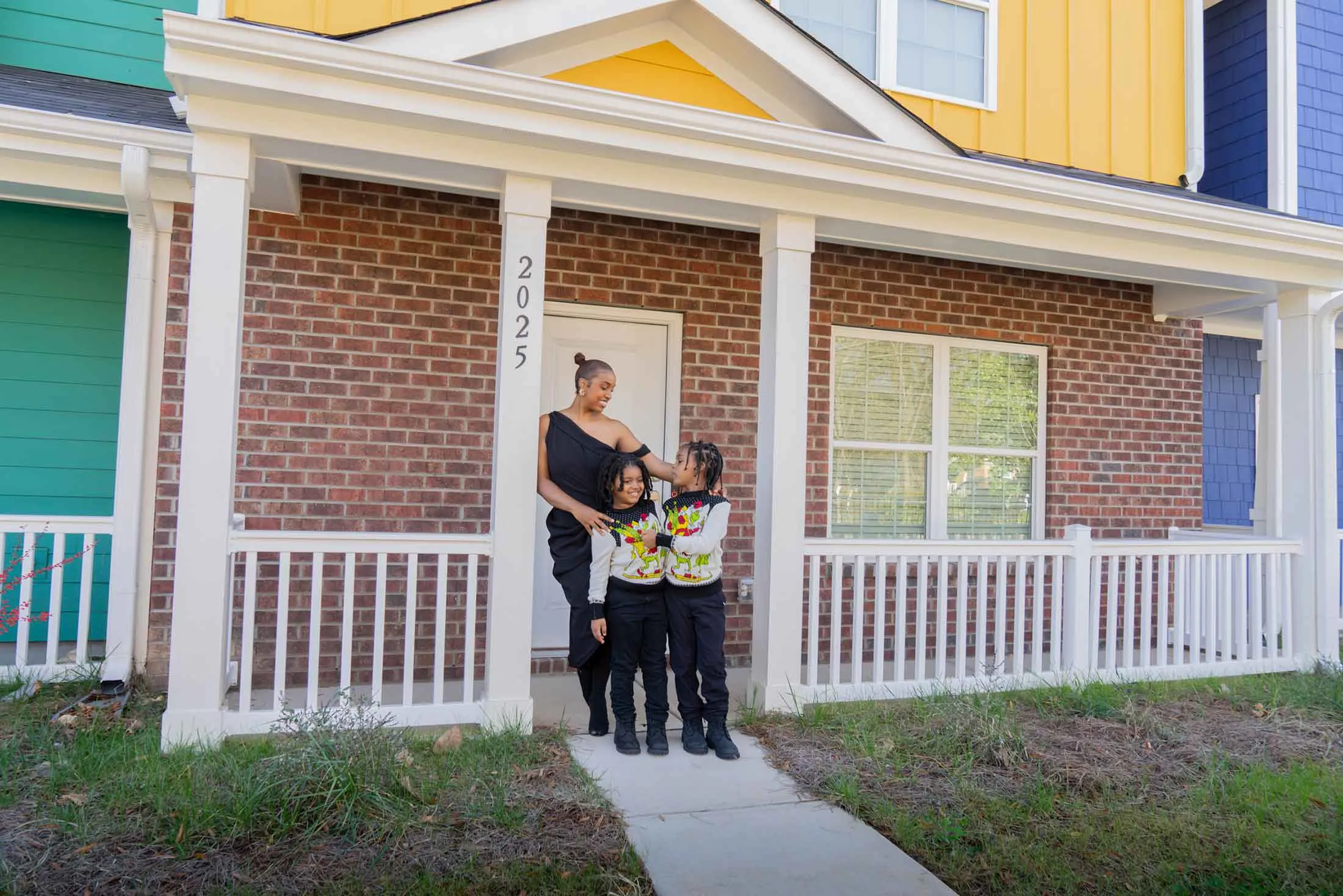
Zayn Bey with her two sons outside her home in Charlotte, North Carolina.
Photographer: Rose Wind Jerome for Bloomberg Businessweek
How Public Shaming Helped Create a Promising US Housing Program
A Harvard study spurred Charlotte to give more support to first-time homebuyers as a way to drive social mobility.
President Donald Trump’s attacks on diversity programs may have changed the tenor of the conversation on inequality, but in the great heap of America’s intractable problems, the economic gap between its Black and White citizens still sits near the top. Studies and government reports—diagnosing the symptoms, describing the deep roots in history from slavery to redlining and laying out the consequences—have been piling up for decades. Black Americans today earn two-thirds of what White Americans do. They are less likely to own their home. And they tend to die younger. The list is so long and familiar that the solutions researchers discuss can seem either hopelessly grand or merely incremental.
And then you meet someone like Zayn Bey. At 30, Bey is the mother of two boys. She drives an Amazon truck—not the kind that delivers packages to your door but a big rig that shuttles among the company’s warehouses in the area. She also has a side hustle selling beauty products and speaks confidently of a bigger future for her and her sons. “Middle class? I’m striving for a little bit higher,” Bey says. “But we’re going to start there.”