Politics


After every U.S. census, states redraw the boundaries of their congressional districts to account for changes in population. This sets off a decennial exercise in partisan gamesmanship, with Democrats and Republicans seeking to alter the lines to their advantage.
Lawsuits inevitably follow. Since new maps were drawn before the 2012 election, courts have weighed in on them in 22 states. Five years after the census and less than a year away from the 2016 election, five states are still waiting on judges to determine the fate of their districts. Their decisions could help Democrats chip away at the Republican majority in the U.S. House of Representatives.
One of the most acrimonious redistricting fights in the nation came to an end on Wednesday, when Florida's Supreme Court replaced the Republican-drawn congressional map with one that shakes up all but three districts in the state. The Court said Republican lawmakers violated a 2010 constitutional amendment, overwhelmingly approved by voters, that prohibited legislators from drawing districts to favor incumbents or to benefit one party over another. Under the court-ordered map, three districts currently held by Republicans will now be more evenly split politically or lean Democratic — and one Democratic seat will lean Republican.
In 2012, the League of Women Voters of Florida and other groups challenged the redrawn lines in court. The lawsuit focused on the 5th District, a brazen example of gerrymandering. The Republican-drawn district snakes down the length of the state, stretching from Jacksonville to Orlando, 150 miles south. The court determined in July that the district was purposely created to scoop up minority communities in central Florida, effectively segregating them into a single Democratic-leaning district.

Nonwhite voters accounted for 63.8 percent of the 5th District’s voting-age population. Legislators argued they drew it that way to comply with the Voting Rights Act, which requires that minority voters be able to elect a representative of their choice. But the Court agreed with the League of Women Voters of Florida, a group often aligned with Democrats, that the GOP legislature had packed the 5th with minority voters in an effort to create neighboring districts with more white, Republican-friendly voters. All of the districts that touch the 5th are represented by Republicans.


Similar redistricting battles took place in states around the country. New districts had to be drawn in 43 states for the 2012 election (the other seven have only one statewide congressional district). Of those 43, lawsuits have been filed in 42, with courts reviewing the district maps in 22. In three states, courts declared the new maps unconstitutional and ordered them redrawn; in nine other states, judges have stepped in to settle district boundaries when lawmakers were unable to agree.
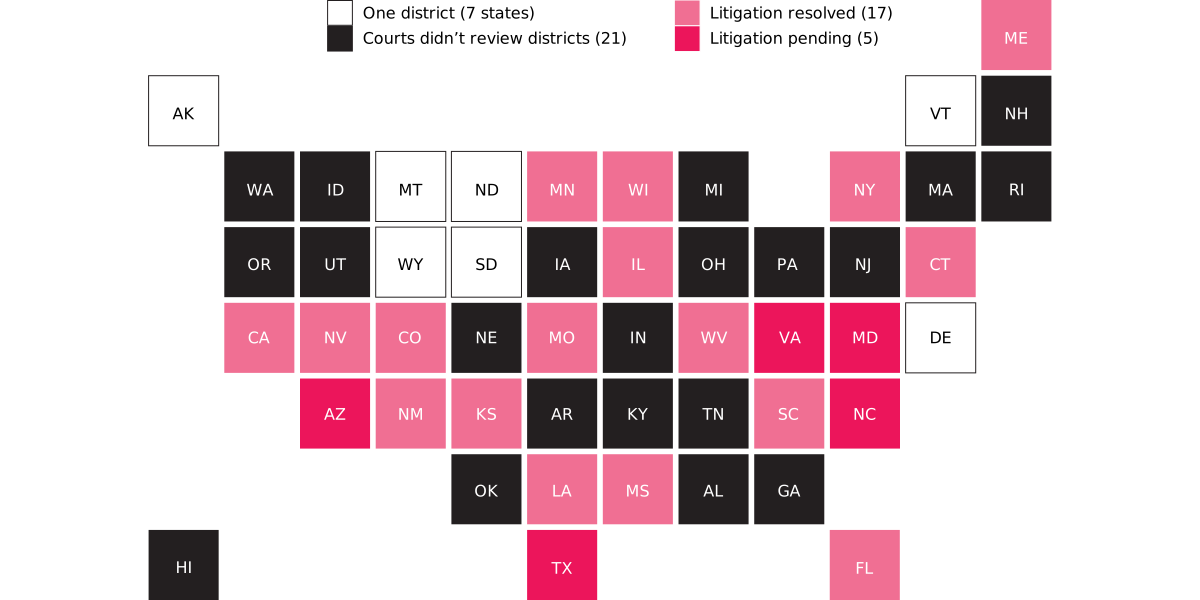
With Florida’s legal challenges resolved, there are now five states left where congressional maps are still in dispute. There’s no guarantee that the disagreements will be settled in time for next year’s election.
In North Carolina, a GOP victory in 2010 state elections put Republicans in charge of redistricting for the first time in decades. Lawmakers drew a map that concentrated Democratic voters into three districts, helping Republicans pick up five congressional seats previously held by Democrats. The state supreme court is considering arguments by the NAACP and others that the new map is an unconstitutional racial gerrymander.
The Maryland map represents one of the most successful Democratic gerrymanders in the U.S. A government watchdog group has challenged the map for its “wildly deformed districts.” Put in place before the 2012 election, the map shifted Democratic-leaning voters in suburban Washington, D.C., into districts stretching to the rural western edge of the state. The change squeezed out a longtime Republican incumbent, Roscoe Bartlett, and left one Republican in the state’s congressional delegation. The state’s Republican governor, Larry Hogan, has called for redistricting reform.
In June, a federal court ruled that the 3rd district, which wanders from Richmond to the Hampton Roads area outside Norfolk, unconstitutionally packs minority voters into a single district. Representative Bobby Scott, a Democrat who represents the district, welcomed the ruling, saying he could still win, even with fewer black voters. Democrats might pick up an additional seat under proposed alternate maps that shift some minority voters out of Scott’s district and into others. The U.S. Supreme Court agreed on Nov. 13 to review the case and is expected to rule by next summer.
Texas is no stranger to legal battles over its congressional districts. The post-census Republican-drawn map was rejected by a federal court, and a separate court redrew the map. The U.S. Supreme Court intervened and required the lower court to draw a map that was closer to the intentions of the legislature. That map remains in use, even as a federal court considers whether it is an illegal racial and partisan gerrymander. Republicans hold 25 of the state’s 36 seats.
Arizona districts were the focus of one of the most watched Supreme Court cases last spring, as the justices decided that redistricting commissions, like the one Arizona used, could redraw congressional boundaries in place of legislatures. Still, the map faces a challenge based on procedural tactics employed by the commission. Republicans in the state argue the commission’s map favors Democrats. Former Republican Governor Jan Brewer attempted to remove a member of the commission, but the state’s supreme court blocked her.
Democrats are likely to benefit from these final redistricting cases. The party could net a couple of seats in Florida and one in Virginia, and would stand to pick up more seats if courts strike Republican maps in North Carolina and Texas. If the disputes drag on through next year, some states might not elect members of Congress on settled maps until 2018, leaving just two years before a new U.S. census starts up the whole thing all over again.