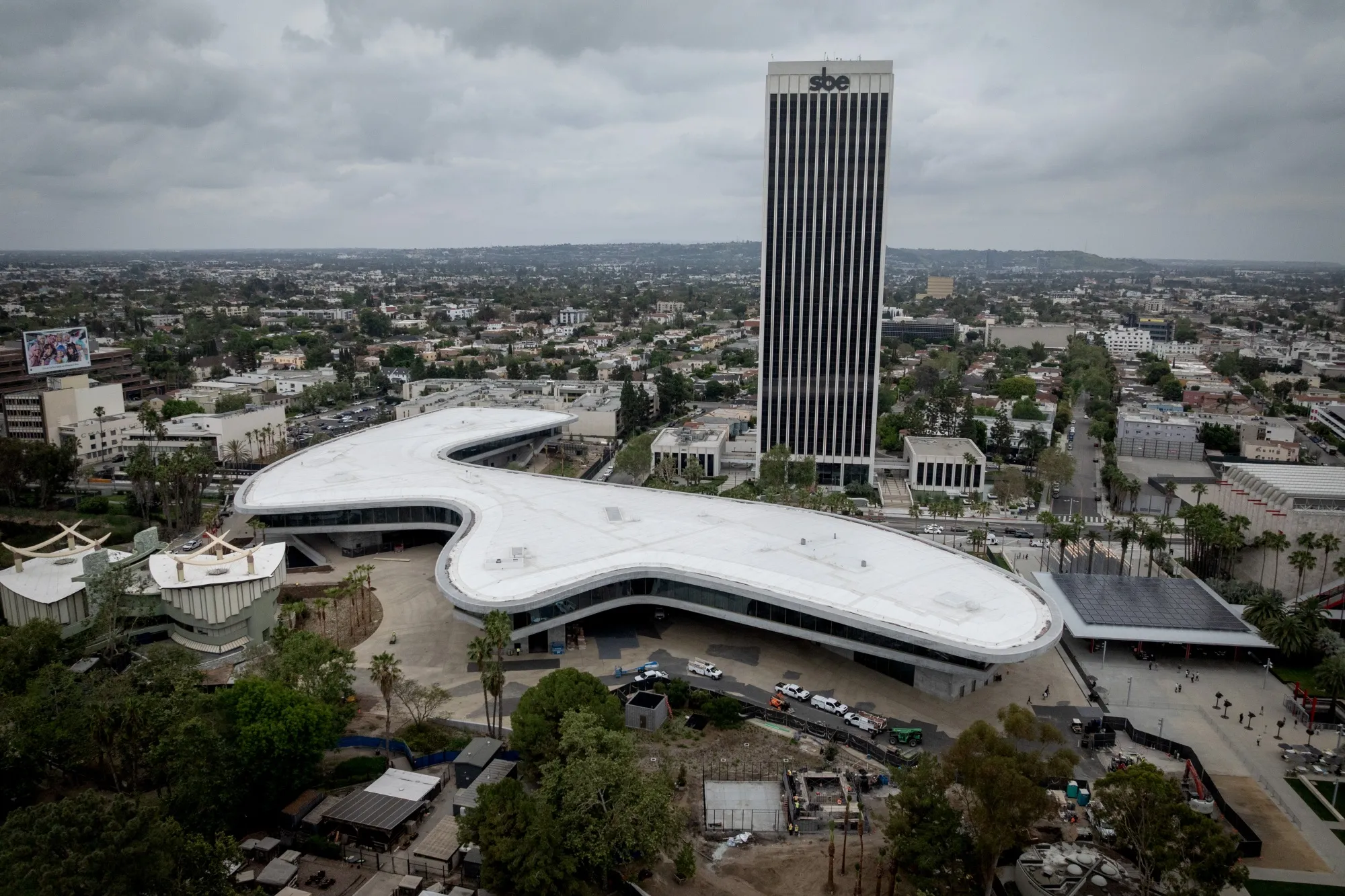
A drone view of the David Geffen Galleries on March 31, 2026 in Los Angeles.
Photographer: Eric Thayer/Los Angeles Times via Getty Images
For Better or Worse, the New LACMA Is an Instant LA Icon
The blob-shaped David Geffen Galleries at the Los Angeles County Museum of Art offers architectural drama inside and out, sometimes at the expense of the art.
In Los Angeles, a city short on historic traditions, one long-running custom is that the Los Angeles County Museum of Art must always be in a perpetual state of architectural reinvention. The museum’s original buildings, designed by William Pereira and completed in 1965, sputtered soon after opening. Critics were not impressed with the trio of modernist pavilions that resembled department stores, and a pool that stood before them quickly turned mucky when tar began to seep in from the neighboring La Brea Tar Pits. Within a decade, the pool was drained to make way for a sculpture garden. By the ‘80s, the garden was gone, replaced by a pavilion by Hardy Holzman Pfeiffer — a postmodern Mesopotamian gate with glass blocks and undulating turquoise handrails. Think Miami Vice.
Other structures were added over time. In the 1980s, a pavilion for Japanese art by Bruce Goff resembling a late modern shinto shrine materialized on the north end of LACMA’s 20-acre campus. And, in the aughts, two boxy exhibition spaces by Pritzker Prize-winning architect Renzo Piano appeared on the west side of the 20-acre campus, along with a more visible point of entry on Wilshire Boulevard. But overall the complex nonetheless felt like a pile-up of buildings that didn’t quite live up to their ambitions.