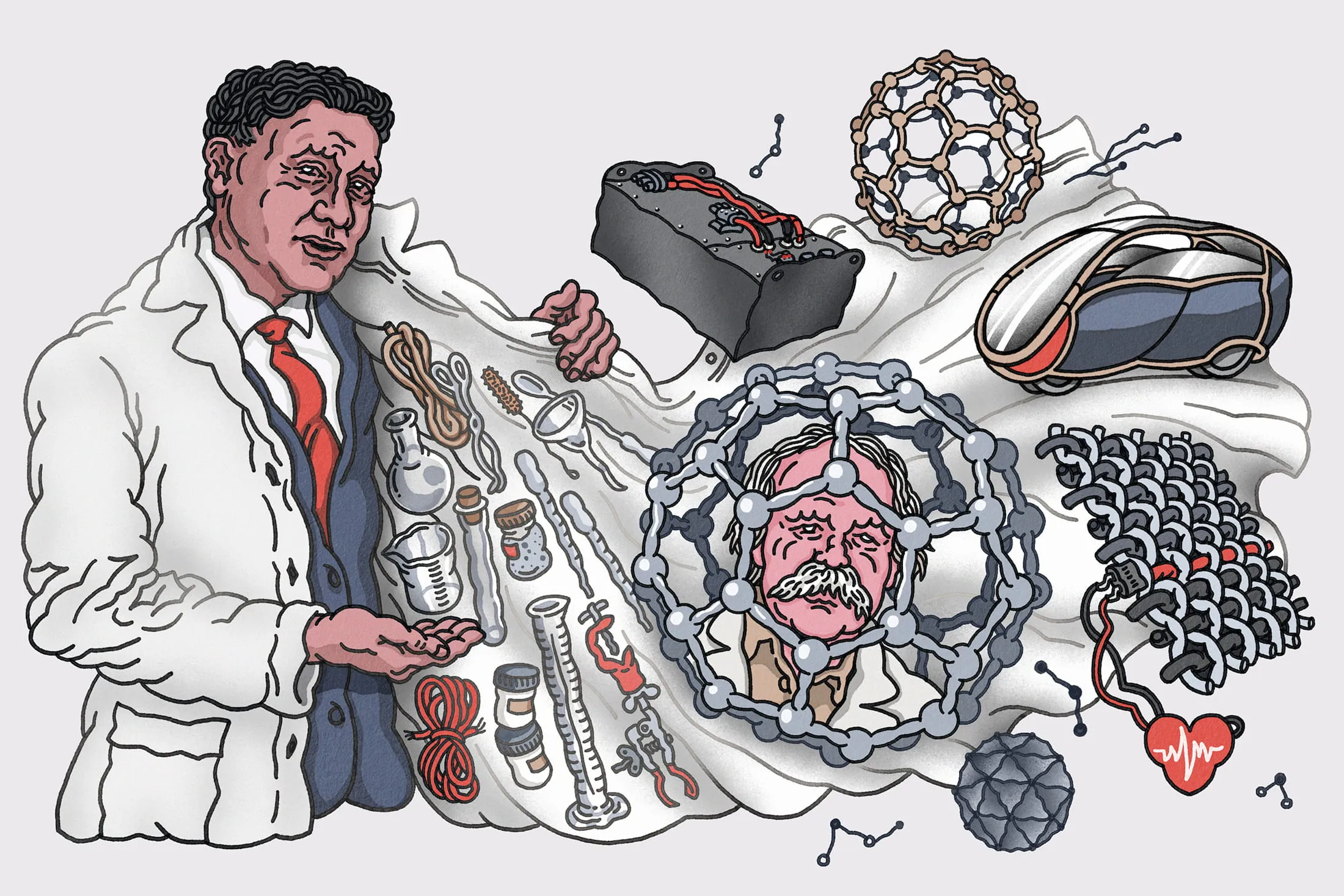
Illustration: Clémence Mira for Bloomberg Businessweek
The MIT Professor Tangled Up in a Tech CEO’s ‘Ponzi-Like’ Scheme
Entrepreneur Faiz Chowdhury’s ties to top academics helped fund startups that the SEC says he exploited to lead a lavish lifestyle.
The chandeliered ballroom of the Shangri-La Singapore hotel was packed for Faiz Chowdhury’s investor showcase. Chowdhury, the chief executive officer of Disruptive Technology Innovations, was on stage highlighting his startup’s wide-ranging portfolio before introducing the evening’s entertainment, Earth, Wind & Fire. DTI Holdings Inc., he told the crowd of 500, had made advances in artificial intelligence, personalized medicine, blockchain engineering and other fields. Its researchers were commercializing wearable health devices, cybersecurity services and electric vehicle batteries that could charge faster than those from Tesla Inc. Its work in nanotechnology and quantum mechanics could prevent cardiovascular disease and cancer. “We also have an invention and a scientific breakthrough that soon will make paralyzed people walk again,” he said, according to a recording of the August 2019 event seen by Bloomberg Businessweek. “We do have a solution that also can make blind people see again.”
Chowdhury’s claims may have come across as especially over-the-top thanks to his co-presenter, Quantum Girl, a blond model clad in a silver bodysuit and glowing-neon tubing meant to evoke DTI’s nanoparticle innovations. But halfway into his 40-minute presentation, he also brought up his “co-founder” and “legendary, influential scientist” Ian Hunter, longtime head of the BioInstrumentation Laboratory at the Massachusetts Institute of Technology and a professor of thermodynamics and mechanical engineering. Hunter described DTI’s next major project: a solar-powered pod designed to transport passengers at almost the speed of sound. This so-called Flashpod, Hunter said, could slingshot through a network of city-to-city tubes, similar to Elon Musk’s Hyperloop concept, and disrupt the fossil-fuel industry. “We can go from Boston to New York under 20 minutes,” added Chowdhury. “It is not a dream. It is not in the lab. It’s a physical product we’ll be launching next year.”