Architect Bjarke Ingels Says Modern Buildings Are So Boring
A favorite of eco-friendly urban planners and the technocrat class, the Danish designer has been getting by on government and donor-subsidized projects as shareholders keep purse strings tight.
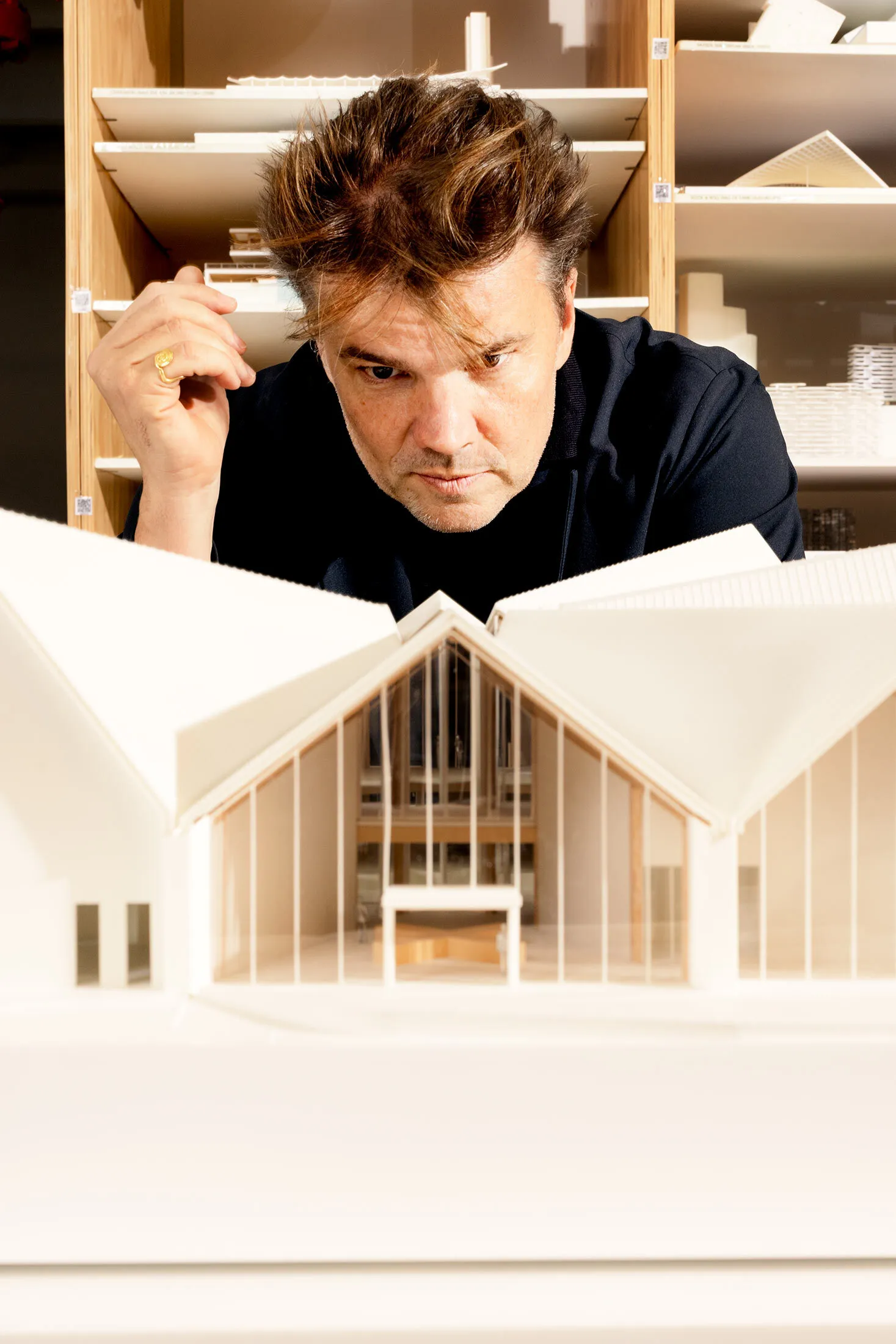
Ingels at his studio in Brooklyn.
Photographer: Adrienne Grunwald for Bloomberg Businessweek
For his 50th birthday, the Danish architect Bjarke Ingels was thrown a surprise party by the fifth king of Bhutan. Bjarke Ingels Group, or BIG, had been designing the Himalayan nation’s “mindfulness city,” a new economic hub near the Indian border. Walking into Dechencholing Palace to a room with many cheering friends, a cocktail bar and a Bhutanese band, Ingels was as flabbergasted as he was jet-lagged. “It took me a while to realize, ‘OK, this is what’s happening.’” Now, a year later, inside BIG’s sprawling ninth floor offices in the Dumbo neighborhood of Brooklyn, New York, he sports the Dragon King’s other birthday gift, a handsome Patek Philippe wristwatch.
Ingels is among the most celebrated architects in the world, a darling of both the corporate class and climate-concerned urban planners. He’s known for his whimsical and inviting style, which is on display at Google’s headquarters in Mountain View, California; a sleek pyramidal residential building in New York known as Via 57 West; and a power plant in his native Copenhagen topped with a ski slope and a climbing wall, dubbed CopenHill. His list of projects-in-progress includes an MLB ballpark in Las Vegas and a new Zurich airport that, when it opens in 2035, will be the largest wooden building on Earth. Off planet, BIG is designing lunar living spaces for NASA.