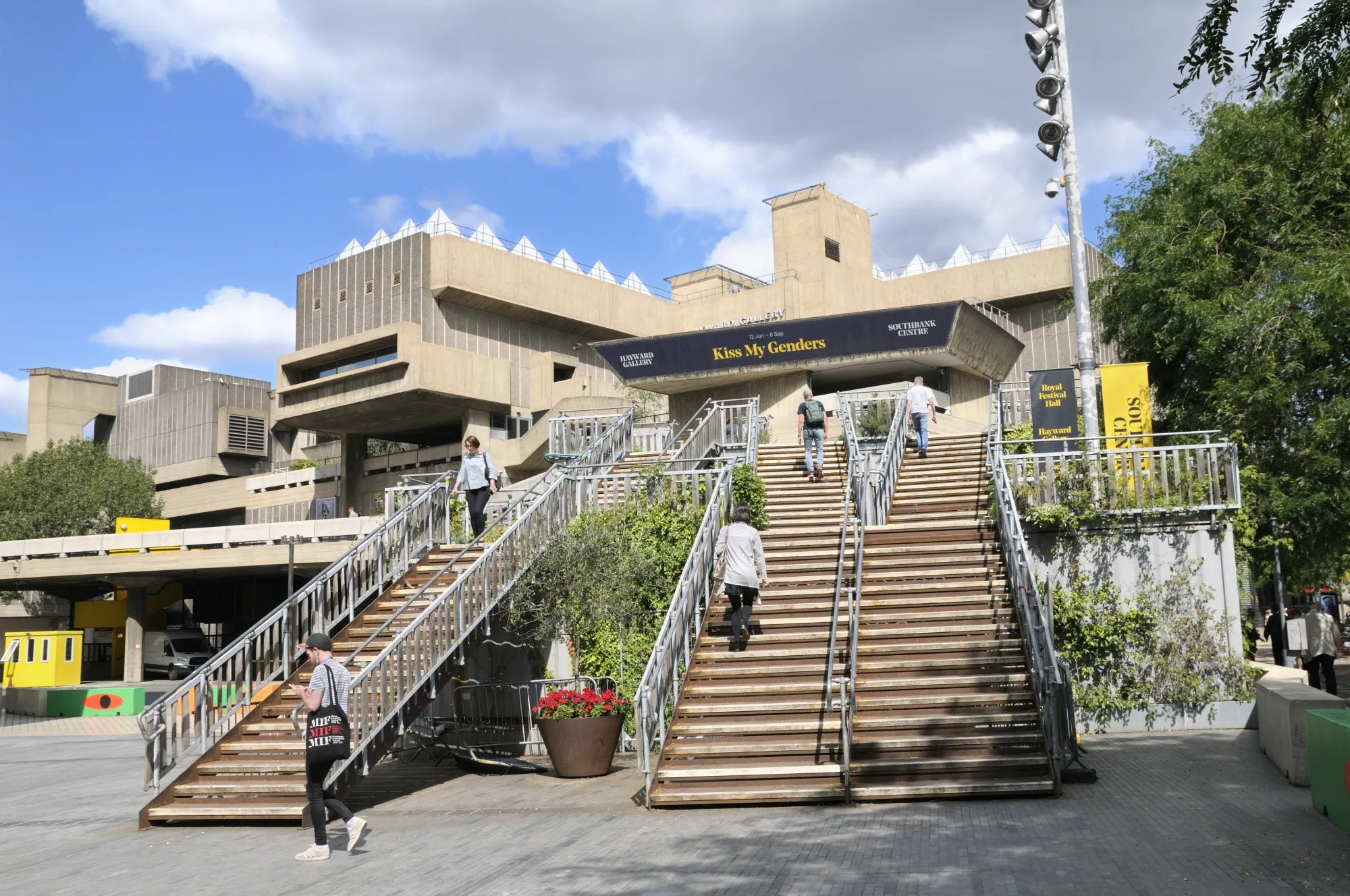
Pops of green and other colors help to explain why Londoners have changed their minds about the Southbank Centre.
Photographer: Chris Harris/Universal Images Group/Getty Images
Britain Says It Hates Brutalism. London Can’t Get Enough of Southbank Centre.
Once dubbed Britain’s ugliest building, the Brutalist arts complex known as the Southbank Centre is now a protected site drawing throngs of Londoners.
It’s been a bumpy 50 years for London’s Southbank Centre. A riverside arts complex completed in 1976 as an addition to the 1950s Royal Festival Hall, the Centre has for decades functioned as Britain’s bete noire for loathers of Brutalist architecture. Home to three concert halls and an exhibition gallery, its textured concrete walls, labyrinthine walkways and stark, spiky silhouettes saw it damned in a 1967 poll as Britain’s ugliest building — nine years before it was even completed. In 1988, then-Prince Charles famously compared it to a nuclear power station.
The Centre, which is part of larger complex that also includes the UK’s National Theatre (listed as a monument in 1994) and national cinematheque BFI Southbank, got something close to full rehabilitation this February, however, when it received listed status as a historical monument (a status already accorded individually to the Festival Hall in 1988). Such official protection alone does not automatically convey popular adoration, and several conservative-leaning critics have decried the decision. But people have voted with their feet: The Southbank has in recent decades become one of London’s most popular public spaces.