How Eric Trump Became an Ally of One of China’s Biggest Crypto Companies
Bitmain has been dogged for years by questions about the security of its mining rigs. But that hasn’t stopped it from going into business with a key member of the First Family.

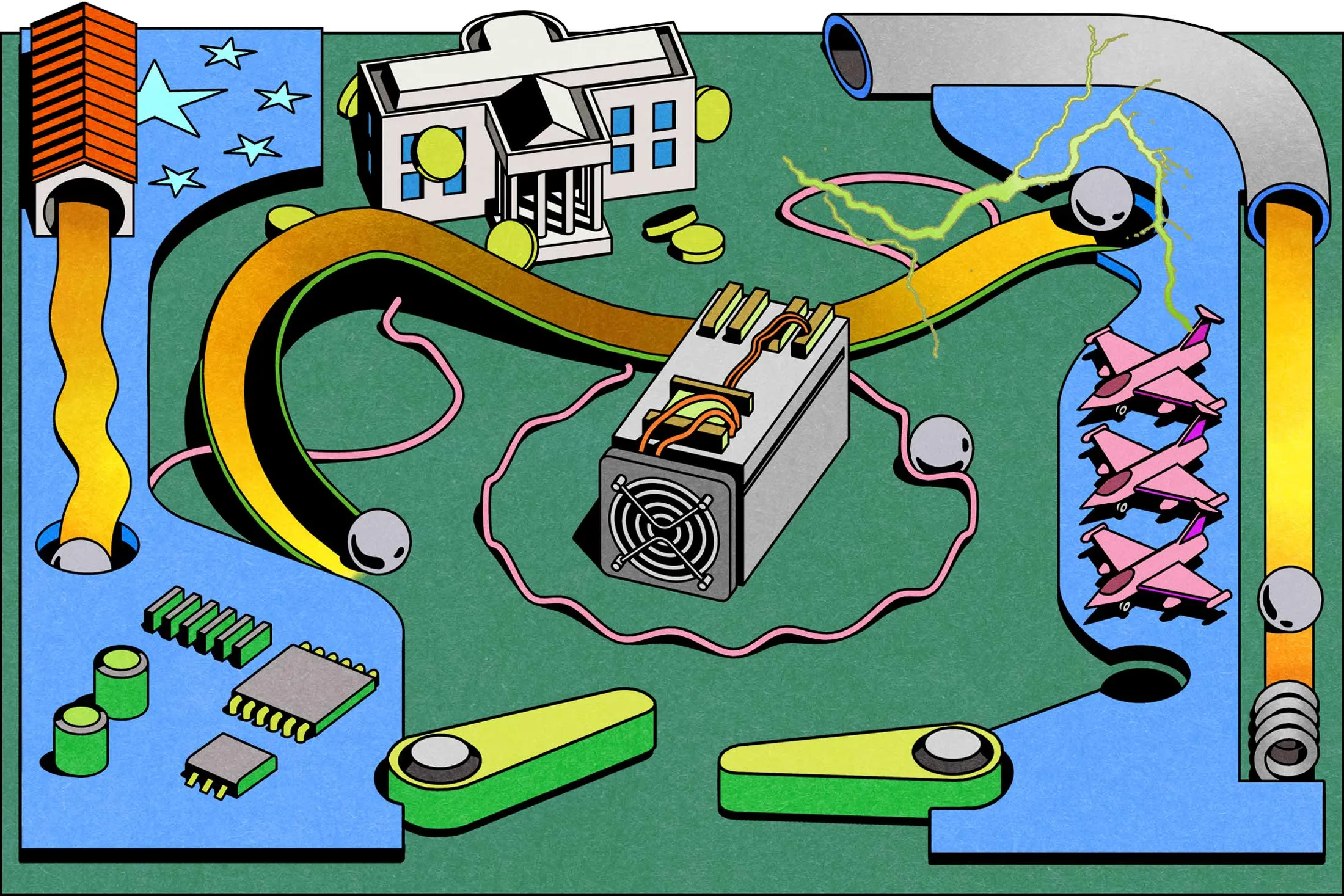
Right now, in settings ranging from purpose-built data centers in rural Texas to converted lumberyards in Borneo, there are racks of shoebox-shaped machines emitting a roar so loud that they sometimes draw complaints from neighbors. Each contains hundreds of application-specific integrated circuits, or ASICs, produced at enormous cost in advanced Taiwanese facilities. The chips are soldered onto three enclosed hashboards that run brute-force calculations, taking directions from a control board. Depending on the precise model, internal fans or a liquid cooling system are used to prevent these components from overheating—a huge draw on the power supply of whatever community they happen to be installed within.
The devices serve a single purpose: probing SHA-256, the algorithm that underpins Bitcoin. SHA-256 is what’s known as a trapdoor function, which means that the only way to solve the mathematical puzzles it generates is to guess. Bitcoin miners engage in this guesswork for a living. When they’re correct, they earn the right to verify other people’s transactions and earn a reward of their own. Their profits are therefore a direct function of the number of guesses that each of these machines, known as Antminers, can make—currently, trillions of guesses every second. Fully loaded, an Antminer costs as much as $17,400. Large mining groups own as many as half a million, an upfront investment of billions of dollars, but the capital outlay is minuscule compared with the potential rewards, at least when crypto prices are high. Some users liken it to owning a fleet of printers that spit out lottery tickets, except with dramatically better odds of hitting on a lucky number.