Native Art Is a $1.5 Billion Market Plagued With Problems
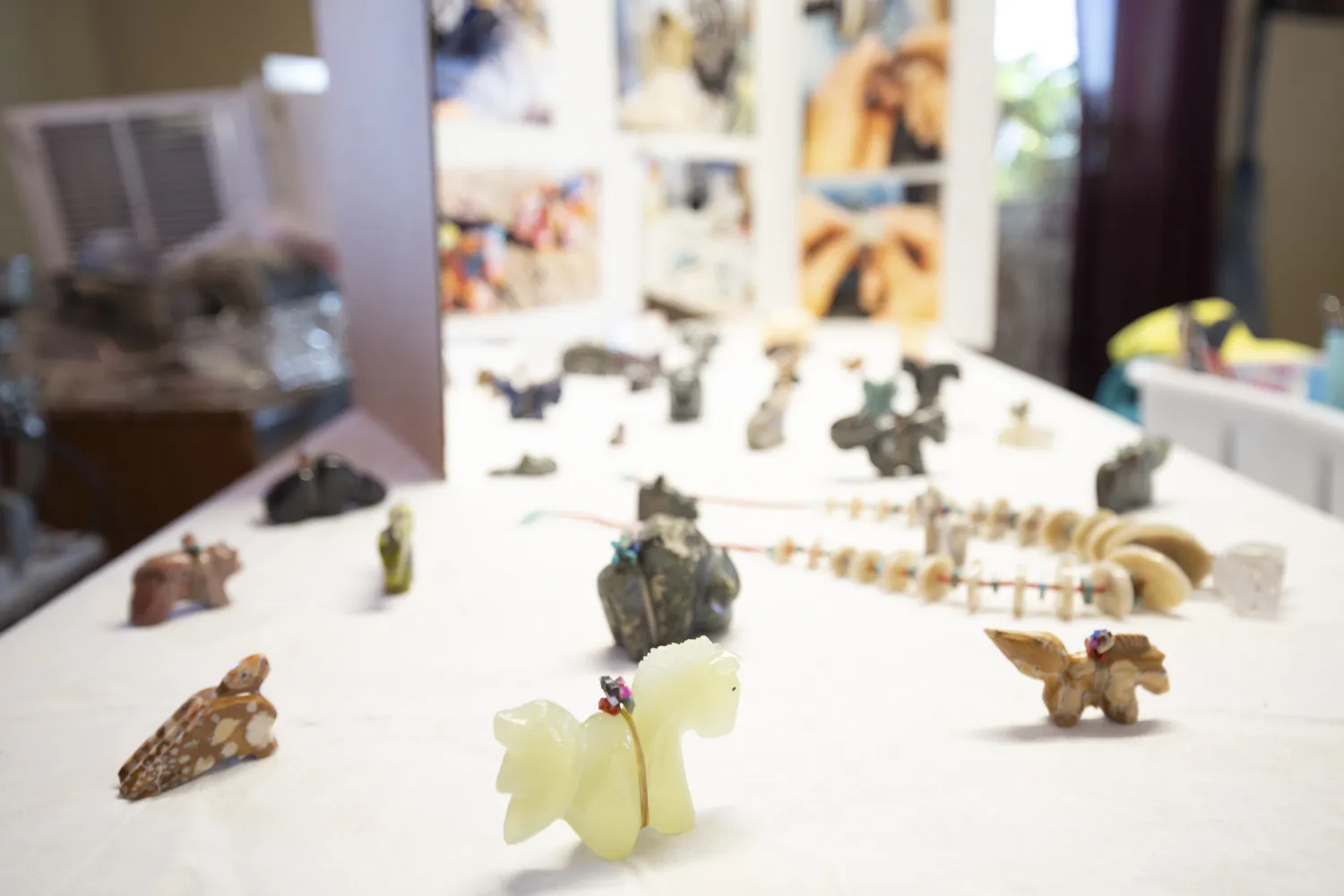
Artwork at Daryl Shack’s studio in New Mexico.
Photographer: Kalen Goodluck for Bloomberg Businessweek
In the beginning, the world was made only of water. Its depths were ruled by dinosaur-like creatures, from which protohumans hid in dark canyons, until a being named ÃwonawÃlona began projecting thoughts of unity and balance into the physical realm. The being made the Sun Father and the Moon Mother, whose movements produced land, as well as twin children who led the pre-people out from the watery underworld. But the sea monsters followed the humans, and to save them, the twin children blasted the monsters with lightning, turning them to stone, and instructed their spirit forms to help the people who were once hunted.
A vibrant mural depicting these events welcomes visitors to the A:shiwi A:wan Museum and Heritage Center, on the Zuni Pueblo in western New Mexico. It’s the kind of rich cultural tradition that’s made this area a hub for artists—and the people who buy Native art. On a balmy day this spring, an artist named Daryl Shack walked me along the mural, which illustrates the creation story of the A:shiwi, or the people of Zuni. A commanding man in his early 50s, Shack makes fetishes, small and intricate animal carvings, some in the shape of the monsters that the twin children petrified. For centuries the people of Zuni Pueblo have created and honored fetishes for the “medicine,” or special traits, of the animals they represent. Each of Shack’s pieces is shaped from stones he finds around the pueblo: a mustang of monochromatic pinolite, a bear of crystallized yellow calcite, a green-blue serpentine shaped into a porcupine. He sells each for $40 to $2,400, depending on its size and material.