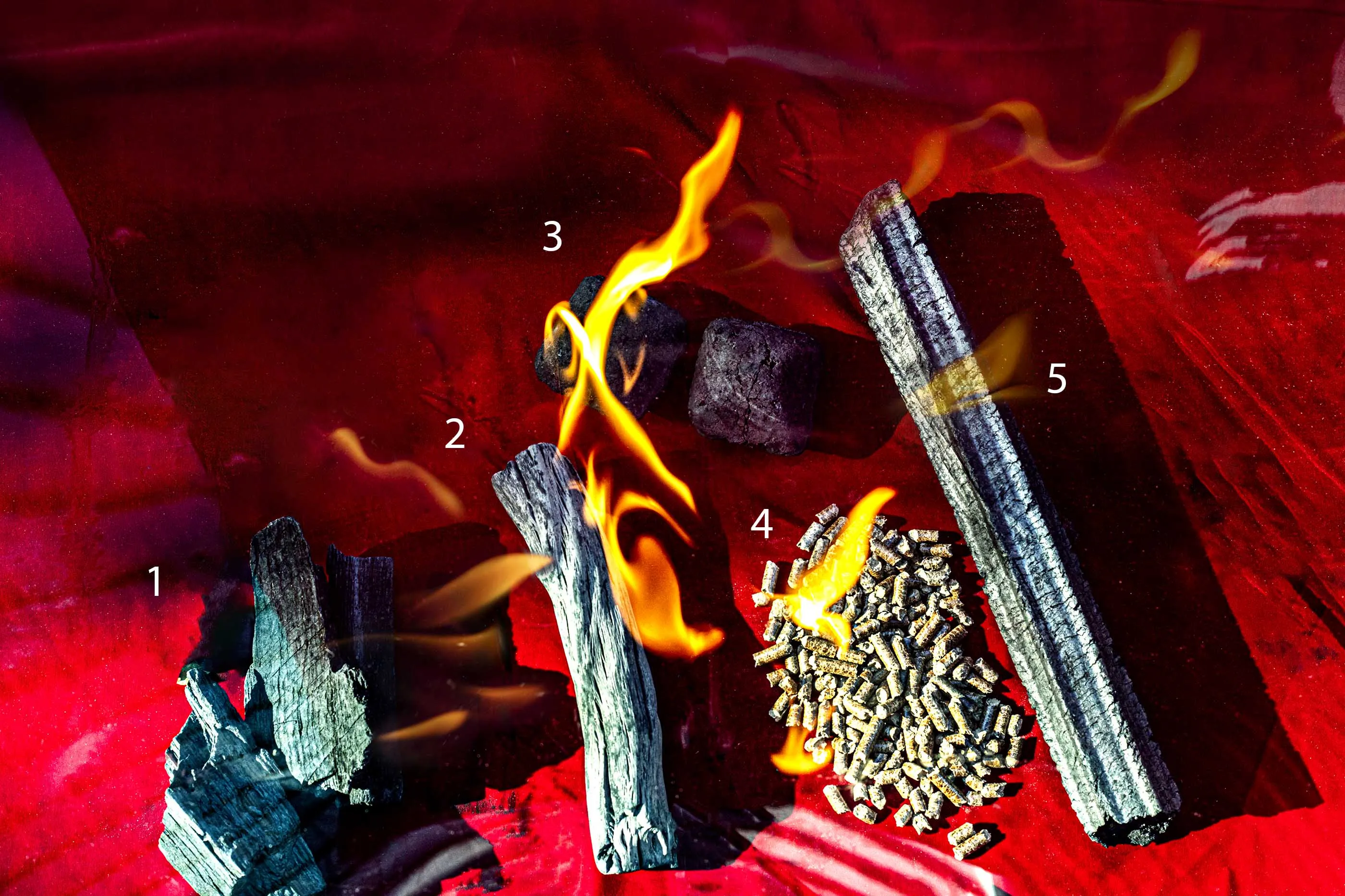
From left: Rockwood lump charcoal, binchotan, Jealous Devil Max XL briquettes, B&B post oak wood pellets, and Prime 6 charcoal rod.
Photographer: Naila Ruechel for Bloomberg Businessweek
Luxury Charcoal Is Fuel to Take BBQ Cookouts to Another Level
Don’t get burned: Here are five ways to beef up your grill’s heat.

1. THE EASY UPGRADE
Grilling with lump charcoal instead of briquettes is a bit like driving a stick shift rather than an automatic: Both will get you where you’re going, but lump is seen as the more pure experience. Unlike many briquettes, lumps of carbonized wood contain no accelerants or substances such as borax, which can affect taste.
Heat check: Although some briquettes can top out at about 1,000F, lump charcoal can burn as hot as 1,400F. This is mostly because lump’s irregular shape allows for more airflow.
Where to get it: Rockwood, based in St. Louis, was started when founder Jonathan Heslop spotted a charcoal plant while working as a medevac pilot. The company makes lump charcoal from Missouri maple, oak, and hickory. The combination lends food a distinct but not overpowering taste. $23 for 10 lbs
2. THE EXTREME UPGRADE
Pound for pound, good binchotan likely costs more than whatever you’re cooking over it. Known for providing smokeless, infernal heat, the Japanese charcoal is perfectly suited to cooking yakitori, and other similar-style skewers, to a burnished brown without drying them out.
Heat check: It can reach more than 2,000F and stay there for hours, though it can take upward of 45 minutes to achieve maximum heat.
Where to get it: This “pro grade” binchotan is made in the oak forests of southern Japan. $105 for 5 lbs