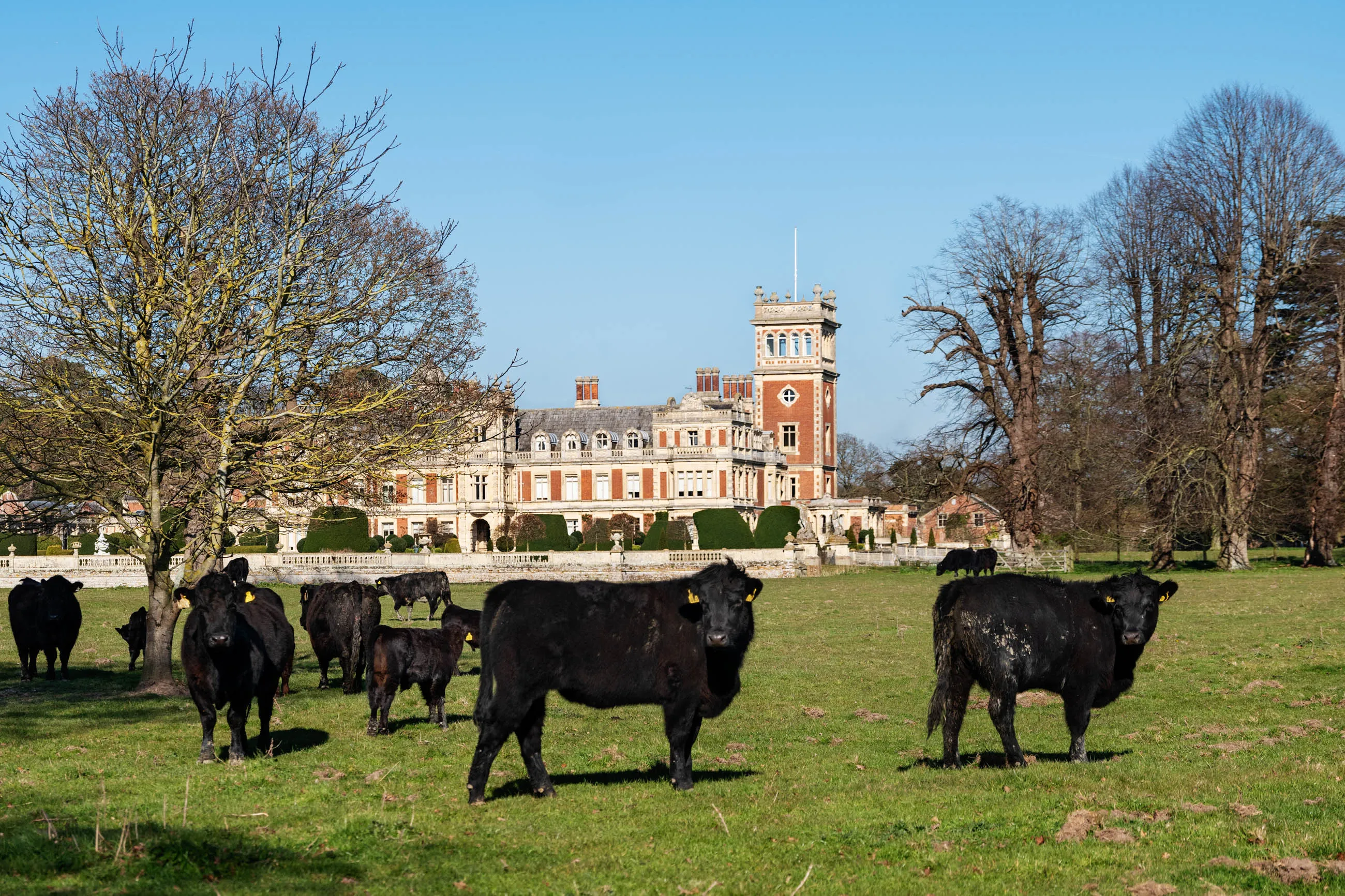
Domesticated cows graze freely at Somerleyton Hall.
Photographer: Claudia Leisinger for Bloomberg Businessweek
These Luxury Hoteliers Are Trying to Return Britain to the Beasts
A small band is trying to turn back the clock on old, aristocratic homesteads—all the way to ancient times, before there were farms or even people on the land.

Depending on whom you ask, the tale of Somerleyton Hall begins in 1863, the 1970s, or hundreds of years earlier. For William Crossley, third baron of Somerleyton and the late owner of the Jacobean manor in East Anglia, England, it originated in the wake of the Industrial Revolution, when his grandfather, a carpet manufacturing magnate, purchased the property at a steal from a down-on-his-luck baronet. For most residents of the neighboring North Sea fishing towns, Somerleyton’s relevance really picks up in the 1970s, when the estate’s adjacent holiday spot, Fritton Lake, began to offer tea parties and kayaking for daytripping locals.
Hugh Crossley, who inherited the Somerleyton estate after his father’s death in 2012, says both stories start much too late. When he looks at the property, he sees back hundreds of years, long before the home’s expansive grounds were manicured with hedge mazes in the 1840s, work credited to royal gardener William Andrews Nesfield. The story stretches past even the generations of Danish and Norse homesteaders who tilled the land and made it their own.