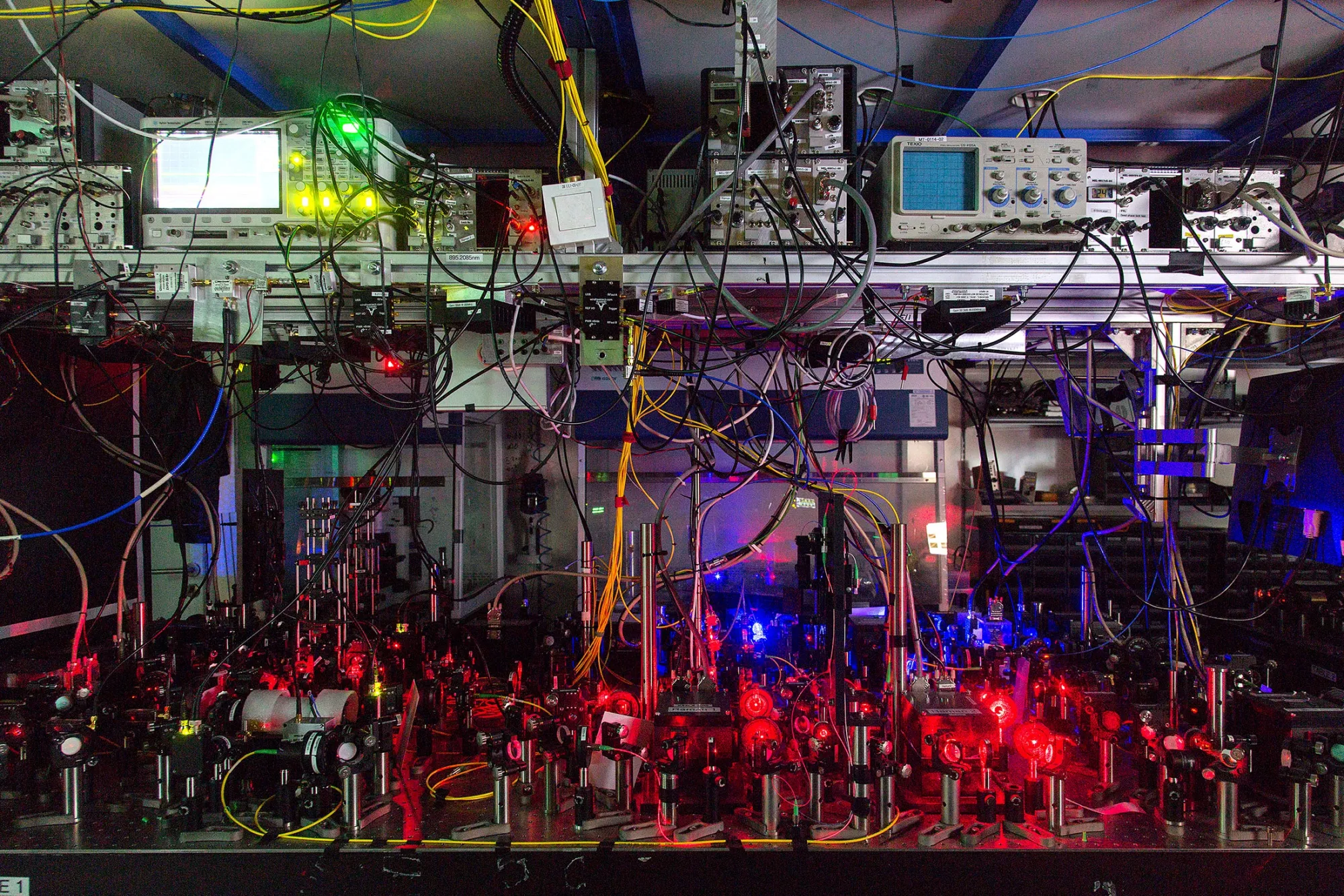
The lutetium-based atomic clock at the National University of Singapore.
Photographer: Ore Huiying for Bloomberg BusinessweekThe Race to Build the World’s Most Precise Clock

The most important part of one of the most precise clocks in the world is a paper-thin, staple-size piece of lutetium. It rests inside a soundproof, vibration-proof, mini-fridge-size box, which sits atop a $22,000 motion-dampening table. Murray Barrett, associate professor of physics at the National University of Singapore, reaches for the case to show me. “It should be OK,” he says in his warm New Zealand accent. But then he hesitates. We’re in a darkened laboratory filled with lasers whose beams bank, split, and intensify through arrays of crystals and electronics. “Normally it’s OK,” he says, backing away from his still-very-much-a-work-in-progress clock. “But I’m not sure if we’re running anything or not.”
Barrett’s clock, located at the university’s Centre for Quantum Technologies, is intended to slice time into more and smaller segments than any clock before it. An analog stopwatch can typically divide the second into 10 pieces: 0.1 second, 0.2 second, etc. The lutetium clock will, in theory, add 14 zeros to the right of that decimal point, thereby segmenting the second into (roughly) a quadrillion pieces, and remain accurate to within a second if left running continuously for 30 billion years. Even the smallest vibrations from, say, the exhaust fans that keep the laboratory environment clean are enough to upset that precision—and with it, all the lab’s work.