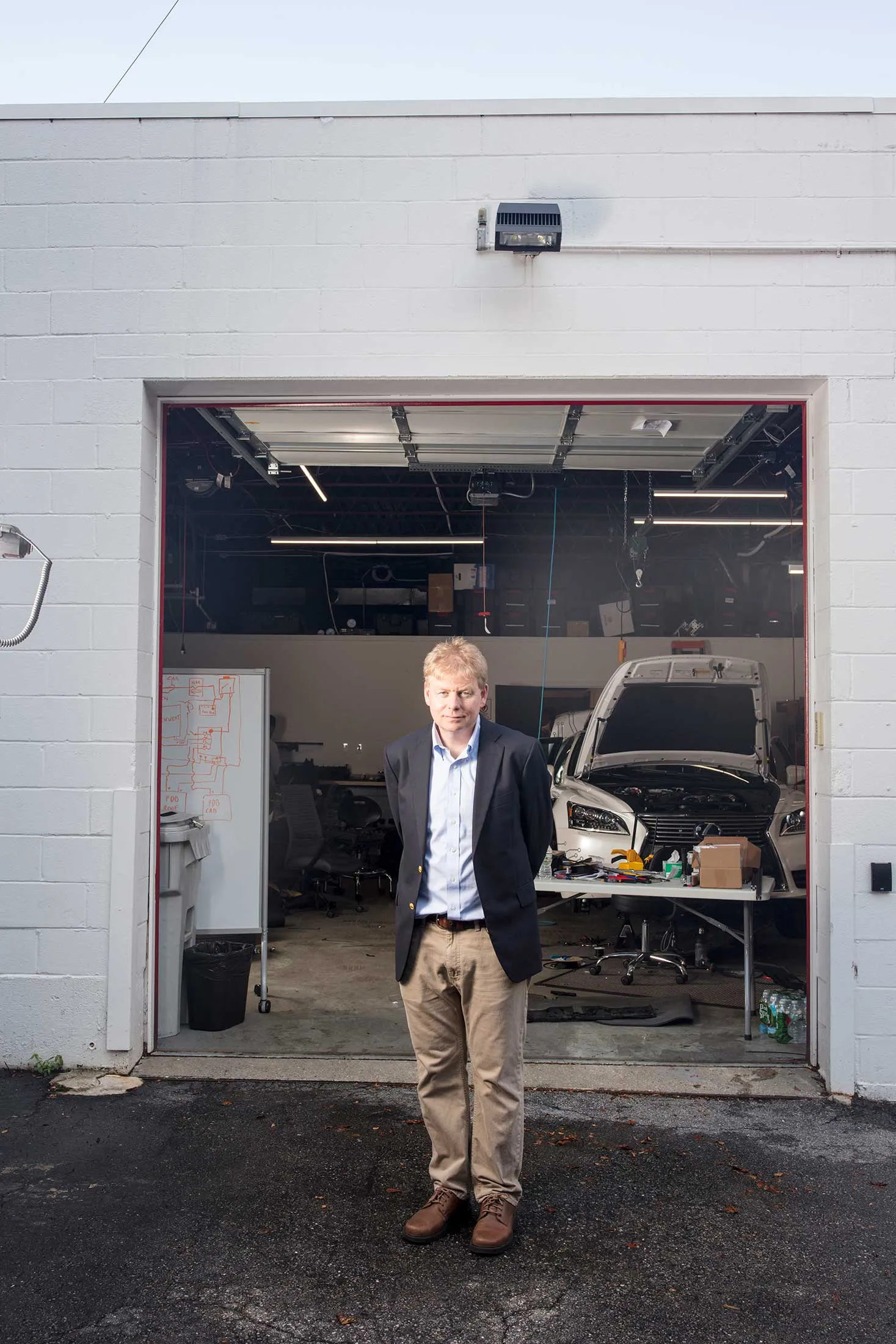
John Leonard at the Toyota Research Institute’s MIT garage. Behind him is the institute’s tricked-out Lexus.
Photographer: M. Scott Brauer for Bloomberg BusinessweekToyota’s Vision of Autonomous Cars Is Not Exactly Driverless

John Leonard strolls up to a drab one-story garage on the campus of MIT and unlocks the door. The building is remarkable only for the reflective windows, which make it impossible to peek inside. “If you were driving past in a taxi,” Leonard says, “would you think the future of Toyota is being designed here?”
Inside squats a silver Lexus LS 600hL sedan. It’s not just any Lexus—this one is vital to Toyota’s effort to develop driverless vehicles. Leonard, vice president for automated driving research at the almost three-year-old Toyota Research Institute, explains how the Lexus is jury-rigged with radars, video cameras, and lasers that can detect, identify, and react to objects up to 200 meters (656 feet) away—twice as far as a year ago. His charges steer the Toyota-built car around Cambridge, Mass., to capture data that can be used to create digital maps and try to extrapolate how a vehicle might behave without a human at the wheel. “It’s sort of like a science project,” Leonard says. “Stay on the road, don’t hit things, don’t get hit.”