Inside the Plan to Demolish and Rebuild a Swath of Trump’s Washington
When President Donald Trump demolished the East Wing in October, it came as a public shock. But the White House likely won’t be the last historic DC building to face a wrecking ball.
An ambitious plan to knock down a desolate enclave of neglected federal office buildings and replace them with a grand neoclassical vision is being advanced by a group of architects associated with Catholic University, including designers who work for former White House ballroom architect James McCrery. The new ballroom architect, Shalom Baranes, isn’t involved with this master plan, but he has his own ideas for reshaping Washington — down to how to finance the conversion of federal office blocks into apartment buildings.
The master plan linked to Catholic University is one of several visions for the office sector in DC’s Southwest neighborhood, an area that has long vexed both local and federal officials. Proposals like these took on new urgency after Trump did the unthinkable and razed one of the most recognized structures in the world.
Welcome to Fedlandia, the city’s next neighborhood-in-waiting, located between the National Mall and the waterfront. Spanning more than 230 acres, this underpopulated reach of federal office space represents the single-biggest development opportunity in Washington — or indeed any other major downtown area in the US. An attractive yet challenging site hemmed in by concrete and red tape, it offers a rare vision for city-center tabula rasa.
“This type of acreage in the middle of the city, you’re not going to get that in any other city in the country,” says Pam Frentzel-Beyme, principal for Stellant Real Estate Advisors and former director of real estate for DC’s Office of the Deputy Mayor for Planning and Economic Development.
For the better part of two decades, no proposal for Southwest has moved past the drawing stage, including a comprehensive vision for a SW Ecodistrict developed by the National Capital Planning Commission. That could change fast under Trump.
A Neoclassical Neighborhood
Over the course of several decades, the master plan from Catholic University would knock down disused federal buildings — and some inconvenient private buildings, too — in order to extend the National Mall south to the Potomac River waterfront.
Source: ESRI satellite images from 2017, 2022 and 2025
Note: This master plan was developed at Catholic University by alumni Andrea Hopkins, Sam Merklein, Casey Rutledge Nardo, Michael Njo, Juan Soto and Sebastian VanDerbeck.
This vision was born at Catholic University in 2023, the culmination of a graduate symposium led by McCrery, the original White House ballroom designer, who Trump has since tapped for the US Commission of Fine Arts, an agency that reviews such proposals. Traditional designers have long dreamed of eradicating what they consider to be Brutalist blight that dominates this stretch of Southwest.
Setting aside the neoclassical trappings, the Catholic master plan is more radical than other proposals. The deluxe version would restore the grid that was broken during the 1950s and ‘60s with the construction of L’Enfant Plaza. It would deck over the span of I-395 that slices downtown in two — likely a cost-prohibitive and intensive transformation. It would uproot the International Spy Museum, a major tourist attraction that only moved to the area in 2019, and Salamander Washington, a five-star hotel that hosted the Bilderberg Conference in 2022.
Even in the more modest version of the plan, monumental museum buildings along the expanded Mall would be buttressed by retail, parks and housing. It would take decades, billions of dollars, local and federal consensus and above all, political will.
As the Catholic University plan’s framers will tell you, they are calling for a repudiation of the midcentury planning push that razed thousands of homes and dislocated some 4,500 families, most of them Black, for concrete government office blocks. If that plan was Urban Renewal, then this plan is Urban Retvrn — a restoration every bit as sweeping in its scope.
“We believe this first objective of preserving what is good in the urban environment in DC should go hand in hand with a second key objective,” McCrery Architects’ Sam Merklein told an audience at the nonprofit Congress for the New Urbanism in November. “Improving what is not good.”
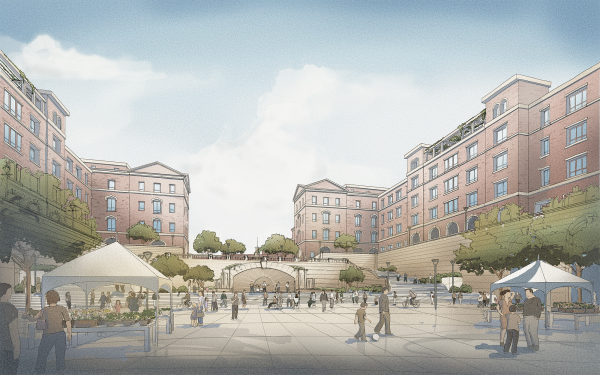
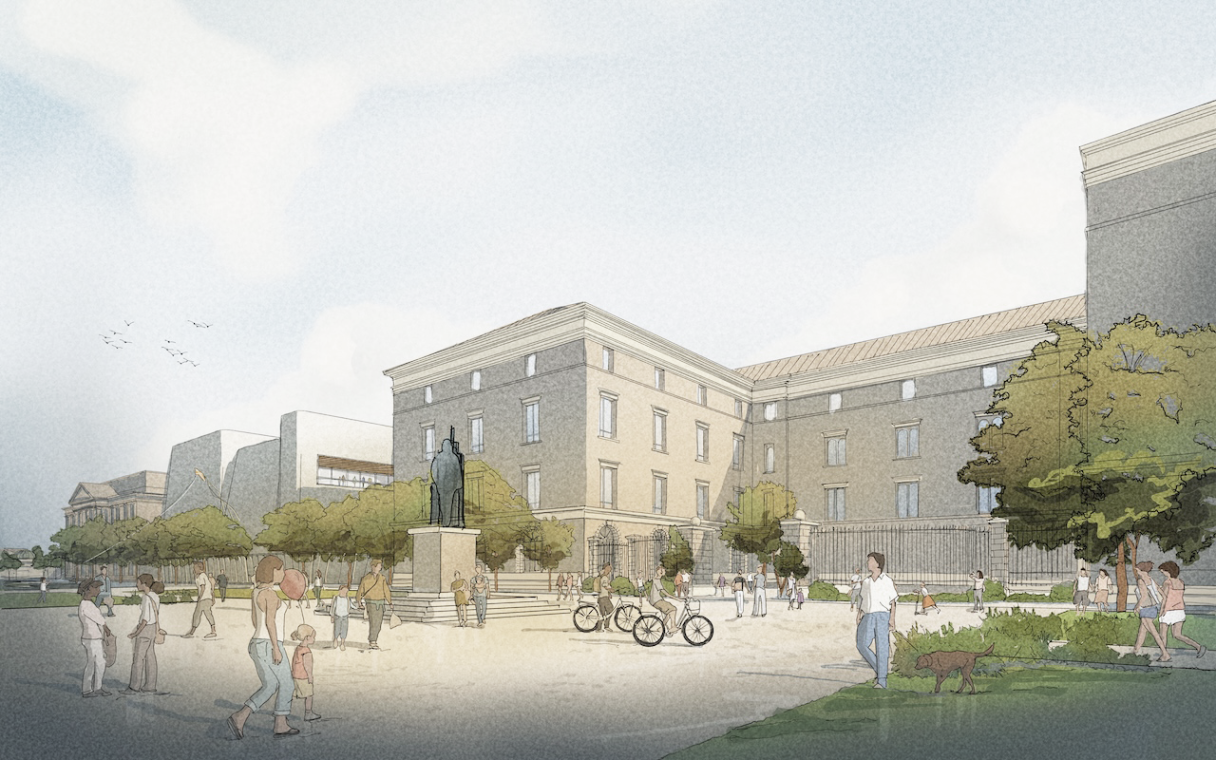
Left: The Banneker stairs, central to the Catholic University plan, would link the redeveloped area to The Wharf. Right: Rendering of the “museum core” that would replace the Department of Energy buildings. Credit: Catholic University
The framers of the Catholic University master plan have presented it before the Smithsonian Institution, National Capital Planning Commission, US Commission of Fine Arts and other federal stakeholders. But it’s far from the only scheme targeting this area for reconstruction.
The Public Buildings Reform Board, a task force chartered by Congress in 2016 to downsize the federal government’s real estate portfolio, has so far identified two dozen properties in the capital region for consolidation or disposal, most of them clustered in Southwest. The global firm SOM produced renderings that point to 42 city blocks’ worth of disused office buildings — some of them historic, many of them hulking, all of them contributing to a federal no-man’s land.
The Chopping Block
Architects, planners, feds and even tourists can agree on one thing: The James V. Forrestal Building has to go. But what should replace it is the subject of feverish speculation in Washington.
The longtime home of the US Department of Energy, the Forrestal Building is an eyesore. The 1.8-million-square-foot federal complex occupies pride of place on the National Mall, just across Independence Avenue from the Smithsonian Institution’s Castle. Even the most ardent Brutalism defender will acknowledge that the 1969 building obstructs what could be an unrivaled vista from the Mall south to the waterfront. Virtually vacant today, it’s a horizontal concrete office slab that stretches three full blocks.
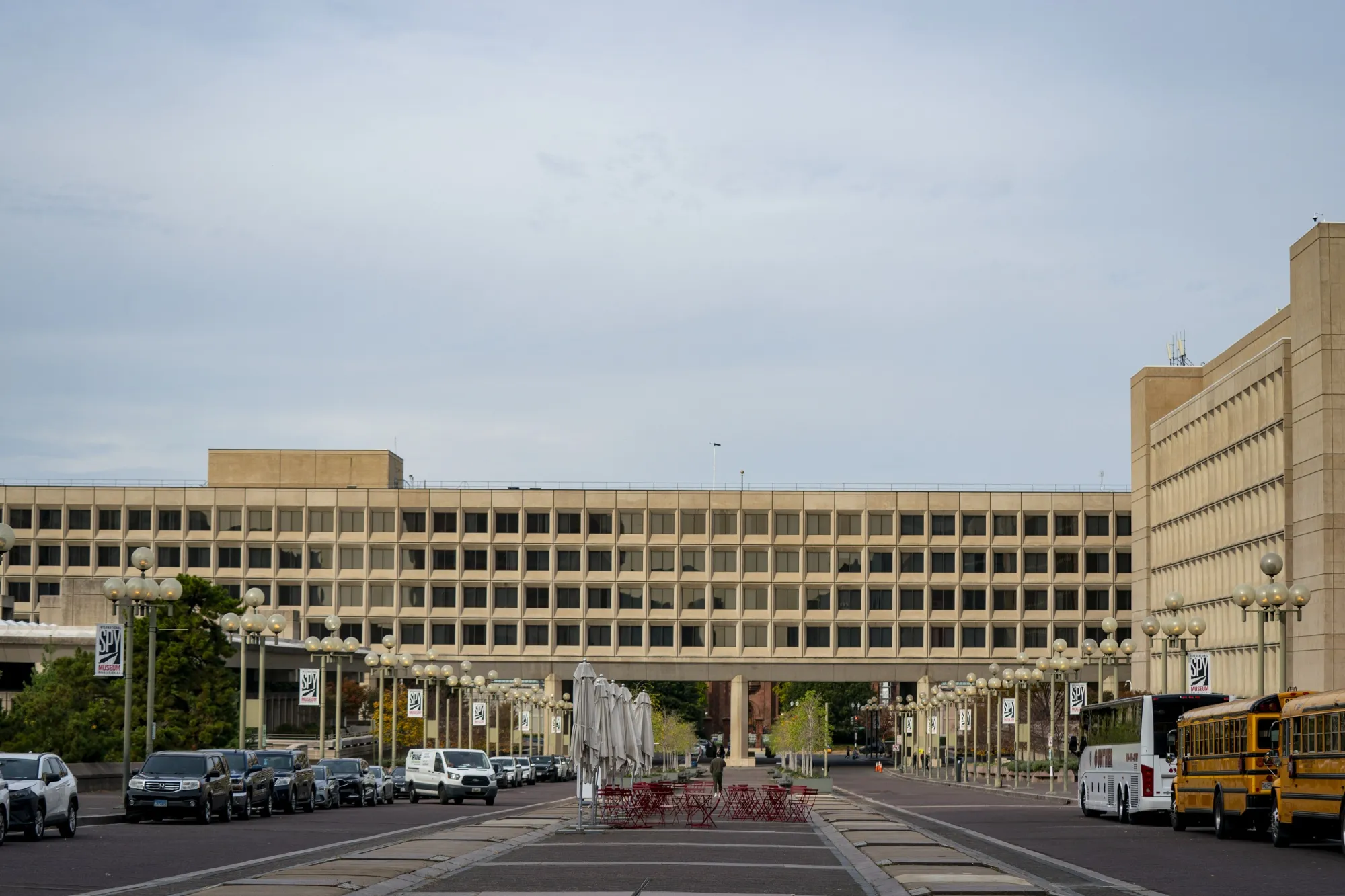
James. V. Forrestal Department of Energy building. Credit: Leigh Vogel
“There’s a general consensus about the Forrestal building coming down,” Baranes said in an interview, before his appointment by the White House was made public.
Justin Shubow, president of the nonprofit National Civic Art Society, says that the Catholic master plan came about as an effort to get ahead of the Forrestal Building’s eventual demise. A key influencer on cultural policy decisions at the White House — the proposal for a monumental “Arc de Trump” was his idea — Shubow asked McCrery and Catholic University architecture dean Mark Ferguson to develop a plan to replace the Forrestal. Ferguson and David M. Schwarz co-led the symposium with McCrery.
“I’d be shocked if that building doesn’t meet its demise over the next couple of years,” Shubow says.
What comes next after the Forrestal Building falls could be an extension of the National Mall: another grand City Beautiful boulevard lined by neoclassical buildings for future museums, as the Catholic University plan envisions. There’s little room left on the Mall for new museums as it stands.
But Fedlandia could be the site of a vibrant new neighborhood with walkable living, two Metrorail stations and unbeatable access to the Mall. Some of the federal buildings slated for disposal are in fact strong candidates for residential conversion. One former US Department of Agriculture building is already clocking luxury rents as the Annex on 12th.
Bureaucracy-to-Housing Conversion
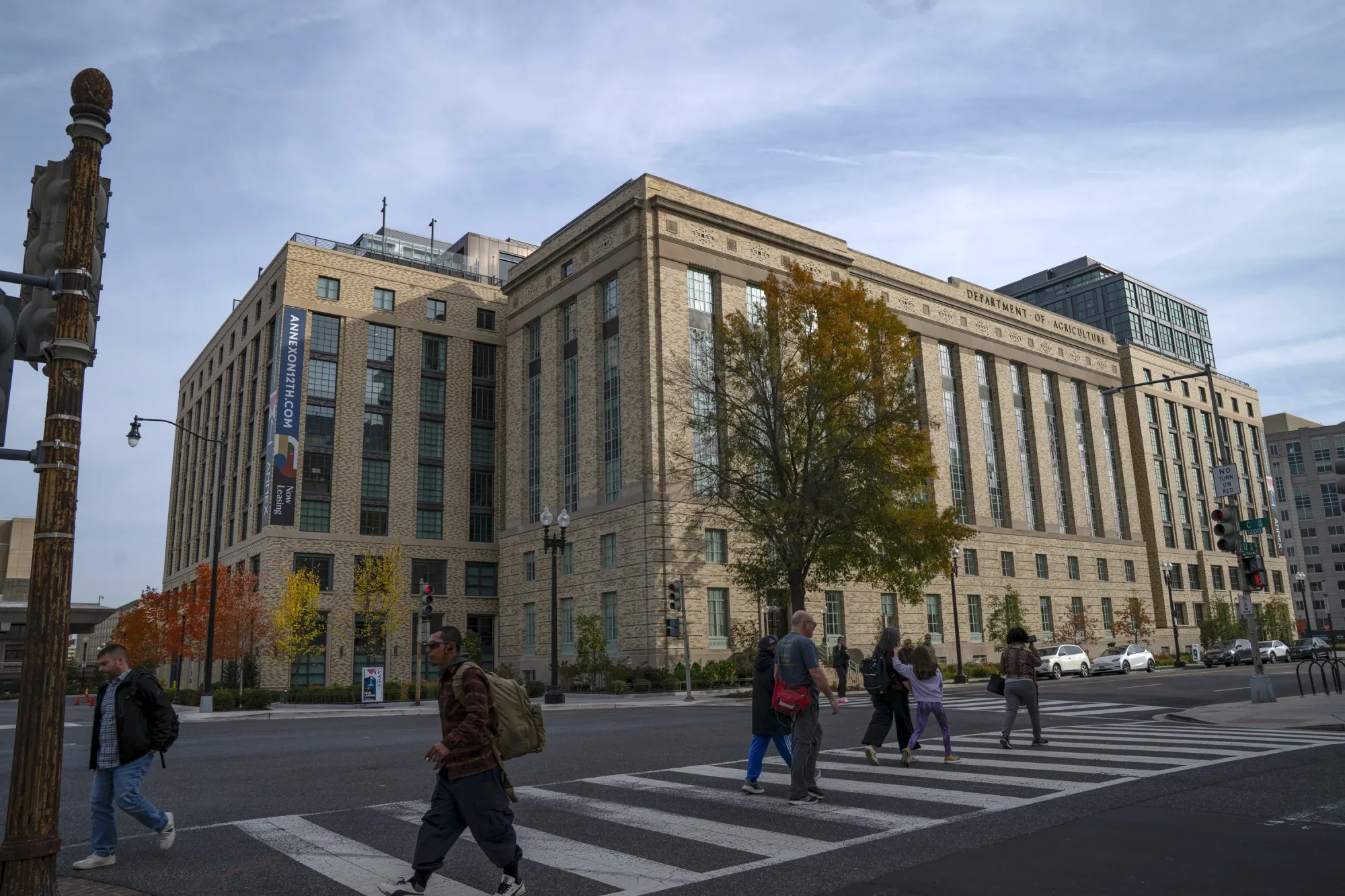
The Annex on 12th was once a USDA building. Now it’s luxury apartments. Credit: Leigh Vogel
From the infinity pool on the roof of the former USDA Cotton Annex, the view to the Romanesque brick spires of the Smithsonian’s Castle is only partially obstructed by the forbidding grid of the Forrestal. The number of world-class destinations within a 15-minute walk is impressive: Fabio Trabocchi’s Del Mar restaurant, The Anthem music venue, the Thomas Jefferson Memorial. But the building is an extreme outlier in an office district that is dead quiet even during business hours and lacks basic amenities like a grocery store.
Here the scope of what Fedlandia living does and doesn’t offer comes into view.
This federal office building conversion commands some of the highest rents in the city. The architecture firm Design Collective led a complex effort to restore the original annex, construct a 13-story addition and connect the spaces between them. The project is filled with mod furnishings and Art Deco finishes; a barrel-vaulted room with a dramatic skylight once used for drying tobacco serves as a residents-only speakeasy. There’s already a Cybertruck in the garage.
From Federal Offices to Luxury Apartments
In many ways older government office buildings are ideal candidates for conversions: Designed before the arrival of air conditioning, many of them feature shallow floorplates, interior courtyards and plenty of windows for cross-ventilation. Unlike modern office buildings with deep, square floorplates, which require a ton of demolition, adapting something like the Liberty Loan Building or USDA South would be relatively straightforward. Even given the fact that the USDA building boasts 7 miles of hallway.
“These are pre-war buildings, beautiful floor plates, robust structure, with access to natural daylight,” says Joseph Ruocco, principal at SOM, describing a pair of New Deal–era buildings in Southwest that house the US Department of Treasury’s Bureau of Engraving and Printing — properties that are a stone’s throw from the Tidal Basin and its graceful cherry blossoms. “The greenest building is the one you own.”
San Francisco’s Carmel Partners purchased the Annex for $45 million in 2021 and built out the project in record time. After opening about a year ago, the building is nearly 70% leased. The redevelopment only happened, however, after DC-based Douglas Development Corp. bought the property at auction for about $30 million in 2017 and led it through the exhaustive entitlement process required for historic properties.
Carmel hopes to develop other properties in Southwest, according to Ronnie Gibbons, senior vice president for acquisitions and development. But there’s no low-hanging fruit in the area. For the broader neighborhood to flourish, local and federal government officials need to approach it with a more intentional process.
“Before we understood what the building could be in terms of use and density, we’d assigned a far lower value on the land and the building. Once all of that was ironed out, we were comfortable paying a higher price,” Gibbons says.
Baranes, a veteran Washington architect who has led complex federal renovation projects, sees even more residential-conversion opportunities just north of the Mall. Most of the buildings that are easily convertible are in Federal Triangle, he says, closer to downtown and adjacent to the J. Edgar Hoover Building — the Brutalist headquarters being vacated by the US Federal Bureau of Investigation.
“The demolition of the FBI building is going to create an enormous opportunity for a huge anchor with a north–south axis on 10th Street,” Baranes says. “You could develop a much more impressive idea about transforming downtown and transforming the federal presence.”
Diane Sullivan, director for the current planning division at the National Capital Planning Commission, says that Federal Triangle is very much a part of the discussions about the future of DC’s federal footprint: “We’re not looking at this in isolation.”
A Sinking Ship
Scrutiny over the federal government’s office stock didn’t arrive with Trump’s second term or Elon Musk’s Department of Government Efficiency.
The watchdog Government Accountability Office concluded during the Biden administration that the buildings of 17 different federal agencies were grossly underused, with occupancy at 25% or less.
Returning these buildings to productive use isn’t just a matter of getting workers in the office. The average federal building is more than 50 years old. The federal government’s unfunded real-estate liabilities add up to an estimated $72 billion, with staggering costs of $1,000 per square foot or more for problem properties.
One developer on the Public Buildings Reform Board, D. Talmage Hocker, says that some properties pose unsafe working conditions for federal employees. The board’s executive director, Paul Walden, describes the federal government’s burden as a “sinking ship.”
Both the city and the federal government have been eyeing Southwest for more than 20 years, says Nina Albert, DC’s deputy mayor for planning and economic development. Mayor Muriel Bowser asked for $1.5 million to fund a new master plan for Southwest in May. While the City Council didn’t fund the new master plan, change has never been closer to a reality, according to Albert. “There are other ways to create a vision and publish it. Those conversations are happening actively around a whole variety of players.”
Demolition Man
The X-factor in all these plans is Donald Trump, whose ready-fire-aim approach to federal procedure has already turned Washington upside down. Construction on the foundation for the new ballroom began before its designers had even finalized drawings for the structure, much less submitted plans for federal review.
As of January, the White House faces a lawsuit from the National Trust for Historic Preservation to stop the construction of Trump’s ballroom, as well as a suit from historic preservation firm Cultural Heritage Partners to block plans to paint the Eisenhower Executive Office Building white.
In a related legal filing, former federal staffer Mydelle Wright said that the White House is finalizing a bid package for the demolition of four historic federal buildings. All four properties — the Robert C. Weaver Federal Building, Wilbur J. Cohen Federal Building, GSA Regional Office Building and Liberty Loan Building — are either listed on the National Register of Historic Places or eligible for listing. Like the Forrestal Building, all four are located in Southwest.
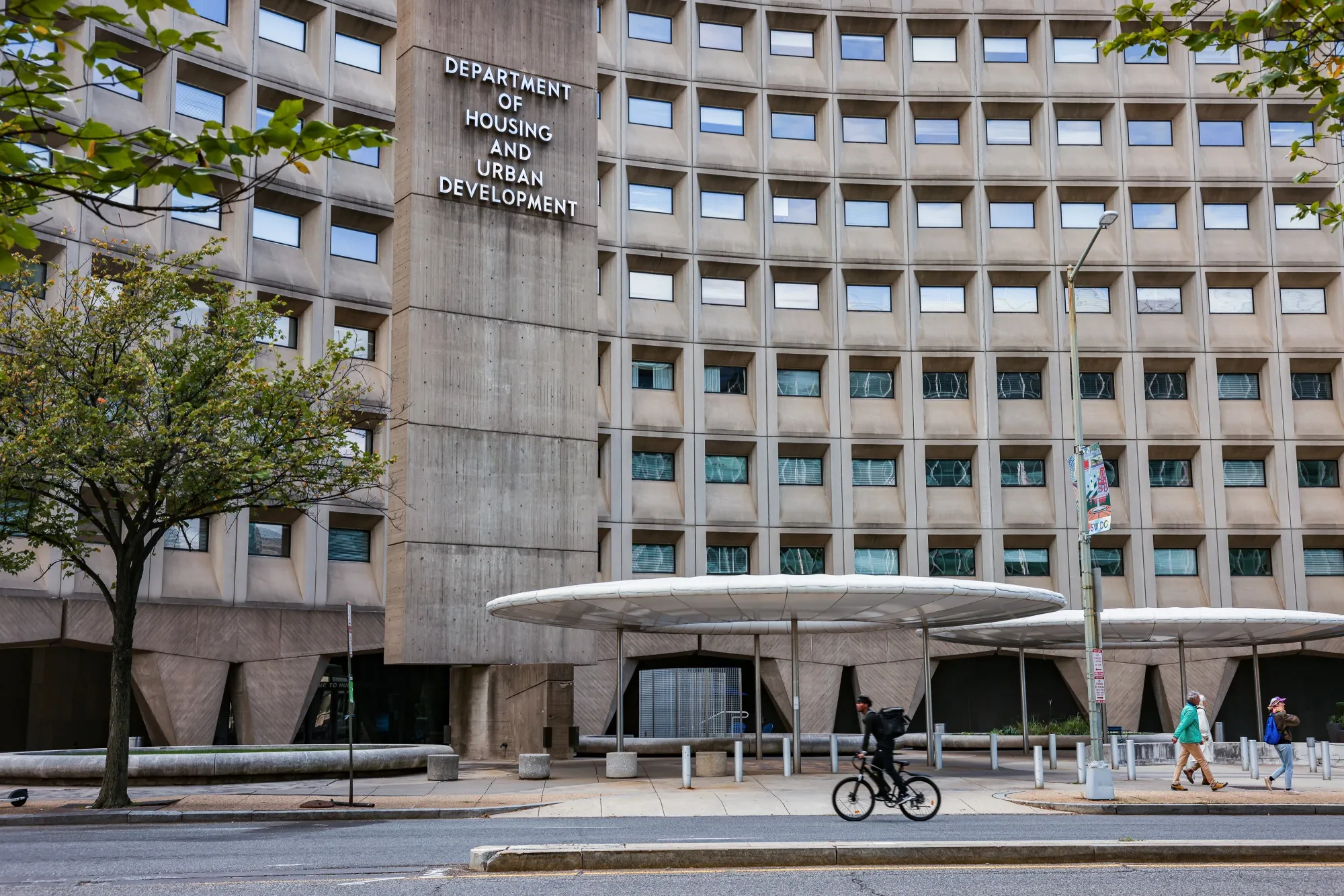
The Robert C. Weaver Federal Building, the headquarters of the US Department of Housing and Urban Development, is listed on the National Register of Historic Places. Credit: Valerie Plesch/Bloomberg
Demolishing these historic buildings without undergoing a federal review process would violate multiple laws for environmental protection and historic preservation, according to Greg Werkheiser, founding partner of Cultural Heritage Partners.
“Every president before this has paid at least nominal respect to the process,” Werkheiser says.
Process has not hindered the Trump administration from remodeling the John F. Kennedy Center for the Performing Arts — or affixing the president’s name to the building in December. Trump has pledged some $2 billion to contractor Clark Construction, the firm building the White House ballroom, for other unspecified improvement projects around Washington. It’s hard to imagine that he will stay on the sidelines when it comes to what could be the most consequential shift for DC since the 1902 McMillan Plan.
Fedlandia is not the federal government’s only development opportunity in Washington, either. For the past 15 years, the US Department of Homeland Security has been engaged in an effort to redevelop the sprawling west campus of St. Elizabeths Hospital in Southeast DC as its consolidated headquarters. In a December memo, Homeland Security Secretary Kristi Noem proposed demolishing more than a dozen structures.
But the opportunity is largest in Southwest. Across more than one-dozen properties there, the federal government owns or leases some 15.3 million square feet of office space, 87% of which goes underused, according to a presentation by SOM. The government had been kicking the can down the road on capital needs long before the pandemic and remote work arrived, which only underscored the problem.
Even Trump’s critics will concede that the process for addressing the government’s property problem is painfully slow. Yet federal historic preservation law exists to protect the history embodied in these structures, be it the New Deal murals in the Wilbur J. Cohen Federal Building or the last of the “tempo” buildings erected along the Mall to prosecute World Wars I and II.
For Merklein, one of the designers of the Catholic University plan, Southwest represents an opportunity to heal decades-old scars in the urban landscape. The capital city showed its ability to push through change on an epic scale with the urban renewal that produced L’Enfant Plaza in the 1950s. The city could do so again.
“There’s something in the water in this area, so to speak,” he says. “There’s only so much longer it can lay untouched.”