Rue de Rivoli, one of the most famous streets in Paris, has banned most cars.
Welcome to Paris, the City That Said No to Cars
Honking horns and screeching tires used to be a cliched scene-setting device for writers describing Paris. Those sounds no longer define a city where cars have taken a back seat. Visitors will discover that it’s a dramatically different place than a decade ago: lines of bikes and throngs of pedestrians where lanes were once jammed with cars, greenery encroaching on former pavement, summer swimming in the once-grimy Seine river — and a corresponding drop in air and water pollution.
The shift is the result of a spate of policies under outgoing Paris Mayor Anne Hidalgo intended to make the city more walkable and bikeable while reducing emissions. Internationally, Hidalgo has become one of the best-known promoters of green urban change.
Locally, this transformation has been more controversial, especially among her political opponents and suburbanites who have criticized her for penalizing drivers. Her embrace of the 15-minute city — a planning concept intended to spread amenities more evenly throughout the city and reduce the need for daily driving — has even gotten her embroiled in recent conspiracy theories.
Hidalgo was not alone in pursuing such changes. Other French cities have seen more bikes and fewer cars, while some of Paris’ global big-city peers are pursuing ambitious tree-planting efforts or pedestrian plazas. What’s most remarkable is the sheer volume of aggressive new policies Hidalgo has managed to push through.
Sunday’s mayoral election may determine the direction of her legacy. The Socialist Party candidate running to replace Hidalgo, her former Deputy Emmanuel Grégoire, garnered a plurality in the first round of voting.
A journey from Paris’ city center to one of its newest suburban developments shows how the region has changed.
Sources: Institut national de l’information géographique et forestière (IGN), Overture Maps Foundation
La Bastille
Cutting back car lanes
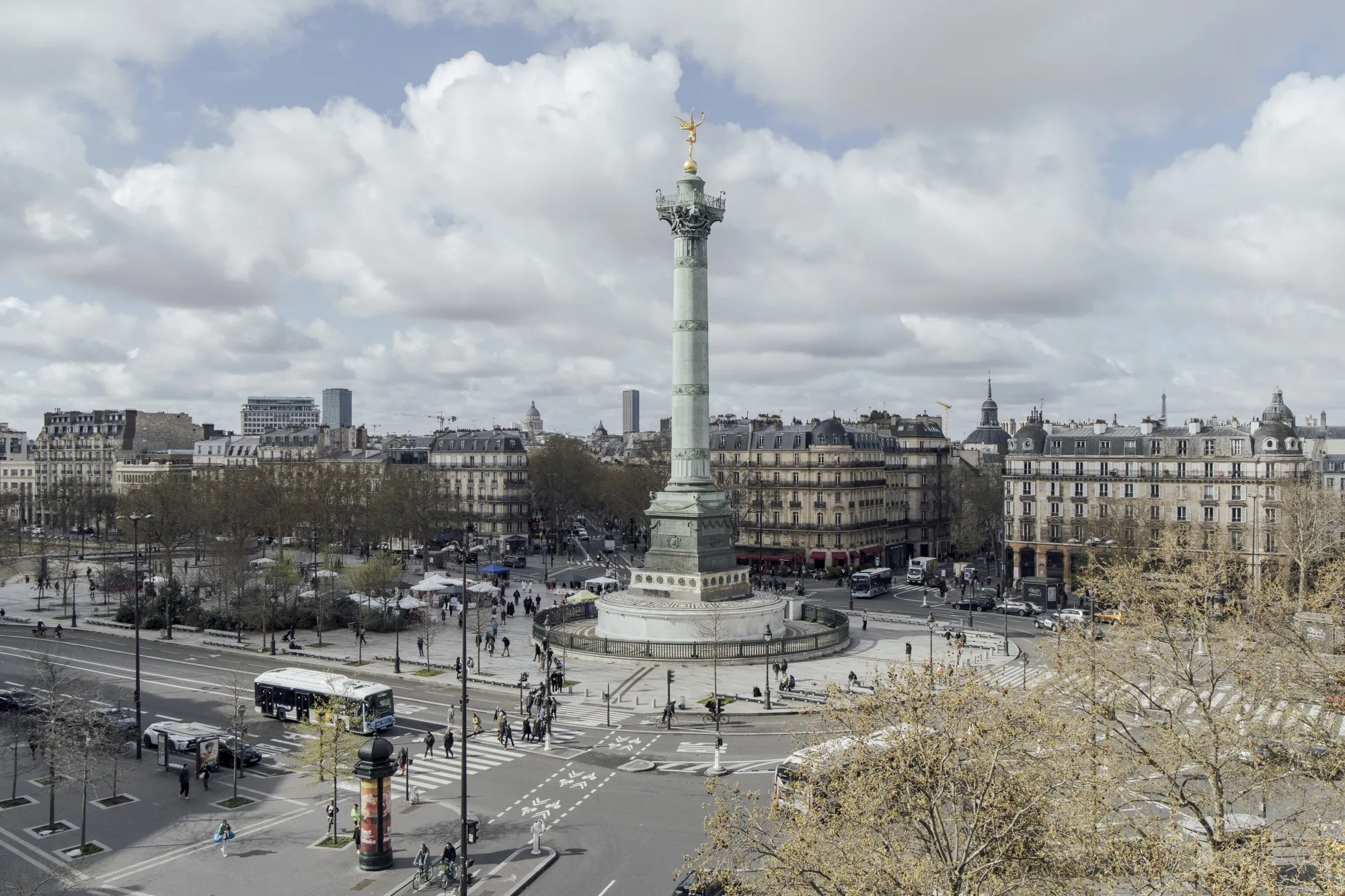
The Place de la Bastille, which was redesigned under Hidalgo into a pedestrian- and bike-friendly space.
Before Mayor Hidalgo’s arrival at Paris City Hall, the city’s Place de la Bastille was a roaring, largely treeless car carousel that was forbidding to pedestrians. During the mayor’s tenure, the historic square has seen the proportion of its area devoted to cars slashed, with enlarged sidewalks, bike lanes and new banks of vegetation taking their place.
One of seven major squares similarly remodeled, Place de la Bastille now boasts 50 more trees and 7,000 square meters (over 75,000 square feet) of additional pedestrian space and bike paths. Visitors can walk up to the square’s previously marooned central column, the site of the former Bastille Prison, without crossing lines of traffic.
Source: Google Earth
The square also has a new role as a traffic hub — this time, as a key junction for bicycles. The transformation may be bold but it is also “logical,” former Hidalgo cabinet member Jean-Louis Missika told the newspaper Le Monde in 2019, as the large car crossings of the past are now becoming large bike crossings.
The Seine
Pedestrianizing the banks
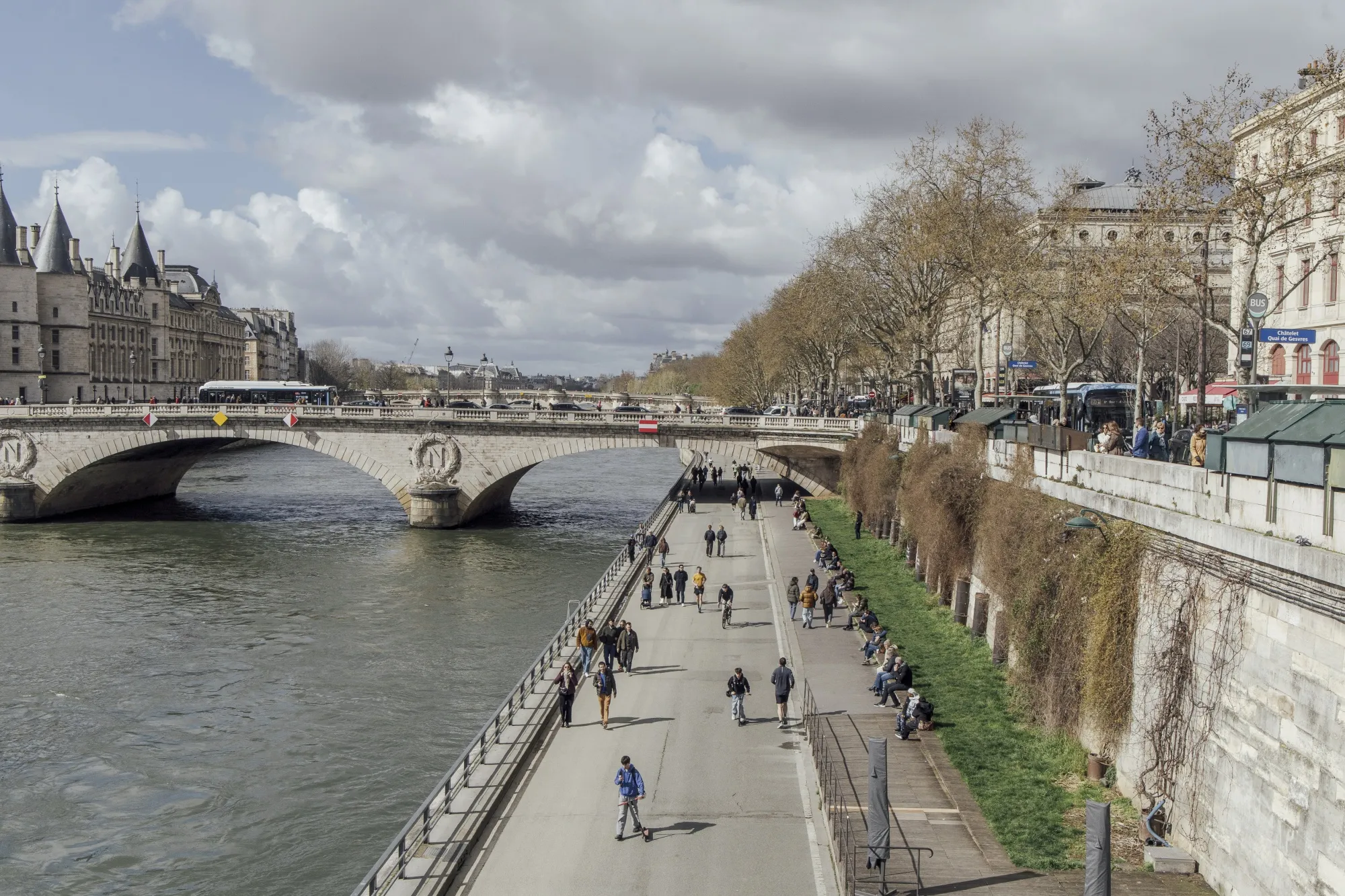
The Voie Georges Pompidou, the Seine riverbanks, in March 2026. The Hidalgo administration pedestrianized most of the former motorway.
Strolling along the riverside walkway on Paris’ Right Bank today, it’s hard to believe this busy but peaceful pedestrian quayside hosted one of central Paris’ main motor vehicle routes just ten years ago. This 2-mile stretch of embankment once channeled 43,000 cars across the city daily, polluting the air and assailing landmarks such as the Louvre and the Pont Neuf with noise and vibration.
Today, all cars have been removed, and the pedestrianized quayside is not just a popular amenity but a tourist attraction. The scheme has proved to be the start of a wave of pedestrianizations across the city, which have banished cars from some major streets and reduced the number of car lanes on many others.
The Voie Georges Pompidou, part of the Seine riverbank, before and after pedestrianization. Photographer for 2015 photo: Robert Deyrail/Gamma-Rapho via Getty Images.
On streets that motor vehicles can access, meanwhile, cars are driving at a much slower pace, with a speed limit of 30 kilometers per hour (19 miles) on all streets but a few main arteries. Vehicles also have notably fewer places to park if they want to stop; the city has removed 24,000 parking spots in the last six years with plans to remove tens of thousands more across 500 streets, replacing them with bike lanes, sidewalks or greenery.
During this period, air quality has improved considerably, though it still falls short of meeting World Health Organization thresholds. Pollution from both nitrogen dioxide and fine particles dropped between 2012 and 2022, while carbon emissions from vehicles went down by 35%, according to a study by Airparif. These changes are partly attributable to vehicle modernization improvements, and partly to reduced car traffic — shifts that have also led other cities to see air quality improvements.
Pollution Fell Everywhere, But Especially Along Major Roads
Sources: IGN, Airparif, Overture Maps Foundation
For Paris, the journey in this direction has not been smooth. The closing of the quaysides to cars faced substantial challenges, with an inquiry finding that the project risked merely displacing congestion and pollution to other streets for their vehicles, while a court challenge paused the project’s implementation by highlighting missteps in its impact study. In the end, it was the cultural and aesthetic benefits of pedestrianization that enabled the city to overcome the legal challenge: The car-free quays pass through — and unquestionably enhance — one of the world’s most beautiful urban waterfronts, a Unesco World Heritage Site since 1991.
Since completion, public reception has been largely positive. A 2019 poll on the subject found that 63% of Parisians — who, unlike less enthusiastic suburbanites, get to vote in mayoral elections — were in favor of the pedestrianization, while a poll before this March’s elections showed a narrow majority favorable to City Hall’s actions on the environment in general.
They have also voted with their feet. The quayside, now planted with fast-maturing plane trees and creeper climbing the sandstone walls, is thronged on any sunny day with joggers, walkers and their dogs.
Since then, the city has taken the Seine’s role as an amenity and tourist attraction further — by making the river swimmable, both for athletes competing in aquatic events in the 2024 Summer Olympic Games and for regular people thereafter. A cornerstone of Paris’ Olympic legacy, the cleaning of the Seine cost an incredible €1.4 billion — a more reasonable sum when you realize that this entailed the re-engineering and improvement of Greater Paris’ sewage system, a worthy goal in its own right. While the project’s success was not rock solid in creating reliably pristine water quality — swimming competitions were rescheduled when rainfall spiked E. coli levels — it provided a highly visible publicity coup for the city right when the world’s eyes were on it.
Hotel de Ville
Creating green spaces
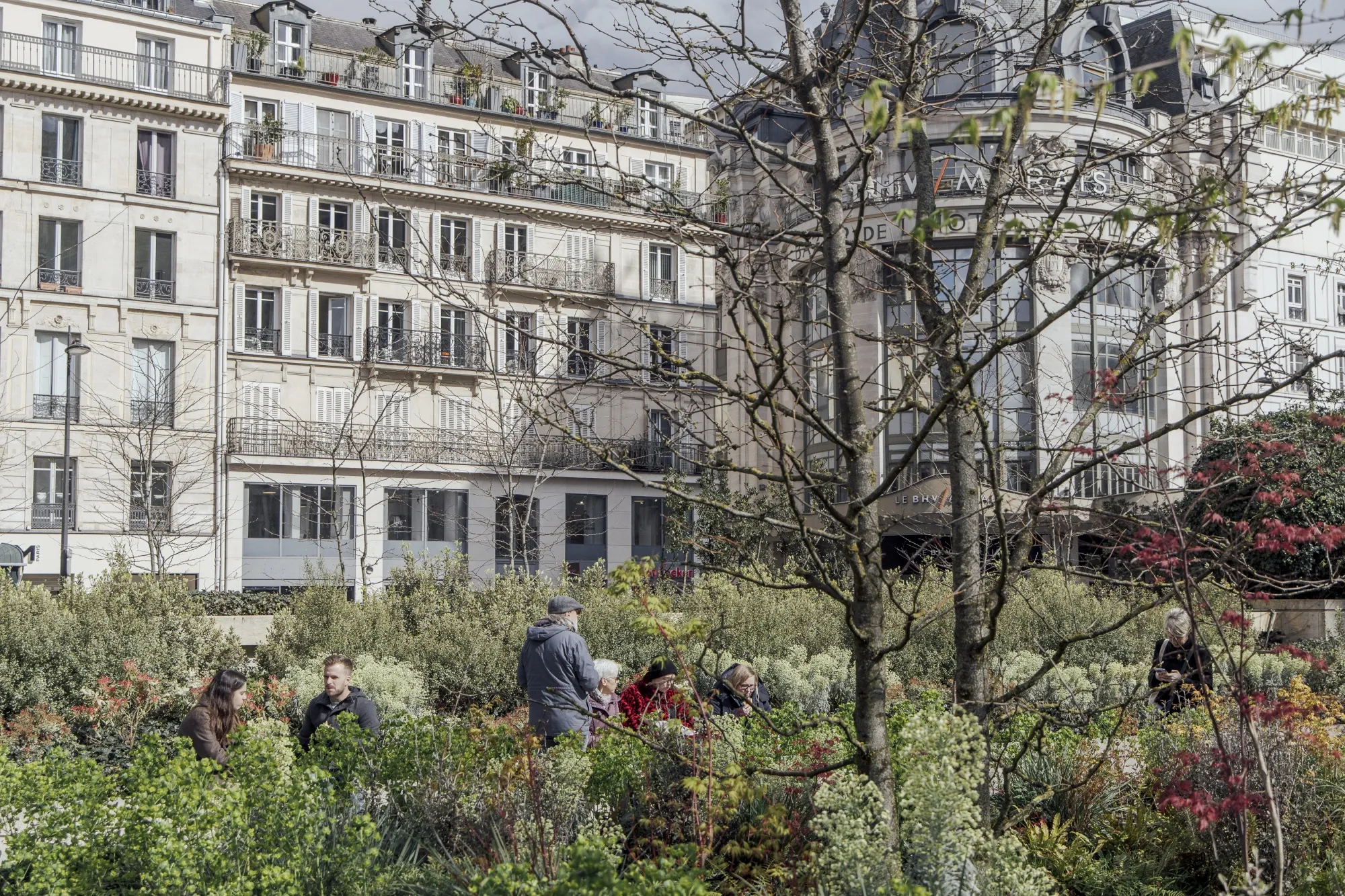
Bushes and young trees on the plaza in front of the Hotel de Ville, Paris’s City Hall. The added vegetation aims to provide shade and reduce flood risks.
As recently as 2023, the square in front of Paris’ City Hall was a bare space whose paving stones baked in the summer sun. Now thanks to the city’s Urban Forest program, the space is bracketed with 10,800 square feet of new greenery, including raised flower beds and tall trees that together create lush, semi-secluded arbors with benches.
Calling the space a “forest” is essentially a branding exercise: Several such newly planted areas are small in size. Their purpose is not to blanket the city with seamless woodland, but to create interconnecting green seams along the streets that provide shade and cooling vapor in the summer, and reduce flood risks by absorbing heavy rain.
They are typical of the Hidalgo era’s greening efforts. Between 2014 and June 2025, the city says it has planted 213,000 trees, mainly in small groups, particularly around schoolyards and along streets. The city has mapped these so-called “islands of freshness” as part of a guide to places that can provide a cooling respite, whether through tree shade, fountains or within the cool interior of public buildings such as museums.
The plan is about more than beautification: The urban heat island effect makes climate change especially dangerous in cities, and it has been estimated that systematic tree planting could cut Europe’s summer heat deaths by a third.
The plaza in front of the Hotel de Ville, before and after greenery was added. Photographer for 2019 photo: Paulo Amorim/NurPhoto via Getty Images.
So far, there’s some indication Paris’s efforts are working to cool particular spots. When temperatures in the city’s paved streets reached 40C (104F) last August, a visit to the Place de Catalogne “forest” by newspaper Liberation registered a far cooler 29C (84.2F). Still, critics have condemned these modestly sized green areas as a PR stunt, citing the high cost per square meter. International experience shows that planting trees is a lot cheaper and easier than keeping them alive until they reach maturity, so it may be 20 years before the success of this tree-planting effort can truly be assessed.
Boulevard Sebastopol
Expanding bike lanes
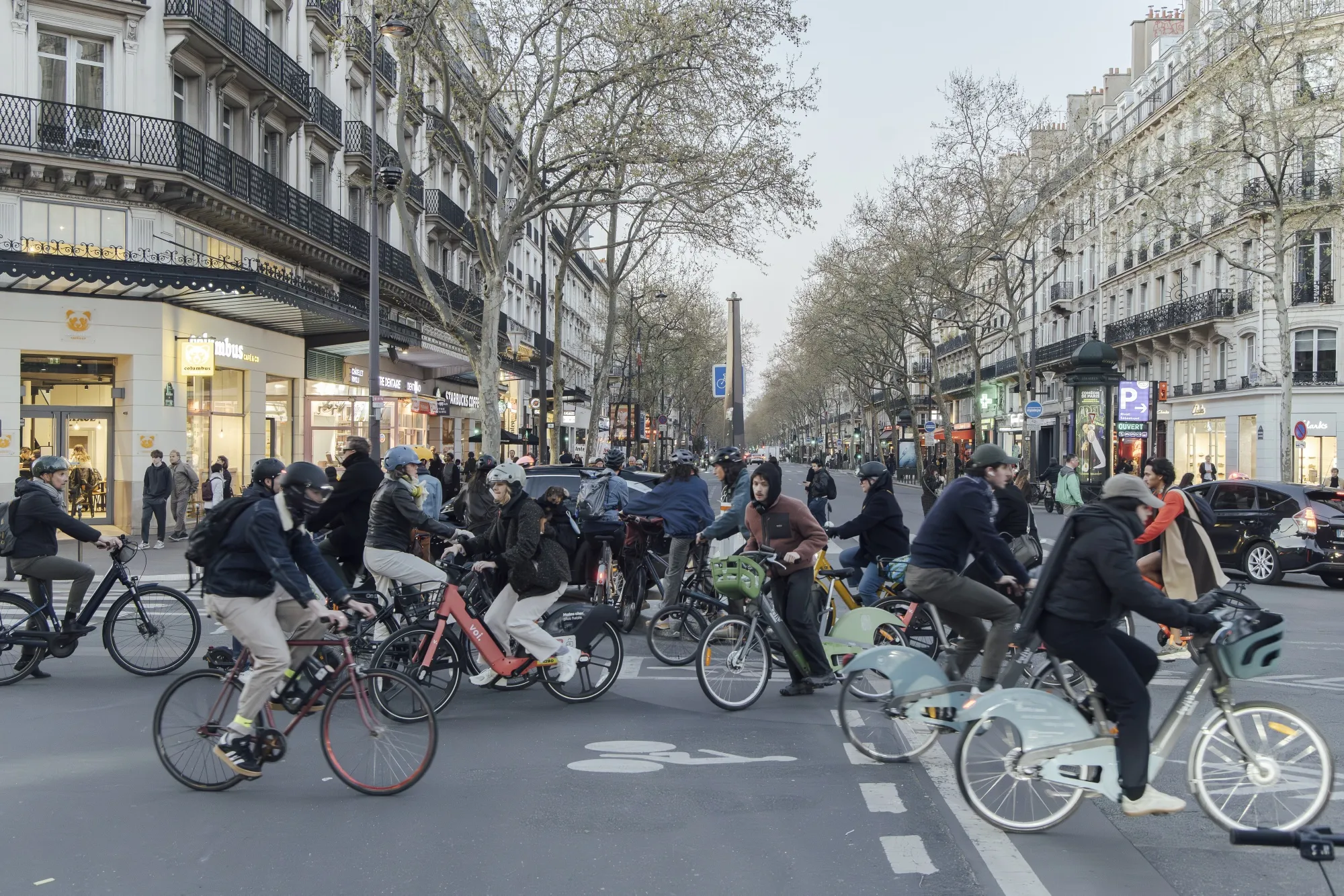
Cyclists on the Boulevard Sebastopol. The bike counter on this Boulevard counted over 3 million bikes within the last year.
Last year, the city said it had added 550 kilometers of bike lanes over a decade, reaching a total of 1,400 kilometers (870 miles) of tracks by March 2026 — a notable amount of track for a city that’s less than twice the size of Manhattan, which currently has 386 kilometers (240 miles) of bike lanes.
These figures don’t reveal what could be a yet more important shift — one toward wider lanes, more barriers and overall better safety. Paris has also moved from cycle lanes that are partly shared with other forms of traffic toward completely segregated bike paths protected from traffic via barriers. These too are widening.
As the city has made more space for bikes, it has allowed less for cars. Major streets such as the Rue de Rivoli have been largely cleared of cars, while vehicle lanes on many other streets have been reduced and replaced with bike lanes or trees.
These changes have helped Paris double its modal share for bikes, which has risen from 5% of all journeys in 2020 to over 11% in 2025. This hasn’t made Paris a biking city along the line of Amsterdam or Copenhagen — whose cycling modal shares both exceed 35% — but the shift is highly noticeable in central Paris, where 3.5 million bikes were recorded as passing along one main avenue, the Boulevard de Sebastopol, in 2025.
Bike Ridership Grew Across Paris
Sources: IGN, Overture Maps Foundation, Direction de la Voirie et des Déplacements — Ville de Paris via Paris Data
Only includes counters that have been active since at least 2021. Counters that flatlined in either May 2021 or May 2025 were excluded. Porte de Charenton’s tally was excluded because the bike lane moved further from the counter.
Safety remains a concern. Many bike lanes are still unprotected or vulnerable to traffic. While Parisian collisions involving death or hospitalization dropped 6% between 2023 and 2024, bike-related collision deaths or hospitalizations edged up from 61 to 69, as the overall number of bikes on the road rose.
A common complaint is that Paris’ road rethink has not so much reduced congestion as concentrated it more intensely in fewer places. The number of hours Parisian drivers spent in traffic did nonetheless drop between 2024 and 2025, a period when overall space for motor vehicles decreased.
Porte de Clichy
Connecting to the suburbs
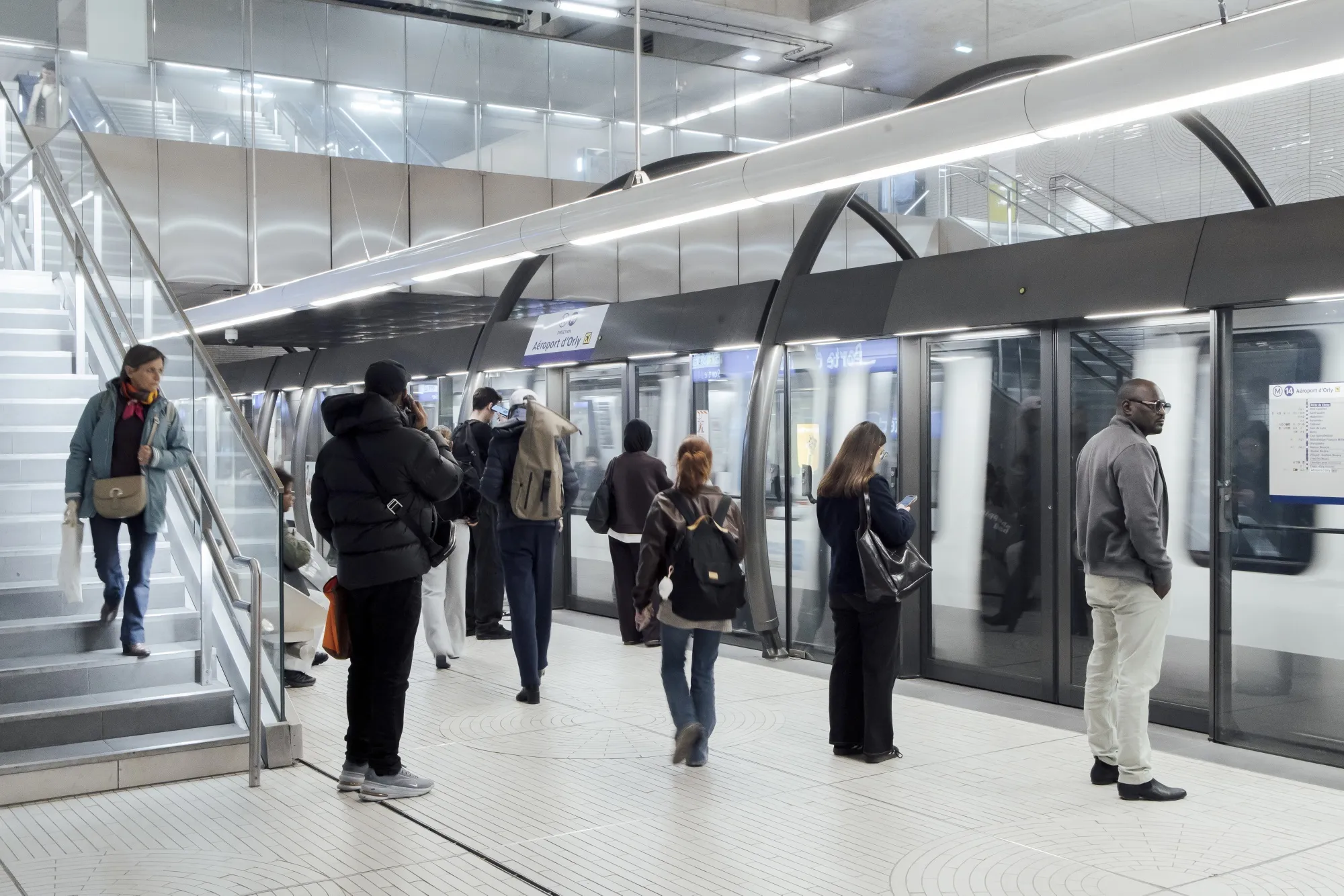
The Porte de Clichy metro station, on Line 14, is part of the Grand Paris Express metro expansion. The line is fully automated and features platform screen doors.
The cacophony of drills and construction trucks outside Porte de Clichy Station portends a major public transit expansion, intended to benefit not just the city of Paris but the suburbs around it.
The Grand Paris Express project is pharaonic in scale, with 68 new stations and 200 kilometers (120 miles) of new tracks planned by the end of 2031. Much of this work is planned and funded outside Hidalgo’s jurisdiction, in the suburbs, where some residents balked at her agenda to remove cars. By providing more transit alternatives outside the city, the project should help preserve her car reductions in central Paris and perhaps inspire others like it on the periphery.
Chief among the Grand Paris Express’ new links will be the 36-station orbital metro Line 15, which circles Paris proper without ever entering it, allowing people to connect from one suburb to another without taking “dog leg” journeys in and out of the city center. This line connects to both the city core and suburbs further out via another four new stretches of metro line — three of them completely new lines and one extension of an existing one.
This expansion will certainly be transformative. Previously, none of Paris’ metro lines extended more than a few stations beyond the Boulevard Peripherique inner beltway, requiring suburbanites to use an alternative rail network called the RER, from which it can be slow and inconvenient to transfer to the metro once within the city.
An Extensive Train Network to the Suburbs
Sources: IGN, Île-de-France Mobilités, Société des grands projets, Overture Maps Foundation
The new suburban metro loop will help to integrate inner and outer Parisians on a shared network, breaking down this division and making cross-regional travel a lot more seamless. As the new homes the region needs are increasingly likely to be built in suburban locations, such links are going to become ever more necessary.
Other new minor links will also help. An extension of Paris’ tramlines — which shadow the beltway from the inside and now form an almost-complete ring around the city — has also given people who live in Paris’ outer boroughs their own alternative. Meanwhile, a hilly section of the southern suburbs is now served by a gondola, Greater Paris’ first.
Saint-Denis Pleyel
Growing beyond the city
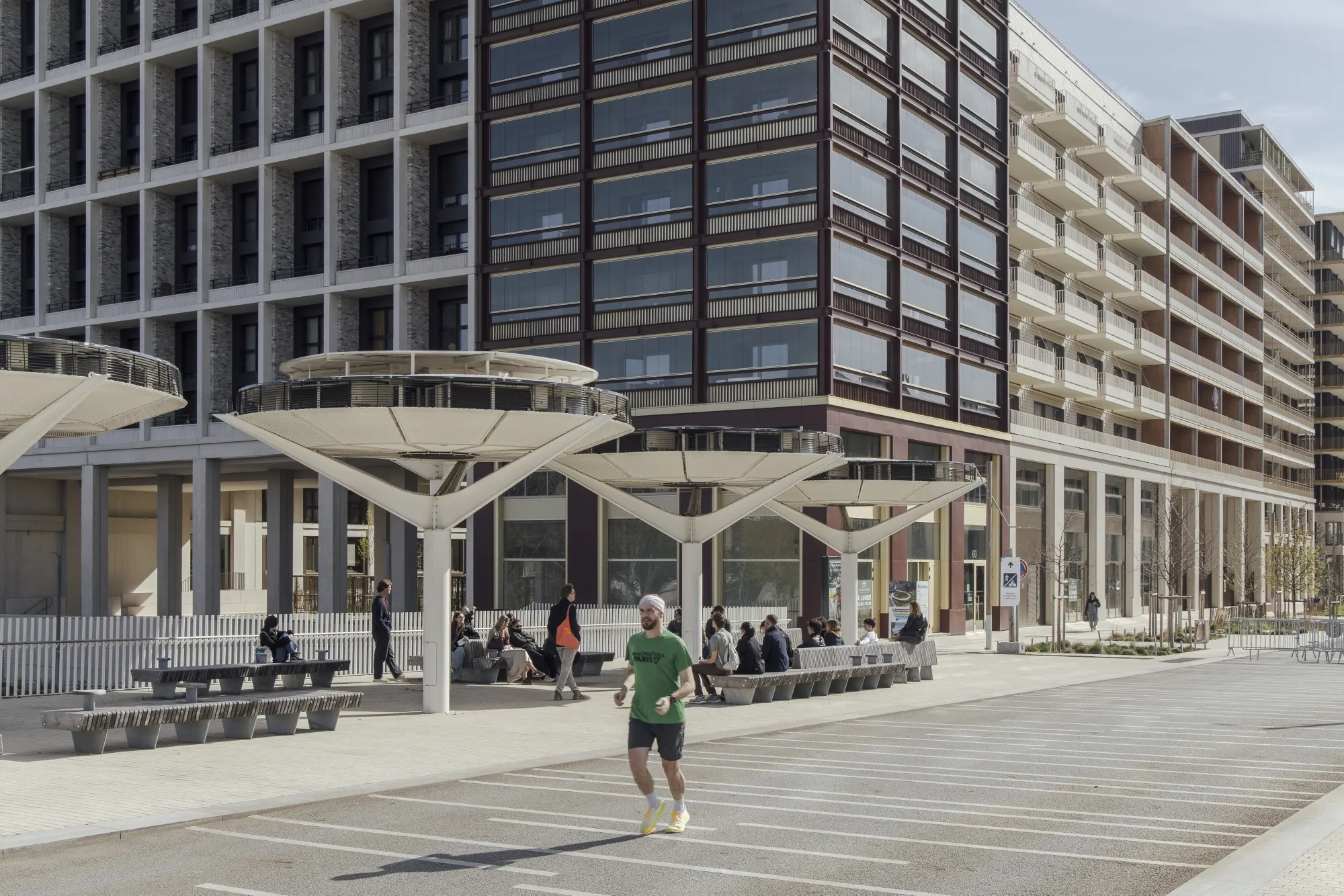
The former Olympic Village in the suburb of Saint-Denis is being adapted into housing.
To understand why the extension of Paris’ metro into the suburbs is so important, the brand new neighborhood at Saint-Denis Pleyel, just beyond the city’s northeastern border, is a good place to start.
Built as the Olympic Village for the 2024 Summer Games, the new quarter’s 2,800 homes completed so far mix housing for sale and for rent and include market rate, affordable and public units. The development has been cited as a model for sustainable development, and the hunger with which its units are being snapped up reveals a key trend of Hidalgo’s mayorship: Paris’ housing costs have been going up, pushing residents out of the city to suburbs such as Saint-Denis and beyond.
Paris Housing Prices Increased Much Faster Than Suburbs
- Paris
- Seine-Saint-Denis
- Other suburban area
Source: Jacques Friggit, Inspection générale de l’environnement et du développement durable (IGEDD)
Paris’ population has been in decline since around 2010. It isn’t losing residents to other cities as such, but to the districts outside the official city of Paris — a relatively small, dense historic nucleus which is home to a little over 15% of the Greater Paris population of over 13 million.
This suburban drift does not necessarily represent a worrying shift to sprawl — some of Paris’ suburbs are as densely populated as the cores of major North American cities. But it does mean that all the changes to Paris’ landscape come with an asterisk: They are an amenity for those who can afford to live there — and visitors.
Population Fell in Paris and Rose in the Suburbs
- Paris
- Seine-Saint-Denis
- Other suburban area
Source: National Institute of Statistics and Economic Studies (Insee)
To be sure, Hidalgo’s agenda to create a city of 15-minute neighborhoods has included affordable housing policies. A city trust targeting the middle class aims to ensure that 10% of the city’s rental homes are offered at 75% of market price or less by 2035, while the city has adopted a target of 30% public housing for low-income Parisians.
With public housing, the most eye-catching effort has been a drive to ensure that even Paris’ wealthier neighborhoods retain a proportion of public tenants — by using compulsory purchase orders and some small new developments, such as the housing built atop Central Paris’ revamped Samaritaine department store.
Such plans aren’t on a large enough scale to solve Paris’ affordability problems, however, meaning that more and more Parisians may be moving out to the suburbs — and possibly relying on the new metro line to visit the city. But even for those who don’t live there, Paris’ policy changes are starting to have knock-on effects, as city-center spaces that were once parking lots are repurposed for other greener uses like retail warehouses.
Pedestrians and cyclists along the Seine.
Correction: A previous version of this story incorrectly stated that a picture of the Hotel de Ville was taken in 2009 rather than 2019.