Deportation in the Trump Era Is All About Location
If you’re an undocumented immigrant, where you live often determines your future.
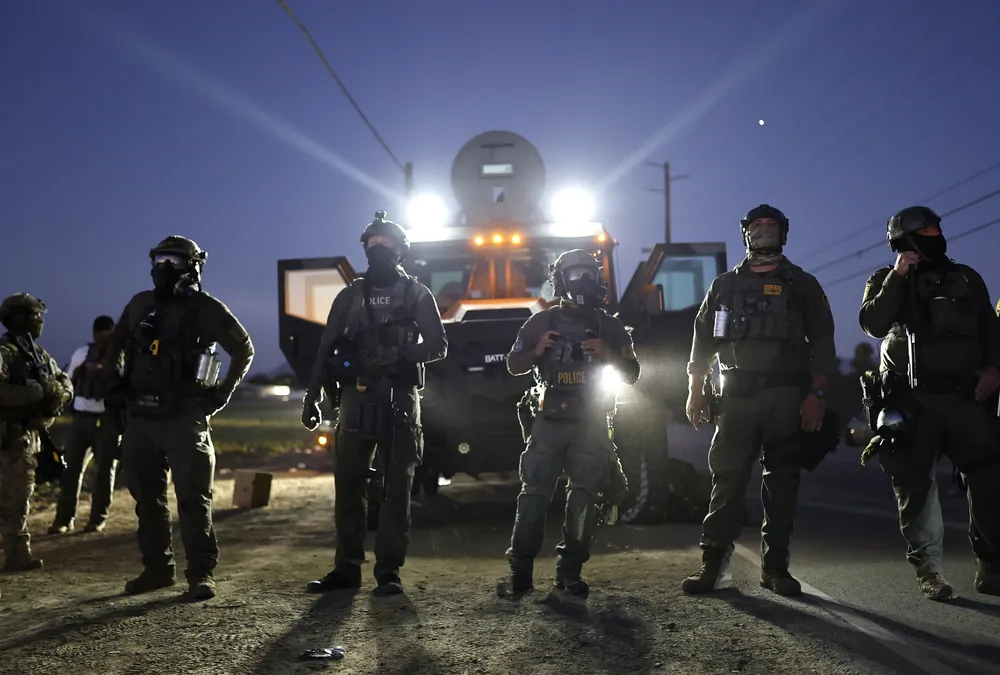
A two-tier system of federal immigration enforcement is emerging as the Trump administration enlists more sheriffs and police officers into its deportation agenda. In many Republican counties, undocumented immigrants face a much greater risk of deportation almost any time they interact with the criminal justice system, even for minor offenses — or no offense at all.
This divergence is part of a larger pattern. Red and blue states are pulling apart in their laws covering a panoramic range of issues — abortion, voting, guns, LGBTQ rights. Not since the era of Jim Crow segregation in the South have so many states differed so profoundly in the rules governing daily life.
The Trump administration’s approach to deportation extends this divergence into another area: immigration. Since President Donald Trump returned to office, the Department of Homeland Security has intensified its efforts to formally partner with state and local law enforcement agencies. In December 2024, just before President Joe Biden left office, Immigration and Customs Enforcement had 135 such partnerships, called 287(g) agreements. As of mid-March, ICE reported 1,537 of those partnerships.
That 1,537 figure includes substantial duplication. Combing through ICE’s list, we found 795 counties where either the sheriff or at least one police department have signed 287(g) agreements with ICE. Even so, that represents about a quarter of all counties and covers nearly a third of the total US population.
The Two Americas of Immigration Enforcement
Source: Department of Homeland Security
Note: Includes counties where the entire county, or at least one municipal police department, has signed a formal agreement with ICE. Arkansas, Florida, Georgia and Texas mandate all counties to do so.
These counties cut a distinct profile, both demographically and politically. Most fit the classic definition of “Trump country” — lower in income, education levels and racial diversity than the national norm, and with fewer immigrants.
In 2024, Trump carried 95% of cooperating counties, and his margin of victory there averaged 45 percentage points. Nationwide, only 40 counties won by Vice President Kamala Harris have signed agreements with ICE — and 15 of them are in four red states that require it. “That’s an astounding disparity” that underlines “the political nature of the enforcement regime,” says David Leopold, a former president of the American Immigration Lawyers Association.
As of March, local law enforcement agencies in 795 out of 3,144 counties had entered into formal partnerships with ICE.
Bubbles are sized by population of counties.
Approximately 107.7 million people live in these counties, and their undocumented populations face a heightened risk of deportation.
We analyzed how the counties cooperating with ICE compare to the nation on key demographic and socioeconomic features.
Click below to select a metric:
Counties Cooperating With ICE Have Fewer Immigrants Than Average
- 2024 vote margin: Trump 0–25 pts
- 25-50 pts
- 50+ pts
- Harris win
Source: Department of Homeland Security; the American Community Survey
Note: Includes counties where the entire county, or at least one municipal police department, has signed a formal agreement with ICE. Arkansas, Florida, Georgia and Texas mandate all counties to do so.
Among the jurisdictions that have signed 287(g) agreements, 477 have adopted the most aggressive form of partnership — “task force model” agreements that empower local sheriffs or police officers to fully enforce immigration law.
These agreements authorize police officers to inquire about the immigration status of people they encounter for any reason — whether it’s jaywalking or no infraction at all. In these counties, just “driving to the grocery store” can escalate to an assessment of immigration status that quickly moves an undocumented person into removal proceedings, notes Nayna Gupta, policy director for the American Immigration Council. The remaining agreements focus on cooperation in jails and prisons and authorize local officials to serve ICE warrants to prisoners or interrogate them about their immigration status.
In red America, partnerships between local law enforcement and ICE are now normalized. Scott Bradley, executive director of the Arkansas Sheriffs’ Association, told me that few of his members have raised concerns last year, when the state mandated that all counties sign 287(g) agreements.
“We’ve had a real issue with overcrowding in our county jails, so if we get an opportunity to get rid of a bad actor, someone who has broken the law, and we get an opportunity to remove them from the United States because they are not here legally, that’s a good option for us,” Bradley said.
But the paucity of 287(g) agreements in blue counties underscores how controversial they remain outside Republican-leaning places. Civil rights groups and Democratic officials say that such agreements encourage racial profiling and the harassment of US citizens and legal immigrants. Enlisting local officers in immigration enforcement also erodes trust among immigrant communities, they argue.
The chasm between red and blue jurisdictions could widen. Congress last summer authorized ICE to spend more to reimburse local agencies for signing 287(g) agreements, which will likely encourage even more red communities to participate. Yet these agreements risk creating an assembly line between even the most minor offenses and deportation.
The divergence in immigration enforcement “is actively contributing to the exact kind of polarization and division in the United States that many of us see as tearing our country apart,” said Gupta. “It shouldn’t be that the way a non-citizen is treated by police differs on whether a county is red or blue.”
For years, policy in red and blue America has drifted apart. Drive across a state line, and you may find yourself governed by a very different set of laws. Red and blue communities also now increasingly diverge on whether a broken taillight can lead to deportation and on whether a traffic stop requires a US citizen to show their papers.
–With assistance from Carolyn Silverman and Taylor Tyson
This column does not necessarily reflect the opinion of the editorial board or Bloomberg LP and its owners.