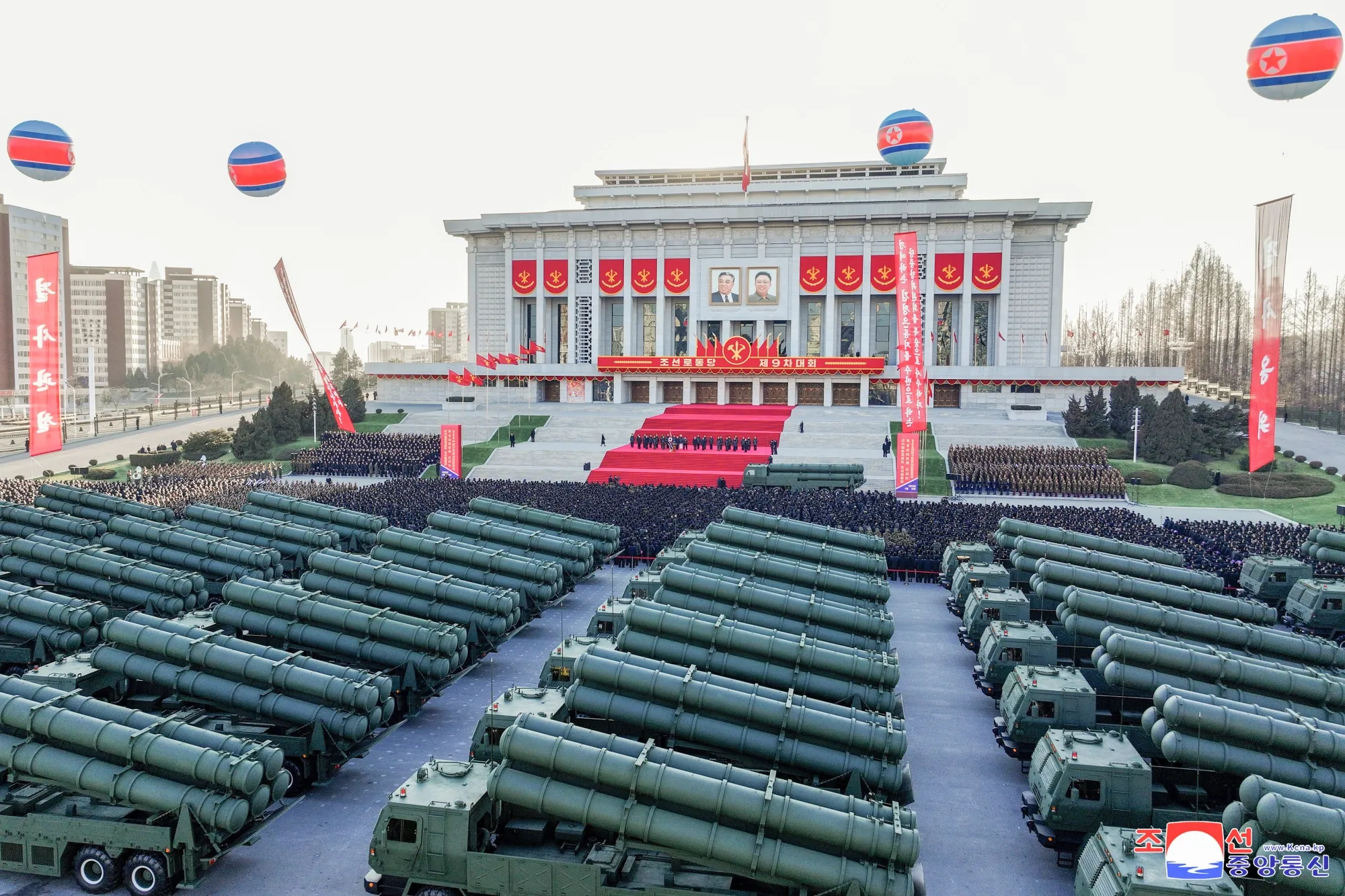
North Korea’s Nuclear Arsenal Is Outgrowing US Missile Defenses
North Korea’s nuclear arsenal is nearing a crucial tipping point: being big enough to possibly overwhelm the ground-based missile defenses the US spent billions developing over the last 30 years.
Sources: Stockholm International Peace Research Institute; Bloomberg News
Note: Excludes retired warheads, data as of January 2025. Timeline assumes current growth rates; actual overtaking dates depend on concurrent expansion of other countries.
Within a decade its arsenal could surpass those of Israel, Pakistan and the UK. But its Hwasong-15, -17, -18 and -19 ICBMs combined with its existing warheads may already give it the volume of firepower needed to get past US ground-based mid-course missile defenses, designed to stop a small-scale attack at a cost of about $65 billion.
A much larger collection of shorter-range weapons can hit US allies in Asia and American bases in Guam, where the US maintains one of its largest munitions depots in the world.
Listen: Listen to The Big Take Asia: North Korea Nuclear Arsenal Worries US (Podcast) (Podcast)
While Donald Trump wages war in the Middle East to prevent Iran’s clerical regime from acquiring a nuclear weapon, the data show US efforts to restrain Kim Jong Un’s program have failed. North Korea’s ascent from a “rogue state” to a full-fledged member of the atomic arsenal club means it can do more than just threaten nuclear war; it may now be able to fight one.
“They have more experience stewarding their nuclear forces, they have far greater confidence in their delivery systems,” Ankit Panda, a senior fellow at the Carnegie Endowment for International Peace, said at a recent seminar. It means “you have a nuclear-armed adversary in North Korea that’s going to be far less skittish than they would have been a few years ago.”
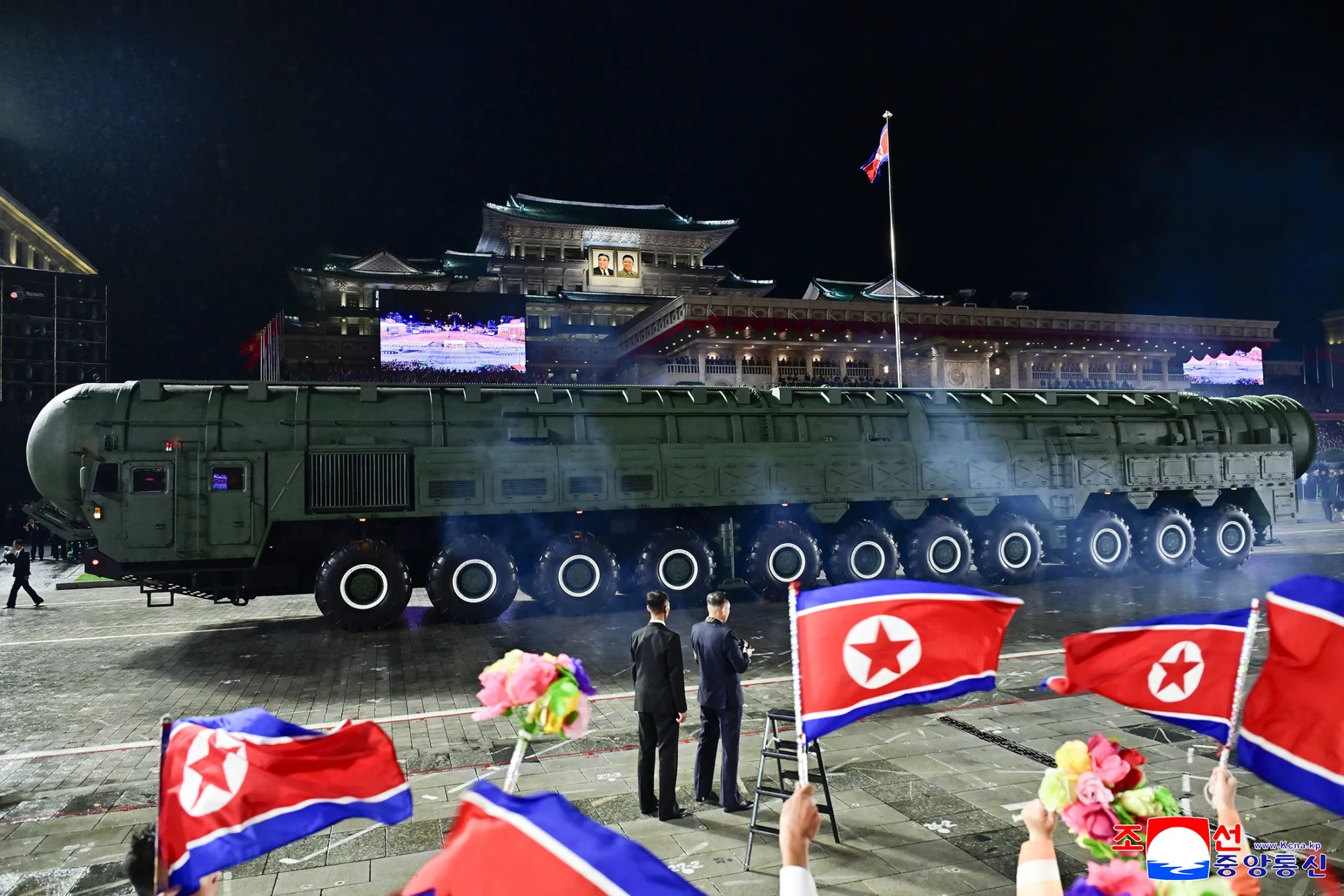
A photograph provided by North Korean state media shows what it says is a Hwasong-20 intercontinental ballistic missile during a military parade in Pyongyang on Oct. 10, 2025. Source: Korean Central News Agency/Korea News Service/AP
Estimates of how many ICBMs North Korea has varied. The US Defense Intelligence Agency said last year in a presentation supporting the Golden Dome missile defense project that Pyongyang had only 10.
North Korea, however, has test-launched at least that many in the last decade and could have as many as 48 launchers, according to analysis by Vann Van Diepen of 38 North, an online publication that tracks Pyongyang’s military developments.
Panda noted that dozens of ICBMs had appeared in parades, although they could be mockups. He assessed that North Korea could have as many as 24 ICBMs now, with production ongoing on more.
The US ground-based midcourse defense system (GMD), with 44 missiles based in Alaska and California, and places for 20 more in Alaska, was designed to defeat a much smaller threat. Launching at least two interceptors at incoming targets means running out of missiles against an attack of two dozen ICBMs.
The US Missile Defense Agency did not respond to a request for comment.
North Korean Ballistic Missiles Approach Limits of US Defenses
Sources: CSIS; Bloomberg News
Note: Ranges under 1,000 km are not shown.
Pyongyang has never demonstrated it can carry out a large-scale ballistic missile attack, and pre-emptive strikes could reduce the number of ICBMs it can put in the air.
But the threat is only growing. Even at lower estimates — some arms experts say the annual output may only be 12-15 bombs’ worth of fissile material per year — it is moving faster than India, which added eight warheads to its stockpile between 2024 and 2025 to reach 180, according to SIPRI.
Kim Jong Un’s regime was able to produce only about six bombs’ worth of fissile material annually during the first term of US President Donald Trump, according to estimates from weapons experts. During that time, Trump’s relationship with Kim shifted from brinkmanship to bromance — prompting the US president to declare North Korea was no longer a nuclear threat.
Trump returned to the Oval Office last year facing a much emboldened Kim. In 2023, North Korea enshrined its policy of growing its nuclear forces into its constitution, with Kim stating the need to counter threats from the US against Pyongyang’s atomic ambitions. A military alliance with Russia the following year gave him new revenue to fund his program, along with crucial battlefield experience for his weapons.
The Pentagon’s top policy official Elbridge Colby in March warned Pyongyang and Moscow’s atomic weapons are now the “primary existential threat” to the US.
That growing threat, combined with Trump’s derision of longstanding military alliances, is causing countries from Sweden to South Korea to consider whether it’s time to develop their own atomic arms, worried the US nuclear umbrella may no longer be reliable.
Over the past several years, Kim has pushed North Korea toward a credible nuclear strike capability against the US and its allies, modernizing his arsenal with solid-fuel missiles that are easier to conceal, faster to launch and harder to intercept.
Short-range ballistic missiles sent to Russia for use in Ukraine have been battle-tested, giving him real-world data on how US and Western interceptors perform.
This year, Kim has tested missiles with cluster bombs and decoys as his military attempts to develop systems that can penetrate US and South Korean defenses.
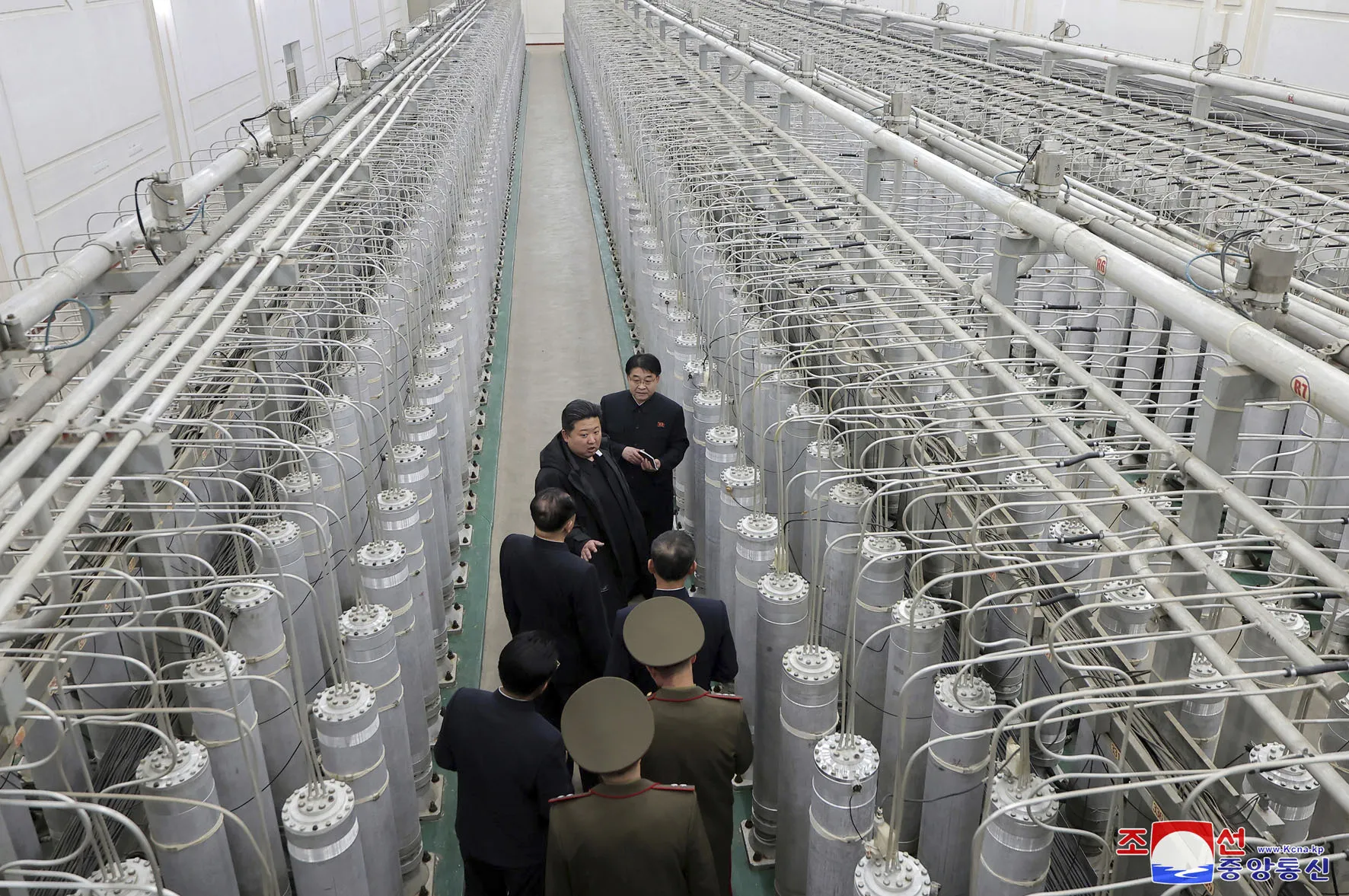
In this undated photograph provided by North Korean state media on Jan. 29, 2025, Kim Jong Un, second from top, inspects a facility that produces nuclear material at an undisclosed location in North Korea. Source: Korean Central News Agency/Korea News Service/AP
The importance of his nuclear arsenal as a deterrent against the US has only grown after strikes on Iran’s nuclear enrichment facilities last year and the US capture of Venezuelan leader Nicolas Maduro in January. The latest US-led attack on Iran that killed its supreme leader, Ayatollah Ali Khamenei, has only raised the importance of a deterrent for Pyongyang.
“Iran and Venezuela will strengthen Kim Jong Un’s conviction that his decision to build up and modernize nuclear arsenal was wise and farsighted,” said Chun Yungwoo, South Korea’s former chief nuclear negotiator with North Korea.
“He may believe that his regime is safe as long as he possesses enough nuclear and missile capability to inflict unacceptable level of harm to the US and its allies,” said Chun, who brokered a rare nuclear deal with Pyongyang nearly 20 years ago.
Kim has even begun to display key components of his nuclear infrastructure to the outside world. That has included images showing the interior of two plants to enrich uranium for weapons, allowing experts to see centrifuges and produce reasonable estimates of capacity.
One set of images was released days after Trump took office in 2025, when North Korea’s state media showed what experts believe was the interior of the enrichment plant at the Yongbyon complex. The plant’s closing in exchange for sanctions relief had been on the table during a Trump-Kim summit that collapsed after the president said North Korea was demanding too much.
Developments in Yongbyon Nuclear Site Escalate
Sources: Planet Labs; Google Earth; Institute for Science and International Security; Bloomberg News
Sanctions relief might not be attractive if North Korea’s strategic partnership with Russia remains intact, and the decision to release images was most likely aimed at enhancing the country’s “deterrence posture by showcasing its nuclear capabilities to the US and other countries,” said Ellen Kim, director of academic affairs at the Korea Economic Institute of America.
“Nuclear weapons are the biggest achievement of Kim Jong Un, and the Kim family,” she said. “They are the means by which the regime can maintain and justify its legitimacy.”
To be sure, Kim’s nuclear missiles have never been tested with live warheads, and it’s not clear they could survive the flight to North America, evade defenses, or handle the heat and extreme stress of re-entry.
The US is also working on its Golden Dome missile defense program, whose aim — laid out by executive order — is to defend the country against any aerial threat from the likes of North Korea, China and Russia. It’s unclear whether that’s possible without spending $1 trillion or more.
But North Korea’s rapidly expanding arsenal puts it in a stronger geopolitical position than at any other time in its history.
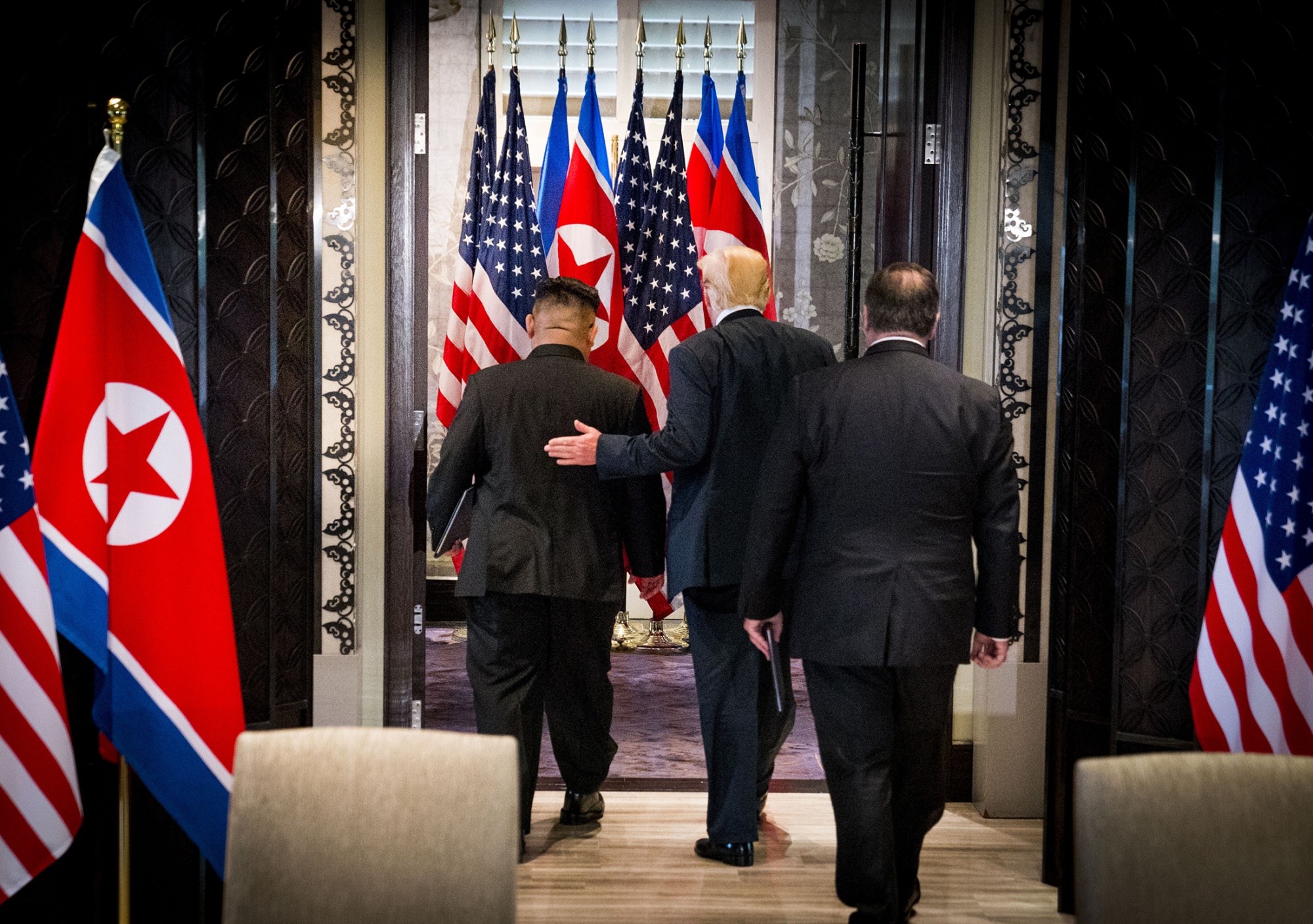
Donald Trump and Kim Jong Un in Singapore on June 12, 2018. Photographer: Doug Mills/The New York Times/Redux
US intelligence agencies have said for years that North Korea has a network of secret plants to enrich fissile material and build warheads, and there is public information about a few of them.
“It would be a mistake to think that the US and South Korea could just pick up where they left off with North Korea in 2019. The North Korea of today is very different than back then,” said Joel Wit, a former State Department envoy who has negotiated with North Korean officials.