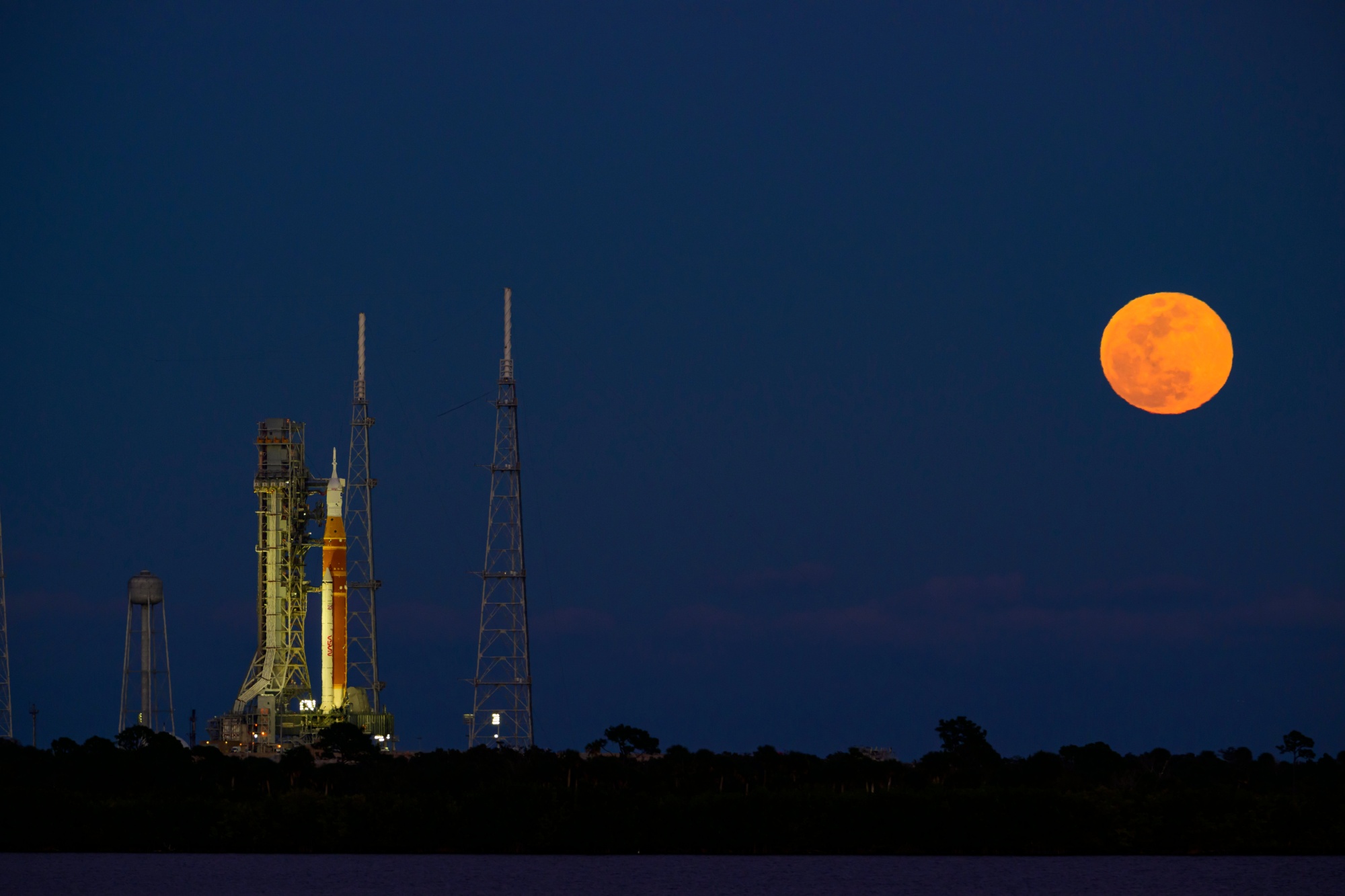
Around the Moon and Back
NASA’s Artemis II mission is sending astronauts on a lunar mission with big stakes in the program’s future plans
On April 1, NASA is set to send astronauts on a journey around the moon, part of a historic mission called Artemis II. The trip will mark humanity’s return to the lunar vicinity for the first time since the last Apollo mission sent astronauts to the moon in 1972.
The mission is a critical milestone in NASA’s ambitious Artemis campaign, aimed at landing humans on the moon once again. In Greek mythology, the goddess Artemis is the twin of Apollo – a nod to the predecessor program that put US astronauts on the lunar surface. This time, however, NASA hopes to establish a base there, where humans can live and work.
No astronauts will land on the moon during this mission, though. Instead, Artemis II is something of an elaborate dress rehearsal. The goal is to demonstrate that many of the major components of the Artemis program – the Boeing-built Space Launch System rocket and the Lockheed Martin-built Orion space capsule – can safely send a crew beyond the moon and back.
The Artemis II crew – NASA astronauts Reid Wiseman, Christina Koch and Victor Glover, as well as Canadian astronaut Jeremy Hansen – will board their Orion capsule perched atop the SLS rocket at NASA’s Kennedy Space Center in Florida. Their rocket is scheduled to take off at 6:24PM ET, sending them into orbit and starting what should be a 10-day mission that will slingshot them around the moon and bring them home to splash down under parachutes in the Pacific Ocean.
“Launch is certainly a huge part of the mission,” said Paul Konyha, a flight director for Artemis II at NASA’s Johnson Space Center in Houston. “Obviously, that keeps us up at night too. So that first day is going to be a doozy.”
Wiseman, Koch, Glover and Hansen will only come within 4,000 to 6,000 miles of the moon during their closest approach. Still, Artemis II will mark the closest humans have come to the moon in more than 50 years, and if the launch takes place on April 1st, the crew will also break the record for the farthest any humans have ever traveled into space.
During their journey, the crew will conduct tests, experiments and demonstrations – all aimed at practicing and learning more about what it will take to conduct regular missions to the moon in the future. Follow along on what to expect during their journey.