
How to Shred a Federal Agency
Republicans have been trying to dissolve the Department of Education since it was created. Under Trump, they’re closer than ever to getting it done.
In the early days of President Donald Trump’s second term, he made a blunt promise about the US Department of Education:
“We’re going to shut it down as quickly as possible.”
In a matter of months, 40% of the agency’s staff were gone. At the department’s hulking office building just south of the National Mall in Washington, hallways are quiet and rows of cubicles — once occupied by some of the more than 1,500 colleagues who’ve left since Trump took office — are vacant.
It’s part of a sweeping attempt by the Trump administration to reshape the federal government. Some agencies, including those that oversee consumer protection and disaster relief efforts, have been gutted. Others, like the Department of Homeland Security, are being beefed up.
But the Education Department is the only cabinet agency that has been singled out for complete elimination. The White House has set out to achieve that goal with massive layoffs and a major reorganization effort.

Though the changes sound bureaucratic, their impact is anything but: This is the department forged to unite the numerous federal programs born out of the civil rights movement and the war on poverty. It oversees school funding that supports millions of children in low-income families across the US, and is tasked with making sure discrimination complaints are heard quickly and resolved fairly.
Administration officials say they’re removing a layer of red tape, and that students will be better served by state and local governments. But staffers say schools are already struggling with the effects.
Some districts and organizations that receive federal support have been hesitant to raise issues or ask questions, worried the administration will use any pushback to justify cutting their grants, according to one current employee, who asked not to be identified for fear of retaliation.
And since Trump began his second term, the department has resolved just two racial harassment cases, federal data show; in 2024 that number was 25.
Nearly half a century after the department was established, seasoned staff say it’s a shell of its former self.
Senior officials say they’re just getting started.

Overseeing the dismantling of the department is Education Secretary Linda McMahon, the former chief executive officer of World Wrestling Entertainment, who served as head of the Small Business Administration during Trump’s first term.
She’s approaching the task with all the hallmarks of a corporate cost cutter: touting “streamlining” efforts, saying she’s eliminating “bureaucratic bloat” and referring to staff layoffs as a “reduction in force.”
“We’ve got a lean, mean machine,” McMahon said at a cabinet meeting in December. “It is only half the workforce of when we started, and we’re more efficient.”

Conservatives have been trying to abolish the Education Department since its creation, when Ronald Reagan’s campaign lambasted the Carter administration for federal overreach.
Generations of Republican lawmakers have followed his lead and called for dissolving or scaling the department back, but it has proved stubbornly resilient. Congress created the department by law, so only Congress can abolish it.
To circumvent that, McMahon is working within legal constraints to dismantle it from the inside, following a strategy laid out in the Heritage Foundation’s Project 2025: Eliminate programs deemed ineffective or duplicative, shift functions to other federal agencies and transfer control over billions in funding to state and district authorities.
The section on education was written by Lindsey Burke, now McMahon’s deputy chief of staff for policy and programs.
The second phase of that plan is a sweeping restructuring of the department’s operations, keeping its formal policy responsibilities while shedding work, money and staff to other agencies. So far, seven contracts — known as interagency partnerships — have been arranged, including transferring many of the workers at the Office of Career, Technical and Adult Education to the Department of Labor. Tens of billions of dollars in elementary and postsecondary grants have also moved.
In December, McMahon said these were pilot programs, designed as proof of concept for Republican holdouts in Congress who are nervous about eliminating the department completely.

Deputy Under Secretary James Bergeron said that larger chunks will be moved over the next few years.
In an interview, he called the Treasury Department a “natural, long-time partner,” for the Federal Student Aid office and its $1.7 trillion student-loan portfolio. The Department of Health & Human Services, he said, could take on grant programs for students with special needs, while the Department of Justice “will do a great job administering the office of civil rights.”
Bergeron, an education policy veteran and former staffer in the House of Representatives, said the administration has taken care not to outright cut anything that Congress continues to fund.
“No one is saying that these programs are going to go away,” Bergeron said. “It just doesn't have to just be under this department.”
Critics say reshuffling could affect how policy is applied.
Moving grants to the Labor Department, for example, might shift their focus from improving educational access and outcomes to workforce training and career readiness.
And relocating the Office for Civil Rights could threaten its status as an effective backstop against harm in the education system, said Catherine Lhamon, who led the OCR under former President Joe Biden.
“If you move or remove the office, that won’t happen,” she said.
Under Secretary of Education Nicholas Kent, McMahon’s right-hand man at the department, told Bloomberg in September that the funding and oversight programs they’ve deemed essential — like Title I funding for K-12 schools with a large proportion of low-income families, federal financial aid and college accreditation — would be preserved.
“We’ve begun breaking up the federal education bureaucracy and returning education control to parents and local communities,” Secretary McMahon wrote in an email to Bloomberg.

McMahon, 77, grew up in North Carolina, where she met her husband Vince in church. After college, she trained as a paralegal while supporting Vince’s business ventures, including financing a failed stunt by Evel Knievel. The couple filed for bankruptcy in 1976, but their fortunes changed when Vince started promoting wrestling events for his father’s company. He and Linda bought that business in 1982 and later renamed it World Wrestling Entertainment.
McMahon helped build the wrestling empire from the ground up, transforming a regional sports enterprise into a national entertainment phenomenon. She was CEO when the company went public in 1999, and oversaw the acquisition of rival World Championship Wrestling. McMahon remained a top executive until 2009, when she launched an unsuccessful bid for one of Connecticut’s seats in the US Senate.
Though she served on the board of Sacred Heart University for more than 15 years and the Connecticut State Board of Education for one year, McMahon has never taught or served in an administrative role at a school.
Madi Biedermann, McMahon’s acting chief of staff, said her boss’ business experience — particularly around dealmaking — informs her approach.
“I’ve heard the secretary say it does feel exactly like mergers, which she had a lot of experience with at WWE,” Biedermann said.
Margaret Spellings, who was Education Secretary during President George W. Bush’s second term, said goals like reducing waste and curbing federal overreach are admirable.
But McMahon's strategy, she said, seems likely to increase bureaucratic burden, with interagency partnerships potentially confusing grantees as to which agency they’re working with.
Federal Agency Shuffle
Offices within the Department of Education, by spending and relocation
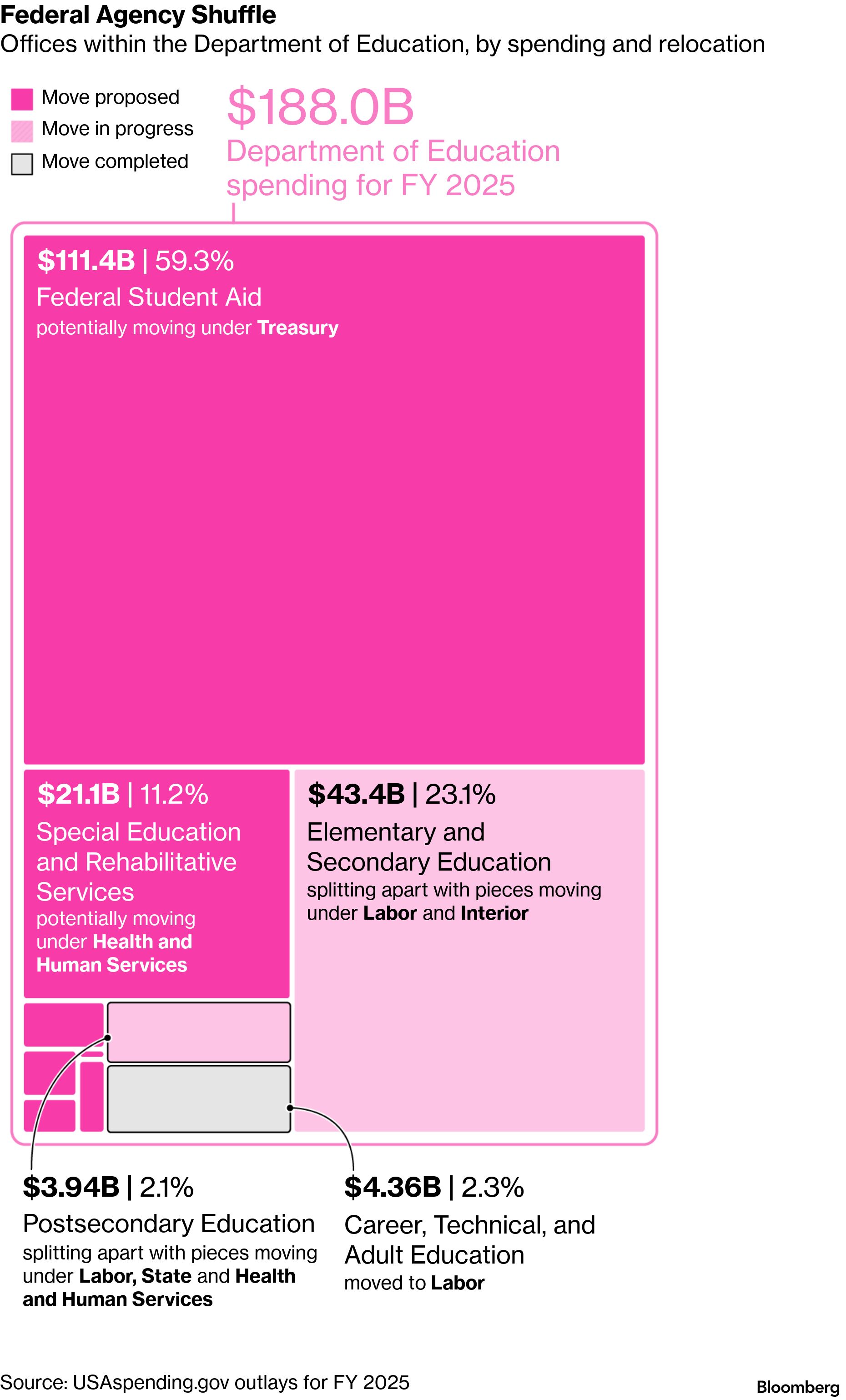
Some inefficiencies have spilled into public view.
Dozens of staffers had their layoff notices revoked after officials determined they were essential. Hundreds more were placed on administrative leave as their dismissal was debated in federal court, during which more than $28 million was spent on their salaries and benefits, according to a report from the US Government Accountability Office. More than 260 of them were told by the department to return to work in December.
One of those employees is Elizabeth Morrow, a deputy director at the Office for Civil Rights. While she was on leave, she heard from her colleagues still going into the DC office that they were in a kind of limbo: saddled with responsibilities spilling in from shuttered offices but with little direction or capacity to fulfill them.
“People at headquarters were just occupying space,” she said.
In the meantime, attrition across the department has been high compared to recent years, said Dorie Nolt, a spokesperson for the federal employees’ union. According to federal data, almost 500 employees quit between January and December of last year.
Barbara Hoblitzell, one of the department’s Capitol Hill liaisons, resigned in April. Before she left, she was fielding questions from legislators in both parties about how the department would function with a sparse workforce and resources. She said she had no answers for them.
Rachel Gittleman, the president of the federal education employees union, said that before the layoffs the average staffer at the Office of Postsecondary Education managed from 50 to 80 grants; now they typically manage more than 200.
“People are being asked to do jobs that they’re either not trained to do or don’t have the bandwidth for,” said Gittleman, a former analyst in the ombudsman office at Federal Student Aid who was laid off last March.
Speaking generally about grant programs, Biedermann said that while offices are in flux, the department is still awarding federal support through the same channels and recipients are receiving funding.
Gittleman said that managers and political appointees have put “immense pressure” on staff to show their productivity. Many have been ordered to sign non-disclosure agreements, she said, most dealing with plans to transfer offices out of the department.
Widespread Cuts, Gains at the Top
Percent change in staff by major agency division, January to December 2025

More layoffs seem inevitable.
The administration announced the October reduction in force during the 43-day government shutdown. A federal judge temporarily blocked the layoffs. Then, as part of a deal to reopen the government, lawmakers included a provision barring federal job cuts until Jan. 30, 2026.
But McMahon has said the shutdown, during which 87% of the department’s staff were furloughed, proved the agency was nonessential.
Meanwhile, the Education Department is still spending around $200 billion a year in federal funds, not counting the student loan portfolio. And despite Trump’s plans to slash education spending, Congress increased the department’s budget last month, and approved funding for initiatives the administration has moved to eliminate.
And with the passage of the One Big Beautiful Bill Act last year, the agency’s workload is growing. It must manage a new federal student aid program for short-term career training, enforce a test that can penalize colleges based on graduate earnings and implement limits on graduate school loans, among other policy changes.
Trump Shrank The Entire Federal Workforce Last Year
Change in staffing by cabinet-level department January to December 2025

Bergeron said many of those new responsibilities can be farmed out to third-party contractors, and that much of the work that department staff once oversaw, especially at FSA, already involves vendors.
The department cancelled about 100 vendor contracts worth more than $1.2 billion early last year, and cut rates with other providers.
Kent said he doesn’t think Congress meant for the education department to grow in size and influence to where it is today. Once the agency is gutted, he expects lawmakers will finish the work the Trump administration started — however long it takes to convince them.
“I have committed, like the secretary, to shut off the lights whenever we leave.”