Inflation Is Down, But Americans Still Feel an Affordability Squeeze
The great inflation shock of the 2020s, which helped bring President Donald Trump back to power, is in the rearview mirror now. But the hangover is all around.
Shoppers have been forced to get used to a new normal they plainly resent. While inflation has slowed overall, the costs of things Americans often want or need most continue to rise — like groceries, utilities and housing. For those forced to borrow to cover their bills, it’s becoming a struggle: delinquency rates just climbed to the highest in almost a decade.
All of this has put the question of “affordability” at the center of November’s congressional elections. Living standards are always a key battleground, and there’s been some encouraging data lately. Last month saw inflation come in below forecasts – though it’s still high enough to keep the Federal Reserve worried – while jobs beat them. But in the US economy nowadays, even good news can’t always dispel the bad vibes.
There’s a psychological dimension behind that – the threat of tariff-led price hikes can be a worry even when they don’t materialize — but it’s borne out in the math too. Wages are rising more than prices on average, but they haven’t always kept up, especially for essentials. As consumers dole out $126 for what cost them $100 before the pandemic, many are left with the sense they’re treading water at best, instead of getting ahead like the American Dream says they should be.
“I just feel like it’s penny-pinching as much as you can,” said Justin Kevin Rodriguez, 25, who is helping his parents and grandmother in North Plainfield, New Jersey keep up with rising household expenses. “I think about what life used to be like: we could go on vacations, we could afford to eat out without worrying about living paycheck to paycheck.”

Justin Kevin Rodriguez at his home in North Plainfield, New Jersey. Photographer: Gabby Jones/Bloomberg
Democrats are seizing on such concerns ahead of the midterms, just 15 months after the same issue helped push them out of the White House. Trump, who promised to bring prices back down, has rolled out election-year plans to alleviate costs as his Republicans ready for a fight over affordability.
Here’s why consumers are feeling so squeezed:
 Click Tap on a section for more info
Groceries
Nothing is more literally a kitchen table issue than the cost of groceries.
Prices are up about 30% since January 2020, about in line with average wage growth. But Americans had gotten used to paying roughly the same at the supermarket each week in the pre-pandemic years. Lately, they’ve been forced to stomach a bigger bill with almost every visit.
What’s more, shoppers keep getting hammered on some of their favorite foods. Last year egg prices surged. As they were coming back down, coffee and beef were on the rise.
Grocery Prices Haven’t Come Down Since Peak Inflation
Source: Bureau of Labor Statistics
“By the time you pay for groceries, that’s your whole work week of pay gone,” said Nick Marsh, 40, a manager at a downtown Atlanta restaurant.
His customers may be feeling the squeeze even more — because restaurant prices have climbed faster. They’re up 35% — and that’s before tip.
As his party gears up for midterms, Trump has dialed back tariffs on some staples that had gotten expensive, like beef from Argentina and coffee from Brazil.
White House spokesman Kush Desai credited Trump’s policies for cooling inflation, accelerating GDP growth and lowering the prices of prescription drugs and gasoline. “Americans can rest assured that, as these policies continue taking effect, the best is yet to come,” Desai said in a statement.
But Trump’s trade-war rollercoaster has “kept affordability issues top of mind” for voters, according to Neale Mahoney, a Stanford University professor who’s studied the afterlife of inflation shocks. “We had a presidential election which was about high prices,” he says. Then came “a year of news cycles around tariffs.”
Housing
A double-punch has pushed homeownership out of reach for many Americans: First the pandemic-era surge in prices, and then a steep run-up in mortgage rates.
A young married couple now needs 70% of their annual household income to afford the average downpayment, according to Goldman Sachs Group Inc. economist Elsie Peng, up from 58% in 2019 and 45% in 2000.
And even for those who can scrape that together, monthly bills have skyrocketed. The average principal and interest payment has doubled since early 2020, according to the National Association of Realtors.
Cost of Mortgages Has Nearly Doubled
Sources: Zillow, National Association of Realtors
Homeownership has been at the core of Trump’s affordability pitch. He’s badgered the Federal Reserve to cut interest rates faster, ordered Fannie Mae and Freddie Mac to buy mortgage-backed securities, and pushed for limits on institutional investors in the housing market.
Taylor Baker, a 33-year-old project manager at a tech company, got a good deal in 2019 on a starter home outside Salt Lake City. But now, with three children and a fourth on the way, he’s finding the search for a larger one “depressing and frustrating,” and says he’s looking at paying two or three times as much per month.
It’s not just owners who feel the housing pinch. Nationwide, rents are up 36% since January 2020, according to Zillow Group Inc., though some cities have started to see prices come down.
Everyday Expenses
As housing has gotten more expensive, so has everything that comes along with it.
In the past year, natural gas prices have risen more than twice as much as wages. Electricity bills have also run well ahead of overall inflation, especially as power-hungry data centers come online — allowing Democrats to pin the blame on Trump’s artificial intelligence drive.
Home-Related Costs Have Boomed
Source: Bureau of Labor Statistics
Note: Home insurance data is not seasonally adjusted because the Bureau of Labor Statistics only provides unadjusted figures.
Mary Dres, a respiratory therapist in Portage, Indiana, said she’s tried everything to lower her utility bills. She set the heat to 66 degrees, avoided using the dishwasher and television, and kept most of her Christmas lights in storage. She’s even getting used to sitting in the dark. Even so, in December she found herself paying $162.24 for electricity and $76.93 for gas — almost twice as much as a year earlier.
“There’s nothing else I can do,” Dres, 67, said. “I’m terrified to see my next bill.”
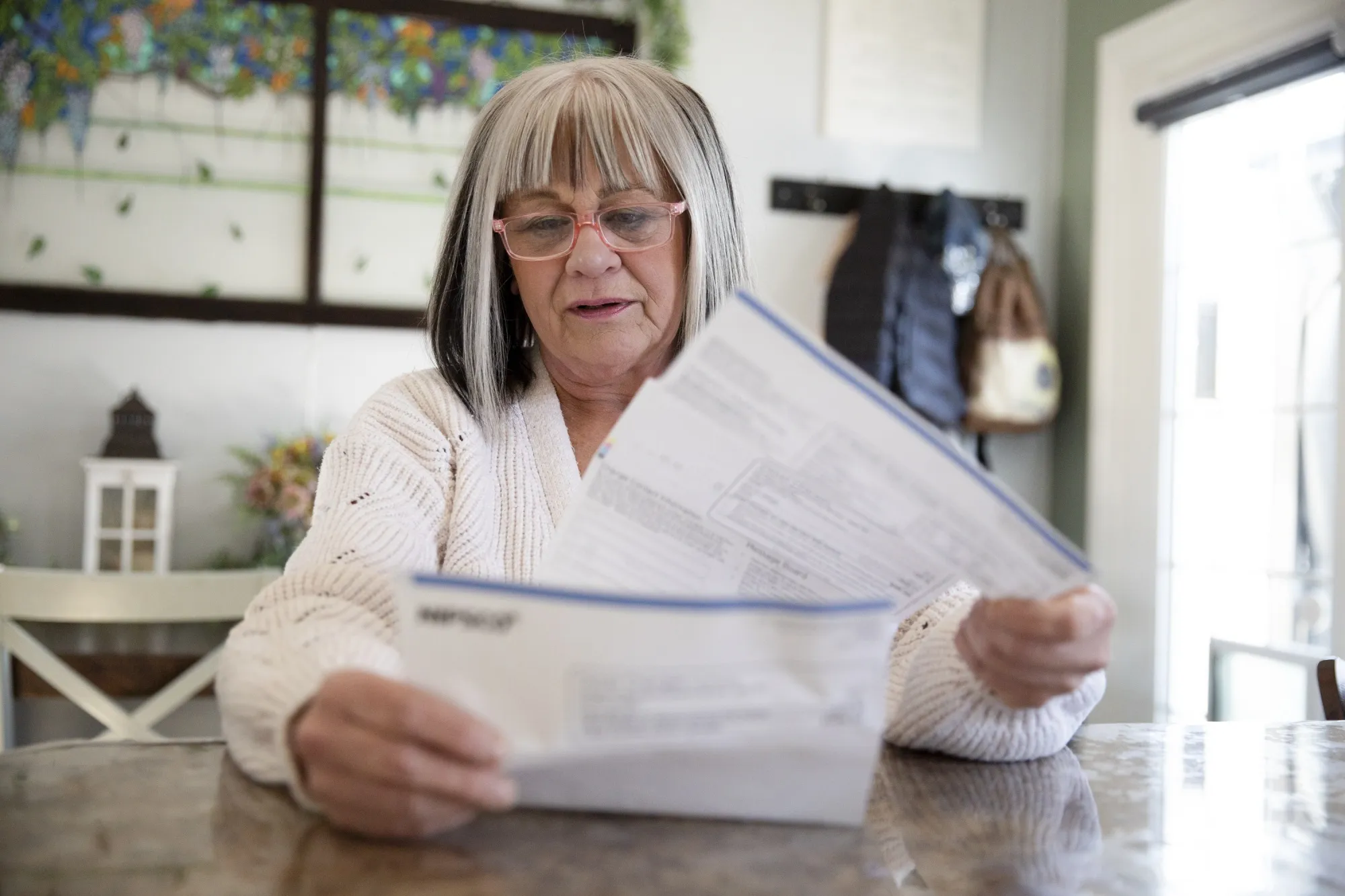
Mary Dres looks at her electricity bills in her home in Portage, Indiana. Photographer: Kayana Szymczak/Bloomberg
Cars have been one of the big pain points for Americans. Prices for both new and used autos soared after the pandemic. More recently, there’s been a spike in the cost of insuring vehicles — and maintaining them. Repair bills have climbed 63% since January 2020. At least some respite arrived late last year in the form of cheaper gasoline.
Most cars are bought with credit that’s gotten pricier and harder to pay back. The share of sub-prime borrowers at least 60 days late on their auto loans hit a new record last month, according to Fitch Ratings. The last couple of years have seen the most repossessions since the financial crisis, according to Cox Automotive Inc.
After Earlier Peaks, Gas Prices Remain Subdued
Source: AAA, Bureau of Labor Statistics
Note: Gasoline prices are reported on a daily basis and shown here through January 31, 2026.
College fees have also continued to climb and student loan delinquencies are rising at a record pace. For families with younger kids, daycare costs have surged 39% since 2019, according to Care.com. Seven in 10 Americans in a 2025 poll said raising a child is unaffordable, up from 58% a year earlier.
Read More: The US May See Its First Decline in Population in 2026
To be sure, not everything has spiked. The cost of an Internet connection is only up by 11% since early 2020, while for clothing the figure is around 8%.
Still, with price hikes coming in waves, it takes more time and effort to chase inflation-beating deals from store to store and keep household finances on track. That’s a key dimension of the affordability problem that doesn’t show up in the data, says Mike Konczal at the Economic Security Project.
“It’s yet another burden for families to try to deal with,” he said.
Medical
Two-thirds of Americans worry about affording health care, according to the policy group KFF.
Employee premiums for family health insurance have risen 23% in the past five years to almost $6,900 on average, according to KFF. And more than 20 million people who rely on Affordable Care Act plans face a hike in their premiums after Congress let Covid-era subsidies expire.
Large ACA Premium Hikes This Year
Source: KFF
Note: Employer figures are not yet available for 2026.
Manuel Lubinus, 61, and his wife Florence, 62, are digging into their savings to help cover rising insurance costs. The former research scientist had to retire in 2019 due to a neurodegenerative disease, and when his wife lost her job and benefits last year, the couple switched to an ACA plan.
He’s now on Medicare. Between their two monthly premiums, the suburban Dallas couple is just trying to keep afloat while Florence looks for another job with benefits. “We just have to manage week by week and see what happens,” Lubinus said. “I don’t see another alternative.”

Manuel Lubinus at home with one of his caretakers, his daughter Ariadna, in Frisco, Texas. Photographer: Emil T. Lippe/Bloomberg
There’s already a heated election debate about healthcare, with Democrats bashing the GOP for cutting help to the poorest, while Republicans tout Trump’s efforts to lower drug prices.
Wages
For most people, whether they can afford something depends not just on what it costs, but what they earn — which is why wages are key to the affordability question.
The average American’s weekly pay has risen 31% over the past six years. That’s faster than prices across that period, so Americans in the aggregate aren’t losing ground — but inflation wiped out most of their income gains. For low earners, who saw the fastest wage growth after the pandemic, the last year or so has been tougher and they’re now lagging behind.
Inflation Has Steadily Eaten Away at Wage Gains
Source: Bureau of Labor Statistics
Trump says Republicans can gain votes by touting his One Big Beautiful Bill Act, which is set to boost tax refunds this year. But the Tax Foundation estimates that higher tariffs erase between 70% and 95% of those gains for middle-income households, while lower-income filers will be worse off.
What’s more, Harvard University economist Stefanie Stantcheva, who’s studied the psychological hit from inflation, found that most people don't think wages keep up. They also tend to see raises as a reward for doing a good job — rather than a cost-of-living adjustment.