Vietnam Is Running Out of Sand to Fuel an Economic Boom
A new crop of factories requires roads, and that means sand. To keep up, the country is importing from Cambodia on a massive scale.
When President Donald Trump launched his first trade war with Beijing in 2018, driving up the cost of goods from China, companies raced to relocate factories making everything from computer chips to crop tops south of the border in Vietnam. The Southeast Asian country’s economy has boomed as a result, with growth in gross domestic product accelerating to 7% in 2024, the fastest in the region. But the surging volume of incoming parts and outbound finished products has also left Vietnam’s transport system under strain.
To alleviate the logistics bottleneck, the Vietnamese government is embarking on one of the largest infrastructure drives in its history, spending billions of dollars to expand national highways and add congestion-reducing alternative routes across the southernmost part of the country. These ambitious projects hinge on one key commodity: Cambodian sand.
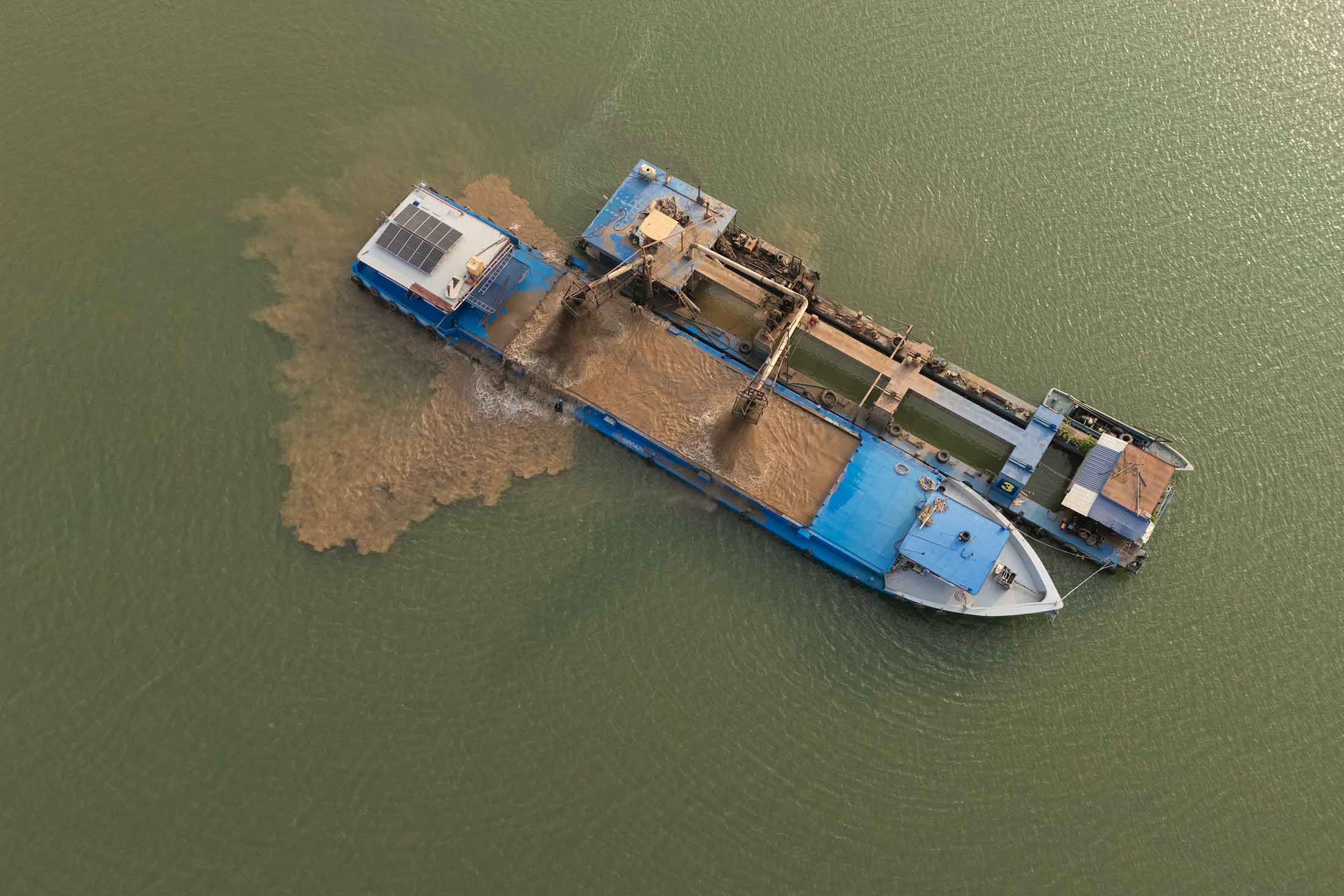
A dredger pumps sand from the bottom of the Mekong River near the Cambodia–Vietnam border. Photograph by Thomas Cristofoletti for Bloomberg Businessweek
Vietnam aims to complete more than 1,000 kilometers (621 miles) of highways in 2025 — assuming Trump’s latest trade war doesn’t derail things. But it’s running low on its own supply of sand, dredged from rivers then used to flatten and stabilize the ground before pavement is poured. Sand mining in Vietnam has been under stricter public scrutiny after multiple riverbank collapses destroyed homes and angered residents.
“It’s difficult to expand sand mining activities to supply highway projects because the government regulates the industry more seriously,” says Hung Nguyen, a researcher at Hanoi’s RMIT University specializing in infrastructure development.
To get the sand that’s crucial for faster economic growth, Vietnam last year approached Cambodian miners to see about importing the raw material on an industrial scale. The plan was quickly put in motion, kicking off a booming Mekong River sand trade.
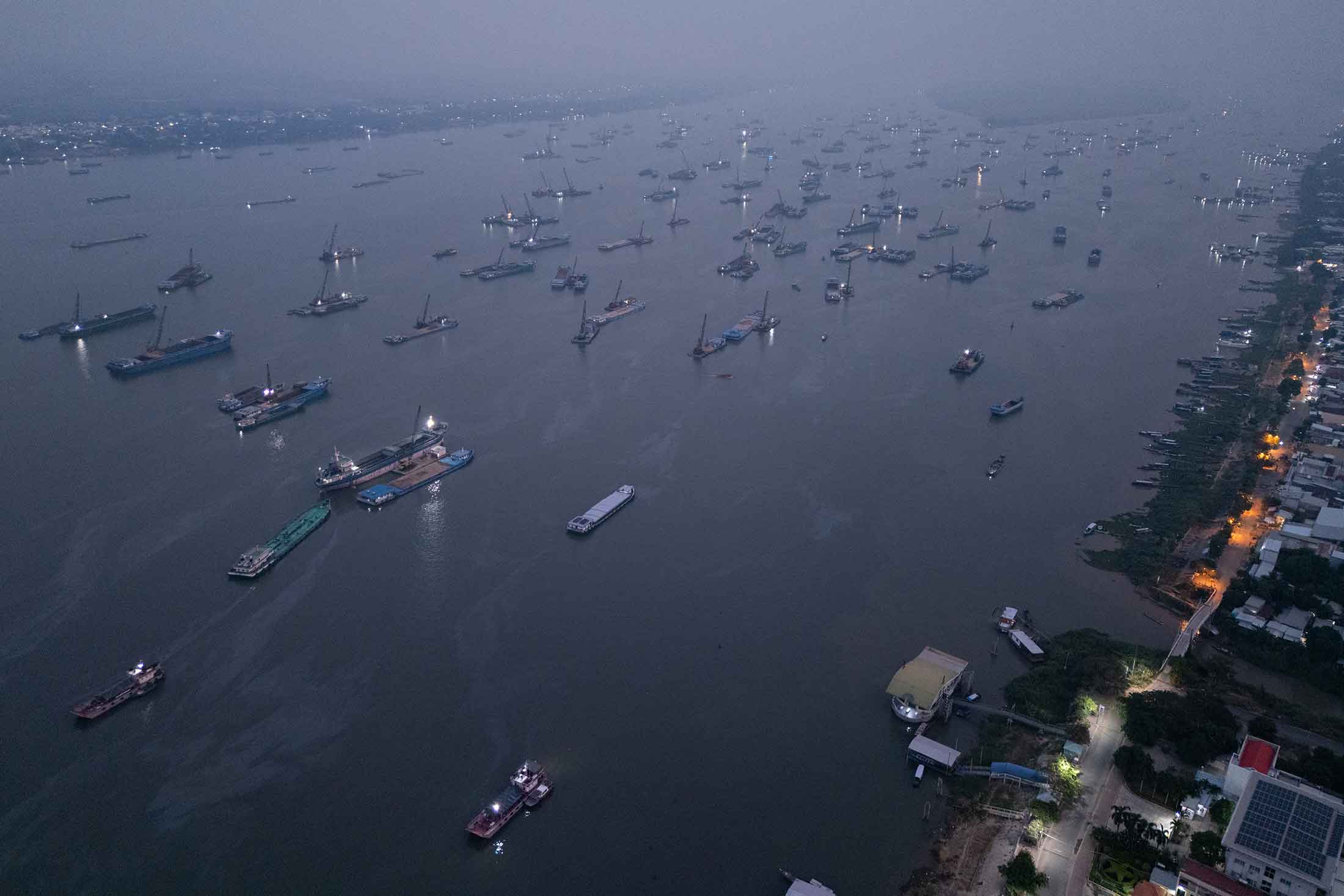
Hundreds of sand barges are anchored along the stretch of river that separates Cambodia from Vietnam. Photograph by Thomas Cristofoletti for Bloomberg Businessweek
Vinh Xuong, a quiet river town on the Vietnamese side of the border, has been swarmed by hundreds of sand barges daily ranging in length from 18 meters to 80 meters—or about the length of three pro basketball courts. Imports of Cambodian sand grew about threefold in 2023, then more than doubled in 2024.
Cambodia Sand Exports to Vietnam
Source: Trade Data Monitor
A Bloomberg analysis of satellite images from Planet Labs PBC and Maxar Technologies Inc. shows just how roaring the activity has become in a short amount of time. Roughly 385 barges and dredgers were seen carrying sand on the Mekong River near Vinh Xuong on March 9, an increase from about 83 such vessels on Feb. 6, 2020. Sand on these barges is unloaded on the riverbank, loaded on trucks and then transported to construction sites in southern Vietnam.
Satellite images show the worsening congestion
Sources: Google/Maxar Technologies (2020 image), Planet Labs (2025 image)
Note: The calculation of sand ships includes dredgers, transportation barges and storage platforms on the river.
“Compared with other sand mining spots, traffic here is overly concentrated at the border, and the transfer boats outnumber the typical dredgers by a higher ratio,” says Edward Park, associate professor at Nanyang Technological University in Singapore, who has surveyed the Vietnamese Mekong Delta on multiple occasions for his sand mining research.
Each barge of newly dredged sand increases the risk of building collapse in Cambodia. A study led by Christopher Hackney, a researcher of river geography in Southeast Asia who helped Bloomberg identify the sand barges in the satellite images, shows lowering the river bed by as little as two meters can cause riverbank collapse; dredging pits in Cambodia often exceed eight metres in depth. “No matter where you mine the river, the lost sediment causes bank collapse and lost homes,” says Hackney.
But importers see opportunity instead of danger. “It’s all about money,” he says. “If it pays, they’ll bring the sand to Vietnam.”
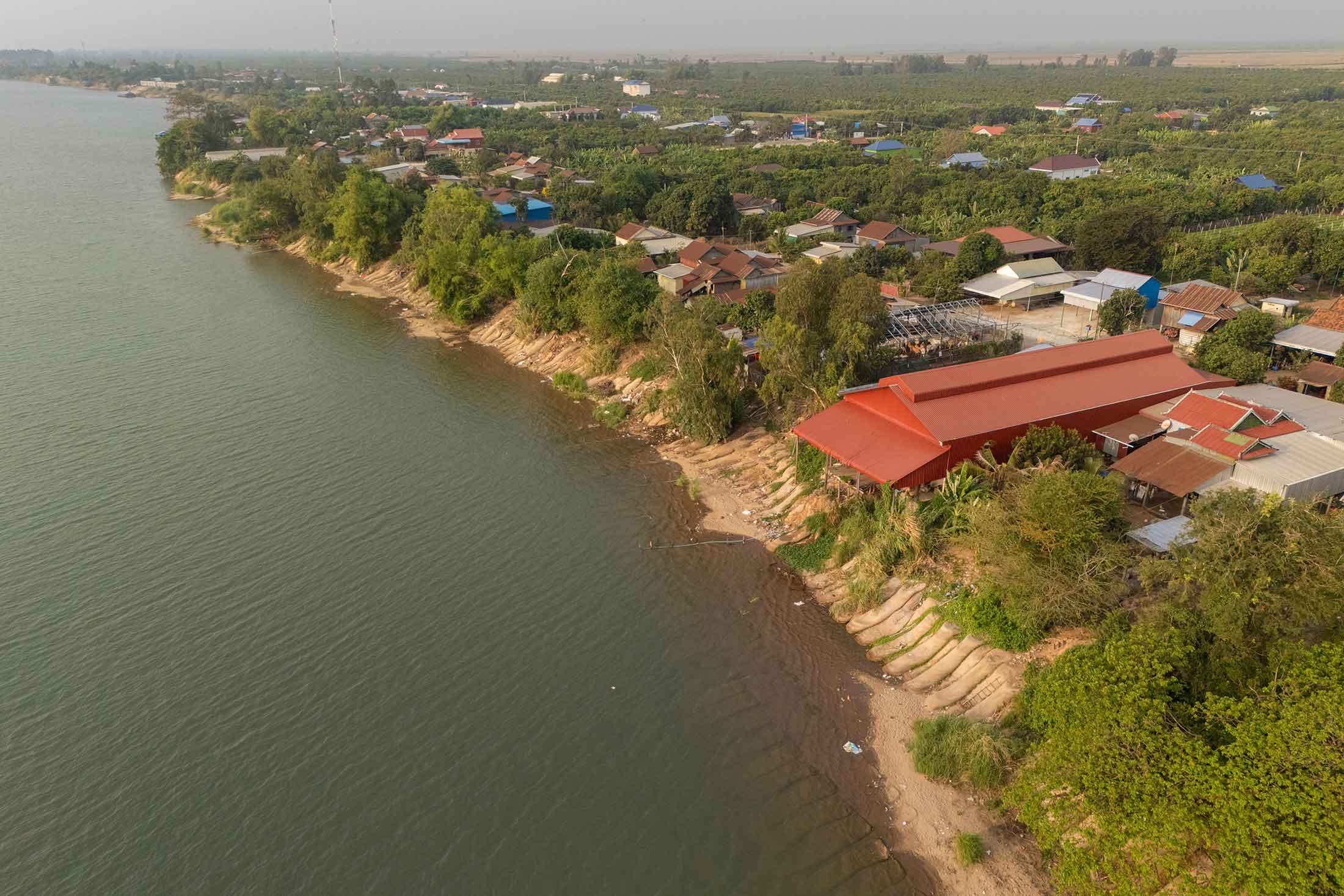
Leuk Daek village in Cambodia, where large sandbags were placed along the riverbank to prevent erosion near an active dredging site. Photograph by Thomas Cristofoletti for Bloomberg Businessweek