GPS Interference Snarls Venezuela as US Warns of Hazardous Skies
An invisible wall of electromagnetic noise has descended over the Caribbean, forcing commercial flights to divert and cancel routes over Venezuela since late last week. For a smartphone user on the ground in Caracas, this interference might just mean a slow map load or a jumping blue dot. For an aircraft cruising at 30,000 feet, the implications are far more severe.
The disruptions are increasing amid a US military buildup in the Caribbean that’s included attacks on alleged drug-running boats, killing more than 80 people. The arrival this month of the world’s largest aircraft carrier deepened uncertainty about US President Donald Trump’s ultimate goal. And the threat of potential land strikes has prompted socialist leader Nicolás Maduro to put Venezuela’s military on high alert.
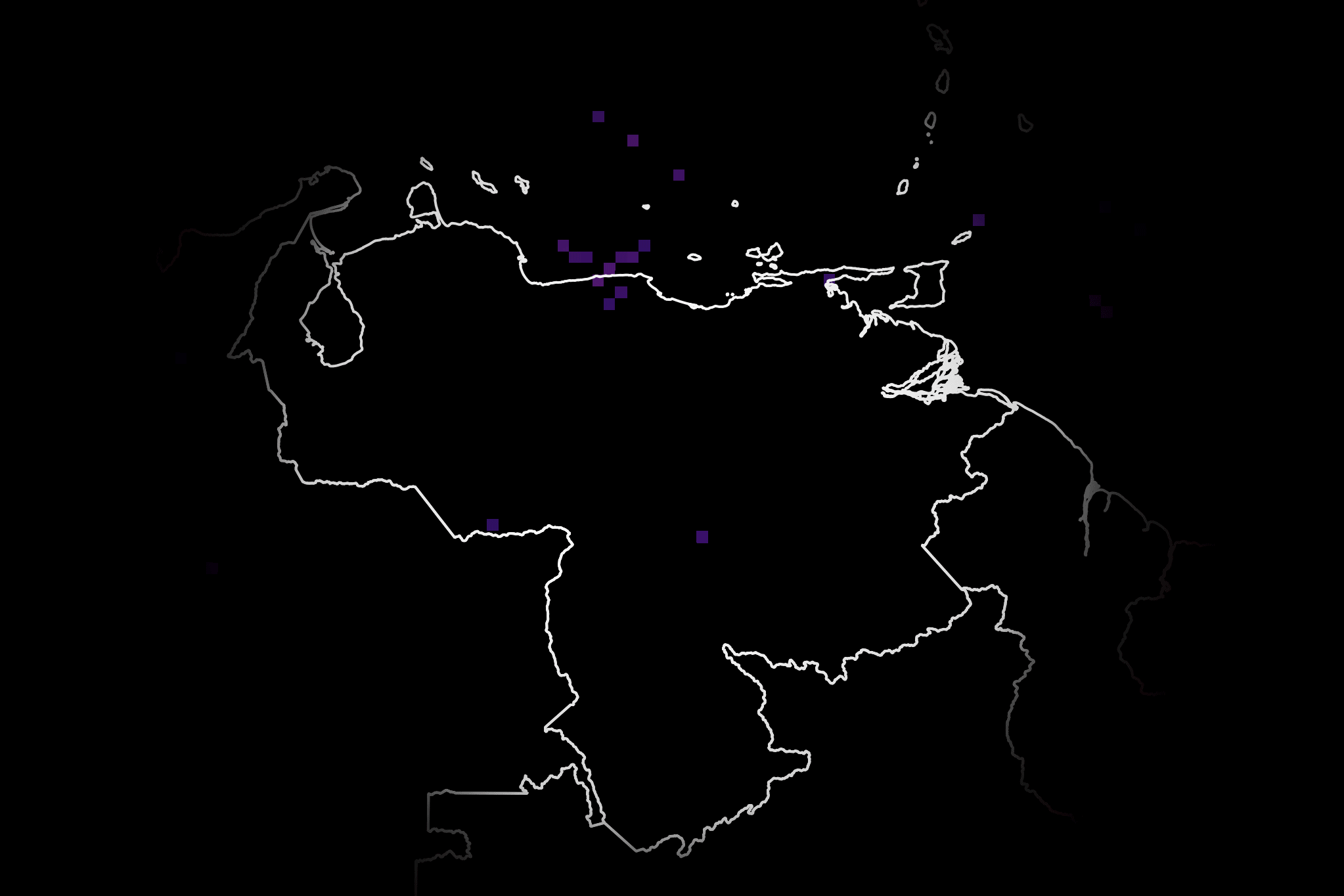
As a result, the skies over the country have become more and more of a no-go zone for commercial aircraft. The US Federal Aviation Administration issued a critical warning to pilots on Nov. 20, citing “heightened interference.” But data analyzed by Bloomberg show the electronic disruption began surging weeks earlier, coinciding with Trump’s naval buildup. The interference has rendered the airspace effectively impassable to standard satellite navigation that countless systems rely upon.
GPS Jamming Surges to Levels Disrupting Flights
Sources: Bloomberg News analysis and reporting, Clara Chew, NASA CYGNSS
Note: Data as of Nov. 17. Data is aggregated to weeks because satellites don’t make enough passes per day to see the entire airspace.
Most navigation relies on the Global Navigation Satellite System (GNSS), colloquially known as the global positioning system. This overarching term covers American GPS, Europe’s Galileo and Russia’s GLONASS — the invisible tethers that guide everything from modern airliners to the smartphone in your pocket.
The scope of the disruption is visible from space. Data from NASA’s CYGNSS constellation, which measures the reflections of GNSS signals that bounce off Earth’s surface, capture the pattern of jamming over the past few months compared to the same period in 2024.
Since the FAA’s warning, international carriers including Colombia’s Avianca, Spain’s Iberia and Brazil’s Gol have suspended flights into Venezuela. But local airlines, which are under tighter government control, have kept flying while the domestic civil aviation authority pressures foreign companies to restore service or risk losing landing rights.
According to FlightAware’s live map, commercial aircraft have been mostly avoiding the area above Venezuela since Friday.
“High levels of GPS interference are often associated with military conflict zones,” said Dana Goward, president of the Resilient Navigation and Timing Foundation, a nonprofit group that advocates for protection of critical infrastructure by promoting the security of GPS signals.
Reports of jamming have proliferated in eastern Europe since Russia’s invasion of Ukraine in 2022. Planes carrying top officials have faced navigational outages, including the UK defense chief last year and the European Commission president at the end of August.
Read more: What Is the GPS Jamming That Disrupted EU Commission President’s Flight?
The impact in the skies above Venezuela’s coast right now is quantifiable. Data from Spire Global show a sharp uptick in aircraft reporting “degraded” navigation integrity in a protocol known as ADS-B. This system is the modern standard for air traffic surveillance, automatically broadcasting a satellite-derived position to ground controllers and other pilots to ensure safe distance between aircraft.
The data indicate that prior to the FAA’s warning, more than 10% of all air traffic in the sector were flying with compromised navigation systems.
Most commercial aviation receivers still rely on the decades old L1 GPS signal that’s relatively weak and notoriously easy to jam. While newer L5 signals are stronger and designed with aviation safety in mind, the vast majority of the global fleet has yet to be upgraded.
“Aviation receivers are often 20 years old,” said Todd Humphreys, a professor at the University of Texas at Austin’s radionavigation laboratory. “L5 would be a big help here given the wider band frequency.” The older signal leaves flights more exposed to noise, both accidental and intentional, he added.
Flights Off Venezuela Faced Low-Level Jamming for Weeks
- Degraded flight pings since Sept. 1
- Pings on Nov. 20
Sources: Bloomberg News analysis, SkAI Data Services, OpenSky
In addition to disrupting air traffic, GPS interference can affect satellites in low Earth orbit. That includes networks like Starlink and OneWeb, along with a half dozen other constellations, which orbit at approximately 340 miles above the surface. For now, SpaceX and others are “weathering the storm,” Humphreys said.
While it’s impossible to identify the source of jamming, experts tie it to military action. Since the beginning of September, the Trump administration has been destroying small vessels in the Caribbean it says are carrying illicit narcotics to the US. And in mid-November, the USS Gerald R. Ford carrier strike group arrived in the region, a deployment visible in the interference patterns offshore near Trinidad and Tobago.
Modern naval fleets often employ GPS jamming as a protective dome. And both the US and Venezuelan militaries have reasons to disrupt communications in this way.
“A carrier strike group is susceptible to attacks from large swarms of drones,” Humphreys said.
Similarly, the Venezuelan military has a long history of viewing GNSS interference as a necessary shield. After a drone assassination attempt on Maduro in 2018, the country ramped up its electronic warfare capabilities, reportedly with the assistance from Russian advisors who have long employed similar spoofing tactics to protect the Kremlin in Moscow.
“Historically, there is a high correlation between this level of noise and military activity,” said Margaux Garcia, a senior analyst at C4ADS, a Washington-based nonprofit that focuses on security.
Meanwhile, everyone from airline executives to everyday Venezuelans, as well as Maduro and his lieutenants, remain watchful for Trump’s next move. With signals in the region being regularly jammed, activities as simple as reliable air travel and potentially the ability to get online, are becoming increasingly precarious.