Texas Redistricting Case Could Reshape House Balance After 2026 Midterms
Federal judges in Texas this week will weigh whether the state’s newly drawn congressional map unlawfully dilutes the voting power of racial minorities, bringing to a head a redistricting battle that could decide which party controls the US House after next year’s midterm elections.
A three-judge panel in El Paso is expected to hear arguments beginning Wednesday over the legality of new districts created by state lawmakers at the urging of President Donald Trump. The unusual mid-decade changes could give Republicans as many as five new House seats.
After Texas’s Republican-controlled legislature passed its redistricting bill in August, Black and Hispanic groups sued to block the new map and prevent it from being adopted in time for the 2026 midterms, calling the changes “egregiously unconstitutional.” Republicans say race played no role in how the map was drawn.
“I am in full support of the new, lawful map passed by the Texas Legislature and will continue to do everything in my power to defend it against baseless challenges from the radical Left,” Texas Attorney General Ken Paxton said in a statement. “My number one priority is ensuring that this new map, which was drawn on a purely partisan basis, is in effect for the 2026 midterms and that Texas delivers five new Republican seats in Congress to help advance President Trump’s America First agenda.”
Texas Lawmakers Drew New Congressional Districts For Dallas-Fort Worth
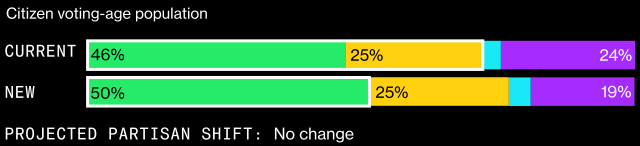
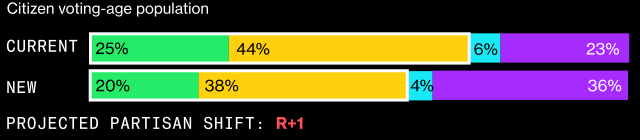
The Voting Rights Act of 1965 says states can’t attempt to adulterate the electoral power of voters of color. US courts have generally upheld redistricting drawn along party lines, while rejecting maps designed on the basis of race.
The legal drama has left candidates in limbo, with many not certain whether their districts will still exist weeks before they must formally declare their intention to run. The fight has also created confusion for voters and community groups who count on their ties with lawmakers to secure government funding.
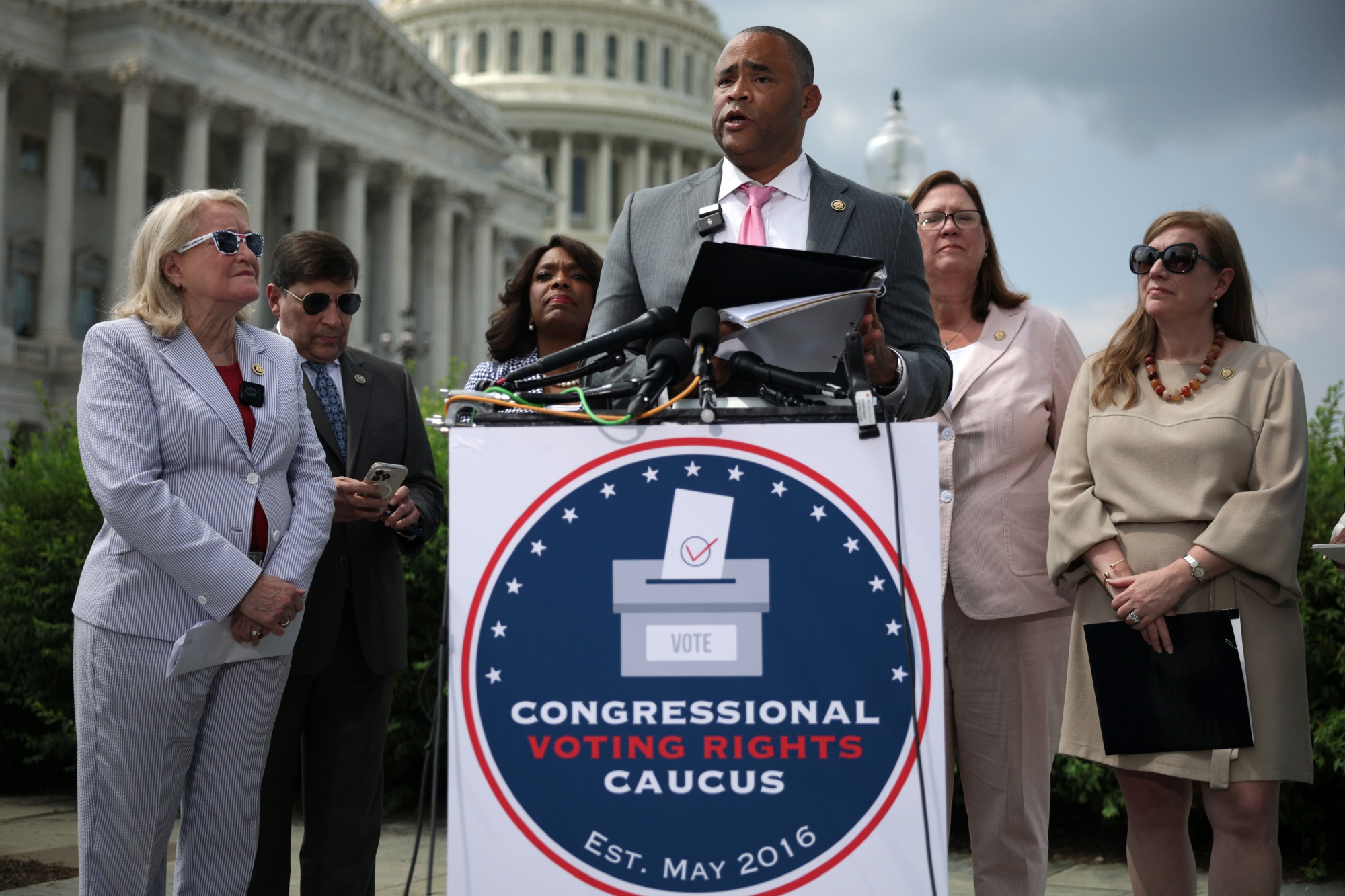
Marc Veasey, a Black Democrat, has represented part of Fort Worth, the state’s fourth-largest city, since 2013. Veasey’s district would be split into three districts to include voters from mostly White, rural areas. He and other critics say that would disenfranchise the current district’s minority voters.
“It basically takes those Black and brown communities and splits them up amongst Republican districts,” Veasey said in an interview. “The problem with that is that it undermines the constituents that I represent, the Black and brown voters.”
Reshaping districts could have repercussions for more than the partisan makeup of Congress.
The Center for Transforming Lives is a nonprofit in southeast Fort Worth focused on helping single mothers and their children escape poverty. Outside its peaceful 14-acre campus lies one of the most impoverished ZIP codes in the city. Some 24% of the area’s residents live below the poverty line, more than double the rate across Dallas-Fort Worth.

Carol Klocek is CEO of a Fort Worth nonprofit that counts on federal funding. Photographer: Desiree Rios/Bloomberg
The center, which offers child-care services and helps women find homes or build businesses, depends on federal resources. As much as 70% of its funding comes from government contracts and grants, according to Chief Executive Officer Carol Klocek. She said Veasey was instrumental in helping the center win funding for its campus from the Department of Housing and Urban Development.
“Especially in this time where the political winds are shifting and blowing, we want people to know that we want money returning to Texas from Washington,” Klocek said.
Currently, nine of Texas’s 38 districts are coalition districts. The new map sheds considerable territory from five of them, creating two White-majority districts, two with Black majorities in Houston and Dallas and one with a Hispanic majority in San Antonio. In three of the five districts Republicans hope to flip, the number of Hispanic voters was increased.
Domingo Garcia, the former head of the League of United Latin American Citizens, one of the groups suing to block the revised map, said Texas Republicans used race to draw the new districts. Garcia said the GOP looked at turnout rates among Hispanic voters to pack those who are more likely to vote into the same district, and leave those who vote less often in more Republican-leaning districts.
Republicans reject those claims. Adam Kincaid, the executive director of the National Republican Redistricting Trust, said the districts were drawn without race or ethnicity data, and that data from half a dozen elections was taken into account.
Propensity among Hispanic voters “was not a consideration in the creation of the map,” Kincaid said.
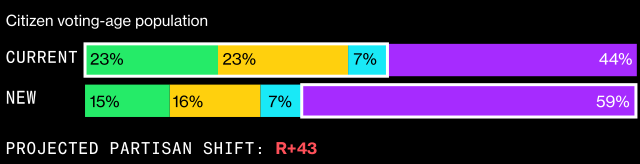
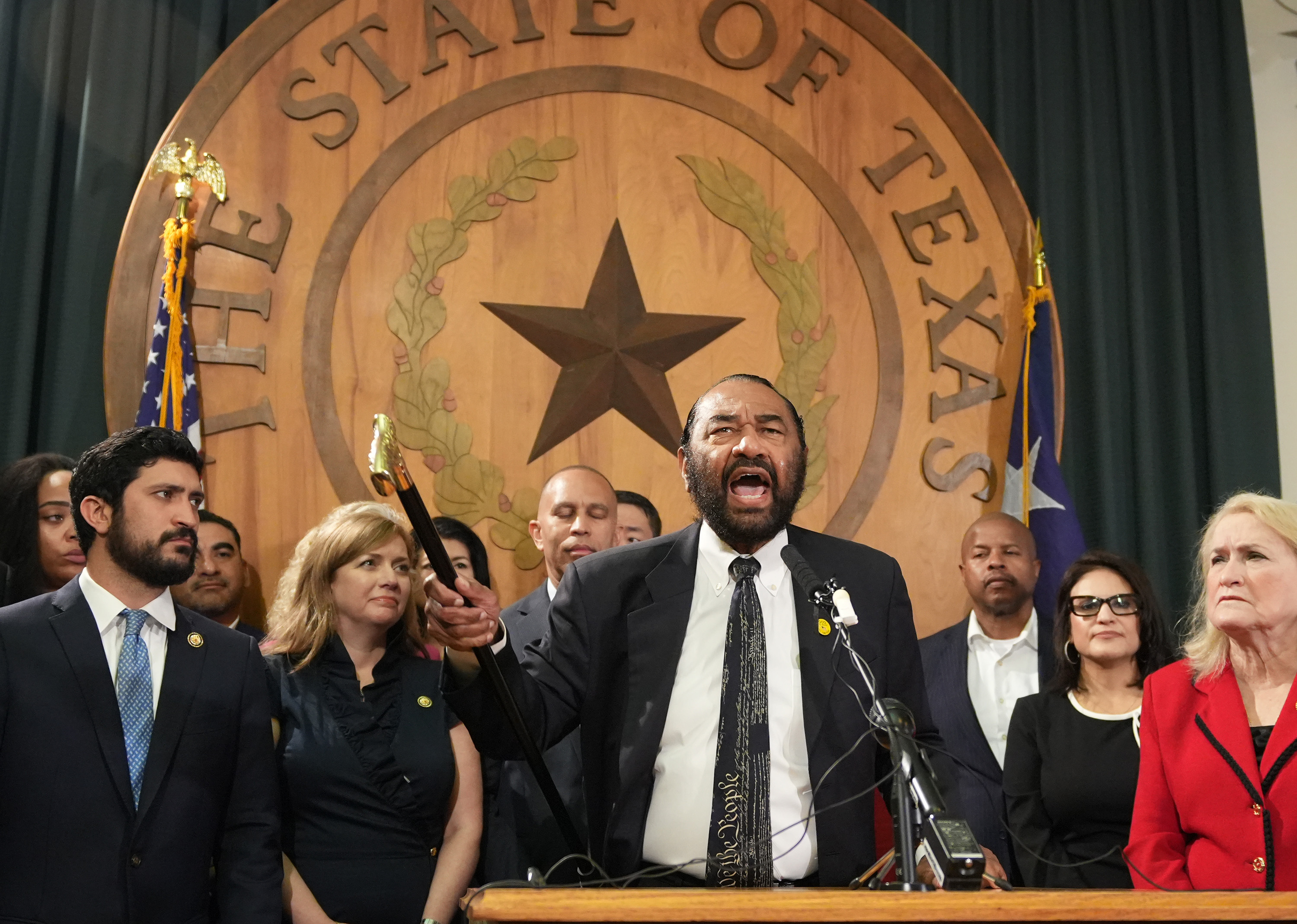
The new districts will be a challenge for lawmakers including Al Green, a Black Democrat who has represented the 9th congressional district near Houston for two decades. That district would retain less than 3% of its current territory in the GOP revamp. Green has expressed interest in running to represent the newly drawn 18th district, a vacant seat that should trend Democratic.
New Houston Districts Would Produce A Big Partisan Shift
Sources: US Census, Texas Legislative Council, Redistricting Data Hub
The composition of Green’s district and Veasey’s district helped set off the redistricting fight in the state. Earlier this year, Trump’s Department of Justice sent a letter to state leaders claiming those districts and two others were designed on the basis of race and thus unconstitutional.
Shortly thereafter, Republican Governor Greg Abbott asked state lawmakers to design a new map, noting the government’s “constitutional concerns.”
Since then, however, Texas officials have denied that the new map was drawn to address racial sorting and instead argued that redistricting was undertaken in order to help Republicans retain their majority in the House. In a September court filing, the state defendants called the Justice Department’s letter “a poor and legally-unsound attempt to provide political cover for Texas to redistrict mid-decade.”
Still, Andrew Mahaleris, a spokesman for Abbott, said that the Justice Department “has made clear that new precedent broadened state authority over redistricting.”
“In line with that guidance, the Texas Legislature acted swiftly to draw congressional maps that better reflect the voting preferences of Texans,” Mahaleris said. “The Governor fully expects these maps to withstand judicial scrutiny.”
Some observers said shifts in the state’s reasons for drawing a new map could weaken its case in court.
“The fact that Texas can’t seem to settle on a rationale for why or how it’s doing what it’s doing is absolutely going to be in the back of the judges’ mind as they consider particularized evidence on particular districts,” Justin Levitt, law professor at Loyola Marymount University, said.
A Justice Department spokesperson declined to comment for this article.
The national stakes in the Texas battle are high. Republicans hold a narrow majority in the House. Should Democrats retake control, it would give the party the power to more closely scrutinize the Trump administration’s actions – and the votes to block most of Trump’s legislative agenda.
The moves by Texas have meanwhile set off a wave of redistricting efforts in other states that could further reshape the partisan makeup in Congress. A proposed amendment to California’s state constitution, if approved by voters, could yield five new Democratic seats. Missouri Republicans approved a map that would likely give the GOP an additional House seat. And Trump is pressuring Indiana and Kansas to draw their maps to his advantage.
There are reasons for both parties to be cautious. Even the most carefully rendered map isn’t guaranteed to produce the intended results, some election experts say.
What’s more, voting patterns can change. One area that election experts are watching closely is the Texas-Mexico border, where a large number of Hispanic voters cast their ballots for Trump in 2024. But it isn’t clear whether that represents a lasting alignment with the president’s party.
Republicans Bank Hispanic Support in Border Districts
Sources: US Census, Texas Legislative Council, Redistricting Data Hub
Presidential elections have become less reliable predictors of how people will vote in upcoming cycles, according to Doug Spencer, a law professor at the University of Colorado. And in 2026, Trump himself won’t be on the midterm ballot.
Yet Republicans are confident that their voters will turn out. “Voters that support the president will be motivated to elect the candidates that will have his back in Congress,” said Kincaid, the GOP redistricting advocate.