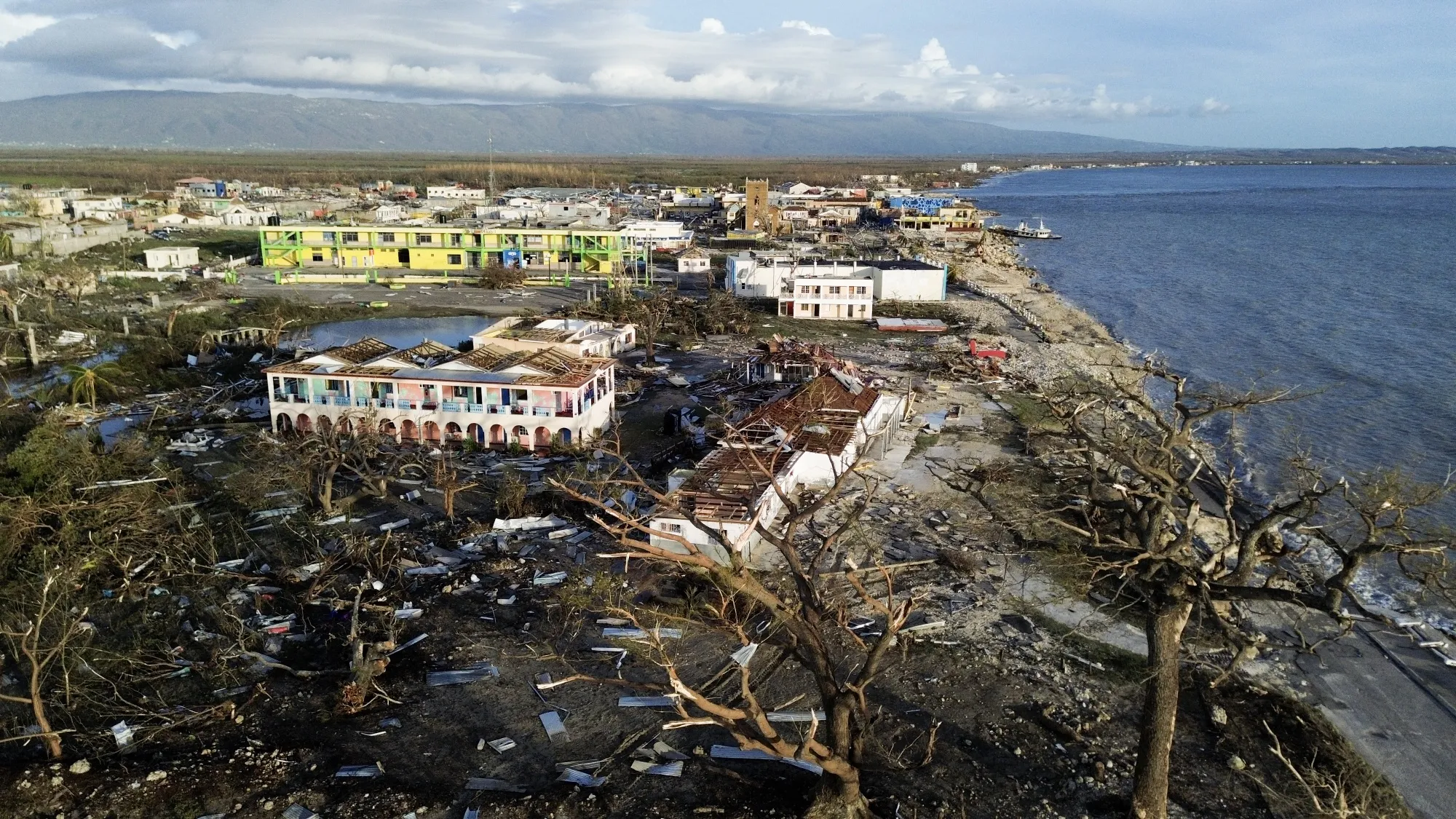
Satellite Images Reveal Scale of Melissa Destruction in Jamaica
Hurricane Melissa plunged much of Jamaica into darkness when it slammed into the country this week as the worst storm in its recorded history. It killed at least 19 people and knocked out access to the essentials: power, water, and communication with the outside world.
As of midday Friday, little of that had been restored. Jamaica’s government and military are still struggling to reach isolated towns.
Now, satellite images reveal in detail the areas ravaged by Melissa and, for hard-hit Black River, the scale of destruction. A Bloomberg News analysis found that at least 76% of the buildings in Black River, a port community near where the hurricane crashed into the Jamaica coast, were damaged, many with collapsed roofs.
At Least 76% of Buildings Damaged in Black River
Sources: Bloomberg News analysis, UMBRA, Overture Maps
Note: Satellite image taken Oct. 29, 2025
In some communities across the western part of the country, at least 40% of buildings and roads suffered damage, the images show.
“It’s a bombsite,” said Peter Williams, a 67-year-old retired farmer who lives near Bethel Town in Westmoreland Parish, where at least nine people died during the storm. “There’s standing buildings but no roofs.”
Black River Before and After Melissa
Source: Vantor
Accessing some parts of Black River has required muscle and sweat. Soldiers have used machetes to cut through intertwined bamboo plants to create makeshift corridors for emergency vehicles.
As of Friday, more than 500 municipal and parish roads had been cleared of debris, along with a main road that connects to Black River. But it may be several more days until the country’s National Works Agency, or NWA, is able to restore fuller access. The goal is Sunday night, said Dana Morris Dixon, the country’s minister of education, skills, youth and information.
Melissa Wreaks Damage Across Jamaica
Sources: Earth Observatory of Singapore Remote Sensing Lab, NOAA/National Hurricane Center
“The NWA is working to find a path, a road, to build it if they have to, or to clear a path from Westmoreland,” she said at a briefing Friday.
The Jamaican military assigned a helicopter to locate and recover bodies. There have been at least eight deaths in St. Elizabeth Parish, where Black River is located, as well as the nine in Westmoreland Parish and two in St. James Parish, including a child, according to newspaper the Jamaica Gleaner late Thursday. Melissa also caused widespread damage in other Caribbean countries including Cuba and Haiti. The storm has been blamed for at least 31 deaths in Haiti, according to the Associated Press.
Williams, the retired farmer, spent most of Tuesday sheltered alone in his basement in Kew Park, a small community near Bethel Town. When he emerged the next morning, he was shocked to see how Melissa had transformed the area around him.
“It’s wholesale. It’s not just one or two houses without roofs, it’s entire communities,” he said in a telephone interview made possible by his Honda generator and internet provider Starlink, which is a unit of SpaceX. “In many cases, houses are just completely destroyed.”
Larger buildings also suffered. A school in Kew Park had its roof torn completely off and the church Williams has attended his entire life was destroyed, he said. “What was the church, with all its pews and beautiful woodwork, is full of stone from the collapsed walls.”
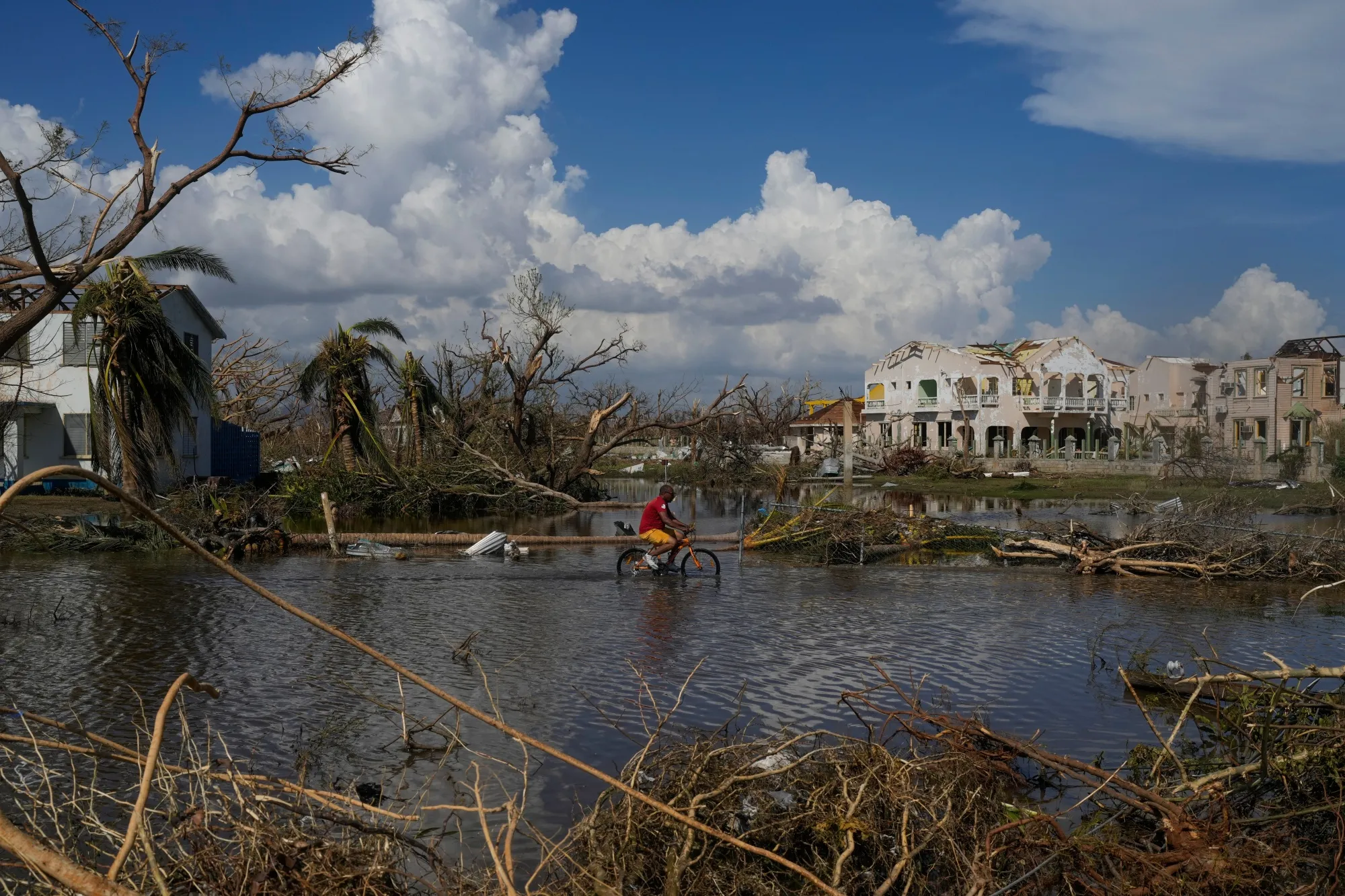
A man rides his bicycle through a flooded street in Black River, on Oct. 30. Photographer: Matias Delacroix/AP Photo
Melissa slammed into Jamaica on Tuesday afternoon, as a rare Category 5 hurricane – the highest on the Saffir-Simpson scale – to make landfall. The wreckage is expected to cost insurers $1 billion to $3 billion, according to property intelligence company Cotality. That’s a fraction of the total property damage, which the company estimates at up to $5 billion, though there’s uncertainty given limited direct observations of the damage.
Chuck Watson, a disaster modeler at Enki Research, estimates economic losses at almost $7.7 billion, or about 39% of the island’s gross domestic product.
Melissa Is Strongest Storm Ever to Strike Jamaica
Source: US National Hurricane Center
The storm triggered Jamaica’s catastrophe bond, officials said Friday. The country’s $150 million cat bond is designed as the ultimate backstop for only the most extreme weather of events.
Jamaica’s power grid was among infrastructure that sustained massive damage. Melissa knocked down power poles and plunged almost 80% of Jamaica Public Service customers into darkness.
Jamaica’s Power Grid Was Unprepared for Category 5 Storm
Source: NASA Black Marble satellite imagery
While the storm’s path avoided population center Kingston and satellite images show lights still glowing there after the storm, the hard-hit western regions of the country were almost entirely blacked out. Daryl Vaz, the country’s minister of transport, telecommunications and energy, said Friday that at least 27,000 customers in eastern Jamaica were expected to regain power by Monday.
“But that’s not enough,” he added.
“Practically half” of national water systems were still offline Friday according to Delano Williams, a spokesperson for the National Water Commission. Major town centers in eastern Jamaica including Kingston “should be back to some normalcy by the weekend,” he said at the briefing, but there are cascading issues resulting from the storm, including washed-out water pipelines, downed trees blocking access to equipment, and lingering power outages that are preventing systems from kicking back on.
The airport in hard-hit Montego Bay, close to the storm’s path, is expected to reopen to commercial flights Saturday morning, Vaz said.
The US government is providing at least eight helicopters to transfer and treat patients in need of care, he added, with charitable organizations sending another half-dozen that could be used to move people and supplies.
“The hard part is the logistics of getting this relief into these areas in the shortest possible time,” Vaz said. “We are now pretty much out of time, in terms of the desperation among the citizenry.” Communications have been a persistent challenge, as the island’s two largest cell providers cope with widespread outages and residents struggle to grab a signal. Jamaican officials said Friday at least 100,000 customers have connected to Starlink in areas where both service networks are down.
Still, five parishes in the path of the storm have “no access to communication,” said Desmond McKenzie, minister of local government and community development, making it difficult to coordinate with local authorities. Extending Starlink access into those areas is a priority, he added.
About 7,000 people, meanwhile, were still housed in 430 emergency shelters across the country as of Friday.
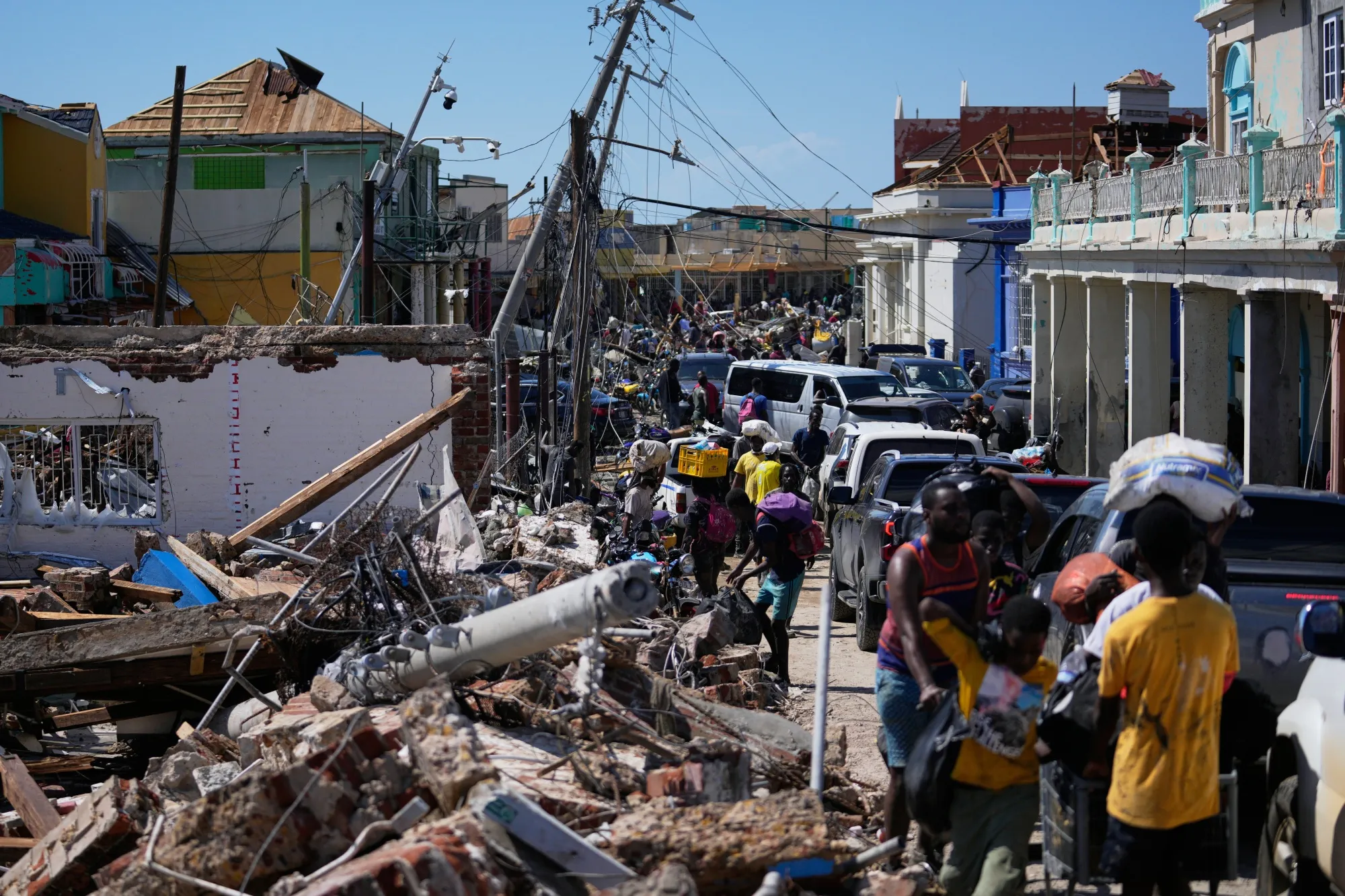
Residents crowd a street in Black River, Jamaica, Oct. 30. Photographer: Matias Delacroix/AP Photo
Juleka Chambers spent the storm huddled with her three children at her mother’s house about 15 miles (24 kilometers) east of Montego Bay, a tourist center hammered in the storm. “The three-year-old was scared and was saying, `A monster is at the door,’” the 31-year old nurse said.
The next day Chambers walked back to her home through the rain to assess the damage. “I had to step over coconut trees to get into the house,” she said, adding that the zinc roof was torn off, her furniture was ruined and a tree fell on her car. She doesn’t have home insurance.
Despite the scale of the displacement and destruction, Jamaica is better-positioned to rebuild from Melissa than it would have been a decade ago thanks to its improved fiscal situation, according to Damien King, executive director of the Caribbean Policy Research Institute in Kingston.
In addition to securing the cat bond, he noted the country balanced its budget, decreased its debt and paid insurance premiums including to the Caribbean Catastrophe Risk Insurance Facility, a multi-country fund. On Friday, the insurer announced a record payout to Jamaica of about $71 million, with a likely second payment under its excess rainfall policy.
“It means that Jamaica has fiscal room to be able to manage a storm even of this magnitude,” King said.