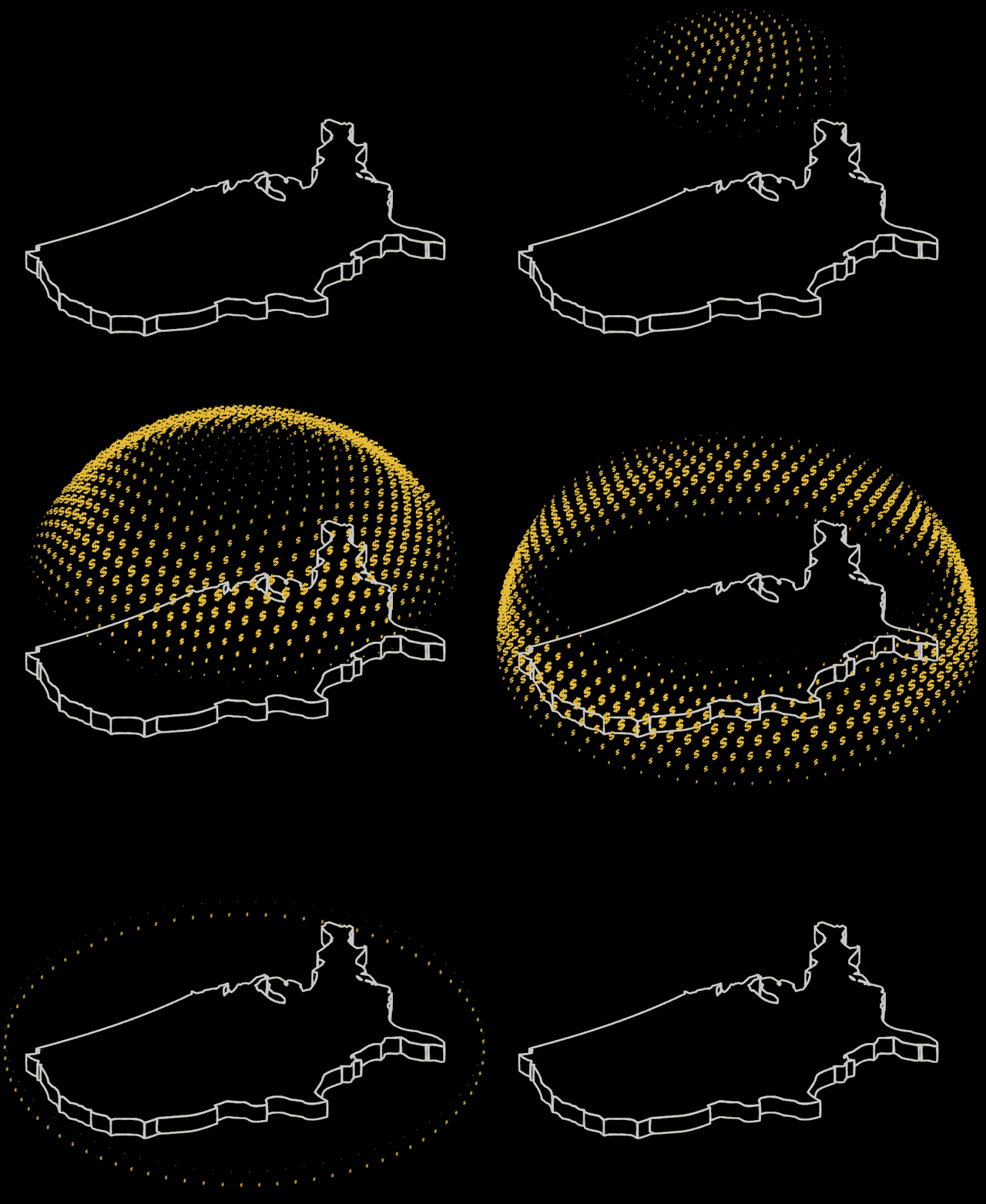
Golden Dome: The Astronomical Cost of Defeating ‘Any Foreign Aerial Attack’
Building Trump’s proposed missile and air defense system would be an enormous task — and the president’s spending target is likely just a fraction of the final price.
Just days into his second administration, President Donald Trump signed an executive order attempting to do what no other commander in chief has done: build a system for the US to “deter—and defend its citizens and critical infrastructure against—any foreign aerial attack on the Homeland.”
The threats that the so-called Golden Dome is meant to defeat sit mainly in the arsenals of Russia, China and North Korea, which together have hundreds of nuclear missiles and thousands of other weapons that could be used to wage war on the US.
The US has historically relied on a policy of nuclear deterrence, and a limited system of ground-based missile interceptors in Alaska and California, to fend off such an attack. But Trump’s Golden Dome would go much further.
The initiative is intended to create layers of defense systems from the ground to space that will stop incoming missiles launched from anywhere in the world. It would uniquely rely on a system of space-based interceptor satellites that track and destroy missiles in orbit as they hurtle toward a destination on Earth—technology that doesn’t yet exist.
Even if Golden Dome does become operational, there’s no guarantee the system will be 100% effective. What it will look like, who will make it and how much it will cost have still not been made public.
The Missile Defense Agency, part of the US Department of Defense, announced on Dec. 2 that it had selected about a thousand companies, including Viasat, Rocket Lab and Deloitte, to move forward with proposals that could support Golden Dome. All are eligible to receive funding from a pool of $151 billion that has not yet been allocated.
Trump has said the project will cost about $175 billion and be completed by the end of his term in 2029, but defense experts say those targets are unrealistic. A Bloomberg analysis found the final price tag could reach many multiples of that; a constellation of space-based interceptors alone would cost $161 billion to $542 billion, according to a May report from the Congressional Budget Office. In late November the US Space Force awarded several contracts, each of which was for less than $9 million, to undisclosed companies to develop interceptor technology.
Bloomberg calculated the cost of a system that would comply with the executive order’s directive of protecting the US against an all-out aerial attack—a worst-case scenario using the combined arsenals of China, Russia and North Korea.
The space-based layer of defense, specifically outlined as a requirement of Golden Dome in the executive order, is the most technologically complex and likely the most expensive element of the project.
The technology for a constellation of space-based interceptors doesn’t yet exist. To build this layer, the US would have to design thousands of interceptors, manufacture them and place them in orbit—tasks that would cost many billions of dollars and would be difficult to complete in just a few years, according to defense experts.
Sources: Department of Defense; Build Your Own Golden Dome: A Framework for Understanding Costs, Choices, and Tradeoffs, Todd Harrison, American Enterprise Institute; Center for Strategic and International Studies; US Congress; Center for New American Security; RTX Corp.; Lockheed Martin Corp.; Congressional Research Service; Defense Technical Information Center; US General Services Administration; InsideDefense; Nuclear Matters Handbook; Arms Control Association; Northrop Grumman; US Institute of Peace; Department of Defense’s Director of Operational Test and Evaluation; Missile Defense Advocacy Alliance; ArmyTechnology; Unmanned Airspace
Note: Illustrations are not to scale
The cost of a Golden Dome system that effectively protects the US from such an all-out aerial attack, according to Bloomberg’s estimate, would end up around $1.1 trillion, more than 500% higher than Trump’s estimate of $175 billion.
That would most likely be a hard sell for both Democrats and Republican fiscal hawks in Congress, though lawmakers allocated nearly $25 billion for Golden Dome in Trump’s One Big Beautiful Bill Act this summer.
How the Costs Stack Up
Source: Trump White House May 20 briefing
“I think that a future administration, a future Congress, would have a hard time looking at all the expenses and the totality of the things that have been thrown out there and saying, ‘This is a good idea,’” says Dave Vorland, who served as the acting deputy assistant secretary of space and missile defense policy in the Biden administration.
The White House declined to comment on the record.
The Missile Defense Agency and Space Force referred questions to the Department of Defense. A Pentagon official said that the baseline architecture for Golden Dome has been established and that the implementation plan is undergoing review. The official added: “As a matter of policy, we do not provide details relating to specifics of architectural discussion or pre-decisional matters. Recognizing adversaries’ intent to exploit Golden Dome’s breakthroughs, we are rigorously protecting its strategic advantages from external access.”
Bloomberg’s estimate is based on the prices of weapons and defense systems, but it doesn’t account for operating costs, personnel or the research and development of new technology like space-based interceptors, factors that would drive the total price tag higher.
A Golden Dome that provides only limited protection could be built more cheaply. Bloomberg also calculated the price of a more modest missile defense shield designed to protect against an all-out attack from just one adversary, Russia, and found that even this version would cost $844.4 billion.
Critics, including some experts and lawmakers, also say that if the US rapidly expands its missile defenses, it could fuel an arms race that spurs Russia and China to accelerate nuclear weapons development, dimming prospects of negotiations to reduce their arsenals. This, in turn, could stimulate even more defense investment from the US as it races to maintain a strategic advantage over its adversaries, potentially driving up spending on homeland security for years to come.
The concept of a protective shield around the US is not new. Both the Reagan and George H.W. Bush administrations had plans for less-ambitious missile defenses before ultimately abandoning those efforts because of cost constraints, feasibility concerns and waning congressional support.
Trump’s vision for Golden Dome is conceptually based on Israel’s Iron Dome, a system that has successfully countered thousands of short-range missiles since it entered service almost 15 years ago. That system, at the low end of a larger Israeli integrated air and missile defense network, was built by Israeli defense company Rafael Advanced Defense Systems Ltd. and US company Raytheon, a subsidiary of RTX Corp.
Every component for Golden Dome will be made in the US, Trump has said, and Silicon Valley companies will play an important role alongside established defense giants.
“What’s exciting about this is it makes it available to everybody to participate, to compete. Big companies, midsize companies, small companies,” Senator Kevin Cramer, a Republican from North Dakota, said in May at a Golden Dome press briefing in the Oval Office.
SpaceX, Palantir Technologies Inc. and other large contractors like Lockheed Martin Corp. are likely to be involved given their close relationship with the government and defense experience. A crowd of defense startups like Varda Space Industries Inc. and Apex have also been positioning themselves for the opportunity to contribute. Varda was among the firms selected by the Missile Defense Agency to move forward with their plans.
SpaceX and Palantir didn’t immediately respond to a request for comment.
Robert Lightfoot, president of Lockheed Martin Space, said in a statement that the company “is ready to move with the speed America needs to field a scalable, integrated missile defense capability.”
Ian Cinnamon, CEO of Apex, said the startup is “laying the foundation for Golden Dome” by showing how industry “can accelerate the deployment of critical, next generation space architectures.” Dave McFarland, Varda’s vice president for hypersonic and reentry test, said in a statement the company is “happy to be able to support national security priorities by offering our reentry vehicles for tracking test and targeting.”
Trump has also mentioned that Canada may be included in the project but would have to pay $61 billion to join, around 5% of what the price tag could be, according to Bloomberg’s estimate. It’s not clear whether the overall cost would be higher to cover Canada.
Since the executive order was signed about 11 months ago, few details have emerged about the specific architecture of Golden Dome, leaving the defense industry, lawmakers and Pentagon officials anxious for answers.
The administration’s timeline of finishing the project before Trump leaves office in January 2029 “was unrealistic from the beginning,” says Todd Harrison, a senior defense fellow at the American Enterprise Institute.
“The name, the concept, the program of Golden Dome probably does not survive after this administration,” he says.