
The New American Hustle: Dividends Over Day Jobs
Decades of schooling. A lifetime at work. A couple of years to enjoy, if you’re lucky. Then it’s all over.
That’s the deal generations of Americans have been sold for more than a century: Work hard and invest cautiously and maybe, just maybe, you’ll get a few good years to breathe.
To a rapidly growing crowd of young retail investors, it’s a ripoff.
On a Friday afternoon in July, some two dozen of them gathered in Midtown Manhattan to preach an alternate path — one paved not with paychecks, but payouts. Their mantra: plow money into a host of newfangled, dividend-chasing strategies and use the steady stream of cash they generate to escape the 9-to-5. Never mind the long-term damage it might do to their portfolios.

Financial influencers and YieldMax executives at the Nasdaq MarketSite in Times Square on July 11. Photographer: Lanna Apisukh/Bloomberg
One of them was Eli Breece, a 26-year-old former real estate analyst who has put his savings into a dividend-focused portfolio from which he withdrew $40,000 to contribute to the down payment on his home in Tennessee. He has sidelined his retirement account and promotes his strategy to the 217,000 followers of his YouTube channel “Dividendology.” In Breece’s telling, it’s all about gaining your freedom.
“My granddad worked at a factory his whole life,” he says. “I don’t want to lock away that capital until I’m 65.”
It’s a strange twist: Dividends — once the stodgiest corner of investing — have become the new hot thing with jaded Gen Zers hellbent on quitting and retiring early. But the new playbook isn’t just about reliable payers like Coca-Cola Co. and Exxon Mobil Corp. Today’s dividend crowd is piling into ETFs offering eye-popping yields generated by complex derivatives.
The broad category of income-generating ETFs captured one in six dollars sent to equity ETFs as a whole in 2025, bringing the overall size of the sector to $750 billion. The most aggressive ones — dangling yields above 8% — have quadrupled in size in just three years to about $160 billion. The craze has sparked a network of YouTube channels and Discord servers, as well as the r/dividends forum on Reddit, which has grown more than tenfold over the last five years to 780,000 members today.
This philosophy is one of the many quasi-religious investing movements that has sprung up among young, financially insecure Americans worried about inflation, unattainable housing and the prospect of AI-fueled economic disruption. The dividend finfluencers see themselves as the sober cousins to the YOLO crew, closer in spirit to the FIRE movement, with its focus on financial independence and retiring early. Unlike meme stocks or crypto moonshots, this strategy — what might be referred to as Dividends and Chill — preaches control and consistency, a monthly drip over flash-in-the-pan riches. Not YOLO, just yield.
The current wave of interest is new enough — and many of the followers young enough — that it has been easy to ignore how the most popular funds have often lagged basic stock indexes and threaten to eat away at long-term returns. Samuel Hartzmark, a professor of finance at Boston College, has researched the issue for more than a decade and has found that investors tend to fall for the “free dividends fallacy,” treating them and capital gains as separate. A 2015 paper of his finds that investors prone to that bias have a preference for funds that report boosted dividends even if they don’t improve overall returns.
“A lot of people think of the dividend as separate from the cash flow,” he says. “They don’t realize it comes at the expense of the price level and isn’t making you richer.”
The appeal of regular payouts has long led investors into stocks and funds that offer quarterly and annual income. Christine Benz at Morningstar Inc. calls it “the psychological pull of the ‘bird in the hand.’” One of the biggest dividend-focused ETFs, the Schwab US Dividend Equity ETF, launched in 2011 and now has more than $70 billion in assets with a yield of around 4%.
A new, faster-growing generation of funds offer payouts that are much higher – sometimes above 100%. Take one product, operating under the ticker MSTY, that is tied to the volatile stock of the Bitcoin-hoarding company known as Strategy.
Let’s examine three ways of getting exposure to this company.
Note: Data from MSTY’s inception to September 3, 2025.
Invest directly in the stock
In a hypothetical scenario, one investor buys $100,000 worth of the stock of the Bitcoin-holding company Strategy in 2024. Since then, the rapid growth of the firm's shares means that the value of the investment is now more than $463,000.
Invest in the dividend-focused ETF (MSTY) that provides exposure to the same company, reinvesting dividends
Another person places their money in a dividend-focused fund (MSTY) that offers exposure to the same company. Even if the person reinvests all the dividends paid out, the investment will be worth about $343,000, or roughly $120,000 less than if they had bought the stock directly.
Invest in the dividend-focused ETF (MSTY), withdrawing dividends
A third person uses MSTY's dividends as income, withdrawing the yield as it comes in. The dividend payouts they pocket, plus the value of their ETF holdings, are together only worth about $270,000, or almost $200,000 less at the end of the same period than if they had put the money directly in Strategy.
But the dividends are the bulk of MSTY's returns. After this investor used the dividend checks to fund day-to-day expenses, all that's left is the value of the ETF, which has now shrunk to less than $73,000.
The fund has roughly $5 billion in assets and promotes a “distribution rate” of about 90%. These payouts are generated through a complicated series of options bets. This setup has made the monthly payouts possible but it has also weighed on the ETF, which has underperformed the underlying company by about 120 percentage points since its inception in February 2024 – and that assumes you reinvested all the dividends it generated. If you pocketed the dividend, as many influencers do, your account would have been left with a security that lagged Strategy’s return by nearly 200 percentage points.
Changes made since 2019 by the Securities and Exchange Commission – streamlining ETF approvals and derivatives rules – cleared the way for the wave of funds and new asset managers offering massive yields.
The Manhattan event that Breece attended, at the Nasdaq, was sponsored by YieldMax, which is responsible for many of the fastest-growing products in the industry, including MSTY. The more than 50 ETFs that the company has created since 2022 have seen about $5 billion in inflows just since the finfluencers rang the closing bell at the exchange on July 11.




Financial influencers focused on high-yield ETFs gathered in New York at an event hosted by YieldMax. Photographer: Lanna Apisukh/Bloomberg
The math these products use – payouts today, erosion tomorrow – have drawn sharp criticism from Wall Street pros, who warn that investors may mistake current dividends for long-term wealth, ignoring how big yields often come at the expense of price returns and overall portfolio growth. Benn Eifert, managing partner at the volatility-focused hedge fund QVR Advisors, has been an outspoken critic of some of the issuers behind this new trend.
“They’re fooling people into thinking that they’re somehow getting income,” Eifert said. “All you’re doing is giving me my money back, so the value of the ETF is declining as you’re paying me that.”
YieldMax executives, for their part, say they are upfront about what the products are designed to do: generate attractive yields for their holders.
“If you want to just own the underlying stock, own the underlying stock. We’re not trying to beat the underlying — we’re trying to turn the volatility of the stock into income,” says Michael Venuto, co-founder at Tidal, which helps launch YieldMax’s ETFs. “People who are only trying to get the upside should not buy YieldMax products.”
Dividend-Focused Funds Often Underperform
When the underlying stocks rise the dividend-focused funds often miss out on much of the gains...
SPDR S&P 500 ETF Trust vs. JEPI
Coinbase vs. CONY
...and for stocks that have suffered losses, some dividend-focused funds have still trailed the underlying.
Moderna vs. MRNY
C3.ai vs. AIYY
Note: Returns assume dividends are reinvested into the fund.
Still, for investors like Cesar Arteaga, the headline appeal of these amped-up products is clear. Arteaga, a 27-year-old mechanical engineer, previously cycled through a number of trendy investments sweeping the retail world. He got into options trading and lost $15,000 before making it back buying and selling memecoins.
”I’ve always had what they call the ‘shiny object syndrome,’” he says.
He recently shifted his attention to high-yield ETFs, after moving to Montana with his wife. He’s had a hard time finding a job, so his interest was piqued when he saw social media posts about the huge dividend payments offered by high-yield products. He began five months ago, with a $5,000 investment, and quickly ramped it up, throwing most of his savings into a handful of YieldMax ETFs, including MSTY.
“It’s just kind of become an addiction,” he says. “Now you’re seeing dividend funds, the high-yield ones coming up with insane numbers, more than 50%. That just really drew me in to add income while I didn’t have a job.”
So far, Arteaga has invested some of the proceeds from the sale of his house and two cars, and about $30,000 in margin loans, taking his portfolio to $160,000. He hopes this nest egg will generate $9,000 of income a month, though that figure doesn’t factor in the payments he’s making on his margin loans or the tax bills he is likely to face.
While YieldMax has been the most visible magnet for investors like Arteaga, a number of ETF companies have latched onto the trend. Income products from firms including NEOS Investments, ProShares and Defiance ETFs, among others, have been introduced over the past two years, often with high fees.
One of the biggest derivatives-based income ETFs is JPMorgan’s Equity Premium Income fund (ticker JEPI), which launched in 2020 and quickly grew to $41 billion with a relatively cautious approach. The fund provides exposure to the S&P 500 but generates 80% of its yield via call options.
JEPI attracted a lot of money from investors after offering some protection from the market’s near-20% decline in 2022 (the fund only went down 3.5%). But it has still underperformed the benchmark index by about 58 percentage points since inception. That’s even for an investor who reinvested all the dividends.
Hamilton Reiner, who runs JEPI, said that the goal of the fund is to offer income and minimize gut-wrenching volatility, not maximize returns.
“One of the things that’s underappreciated with covered call strategies is, yes, you get income, but the options have also helped dampen and reduce volatility for some strategies,” Reiner said. “Ours is one of them.”
Many market experts have raised concerns about covered call strategies, which can cap upside returns and add tax complications. Wes Gray, the CEO of asset manager Alpha Architect, who calls himself a dividend skeptic, says that “yield products appeal to investors because they feel safe, but they’re typically tax-inefficient, expensive myths dressed up as secret sauce.”
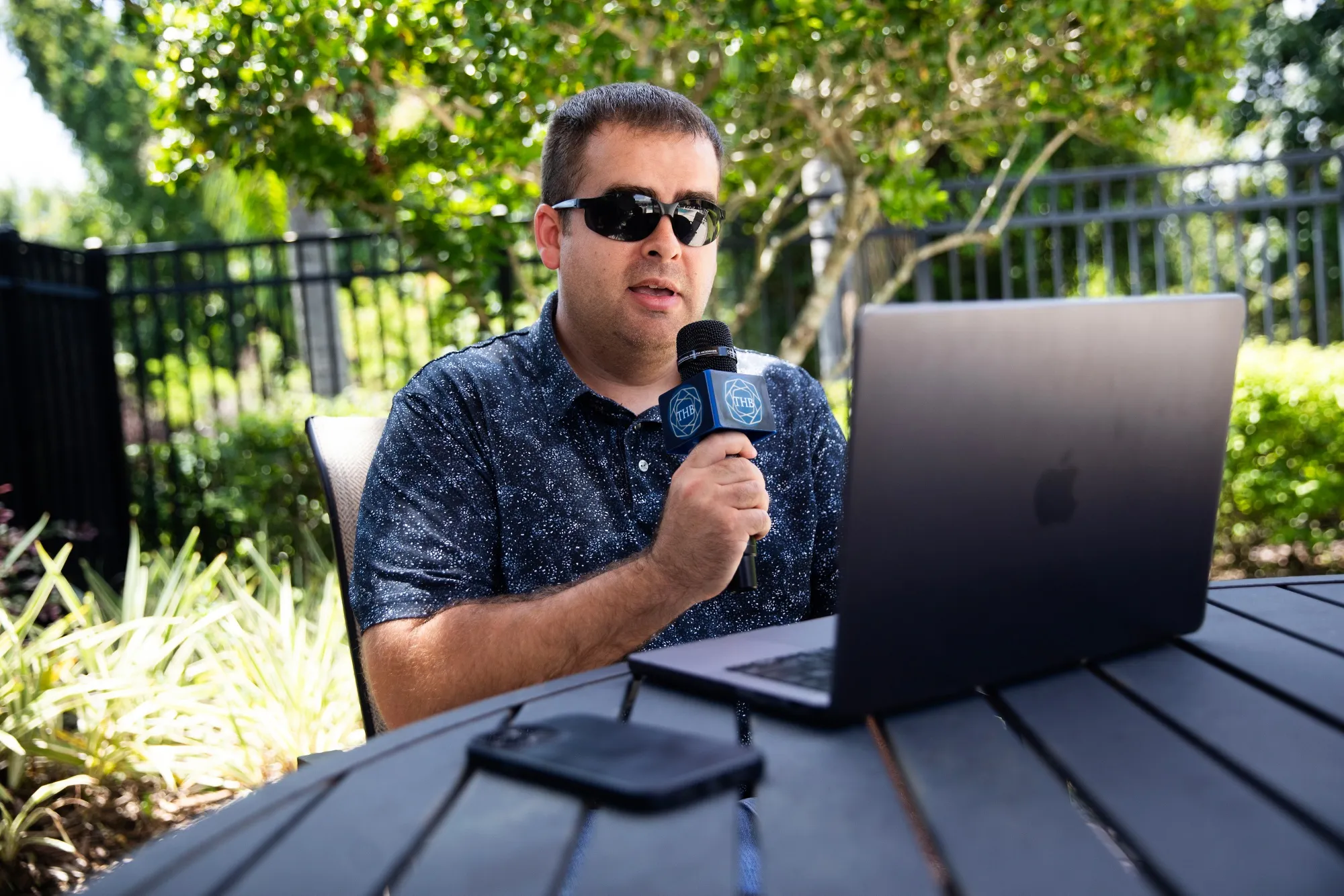
Thomas Bell, the creator of the YouTube channel, “Live off Dividends & Options NOW!” recording at his home in Florida. Photographer: Octavio Jones/Bloomberg
Dividend stocks have always come with additional tax liabilities, because each quarterly or annual payment is considered a taxable event. But most new high-yield products can come with an even higher tax burden, because derivatives-based payouts don’t get the preferential treatment of qualified dividends and are instead taxed at ordinary income rates.
“The space is growing and one of the things we always tell investors is do your homework,” says Troy Cates, co-founder at NEOS. ”It’s very important to understand not only what you’re buying but what the tax implication behind it is.”
These nuances come across in varying degrees in the hothouse of social media communities dedicated to high-yield investing. One of the founding fathers of this online world, Mark VanWagenen, 43, created a Facebook group in 2018 called “Retire on Dividends,” which now has nearly 30,000 members. He quickly followed that up with the launch of a YouTube channel, where he shares his investing playbook. But his most popular creation is a subreddit he founded three years ago, dedicated to YieldMax, that now has 70,000 members.
VanWagenen says he cashed out his wife’s retirement account and invested the money in various YieldMax ETFs and other high-yield products (he kept a 401(k) from his employer). He still has a day job as an accountant, but he uses his investment income to pay his mortgage, gas and internet bills and to make the monthly payment on his Plymouth minivan.
In a recent video, he focused on the $3 billion YieldMax Ultra Option Income Strategy ETF which distributes weekly dividend payments. VanWagenen emphasized the significant income it could spin off, even as he recognized the drag on long-term performance.
“It’s disappointing to see the capital depreciation of 47%,” he said, while displaying a chart of how the investment might perform over the course of twenty years. “But even with that, you can see how good the income is. They do what they can. They produce a solid income.”

Thomas Bell’s laptop showing analytics for his YouTube channel. Photographer: Octavio Jones/Bloomberg
Thomas Bell, who was invited to the Nasdaq event by YieldMax, says he had watched his father, an electrician, work and save up for retirement, without being able to enjoy the journey.
“When you graduate college, you’re like 22, you’re young, you have the good looks and all that, but you don’t have the money,” he says. “And so it’s like, well how do you get the money fast?”
Bell, who is 35, quit his job at a Wall Street bank in 2022. He took a position at a more flexible firm that allows him to work from home and grow his YouTube channel, “Live off Dividends & Options NOW!” About 60% of his net worth is in income-focused strategies, including options plays he’s put on leveraged ETFs. From his portfolios, he generated $65,000 in dividend payouts last year, he says.
Breece, the creator of “Dividendology,” has put most of his money into the less-adventurous corners of the dividend market, with 40% of his portfolio in the big Schwab dividend ETF. His more conservative approach has been enough to offer Breece some $500 in payments each month.
For Breece and his cohort, yield isn’t just income, it’s a form of empowerment. A way to reclaim time, exert control, and make freedom feel a little closer — even if retirement still seems far off.
“The goal was to have the ability to make work optional,” he says. “I want to have that flexibility 10, 20 years from now.”
- SCHD:US (Schwab US Dividend Equity ETF)
- MSTY:US (YieldMax MSTR Option Income Strategy ETF)
- MSTR:US (Strategy Inc)
- ULTY:US (YieldMax Ultra Option Income Strategy ETF)
- SPX:IND (S&P 500 Index)
- JEPI:US (JPMorgan Equity Premium Income ETF)
- COIN:US (Coinbase Global Inc)
- CONY:US (YieldMax COIN Option Income Strategy ETF)
- MRNA:US (Moderna Inc)
- MRNY:US (YieldMax MRNA Option Income Strategy ETF)
- AI:US (C3.AI Inc)
- AIYY:US (YieldMax AI Option Income Strategy ETF)