Global live and planned data center capacity by ownership
AI Data Center Gold Rush Driven by Thousands of Newcomers
Big Tech’s dominance of AI infrastructure is shrinking as a host of other players pile into the arena — with global economic consequences.
In the golden hills of Puglia, a southern region of Italy known today for its olive trees, white cliffs and turquoise mediterranean coves, Lorenzo Avello has artificial intelligence on his mind.
Avello’s relatively unknown company, Adriatic DC, is looking to develop three massive data centers in the area, including a campus capable of turning 1.5 gigawatts of electricity into computing power for artificial intelligence services — easily eclipsing the capacity of most of today’s largest AI facilities. A single gigawatt is enough to power up to 750,000 US homes at any given time. The goal, he said, is to establish “a Mediterranean AI hub.”
Avello has never built a data center. Before this, he worked on renewable energy projects. Thousands of newcomers with little to no computing capacity today are hoping to claim a piece of the AI infrastructure gold rush. If every data center in the trillion-dollar pipeline gets built, a Shark Tank television show host will own a computing empire in the oil- and gas-rich province of Alberta, and a five-year-old Bitcoin mining firm will run one of the largest data centers in the US by 2027. Avello’s year-old company, meanwhile, would soon be running Europe’s largest computing operation.
These are the new faces behind the mega-campuses being developed globally to power the artificial intelligence boom. Their emergence marks a fundamental shift in data center dominance away from Big Tech and points to a new set of heightened risks from the global infrastructure buildout as less experienced firms join the fray.
Source: Bloomberg News reporting and analysis of data provided by DC Byte
The upside to increasing diversification in the data center business is that it ensures no single industry winds up shouldering the risk. But so many types of firms piling into the space also means any collapse in the AI business case stands to ripple throughout the entire global economy, touching off casualties in virtually every corner of the business world, including the equity and debt markets.
Lenders across private and public markets have been lining up to throw cash at various infrastructure projects for months. At least $178.5 billion of data-center credit deals in the US alone have been struck this year so far, according to figures compiled by Bloomberg News. Tech behemoths including Oracle, Meta and Alphabet have helped propel global bond issuance to more than $6.57 trillion in 2025. The sums involved in this global buildout are so large that JPMorgan Chase & Co. expects issuers to tap just about all major debt markets to finance it.
The growing field of data center developers is catering to the tech industry’s ravenous demand for computing power to build better and more widely adopted AI systems. Giants in the space from OpenAI’s Sam Altman to Nvidia Corp.’s Jensen Huang are expecting trillions of dollars in investments to flow into a years-long global AI infrastructure buildout to power a technology they think will reshape the economy.
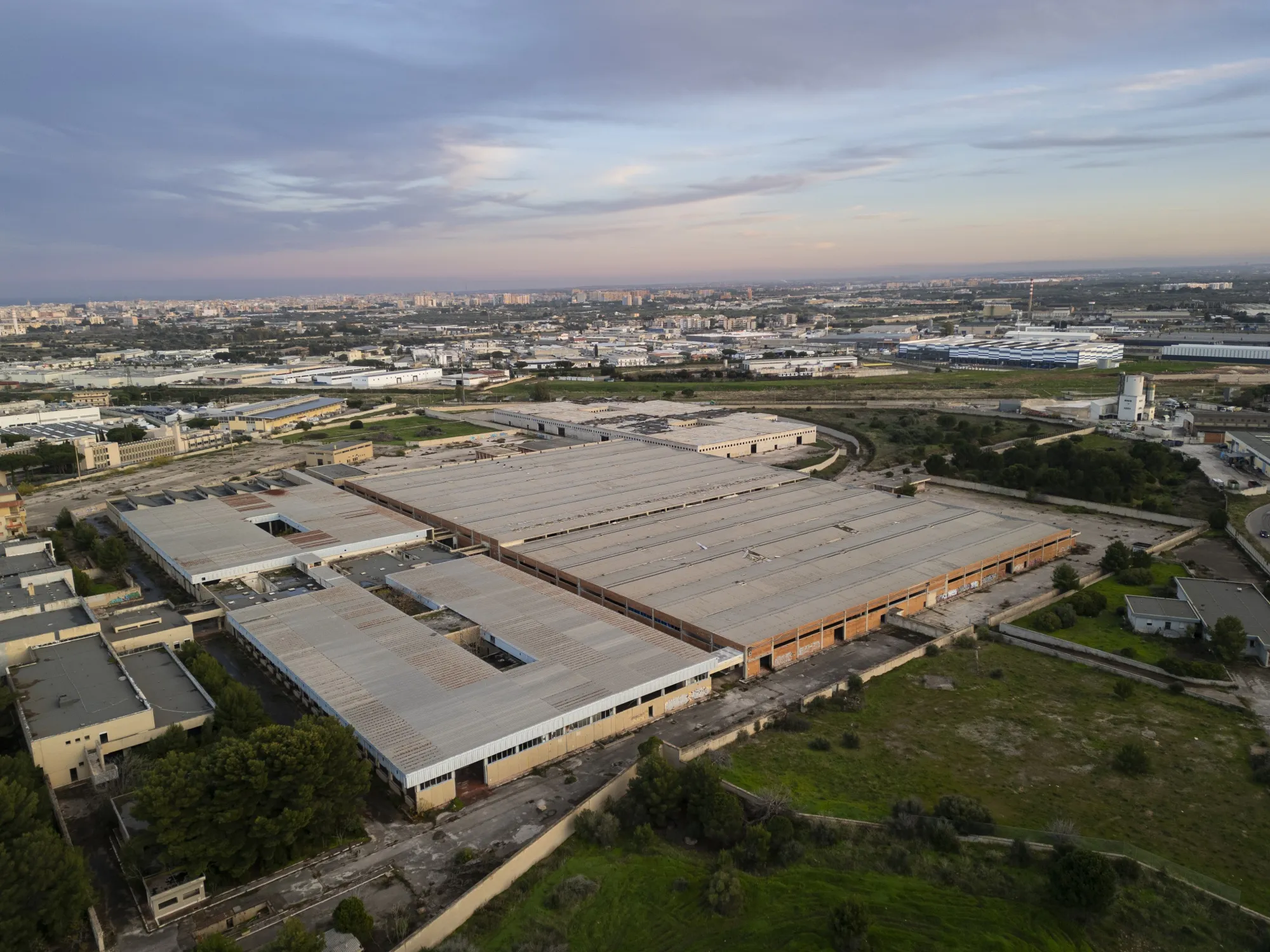
The former Manifattura Tabacchi site outside Bari, where Adriatic DC plans a 200-megawatt data center. Photographer: Roberto Salomone/Bloomberg
But Wall Street veterans and contrarian investors such as Michael Burry are already sounding the alarm on an AI bubble. The circular nature of recent AI deals — by which the likes of Nvidia, Microsoft and others are investing in the very firms that buy their products — is raising questions about how real the demand is for AI products.
Charles Fitzgerald, a former Microsoft Corp. manager who has tracked and written about data centers for over a decade for the blog Platformonomics, said a lot of the projects under development will never see the light of day.
“There just aren’t that many customers,’’ he said, adding that “the dream team for building and operating frontier-scale data centers probably doesn’t include private equity or TV performers.”
Today, there’s far more demand for AI infrastructure than supply. For all the talk of an AI bubble, the world’s current lack of computing capacity looms large for corporate executives. Ready access to AI infrastructure ranked as either the first, second or third most concerning issue across most sectors in a Bloomberg Intelligence survey of more than 600 C-suite executives globally. But over time, Oaktree Capital Management LP co-founder Howard Marks warns, the risk of an overbuild looms large. Savvy tech firms who’ve built flexibility into their leases for such computing space threaten to leave site owners holding the bag if they back out of their contracts.
New Players Could Make Southern Italy Europe’s Largest AI Hub
Source: Bloomberg News reporting and analysis of data provided by DC Byte
Avello expects his project in Puglia to cost upwards of 50 billion euros ($59 billion). Most of that Avello plans on financing through private capital. Avello said he’s in discussions with potential backers but declined to name them. He said he’s already secured some of the land and all electricity commitments to build and power his sites.
He was inspired by the Stargate infrastructure venture that OpenAI, Oracle and SoftBank Group Corp. jointly announced this year alongside Donald Trump shortly after he returned to the White House. Those companies pledged to spend as much as $500 billion in largely rural areas of America to carry out an unprecedented AI data center expansion. (Oracle’s shares have meanwhile tanked nearly 40% over the past three months on fears that its massive AI bets won’t pay off.)
Avello said his team is similarly building a “data center valley” in a sparsely populated area around Puglia, taking advantage of a subsea cable that comes ashore nearby. The plan is to support AI systems running in Europe, Asia and the Middle East.
Avello is betting that people are still underestimating the potential of and the demand for AI. “Governments are moving, countries are moving, the biggest institutional investors in the world are moving,” he said. “I don’t think the US, China or Saudi Arabia would move like this on such matters unless they were aware of something we don’t yet know about how disruptive this technology can be.”
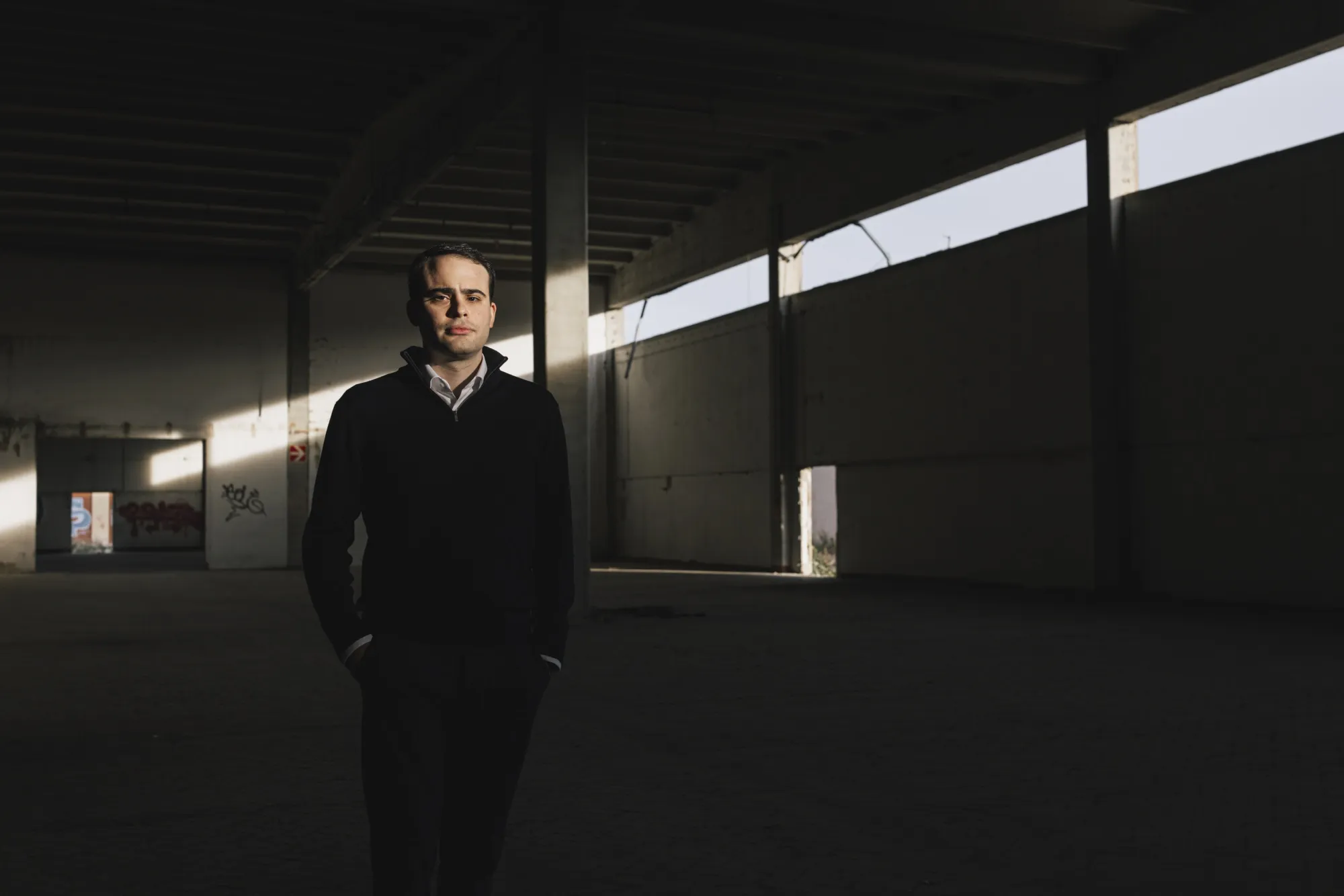
Adriatic DC CEO Lorenzo Avello. Photographer: Roberto Salomone/Bloomberg
“The World’s Largest AI Data Center Industrial Park”
A similar AI enthusiasm is on full display in Canada, where O’Leary has been pitching “the world’s largest AI data center industrial park.” The project, in northwestern Alberta, would run off massive volumes of natural gas and geothermal energy. O’Leary, who co-founded a software company long before joining Shark Tank where he’s known for his blunt commentary, acknowledged the uphill battle for building data centers at this scale. But he expressed confidence in his ability to pull it off.
“I’m arrogant enough to say I will be one of five that will succeed in building hyperscaler facilities,” he said in an interview. “That’s it. I will make it. I will be one of five, and you will see hundreds fail.”
O’Leary said he secured the Alberta site and cheap power after looking for large enough plots of land and energy in the US. One day, he said, O’Leary received a cold call from someone claiming to represent the Alberta government. He ended up speaking with Alberta Premier Danielle Smith and sending one of his experts to do a flyover of various possible locations in the province. “Buy it all,” O’Leary recalled the expert telling him the moment he stepped off the helicopter. “It’s a unicorn.”
The site is capable of supporting up to 17 gigawatts of capacity, O’Leary said, but the company is developing it in stages, likely starting with an initial tranche of 1.4 gigawatts. O’Leary declined to say when it would be operational. “We have to get the turbines. We’ve got to get the permits,” he said. “We’re in the process of doing that. Nobody takes the site seriously until you’ve got all the permits.”
The Bitcoin-mining company Bitdeer Technologies Group also has ambitions to spend “hundreds of millions, if not billions” of dollars to expand into the AI cloud business, said Haris Basit, the firm’s chief strategy officer. Today, the company — a Singapore-based spinoff from the cryptocurrency giant Bitmain Technologies Ltd. — is best known for providing a cloud-based platform for Bitcoin miners.
By the end of the decade, the company envisions running a network of AI data centers capable of drawing hundreds of megawatts of power. Bitdeer’s flagship project lies in Clarington, Ohio, where it’s secured 570 megawatts for an AI data center campus that it’s aiming to bring online in the second half of 2027.
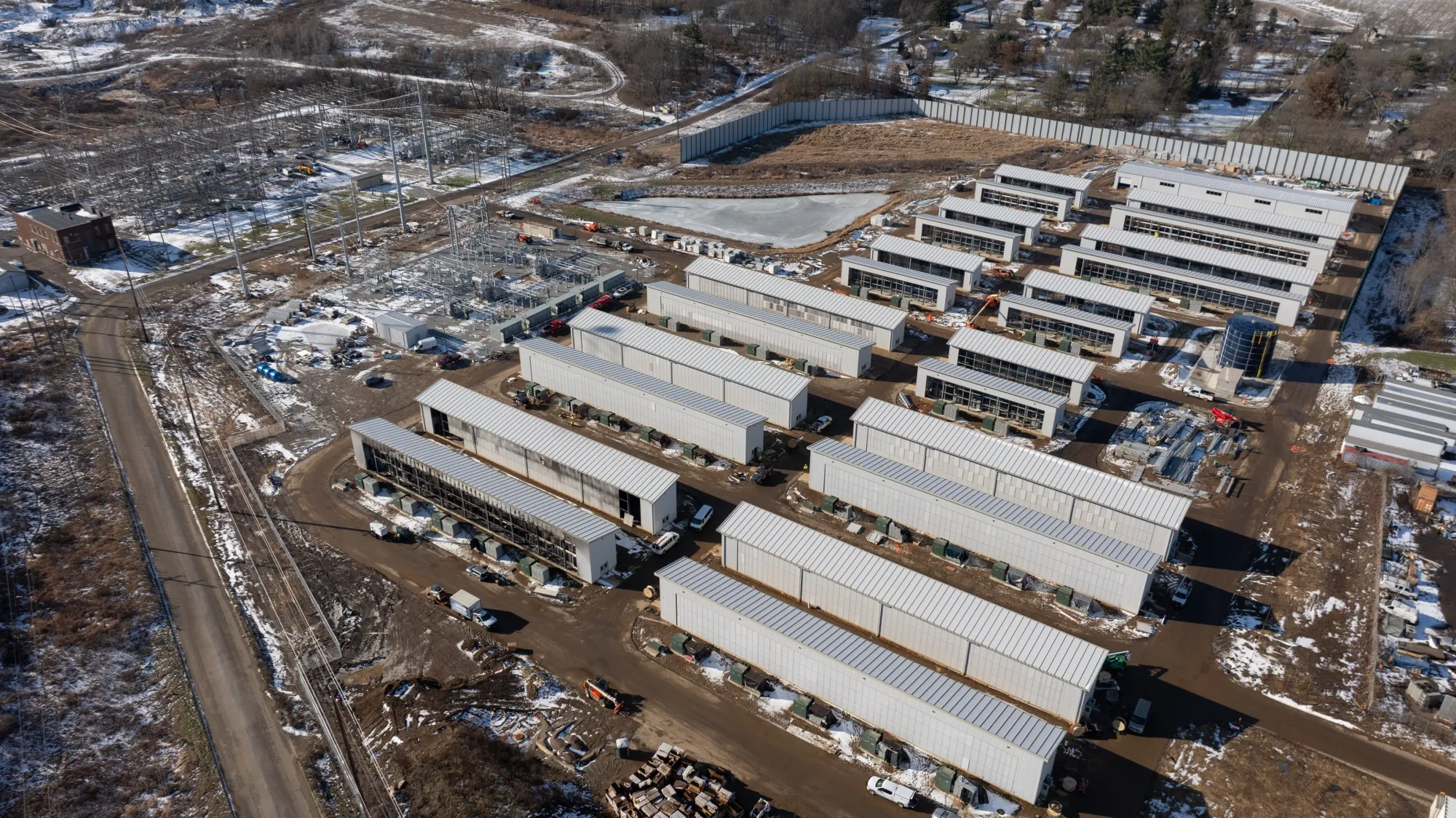
The Bitdeer mining facilities under construction in Massillon, Ohio. Photographer: Justin Merriman/Bloomberg
Bitdeer has deep roots in tech, Basit said, noting that it runs a cloud platform for Bitcoin and that the company designs its own chips to mine the cryptocurrency. “We’ve got this deep technology moat around that part of our business, and it differentiates us, highly differentiates us,” Basit said.
Bitdeer is part of a growing cohort of crypto-focused companies that have jumped on the AI bandwagon. Nscale, a little known British data center company that spun out of a crypto miner last year, has already partnered with Nvidia and OpenAI. CoreWeave Inc., another former crypto miner, has emerged as a leader for renting out Nvidia chips to companies like Microsoft and OpenAI.
CoreWeave is also a poster child for the challenges of building out data center capacity fast enough. The company recently lowered its annual revenue forecast, citing “temporary delays related to a third-party data center developer who is behind schedule.” Bitdeer, too, has seen what can go wrong in a buildout. Last month, a fire broke out at one of its Bitcoin mining facilities under construction in Massillon, Ohio. Basit said the fire was caused by a welding accident. “We’re going to make sure accidents like that don’t happen again,” Basit said.

Bitdeer Chief Strategy Officer Haris Basit. Photographer: Manuel Orbegozo/Bloomberg
As uncertain as the AI bet may look to investors like Burry, Basit said Bitcoin is even riskier. Bitdeer sees AI as the less volatile, more reliable hedge to the notoriously tumultuous business that is Bitcoin. “At any particular moment, Bitcoin is volatile,” Basit said. “AI is also volatile, but perhaps less so and in a different way.”
Bitdeer’s Clarington project is envisioned as a so-called co-location site, meaning Bitdeer will rent the space to hyperscalers like Microsoft or Google that would stock the facility with its own chips and server equipment. Bitdeer plans to take on debt to cover the majority of the project costs. But Basit said he expects attractive financing given it’ll be backed by a 10- or 15-year lease signed by a hyperscaler with strong credit.
Carrying the Debt
In some ways, Bitdeer’s project and the flood of new entrants into the data center business is part of a broader shift in thinking among big tech companies. Instead of taking on the debt to build the data centers themselves, they’re increasingly relying on others to do the work — and to carry the debt load.
Take Meta. In October, the Facebook owner secured about $60 billion in capital to build data centers. But half of that won’t show up on its balance sheet as debt. Instead, Morgan Stanley structured a $30 billion deal — the largest private capital transaction on record — where the financing would sit in a special purpose vehicle tied to the asset management firm Blue Owl Capital Inc.
AI Is Already Wreaking Havoc on Global Power Systems
AI Needs So Much Power, It’s Making Yours Worse
Microsoft has meanwhile committed more than $60 billion to leases with neoclouds that build data centers and stock them full of advanced AI chips themselves. Nscale has secured $23 billion in business alone from Microsoft and plans to supply computing power to the tech giant at sites in the UK, Norway, Portugal and Texas.
In an interview earlier this year with podcaster Dwarkesh Patel, Microsoft Chief Executive Officer Satya Nadella predicted an “overbuild” of computing capacity. Then he cited it as a reason he’s “excited to be a leaser.” Separately, Anthropic’s Dario Amodei acknowledged AI developers face “a real dilemma” deciding how aggressively to build out data centers given the “lag times” for these infrastructure projects and said some companies “pull the risk dial too far.”
Most of Future Data Center Plans Come From Outside Big Tech
Loading data...
In December, Fermi Inc. — the data center power developer co-founded by former Texas governor Rick Perry that’s proposing to build 11 gigawatts of capacity on a single campus — disclosed that an investment-grade tenant had terminated a $150 million agreement tied to the project. Fermi shares plunged as much as 46% on the day of the disclosure.
That risk of an overbuild is why the real estate investment firm Menlo Equities is developing data centers in markets where demand for cloud computing can pick up where AI might drop off. Cloud services-focused sites tend to be relatively close to customers to limit the time it takes for data to shuttle back and forth.
The firm’s new Menlo Digital arm is investing in markets “where there’s a 15- to 20-year history, and we can look at what’s happening to facilities and where leases are rolling,” said Michael Johnston, a partner focused on the firm’s data center portfolio. “It’s fair to say that no one is sure about the renewal probabilities in West Texas 15 years from now. There isn’t a data point.”
For Bitdeer’s part, Basit described the terms written into its contracts as so ironclad that “you’d actually want them to terminate.” That way, he said, you can collect on the exit fees and rent back out the data center for even more revenue.
Even so, he acknowledged the fears of an AI bubble and systemic risk. At least Bitdeer is diversified, he said.
“We have Bitcoin and AI. We have co-location and cloud. We have locations in Europe and the US,” Basit said. “Obviously, you can imagine a scenario where everything gets affected. You probably can’t protect from that.”
- BX:US (Blackstone Inc)
- 1554630D:US (OpenAI Inc)
- MSFT:US (Microsoft Corp)
- BTDR:US (Bitdeer Technologies Group)
- AMZN:US (Amazon.com Inc)
- GOOG:US (Alphabet Inc)
- FRMI:US (Fermi Inc)
- 1892140D:US (Anthropic PBC)
- META:US (Meta Platforms Inc)
- CRWV:US (CoreWeave Inc)
- 1436959D:US (Menlo Equities VI LP)
- 2208797D:NO (Nscale AS)