
In ‘War on Guns,’ Caribbean Allies Ask Which Side the US Is On
In ‘War on Guns,’ Caribbean Allies Ask Which Side the US Is On
Almost all the region’s murder weapons were bought in America. ‘The right to bear arms in the United States,’ one prime minister notes, ‘does not mean that there is also a right to traffic those arms.’
The 55-gallon blue plastic drums that arrived at the Kingston wharves in March 2022 appeared to be a routine shipment of food. When Jamaican customs officials pried the locked lids off of one batch of barrels, they saw bags of flour and squeeze bottles of ketchup and mayonnaise. But digging deeper they found something else: 18 pistols, three rifles and more than 2,000 rounds of ammunition.
Jamaican police eventually connected those smuggled guns to Godfrey “Rev” Martin, a gang leader who’d become something of a folk hero of the local underworld. His name popped up in song lyrics and pop culture blogs, but Martin himself was elusive, rarely spotted in public. About four months after the gun shipment was intercepted, police apprehended him at the Milk & Honey Gala, an outdoor concert on the island’s north coast.
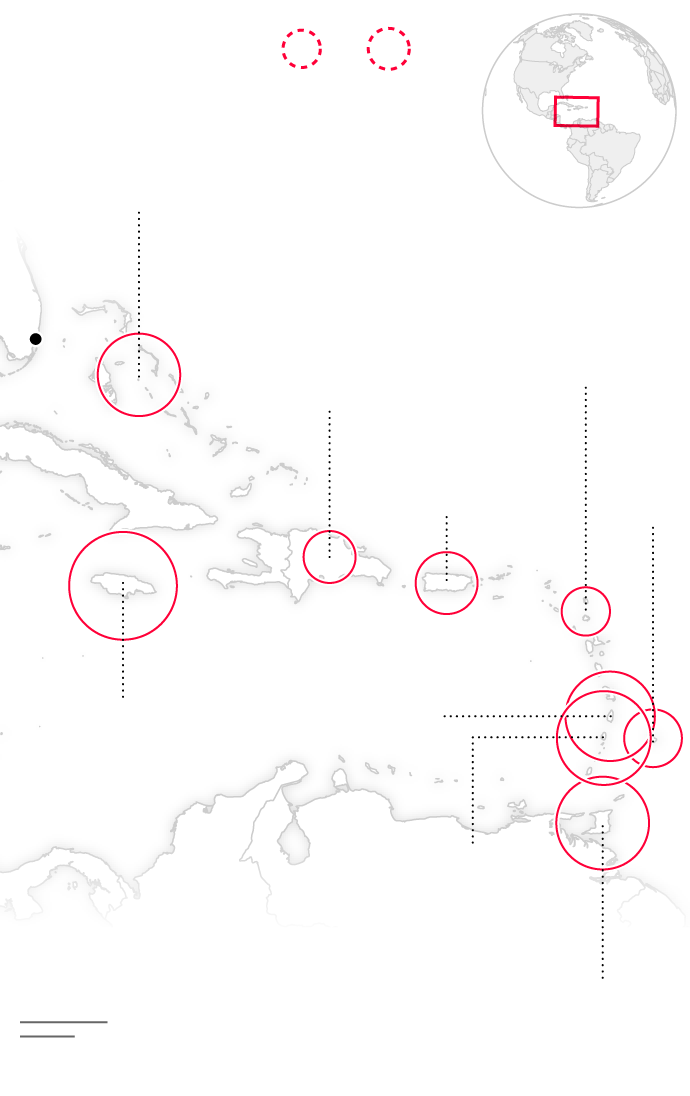
His arrest for gun smuggling made headlines not only because of his notoriety, but also because of the nature of the accusations against him. The Caribbean is now the most dangerous region in the world for deadly gun violence, and its leaders increasingly blame that on an influx of US guns — and on what they call America’s lack of will to confront the smuggling at its source.
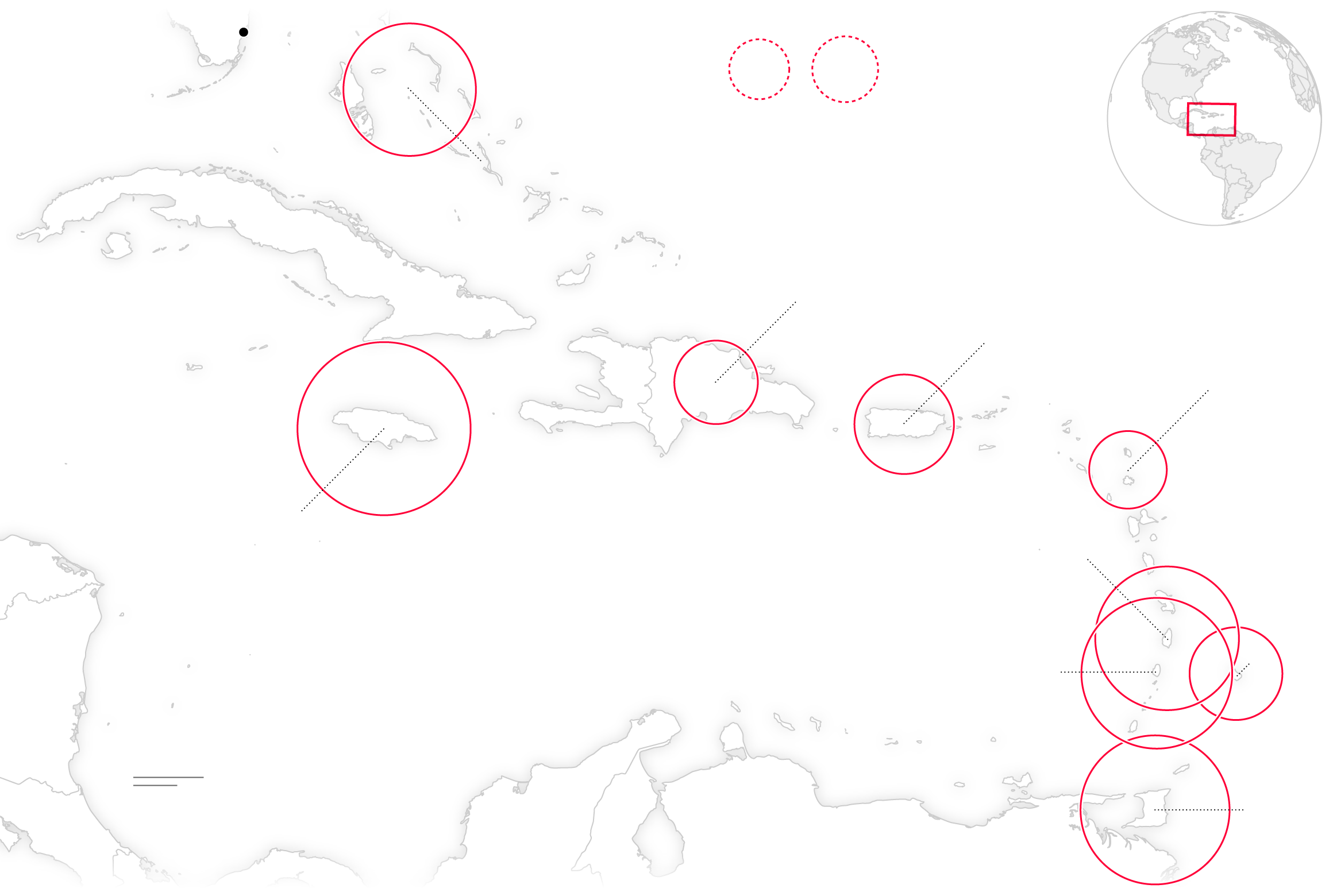
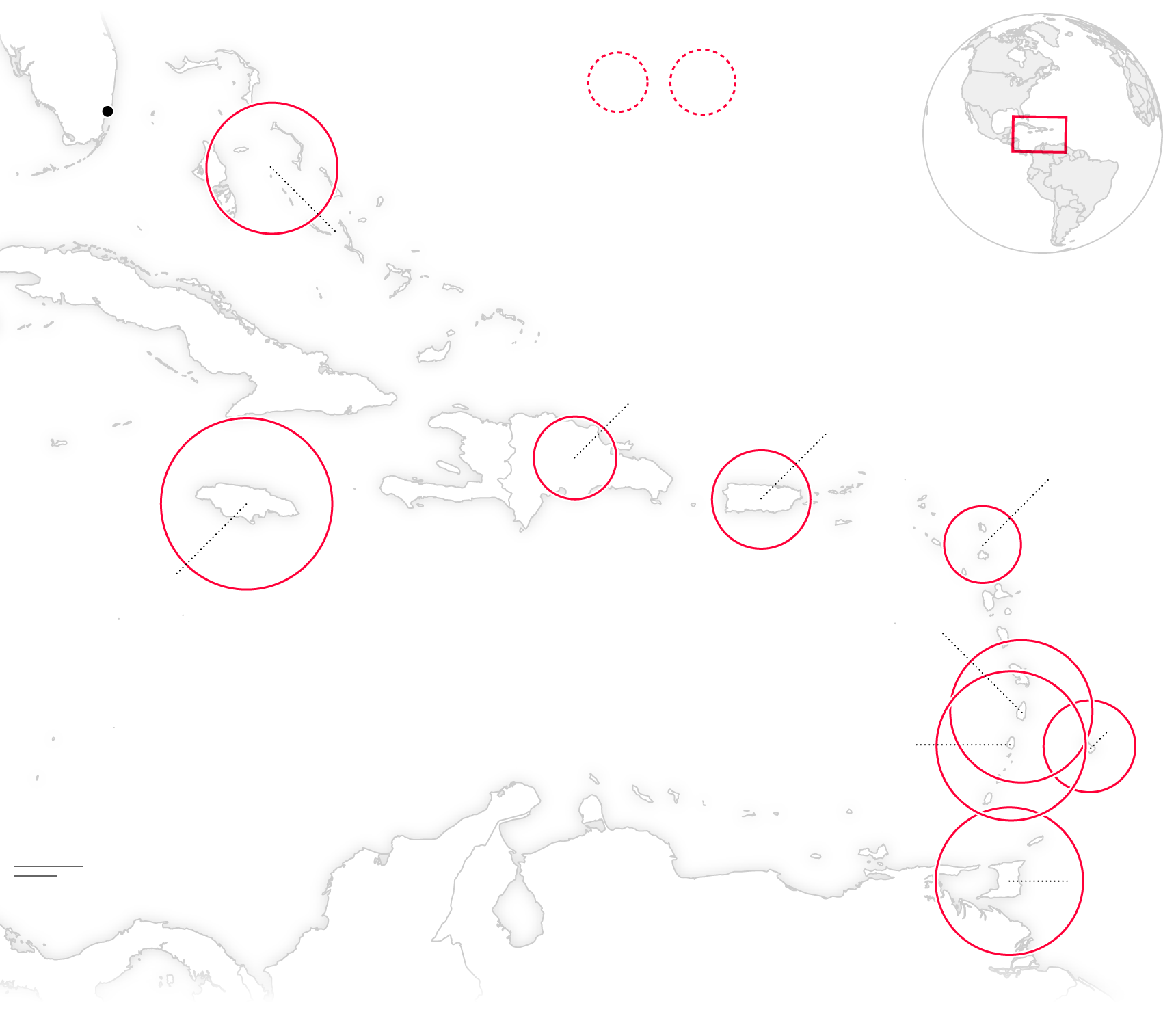
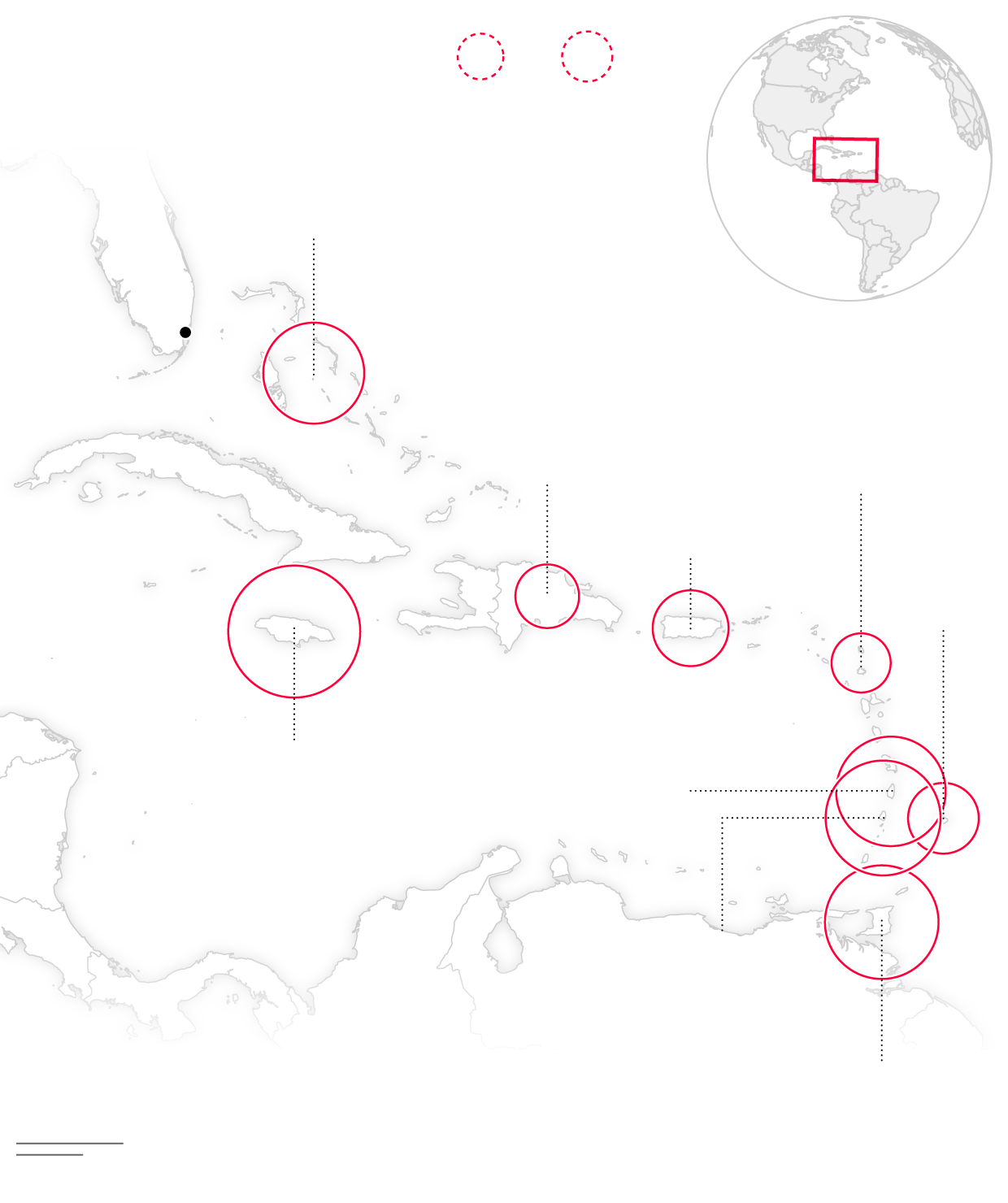
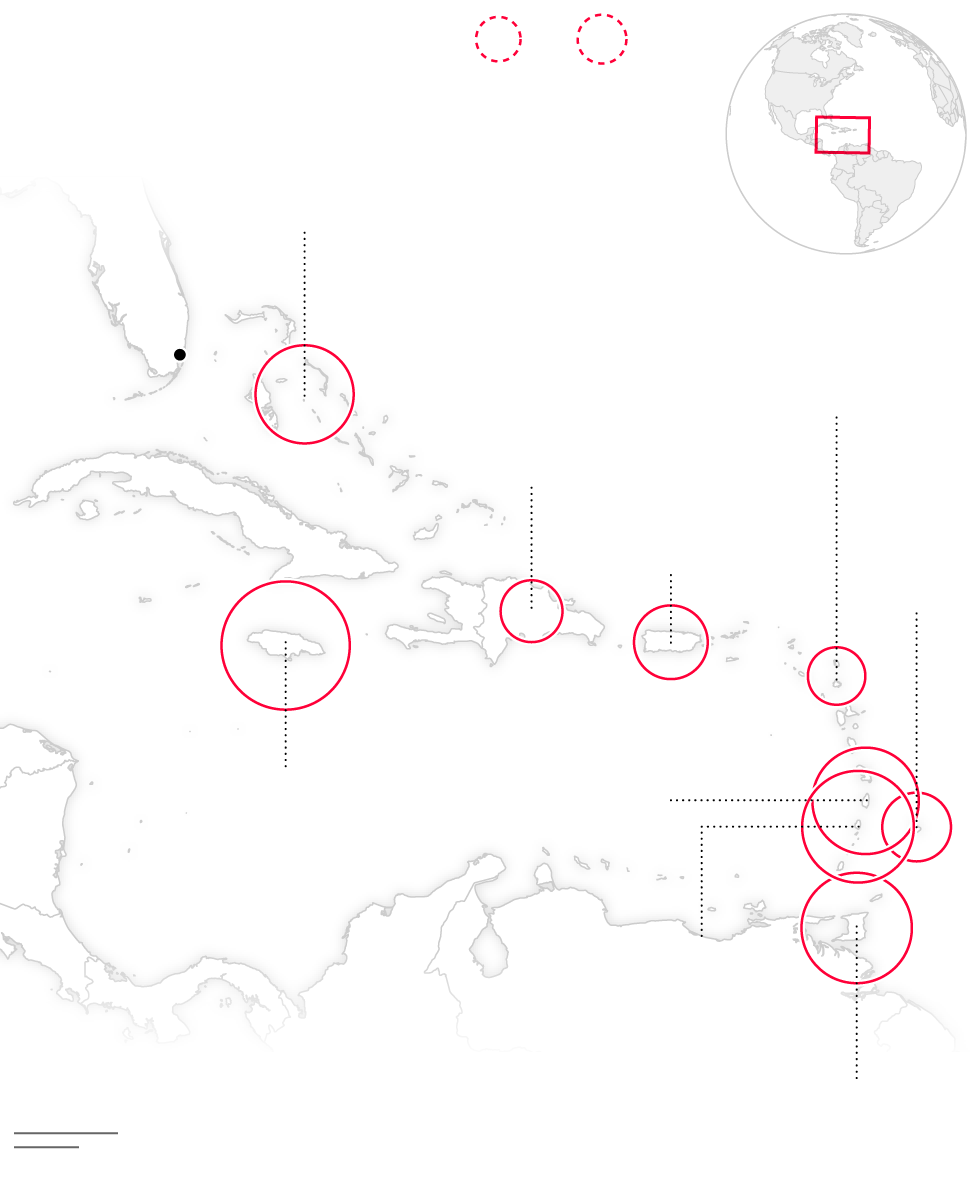
While it’s impossible to count precisely how many weapons are successfully smuggled, US investigators concede that the number of guns illegally pouring into the Caribbean has increased in recent years. So has violent crime. Of the 10 countries with the world’s highest homicide rates in 2022, five were in the Caribbean. (This tally doesn’t count Haiti, which doesn’t compile reliable statistics.) Even islands that had been relatively untouched have seen homicide rates soar — in the case of the British territory of Turks & Caicos, by 150% since 2021, according to Insight Crime, a Washington-based research organization that studies organized crime in the Americas.
Today, regional officials say about 90% of the Caribbean’s murder weapons are purchased legally by so-called straw buyers in the US and then smuggled overseas. Only a small fraction of guns found at crime scenes are traced to their source; of the 9,000 Caribbean crime guns that were recovered and traced from 2017 to 2021, only 724 had been legally exported from the US, according to the Bureau of Alcohol, Tobacco, Firearms and Explosives. The rest were trafficked.
US Guns Feed Violence
Miami
6.4
US
7.7
World
31.2
bahamas
turks &
caicos islands
cuba
Atlantic Ocean
12.4
dominican
republic
17.6
puerto rico
cayman
islands
10.7
antigua &
barbuda
british
virgin islands
haiti
uS virgin
islands
53.3
jamaica
Homicide rate per
100,000 population
36.7
saint lucia
dominica
Caribbean Sea
15.3
barbados
40.4
saint vincent and
the grenadines
aruba
curaÇao
100 mi
100 km
39.5
trinidad
& tobago
colombia
venezuela
6.4
US
7.7
World
Miami
31.2
bahamas
turks &
caicos islands
cuba
Atlantic Ocean
12.4
dominican
republic
17.6
puerto rico
cayman
islands
10.7
antigua &
barbuda
haiti
53.3
jamaica
Homicide rate per
100,000 population
36.7
saint lucia
dominica
Caribbean Sea
15.3
barbados
40.4
saint vincent
and the
grenadines
aruba
curaÇao
100 mi
39.5
trinidad
& tobago
100 km
colombia
venezuela
6.4
US
7.7
World
31.2
bahamas
Miami
Atlantic Ocean
12.4
dominican
republic
10.7
antigua &
barbuda
17.6
puerto
rico
cuba
15.3
barbados
haiti
Caribbean Sea
53.3
jamaica
Homicide rate per
100,000 population
36.7
saint
lucia
40.4
saint vincent
and the
grenadines
39.5
trinidad
& tobago
200 mi
200 km
6.4
US
7.7
World
31.2
bahamas
Atlantic Ocean
10.7
antigua &
barbuda
Miami
12.4
dominican
republic
17.6
puerto
rico
cuba
15.3
barbados
haiti
Caribbean Sea
53.3
jamaica
Homicide rate
per 100,000
population
36.7
saint
lucia
40.4
saint vincent
and the
grenadines
39.5
trinidad
& tobago
200 mi
200 km
6.4
US
7.7
World
31.2
bahamas
10.7
antigua &
barbuda
Miami
12.4
dominican
republic
17.6
puerto
rico
cuba
15.3
barbados
haiti
Caribbean Sea
36.7
saint
lucia
53.3
jamaica
Homicide
rate per
100,000
population
40.4
saint vincent
and the
grenadines
200 mi
39.5
trinidad
& tobago
200 km
Island authorities say that supply has only surged since the 2021 assassination of Haiti’s president virtually eliminated that nation’s ability to police gun trafficking. It’s now a hub for smuggling. Many of the firearms are purchased at US retailers by buyers working for smuggling networks based in the islands. Leaders from those countries point out that they’ve spent decades — and diverted millions of dollars from their domestic budgets — to help the US combat drug-trafficking rings.
Now they want the favor returned. “As we have assisted them in the war on drugs, they must assist us in the war on guns,” Andrew Holness, the Jamaican prime minister, said at a regional security summit last year.


Without that support, they fear the Caribbean could become the next Mexico, where academics and law enforcement officials estimate that criminal cartels heavily armed with US-made weapons control more than half the country’s territory.
Bloomberg News in the past year has documented how the US Commerce Department and other American government agencies have helped push the legal export of US-made guns to record levels, often with deadly results in the countries importing them.
At the same time, US efforts to track and police illicit gun trafficking have been underfunded and undercut by weak regulations and political pressure. Some officials from the US and Caribbean say the system effectively insulates gun dealers and manufacturers from accountability while leading many smuggling investigations to dead ends.
The Biden administration has responded by pushing through laws to make straw purchasing a federal offense. Since 2021, it also has stepped up oversight of gun dealers, quadrupling the number of license revocations for violating ATF rules. And in recent months, it has also dedicated additional staffing, opened new offices in the Caribbean and appointed a special prosecutor to work with regional authorities to combat gun crimes there.
But Graham Husbands, a firearms examiner in Barbados for nearly three decades, said those changes will accomplish little without even more robust tightening of oversight at the source — the US. Even by the ATF’s own accounting, it’s failing to meet its goal of inspecting each of the country’s 78,000 gun dealers and makers once every three years. The agency reported in 2022 it would need to more than double its inspector ranks to reach that target.
Even routine inspections can get ensnared by the politics surrounding guns in America. After Martin was arrested in Jamaica, where he’s now awaiting trial, investigators traced weapons from the confiscated shipments to gun stores in Florida and Georgia. Several months later, ATF inspectors showed up in the parking lot of one of the retailers in suburban Atlanta — not to investigate the straw-buying allegations but to conduct the first check on the store in about six years.

Before the inspectors could enter the store, Adventure Outdoors, they were confronted by four members of Georgia’s congressional delegation. Representative Marjorie Taylor Greene, flanked by television cameras, accused them of harassing a law-abiding business. The agents retreated to their vehicles, suspending the inspection of the store until the following day. The store’s manager, Eric Wallace, said in a recent interview that a tiny percentage of the tens of thousands of guns they sell each year turn up at crime scenes. “We shoot for perfection,” he said. “But any time there’s a human element, it’s impossible to have every line on every form be exactly right.”
Foreign leaders pressing for stronger American action recognize the Second Amendment and acknowledge they may not have the standing necessary to challenge the US legal protections afforded to the gun industry. Yet they decry an implicit unfairness.
As Philip Davis, the prime minister of the Bahamas, put it last year at a law-enforcement conference: “The right to bear arms in the United States does not mean that there is also a right to traffic those arms to Caribbean countries.”

The Kingston headquarters of the Jamaica Constabulary Force sits behind a yellow security wall streaked with brown stains from rusting razor wire. The unit that investigates gun trafficking works on the second floor, where stacks of giant ledger books with duct-taped bindings teeter atop mismatched filing cabinets. Scarred desks are covered with more papers, which are riffled by oscillating fans but pinned in place by staplers and coffee cups.
“Sorry,” one of the officers says to a visitor. “The air conditioning broke down yesterday.”
To stop the illicit flow of guns, law enforcement officials need resources, which are in short supply throughout the Caribbean. Regional officials say the most common way for guns to arrive here from the US is by sea. But monitoring every container that comes ashore would cost a fortune. So deterrence depends on randomized searches of shipping containers. Regionwide, security experts estimate that about 98% of all in-bound containers are never inspected.
Even when containers are electronically scanned, guns can easily slip past as disassembled parts hidden in cargo, enforcement veterans say. “I challenge the best X-ray examiner to find guns when they’re broken down among car parts or other metallic pieces,” said Jean-Marc Behar, a former ATF agent deployed to the Caribbean from 2013 to 2017.
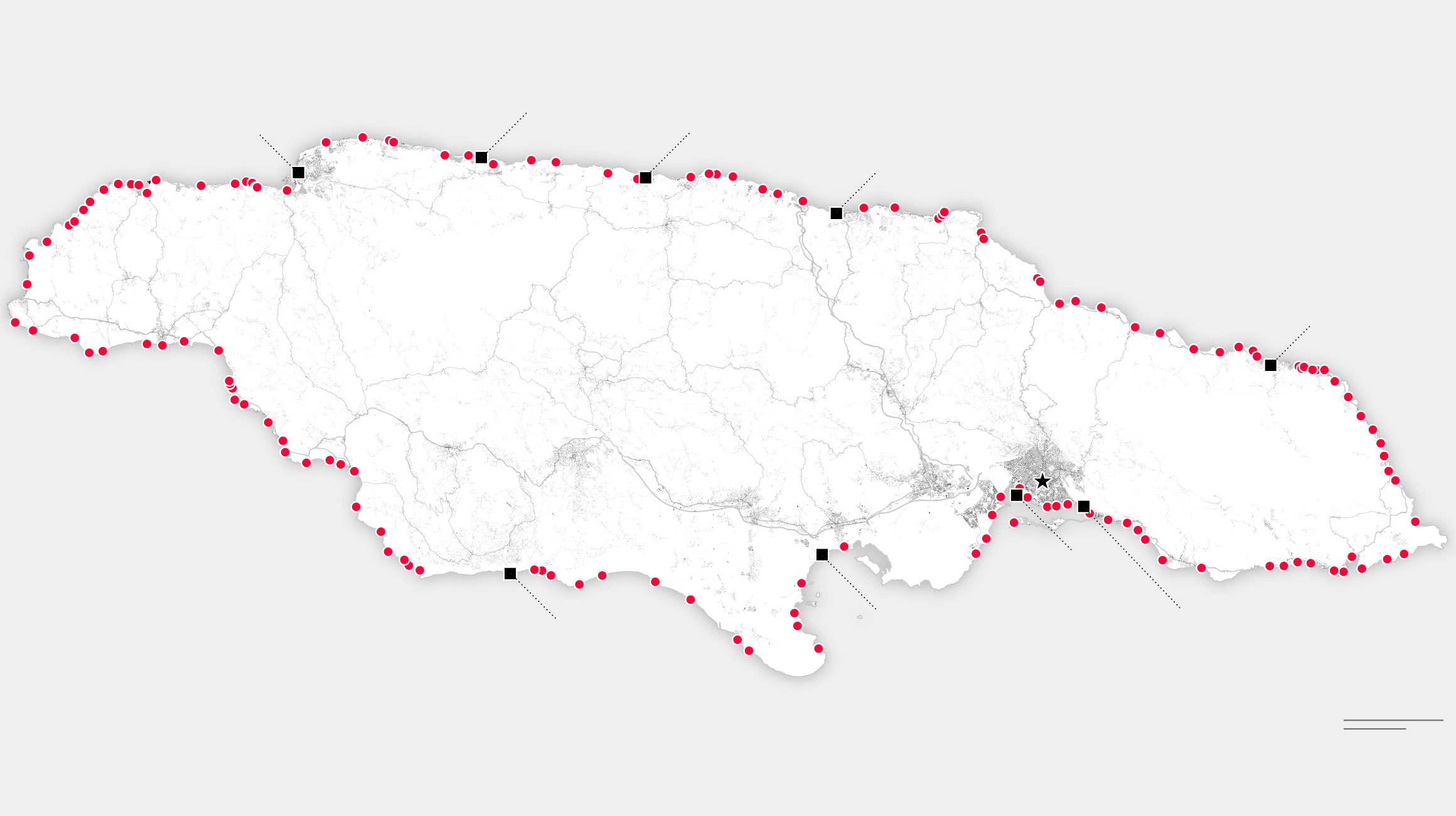
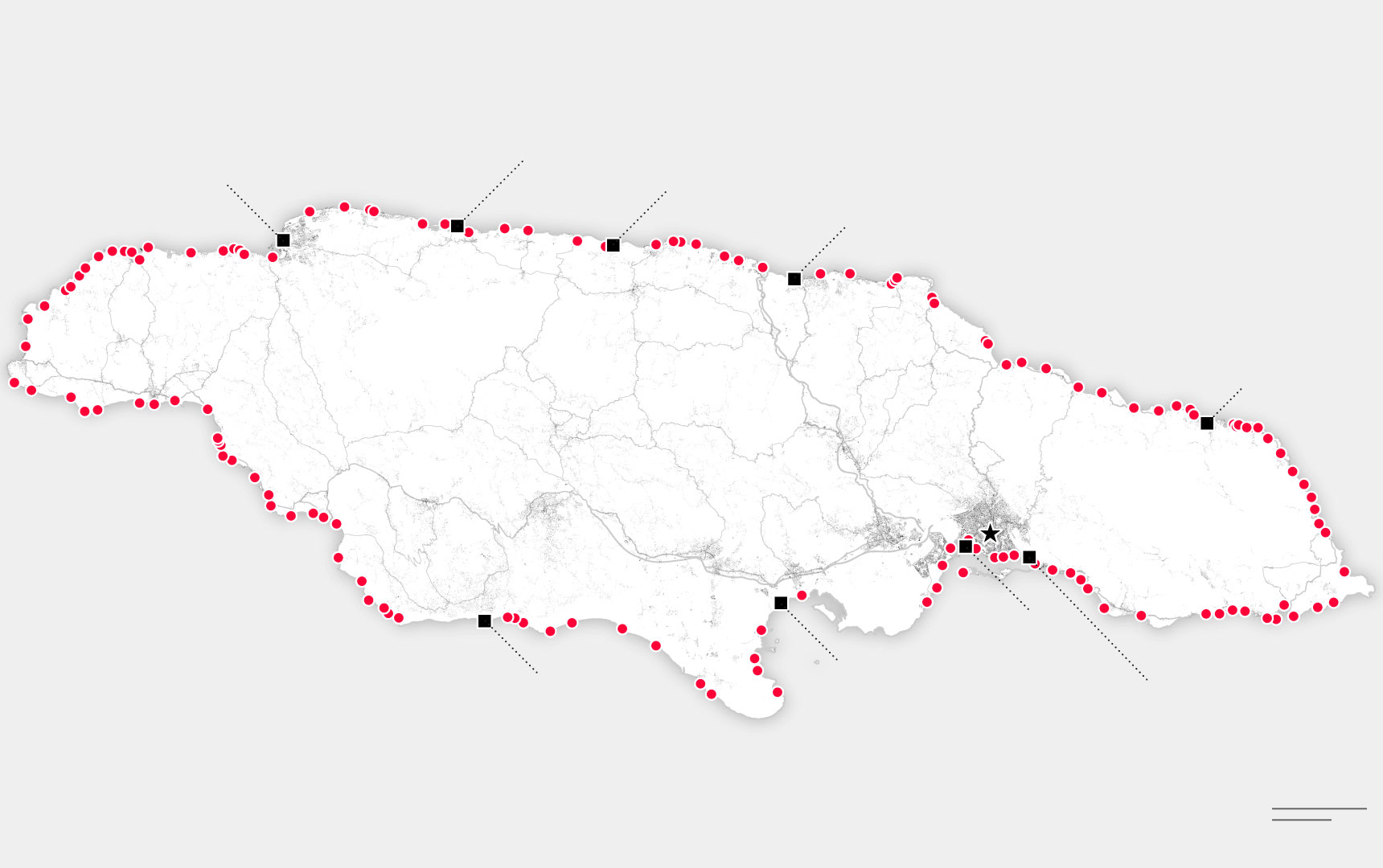
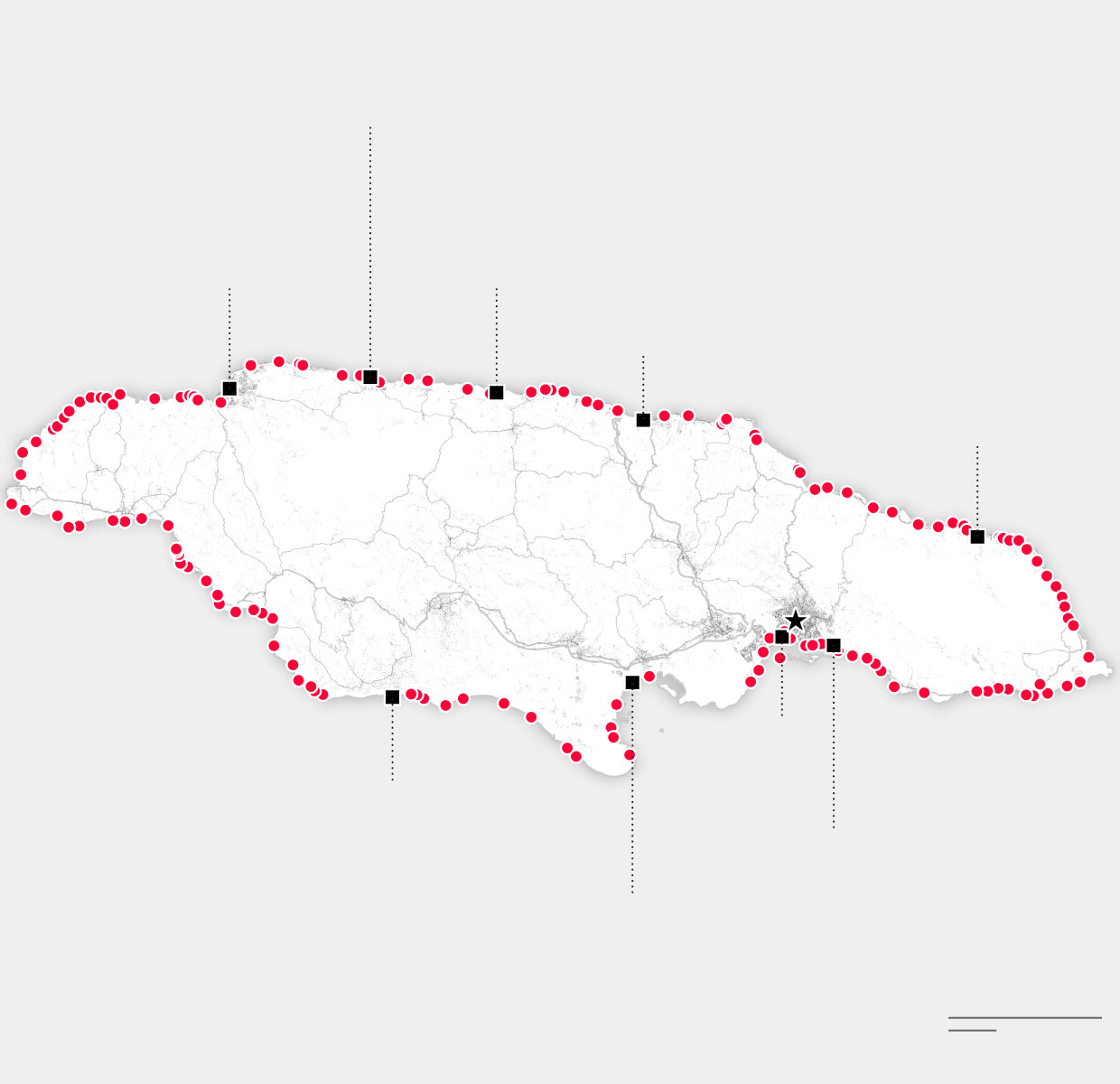
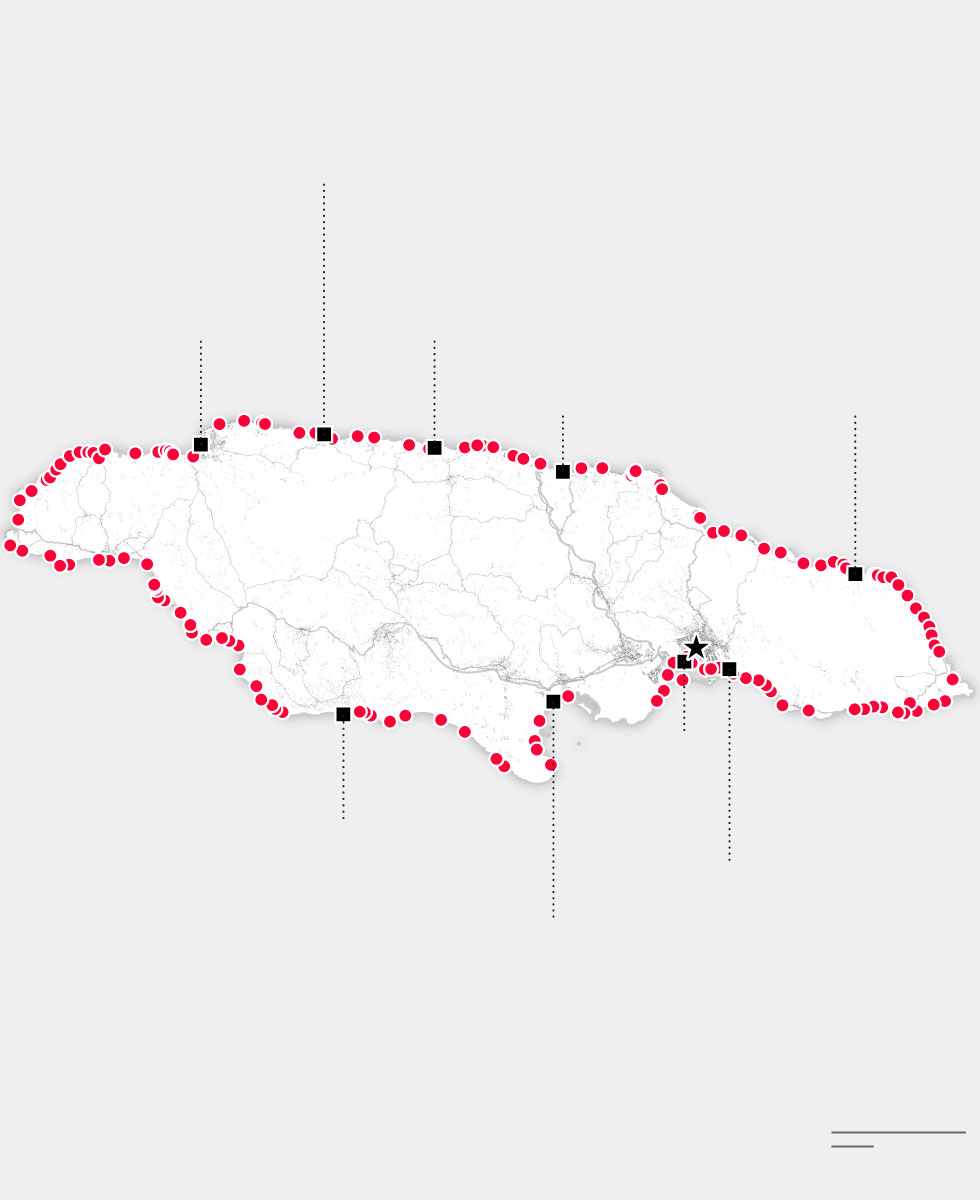
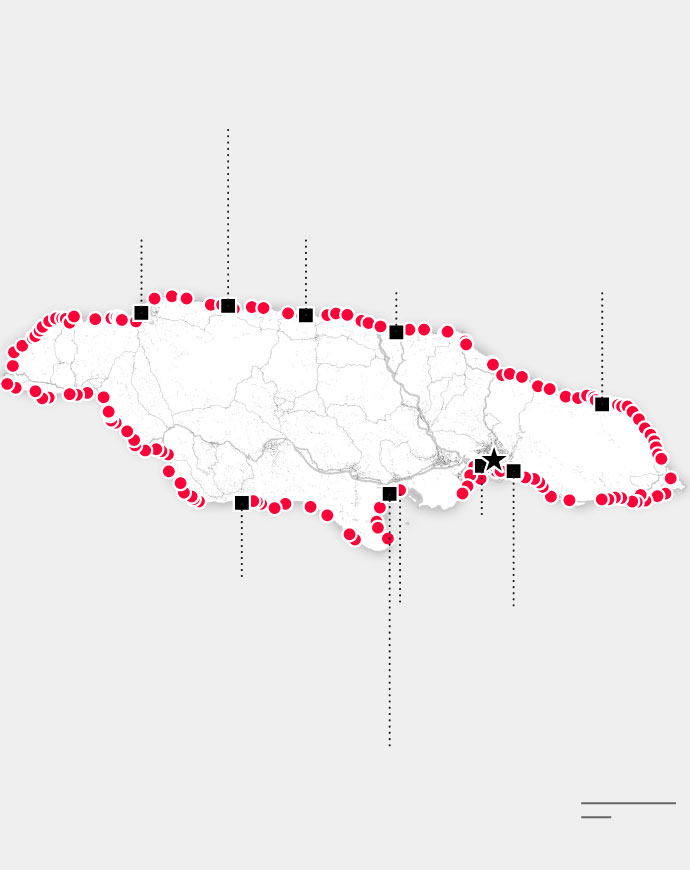
In Jamaica, shipping container inspections are conducted at 10 controlled ports spread roughly evenly around the island’s perimeter. But the police have a map in the office that marks the country’s “uncontrolled” ports — the 150 or so unloading zones that can’t be consistently monitored, places with names like Alligator Pond, Orange Cove and Bloody Bay.
Another is Old Harbour Bay, on the island’s southern coast. It’s a small fishing village where vendors hawk the day’s catch from stalls in a lot where seashell fragments crunch underfoot. At the waterline, dozens of beached wooden skiffs, their rainbow paint peeling from their hulls, await the next morning’s runs. Smugglers use boats like these, police say, to operate an illicit bartering market with Haitian vessels they meet on the open seas. In exchange for marijuana, which is produced cheaply and abundantly in Jamaica, the fishing boats return to the island with guns.
Beyond Control
◼ Controlled ports
● Uncontrolled ports
Falmouth
Discovery Bay
Montego Bay
Ocho Rios
Caribbean Sea
Port Antonio/
Prospect
jamaica
Kingston
Old Harbour
Bay
KW
and KCT
Port Esquivel
Cement
Factory
Port Kaiser
10 mi
10 km
◼ Controlled ports
● Uncontrolled ports
Caribbean Sea
Falmouth
Montego Bay
Discovery Bay
Ocho Rios
Port Antonio/
Prospect
jamaica
Kingston
Old Harbour
Bay
KW
and KCT
Port Esquivel
Port Kaiser
Cement
Factory
10 mi
10 km
◼ Controlled ports
● Uncontrolled ports
Falmouth
Caribbean Sea
Montego
Bay
Discovery
Bay
Ocho
Rios
Port Antonio/
Prospect
jamaica
Kingston
Old Harbour
Bay
KW and
KCT
Port
Kaiser
Cement
Factory
Port
Esquivel
20 mi
20 km
◼ Controlled ports
● Uncontrolled ports
Falmouth
Caribbean Sea
Montego
Bay
Discovery
Bay
Ocho
Rios
Port Antonio/
Prospect
jamaica
Kingston
Old Harbour
Bay
KW and
KCT
Port
Kaiser
Cement
Factory
Port
Esquivel
20 mi
20 km
◼ Controlled ports
● Uncontrolled ports
Falmouth
Caribbean Sea
Montego
Bay
Discovery
Bay
Ocho
Rios
Port Antonio/
Prospect
jamaica
Kingston
KW and
KCT
Port
Kaiser
Old
Harbour
Bay
Cement
Factory
Port
Esquivel
20 mi
20 km
This sort of trade — widely known as “guns for ganja” — has evolved since Haiti’s government collapsed and the country spiraled into unprecedented levels of poverty and violence. Today, everyday staples like rice and meat are traded as well, according to several investigators. This informal marketplace accounts for much of the roughly 200 US-made firearms that illicitly flow into Jamaica each month, according to the Jamaican Security Ministry.
In Old Harbour Bay, a community of 30,000, gun violence prompted authorities in November to temporarily impose a 6 p.m. curfew. The community registered 33 murders in 2022 — a rate of more than 100 per 100,000 people. (Jamaica now ranks first in the world with an overall homicide rate of about 53 per 100,000, according to the UN. That’s more than eight times that of the US.)
The responsibility for monitoring the boats that trade with Haiti falls largely to the island’s Coast Guard air patrols. But they’re overmatched by geography in Jamaica, whose maritime territory is 21 times larger than the island itself. “We’ve got two aircraft which spend a lot of their time doing patrols and looking for suspicious activity at sea,” said Anthony Clayton, lead author of Jamaica’s National Security Policy. “And on a number of occasions, all they can do is document it because there’s no one available to do an intercept.”
The US has called on the island governments to tighten screening at their ports and deter corruption among officers who patrol them. But Clayton points out a double standard: The US demands far more vigilant screening from other countries than it provides for its own outgoing cargo.
Behar, the former ATF agent, recalled a former supervisor’s reaction when he suggested they needed more support for international investigations. “He said, ‘Look, the gun left the US — what the hell do I care about it? It’s not my problem.’” Behar said he offered some pushback, but his boss summarized the views of their higher-ups: “Well, Jamaica should send officers to the US.”
Some Caribbean officials have made the trip north, to try to get a better handle on the challenges. A few years ago, Lt. Col. Michael Jones, who runs a regional security task force called CARICOM IMPACS, traveled to Miami and visited a port on the Miami River, where vessels are loaded on the way to Haiti. He wanted to see what sort of controls the US imposed on the shipments.
Today, when Jones recalls that visit, he recreates his facial expression upon witnessing the scene: His eyebrows climb his forehead, his mouth gapes and he slaps his palms to the sides of his cheeks — a pantomime of exasperation.
About a mile up the Miami River from Biscayne Bay lies a cramped and chaotic stretch of piers that could easily be mistaken for a dockside junkyard. At a half-dozen wharfs, a procession of delivery vans, pickup trucks, overladen dollies and wheelbarrows roll in and out, bringing a flea market’s worth of cargo to small shipping companies that run aging freighters back and forth to Haiti.
This area is unlike any commercial port in the US. Known as a “break-bulk” port because its cargo is broken into individual units, it’s a throwback to the days before shipping containers transformed maritime trade. A low-cost, seat-of-the-pants enterprise, break-bulk shipping provides business opportunities for Miami’s Haitian immigrants, and a lifeline of food, cars, second-hand clothing and household items for residents of the impoverished island. The sheer chaos of the system — blue plastic barrels, grain sacks, used mattresses, appliances and vehicles all stuffed under and atop the deck of each vessel — also offers a convenient portal for smugglers. In the 1980s, South American drug traffickers began using the ports as a major entry point for cocaine.
During the past decade, however, the illicit flow began running in the other direction as well; law enforcement officials say guns are now their main focus with break-bulk vessels. After Haiti’s president was killed in 2021, US Homeland Security Investigations noticed an uptick in firearms trafficking through the Miami River and other ports.
In 2022, US officials made an alarming seizure: For the first time, they found .50-caliber sniper rifles and belt-fed machine guns being smuggled from one of Miami’s break-bulk ports. US investigators say the increase in both volume and caliber seemed related to the chaos in Haiti. “It was like, ‘What is going on?’” recalled Anthony Salisbury, chief of the Miami office for HSI. The agency is now “seeing stuff that we’ve never even seen going to Latin America.”
Trying to screen such cargo is daunting. The staffing and budget for US Customs and Border Protection is too limited to give break-bulk wharves the dedicated security and X-ray scanners assigned to major container ports. So HSI agents intermittently inspect bulk facilities but often have to use search methods as low-tech as the ports themselves: sticking a knife into boxes and bundles and letting police dogs sniff for signs of gunpowder inside.
Philome Charles, owner of God is Able Shipping, said that on rare occasions, customs agents will arrive at his docks with a mobile X-ray scanner to search for contraband. But most of the time, screening is left to the shippers themselves.
“You have to know your customers,” said Charles, standing beside his 119-ton freighter as stevedores used forklifts and massive cargo nets to hoist shrink-wrapped bundles of clothing into the hold. “And they have to know that you won’t allow it.” Charles said vigilance has allowed him to avoid the legal problems that other shippers have faced when customs agents discovered that their vessels had been used to smuggle weapons.
No firearms or ammunition are manufactured anywhere in the Caribbean, and Haiti has been under a US arms embargo for decades. Yet the nation of 11 million people is now home to as many as 500,000 illicit guns, the vast majority smuggled from the US, according to Haiti’s National Commission for Disarmament, Dismantling and Reintegration.
In 2021, members of the Haitian gang 400 Mawozo purchased more than a dozen high-powered rifles from Florida gun shops and shipped them on a freighter from Miami to Haiti in plastic barrels crammed with shoes, clothing and bottles of Gatorade, according to US court records. Some of the guns arrived in Port-au-Prince just days before gang members in the city kidnapped 17 missionaries, all but one of them American.
But investigators say the weapons seized in such cases are a small fraction of the illegal firearms that arrive in Haiti undetected. And they worry that even when smugglers are caught, US gun laws don’t provide a strong deterrent. In 2019, Junior Joseph, a former US Marine sergeant who ran an Orlando gun shop, was convicted by a federal jury of smuggling more than 160 high-powered weapons to corrupt government officials in Haiti. The conviction carried a possible sentence of up to 20 years. But Joseph pleaded for leniency from the judge, citing his military service, which included tours of duty in Iraq and Afghanistan. He was sentenced to 16 months.
Complaints from Caribbean law officers echo the struggle that has consumed Mexico in the two decades since the US assault-weapons ban expired. For years, with an estimated flow of 250,000 guns a year smuggled into their country from the US, Mexican officials have pleaded — fruitlessly — for US leaders to significantly strengthen enforcement tools on the supply side, including stricter background checks on buyers.
After-the-fact help has been hard to find as well. In 2021, Mexican officials assembled a spreadsheet of more than 16,000 firearms that they said came from the US and were recovered at Mexican crime scenes in 2019–20. But with half a dozen agents in Mexico and a budget of just $1.5 million for the entire country, the ATF did little to pursue the leads. “There weren’t the resources to look at thousands of traces from years ago,” said Tim Sloan, the agency’s attache in Mexico until 2022. “It would be easier for me to walk on the moon.”
A major US enforcement initiative, dubbed Project Thor, began in Mexico in 2018 with a simple strategy: combine agents from several federal agencies to focus on gun smuggling by drug cartels, which have killed hundreds of police, prosecutors, judges and soldiers in recent years. The program quickly found that US-based trafficking networks were more extensive than previously known — handling more than 85% of all crime guns recovered in Mexico, according to documents obtained by Bloomberg News through a public-records request. Yet even with the increased effort, law enforcement officials seized fewer than 5,000 guns — less than 2% of the estimated flow across the US-Mexico border each year.
In an attempt to force tighter US safeguards, Mexican officials in 2021 sued eight US gunmakers in federal court in Massachusetts, arguing that the most effective way to deter smuggling is to compel manufacturers to monitor the gun shops they supply. Defendants included Colt’s Manufacturing LLC, which marketed guns under the names “El Jefe,” “El Grito” and “Emiliano Zapata 1911” — weapons that authorities say have become cartel status symbols.
The gunmakers argued that Mexican authorities had no legal grounds to hold them accountable for actions customers take with their products, especially in a foreign country. The lawsuit was dismissed last year. Mexico has appealed, and last year eight Caribbean countries joined its case.

Investigators in Mexico have criticized some of the Biden administration’s moves. In 2021, the US defunded major trafficking investigations like Project Thor, according to Sloan, the ATF’s former Mexico attache. It shifted resources to expand staffing for Homeland Security, which he said is unable to conduct high-level gun tracing or point-of-sale investigations in the US. Salisbury, head of HSI’s Miami office, said the agency is well-equipped to partner with other federal agencies and foreign governments to pursue traffickers. “It remains a high priority, amid other priorities,” he said.
The Biden administration has embraced a Trump-era effort to disrupt gun smuggling from the US into Mexico. Under the program, Operation Southbound, agents seized almost 2,000 firearms in the six months ending in March, a 66% increase.
The administration also helped create the Caribbean Crime Gun Intelligence Unit to share trace data with investigators from other countries and opened new HSI outposts in Haiti and the Bahamas, bringing the total number of offices in the region to seven. But the agency spends far more of its budget on immigration enforcement and removals than the kind of proactive intelligence operations that might preempt weapons trafficking, according to federal budget documents.
The Justice Department has used a measure that Biden signed into law in 2022 — making straw purchases a federal crime — to prosecute 207 defendants for firearms trafficking, including 80 for making straw purchases. And through November, the ATF has revoked the licenses of 173 firearm dealers, up from 40 in 2021.
Officials in the US and neighboring countries contend that many of these responses are reactive rather than preventative and don’t begin to match the magnitude of the problem. And the Biden administration’s most sweeping proposals — including a ban on assault weapon-style rifles and requiring record keeping for the private resale of guns — lack the support to win passage in Congress.
Christopher Landau, US ambassador to Mexico from 2019 to 2021, said any anti-smuggling program that relies on Mexican and Caribbean authorities without stronger measures in the US is doomed to failure.
“For administration after administration, in both parties, that’s remained our main focus and it hasn’t worked,” said Landau, who was appointed by former President Trump. “The top priority has to be to do things in the US we can do, and not let politics get in the way.”
Everytown for Gun Safety, which advocates gun-safety measures, is backed by Michael Bloomberg, founder and majority owner of Bloomberg News parent Bloomberg LP.