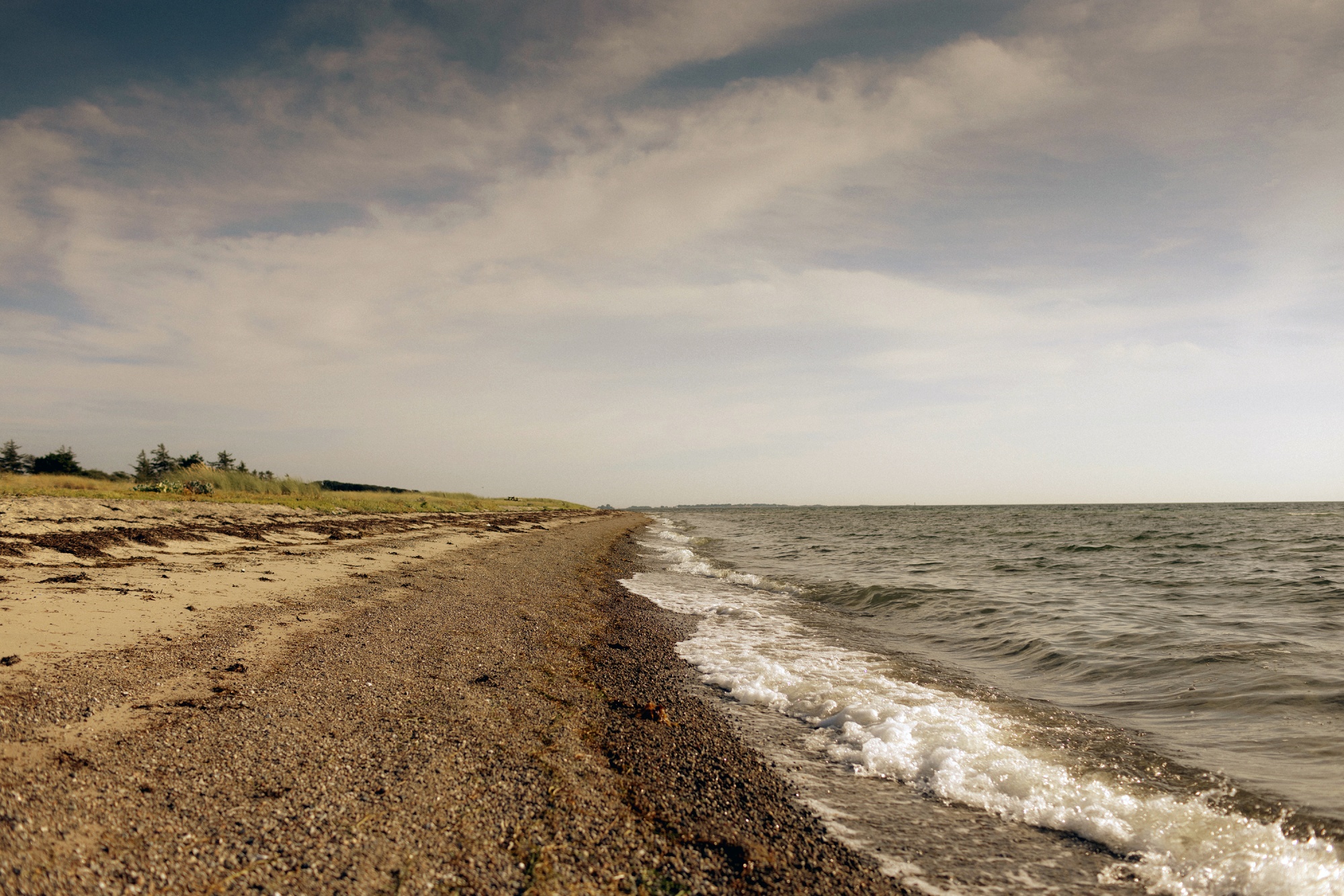
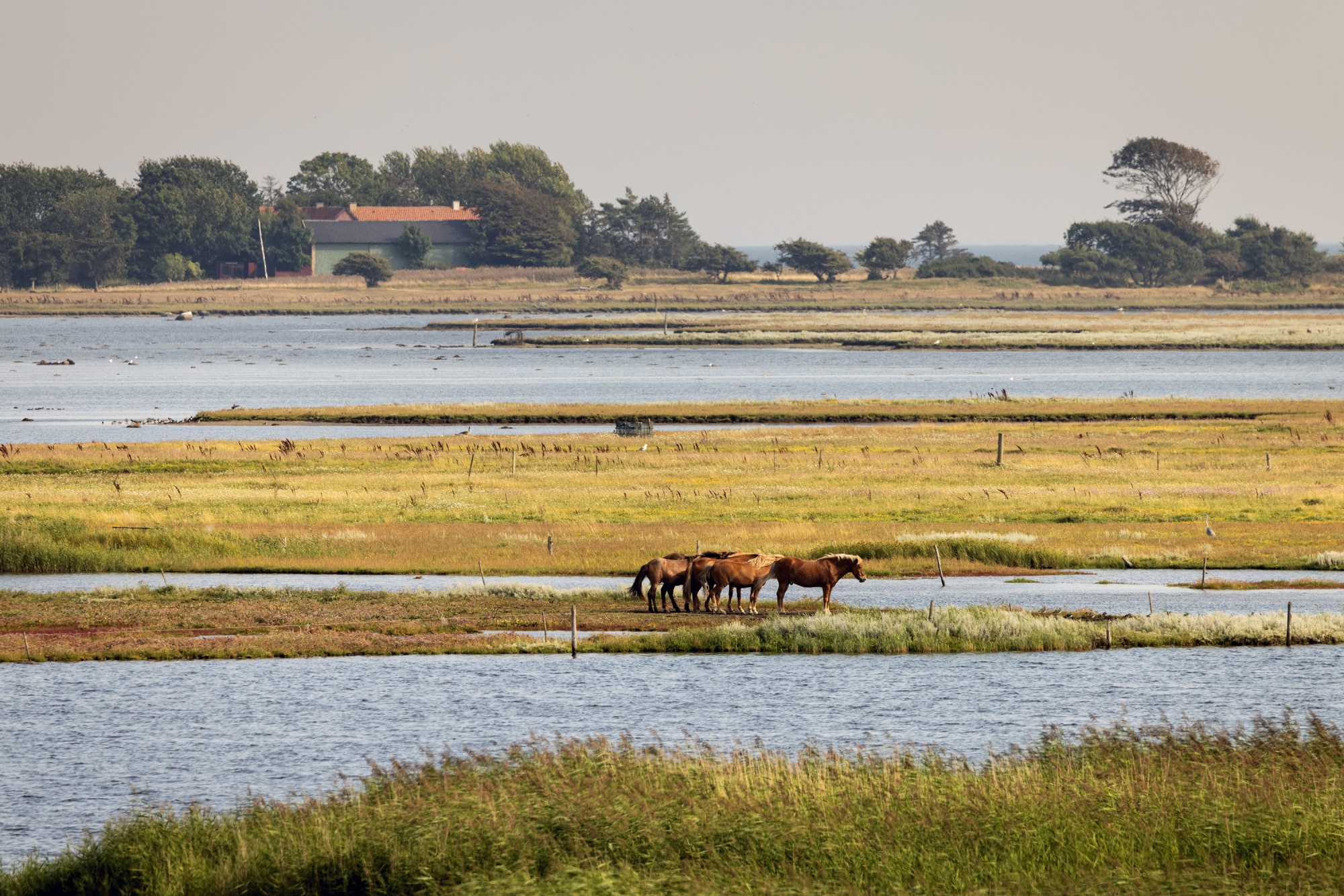
On the small Danish island of Agerso, fishermen and beach-goers see old tankers carry Russian oil through Denmark's narrow straits on a daily basis.
Copenhagen is toothless to stop the activity — which campaigners have called a 'ticking environmental bomb' — due to an 1857 treaty that allows free passage for international ships in its waters.
On Aug. 15, a 19-year-old, 820-foot tanker — the Turbo Voyager — passed by on its way to India, loaded with nearly three-quarters of a million barrels of crude from Russia. It's part of a network of vessels that Russia has assembled since its 2022 invasion of Ukraine to keep its oil flowing.
A Warning From Onboard the ‘Old Piles of Junk’ Ferrying Russia’s Oil Across the Baltic Sea
Mikael Pedersen gets a front-row view of Moscow’s floating oil economy nearly every time he goes to work. The Danish transit pilot boards tankers and container ships traveling through the Scandinavian country’s waters — many of them on their way from Russian ports to world markets — to help them navigate the narrow and difficult straits.
Located between the Baltic and North seas, Denmark has been a transit point for Russian trade for decades. But since Moscow’s 2022 invasion of Ukraine, Pedersen and his colleagues have seen a big change in the tankers they board carrying cargos of Russian crude.
Pedersen is one of a small number of non-crew members to have set foot on Russia’s hastily assembled shadow fleet of aging vessels — many with undeclared owners and often questionable insurance — in the last two years. In interviews with Bloomberg News, he and other pilots paint a picture of poorly maintained vessels, some of which struggle with outdated maps and equipment so old that it is hard to operate. They also report filthy living conditions for ill-prepared crews and say language barriers provide an added complication.
“Old piles of junk” is how Pedersen, who’s worked for the Danish state service DanPilot for 22 years, describes the vessels. And there are more of them than ever before.
The vessels provide a financial lifeline for Russia, helping it to keep its oil flowing to markets like China and India after sanctions were imposed on its exports to the West. The revenues help fund Russia’s war economy but, say officials and environmental organizations, it could be the vulnerable Baltic Sea that pays the price if fears of an oil spill come true.
Tracking Russia’s Shadow Fleet Through the Shallow Baltic Sea
Sources: Bloomberg News analysis of IHS Markit and Wood Mackenzie/Genscape data; Flanders Marine Institute, MarineRegions.org; National Oceanic and Atmospheric Administration
Since the beginning of 2022, 230 shadow fleet tankers have transported Russian crude oil through the Danish straits on 741 occasions, releasing an estimated $35 billion worth of crude out into the world, according to Bloomberg data. More than a third of the ships are 20 years or older — beyond the age at which they’d often be sold for scrap. And several display erratic behavior including turning off safety equipment.
Shadow Fleet Is Older and More Likely to Be Uninsured
- Ship insurer is a member of the International Group of P&I Clubs
- Not a member or insurer unknown
Sources: Bloomberg News analysis of data from IHS Markit and Wood Mackenzie/Genscape; Clarkson Research Services
Note: Includes ships currently in the shadow fleet
“What I fear most is a collision,” says Pedersen, who on average helps two shadow fleet tankers navigate Danish waters every week when he is on shift. “These are old, obsolete ships. We have terrible traffic out there. If there was a leak, it would be a big disaster.”
In March, a shadow fleet tanker on its way to load crude in Russia collided with another ship in the strait between Denmark and Sweden. Last year a fully loaded oil tanker lost propulsion, and for six hours drifted off the Danish island of Langeland.
Maritime traffic along the route — including tankers going through the Baltic Sea and Danish straits — has grown alongside Moscow’s need to find new markets beyond Europe.
At the start of 2022 shadow fleet tankers were all but non-existent. This year they made up 65% of the Russian oil shipments through the Baltic Sea.
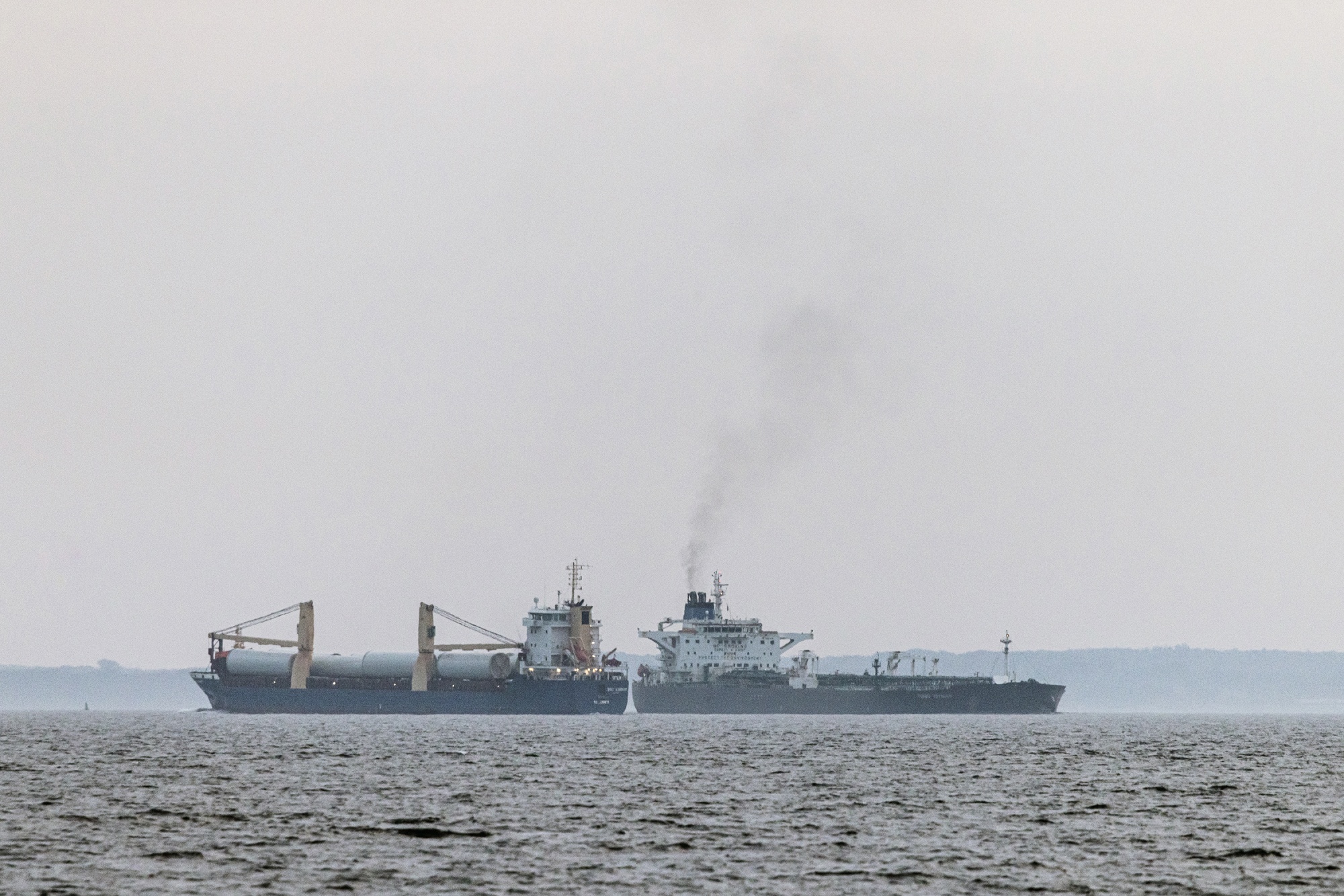
The shadow fleet tanker Turbo Voyager, to the right, passing the cargo ship BBC Lisbon close to Agerso, Denmark. Photographer: Carsten Snejbjerg/Bloomberg
Pedersen says the tankers are easily identifiable from their age, their opaque ownership and the fact that many sail under flags such as Gabon and the Cook Islands, which have poor safety enforcement records. He says it’s unclear whether the ships have proper insurance, or classification — a third-party report that ensures a vessel meets required safety standards. Western buyers and insurers insist that all ships have this classification.
Previously a ferry captain, Pedersen typically boards a foreign vessel in international waters near the island of Bornholm or the coastal town of Gedser and then helps it navigate through to the north tip of Skagen — a journey that normally takes at least 24 hours.
He says many of the shadow fleet tankers that he goes aboard are well known in the world of Danish transit pilots, adding that some are in such poor condition that pilots turn down jobs that require an overnight stay on the tankers, even when the ship has capacity for it.
“It can simply be so filthy,” says Pedersen, “we can’t live there.”
Danish Choke Point
Some critics believe Denmark should be doing more to stop Russian oil and argue that its narrow straits provide an obvious place to block shadow fleet tankers in transit. But a treaty dating back to 1857 that allows free passage for international ships in its waters and prevents authorities from intervening in traffic going through has left Copenhagen toothless to stop the activity.
To remind Denmark of its position, Maria Zakharova, spokeswoman for Russia’s foreign ministry, in May warned that any move by Copenhagen to restrict Russian ships in the Baltic Sea would be seen as hostile, according to the Interfax state news agency.
The Danish government has said it will not take unilateral action, but is in talks with other countries and institutions, including the European Union, about potential measures to tackle the shadow fleet and to minimize the risk of accidents. In July Denmark joined 43 other European nations in a joint “call to action” to disrupt Russia’s global shadow fleet which the UK estimates to be around 600 vessels strong.
“The Russian shadow fleet is an international problem that requires international solutions,” the Danish foreign ministry said in response to questions.
At the moment even sanctioned ships freely use Danish waters. In mid-July an 820-foot Russian tanker the Viktor Bakaev — sanctioned by the US and capable of carrying nearly 1 million barrels of oil, passed through the Scandinavian country’s waters unchallenged. Another sanctioned tanker, the Liberty — until last month known as the NS Laguna — followed in mid-August.
“You are allowed to sail in international waters, even if you are sailing for a country that we’re not friendly with in geopolitical terms,” Kristina Siig, a professor of maritime law at the University of Southern Denmark, says. “Denmark is not a place where we can just put up a fence and then enforce Russian oil sanctions. But if there’s a way in, it’s the environment.”
Coastal states can only stop vessels from Russia’s shadow fleet in international waters if there is an “acute or threatening” environmental problem or physical security issue, Sigg says. But even if Denmark could legally use environmental concerns as a way to make demands on ships entering the Danish straits, it would be very difficult to enforce, she adds.
Denmark instead offers state pilotage to aid transit. Pedersen and his colleagues help to ensure navigation is safe and minimize the risk of collisions. But some of the ships refuse the service. Costs, lax onboard security standards and fear of scrutiny are likely to be reasons, Pedersen says.
More than one in five of the 90 shadow fleet tankers that carried Russian oil through the Scandinavian country from the beginning of May to the middle of June did not use DanPilot transit services on any part of the journey, according to details obtained from the Danish Maritime Authority under a freedom of information request.
Private companies run similar transit services, but are much smaller than the state-owned operator which employs more than 200 pilots to help navigate the waters.
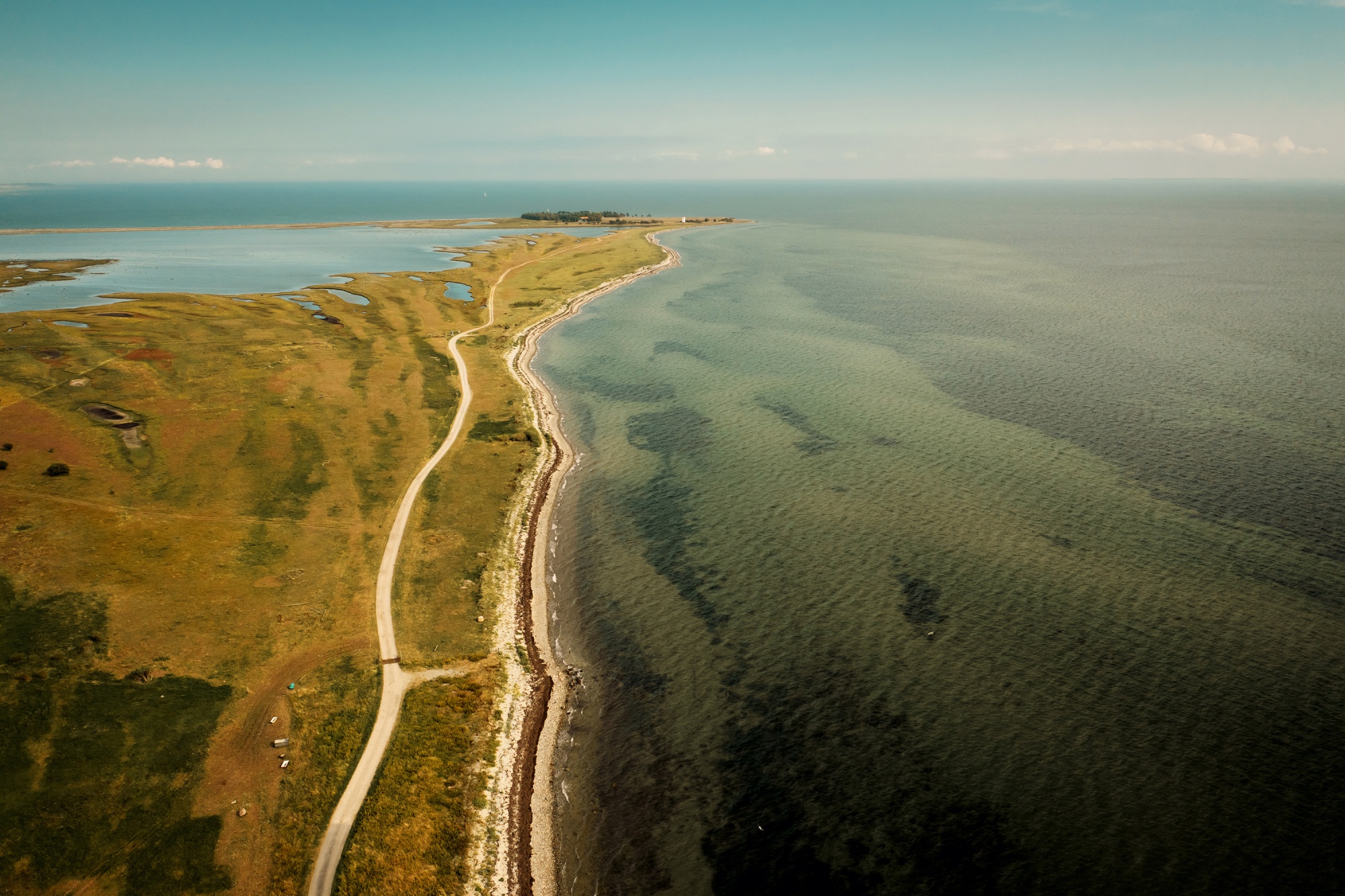
The Danish straits are narrow, the current is strong and the route is busy, making it a difficult path to steer for those unfamiliar with the waterway, says Pedersen. Some points along the journey are particularly challenging. Outside Agerso — an island in the Great Belt where three sea routes come together — he has witnessed several collisions, a grounding and “a lot of near misses” during his career.
Pilots are alarmed that many of the shadow fleet tankers carrying Russian crude through Danish straits are doing so without local assistance.
“Every day that passes we are just closer to an accident,” says Bjarne Caesar Skinnerup, a pilot at DanPilot. “It’s only a matter of time before it happens.”
Skinnerup regularly helps vessels with transit, including the shadow fleet. He says crews are often poorly trained; some lack orientation or fail to plan their transit. “You can tell that it’s not of the same quality as we’ve seen before,” he says of the crew.
In the Danish straits, shadow fleet tanker Aulis passes the island of Agerso on Aug. 1
This narrow and shallow waterway is busy with many types of vessels...
...that closely pass each other, increasing the risk of collision.
A Floating Car Park
The tankers load crude in Primorsk or Ust-Luga, then move through the Gulf of Finland, pass by the Baltic states — Estonia, Latvia and Lithuania — and Poland before reaching the tip of Sweden and finally Denmark. On their way out of the Baltic Sea, many stop outside Gotland, a Swedish island on the eastern side of the mainland, to refuel and load supplies. Tankers have also been seen bunkering outside Bornholm and Skagen.
Authorities in Sweden have evidence of tankers passing fully loaded through shallow waters where the keels are no more than a couple of meters from the seabed, says Tobias Billstrom, the foreign minister. In other cases, vessels are turning off transponders — safety equipment that shows where they are — masking their activities.
Just off the northern coast of Estonia there is a stretch of water that now resembles a floating car park for tankers bound for congested Russian ports, with dozens of ships waiting in international waters for their turn to load cargo. Estonia’s navy has warned of the danger of collision in the Gulf of Finland with vessels anchored too close to one another.
Tiina Tuurnala, chief executive officer of the Finnish Shipowners’ Association, says that the combination of shallow waters and winter conditions — the Gulf of Finland is covered in ice for an average of 100 days a year — make this part of the sea difficult to navigate. She worries that the shadow fleet crews might be too inexperienced and that the vast majority of the vessels are not ice-strengthened.
Finland has asked the EU to provide a standby vessel suited to those conditions and which can support national fleets in case of an oil spill in the northern parts of the Baltic Sea.
The UN’s International Maritime Organization has declared the sea a “particularly sensitive” area because of its shallow and enclosed nature, which makes the marine ecosystem more vulnerable to human impacts. Recovery after any potential oil spill could take decades, according to the government environmental research portal MarineFinland.
More than a third of the sea is less than 30 meters deep, and it takes about three decades for its waters to fully renew, according to a report last year by the Baltic Marine Environment Protection Commission, an intergovernmental organization.
In the event of an accident, oil could drift into an archipelago or coastal area within hours, making even the fastest response unlikely to prevent a catastrophe, according to MarineFinland.
Three Shadow Fleet Tankers Pass Through Ecological Areas in Danish Straits on Same Day
Sources: Bloomberg News analysis of data from IHS Markit and Wood Mackenzie/Genscape; Marine Regions; Baltic Marine Environment Protection Commission (HELCOM)
Note: The tanker Aulis carrying Russian crude oil passed another tanker Oneiroi returning to Primorsk, Russia on Aug. 1. Artemis carrying Russian crude oil entered Danish waters on Aug. 1.
In 2001, more than 2,000 tons of oil spilled into the Baltic Sea after a tanker collided with a cargo ship south of Mon in Denmark. It took eight years for the damaged areas to fully recover from the country’s worst ever oil spill, which killed up to 20,000 birds.
Kasper Thomassen, a former captain of one of the Danish navy’s recovery vessels which helped after the spill, says poor weather caused delays getting to the site, making the clean-up more complicated because oil had drifted onto the coasts.
State auditors recently warned that the Danish navy’s four oil recovery vessels — which have not changed since the 2001 disaster — are obsolete and not equipped to deal with certain types of spills.
Sweden expanded its coast guard fleet after 2008 — as Russia increased its oil terminal capacity at Baltic Sea ports — but local authorities responsible for clean-up efforts onshore would be hard pressed to handle large amounts of oil, according to Jonas Henriksson, a marine biologist at the Swedish Environmental Research Institute.
“Those of us who work on land expect that we will have to handle most of the oil from a spill,” Henriksson says. “Municipalities have now started to realize that they need to train the staff that will be involved, but we have the same equipment in storage as we had 20 years ago.”
Turning The Screw
At least 60 tankers — some that carry crude but others refined oil products — are now under EU, UK or US sanctions. Not all are deemed part of the shadow fleet. The UK has also sanctioned Russian insurer Ingosstrakh, an important provider of cover against risks including oil spills and collisions to the fleet. More measures are expected and sanctions will make it harder for ships to bunker, get supplies, visit ports and find buyers for their cargo.
EU and UK Ramp Up Sanctions Pressure On Russian Oil
- Sanctioned by
- US
- EU
- UK
Source: Bloomberg
But it would still be difficult for nation states to limit the ships’ movement through international waters without escalating tensions with Russia or breaching international agreements on shipping.
The challenge will be to tighten the screw on the shadow fleet without making the situation worse. By banning port visits, for example, Western authorities risk losing oversight of the condition of the ships, says Jaak Viilipus, head of the maritime department at Estonia’s climate ministry.
“Ships should be added to the list,” Viilipus says, “but it has to be done in a targeted manner, otherwise we will lose control of them.”
Danish transit pilotage is exempt from sanctions, but the pilots have faced criticism for helping to facilitate Russian trade. Addressing the accusations, a DanPilot spokesperson says “it is in everyone’s interest” that those ships are assisted in making the journey through Danish straits as safe as possible, and that the company is obliged by law to offer that assistance.
Pedersen, too, has no qualms about the work he and his colleagues do, as it minimizes the risk of accidents. “That’s our job. We make a difference,” Pedersen says. But he fears that, even when the conflict with Russia is resolved, the shadow fleet will continue to operate.
“Even if peace returns, will the shadow fleet stop?” he asks. “They may have realized it’s great they don’t have to have classification, insurance and so on. I’m nervous that it can create a precedent that we haven’t seen before.”