Olympic Athletes Go High-Tech to Beat Extreme Heat
From wearable heat sensors to inflatable ice pools, Olympic athletes are adjusting their training and performance routines for extreme heat.
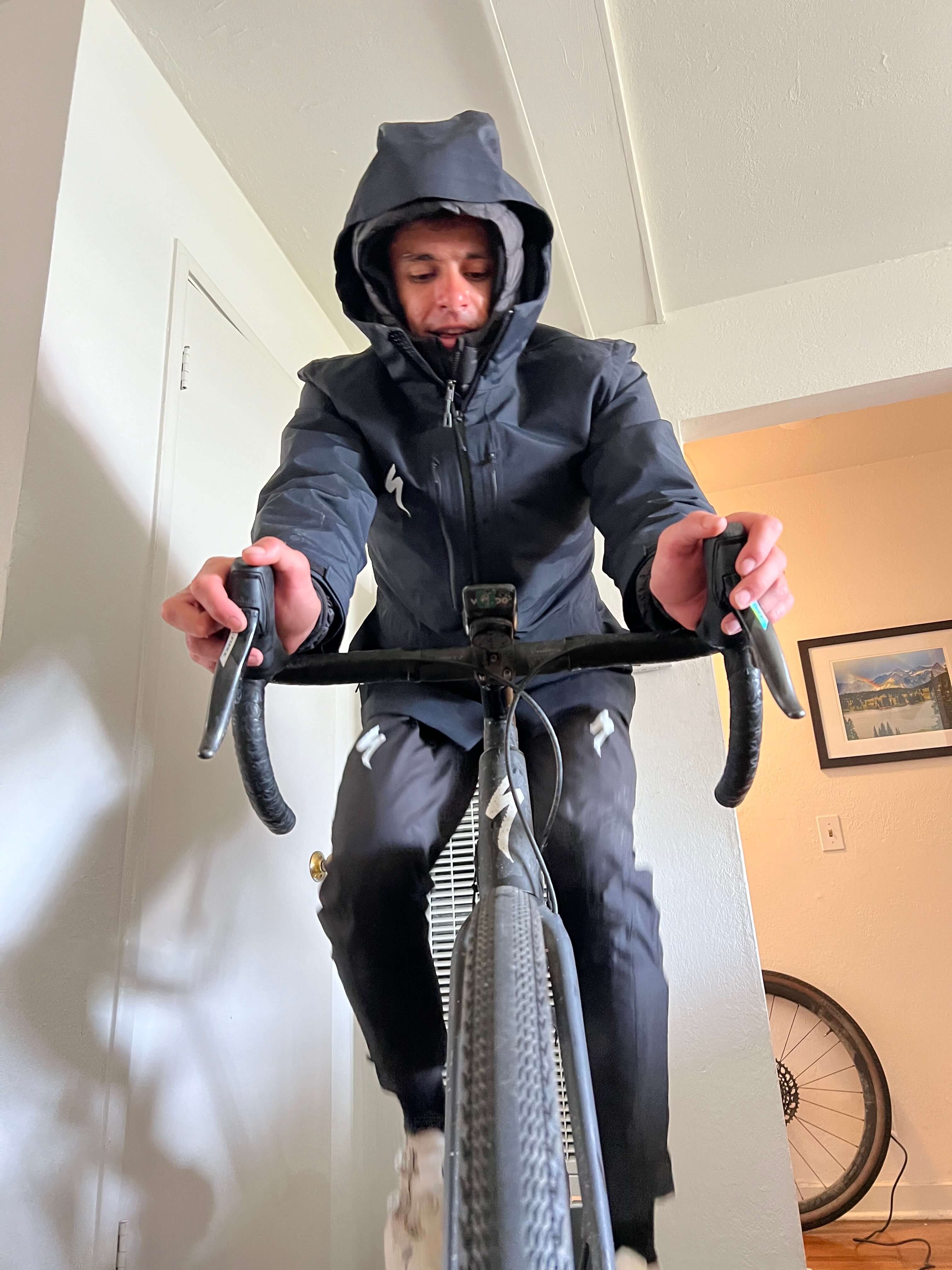
Christopher Blevins trains for the heat indoors in California. Source: Blevins
For Christopher Blevins, an elite mountain biker competing on Team USA at the Paris Olympics, discomfort is a normal part of competition.
“You never really feel good when you’re going as hard as you can for an hour and a half,” says Blevins, who also competed in the last Summer Olympic Games in Tokyo.
One thing that can make this already extreme effort even more demanding — heat. Once-temperate Paris has warmed 1.8C since it last hosted the Olympics in 1924, according to a recent report that also details a rise in “scorching days” and a 2,100% increase in tropical nights. The same stone buildings, zinc rooftops and narrow streets that make Paris so charming can also make it swelter.
Blevins is just one athlete among thousands who are finding ways to contend with it. Other events to be held in the heat-prone city center include beach volleyball, archery, cycling, athletics, football, hockey, and tennis.
Among the most grueling Olympic events is likely to be the marathon, which starts at the large plaza at Paris City Hall, an area with a high density of zinc rooftops and lack of vegetation. Nearly 80% of Paris’ rooftops are made of zinc, which can heat up to 90C (194F) on a sunny day, heating the area around them.
- Rooftop material
- Zinc
- Mineral (concrete etc.)
- Tile
- Green
The race continues along the Seine, which cools the air around it by several degrees, before diverting around Opera, one of the hottest areas in the city. Building materials, urban density and narrow streets combine to trap heat in some parts of the city, making them more prone to the urban heat island effect, where temperatures rise above surrounding rural areas.
- Urban heat island risk level
- Low
- Moderate
- High
As runners leave the city and continue to Versailles, parks create a cooling effect. The increase in elevation outside the capital, that will be physically demanding on the runners, also contributes to how the city traps heat.
Sources: International Olympic Committee; Paris Urbanism Agency (APUR); Institut Paris Region; National Institute of Geographic and Forest Information
An analysis in The Lancet last year ranked Paris as the European capital most vulnerable to heat waves, but the city is far from anomalous. All over the world, a growing number of athletic events face rising heat risk as climate change turns up the global thermostat. For Olympics organizers, coaches and athletes, that means developing a comprehensive heat playbook — from low-tech measures such as proper hydration to sophisticated sensors that help athletes maintain peak performance without sacrificing safety.
“The heat sometimes brings this physiological panic response where your whole system is telling you to get out of there and go cool off,” says Blevins. “Racing is always going to be a game of pushing beyond what your body’s telling you. I think that you run into interesting territory when that’s compounded by extreme heat.”

Blevins at the UCI Mountain Bike World Cup Cross-Country in Brazil in April. Photographer: Michal Cerveny/CTK/AP Images
The harder the human body works, the hotter it gets. Roughly 80% of the energy generated by performing muscular exercises is released as heat, according to Mike Sawka, an environmental physiologist and professor at Georgia Tech. When external temperatures are cool, it’s easy for the body to dissipate that heat through thermal radiation and sweat. But when temperatures soar, and especially when it’s humid, the body struggles to keep up.
“The athlete is not a roasted chicken in an oven. He is not cooked by the environment,” says Dr. Sebastien Racinais, heat expert in the International Olympic Committee’s Medical and Scientific Commission Games Group. “The athlete is producing the heat himself or herself.”
This is also why athletic performance often declines when it’s hot: The body has to devote more resources to cooling itself down. At rest, a human heart might pump five liters of blood per minute to move nutrients and waste around the body. Exercise can bring that to more like 15 liters per minute, but heat will force the body to pull some of that blood out of main circulation and into the skin for cooling. At that point, “it’s harder to maintain that needed blood cardiac output and blood pressure regulation,” says Sawka.
The impacts are most acute when it comes to the intensity and duration of athletic performance, which is why Racinais says events such as the marathon, half-marathon and 10,000-meter races are the highest-risk. “This is the window where you have both intensity high enough to produce a lot of heat and duration long enough for this heat to accumulate,” he says.
Marathon Is Olympics’ Highest-Risk Event
Note: Results based on biennial World Athletics Championship results from 1999–2011.
Kristian Blummenfelt, a Norwegian triathlete who won the gold in Tokyo, says heat stress makes for a special kind of suffering. “You can be forced to be standing still on a bike or on the road, not because you are in poor shape but just the heat is basically killing your legs,” he says.
In the marathon stage of the 2022 Ironman World Championships — held in Kona, Hawaii, where temperatures reached 31C with 65% humidity — Blummenfelt fell off pace with 10 kilometers (6.2 miles) left in the race. “My core temperature went through the roof, up to almost 41C,” he says. A core body temperature of 40C or higher is a sign of heat stroke that, if not properly treated, can be fatal. In this case, the consequences were less severe: Blummenfelt’s fellow Norwegian Gustav Iden pulled away to win the race, leaving him to finish third.
A CORE sensor worn by Blummenfelt provides insight into an athlete’s physiological response when his core body temperature peaked at an estimated 40.8C and needed medical attention.
Race Start
Blummenfelt began the marathon stage with his core temperature at a comfortable level.
Source: CORE

Core Temperature
Skin Temperature
Signs of cooling efforts working
More aggressive cooling efforts
45 Minutes Later
His core temperature climbed 0.7C and remained stable for 80 minutes. Blummenfelt's skin temperature repeatedly and abruptly dropped by several degrees after his effective cooling efforts with water.
2 Hours Later
His skin temperature has larger and more sudden drops after ice went into his suit and he poured water over his head at aid stations. Yet his core temperature still climbed above 40C and remained there for about 50 minutes.
Source: CORE
Signs of Heat Stroke
Blummenfelt lost his lead to competitor Iden.
Source: Calculations from GPS data collected by CORE
Collapse
Blummenfelt collapsed after the finish. His core temperature peaked and remained above 40C for several minutes, and did not drop significantly for 20 minutes while receiving medical attention.
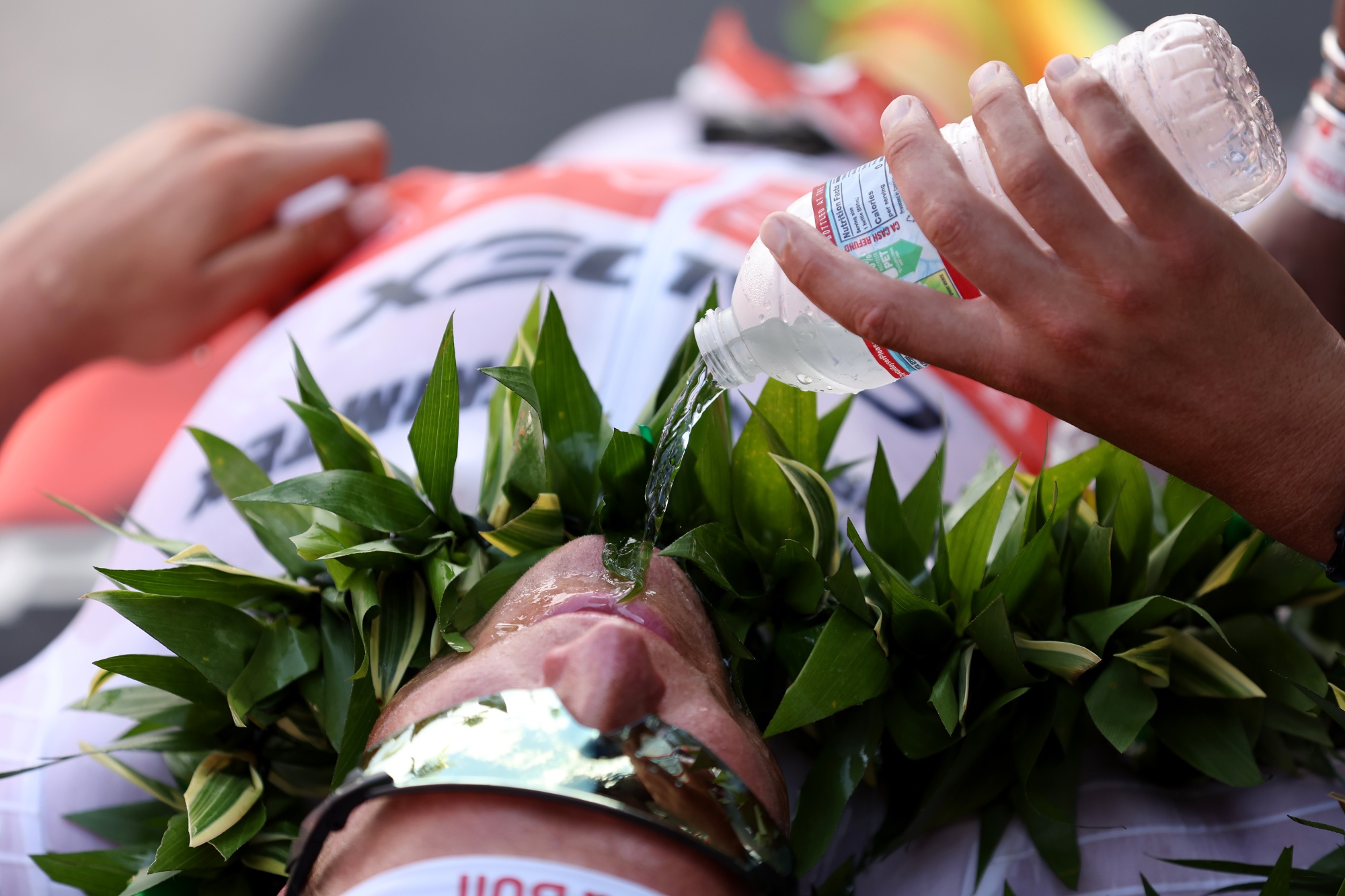
Blummenfelt drinks water lying down after finishing third during the Ironman World Championships in 2022. Photographer: Ezra Shaw/Getty Images for Ironman
The good news is that athletes can adapt. “When you introduce a specific stress on the human body, it will adapt to this specific stress,” Racinais says. And because adapting can mean the difference between an Olympic medal and the emergency room, athletes are increasingly focused on tactics for achieving it. The most critical piece of adaptation is training in the heat. A few weeks before competing in Tokyo in 2021, Blummenfelt traveled to Thailand to train; in the leadup to Paris, he’s been incorporating heat training into sessions in the French Pyrenees. Blevins, who lives and trains in Santa Cruz, California, dons five layers of clothing for indoor heat-training rides, which he complements with time in the sauna.
Indian triathlete Pragnya Mohan usually trains in the UK, as much of India is too hot for most of the year to train outdoors. But the UK’s milder conditions are a hindrance when she has to compete in hotter climates. Last year, Mohan had a competition in India during which temperatures were expected to hit 40C. She flew in two weeks early to acclimate.
This type of training essentially teaches the body to sweat more and to cool itself more efficiently. Even a week of exposure can make a big difference, says Brent Ruby, director of the Montana Center for Work Physiology and Exercise Metabolism at the University of Montana. “We’re the best animals on the planet as far as thermal regulation,” Ruby says. “But you have to have those critical talents dialed up. Otherwise, they’re not going to work.”
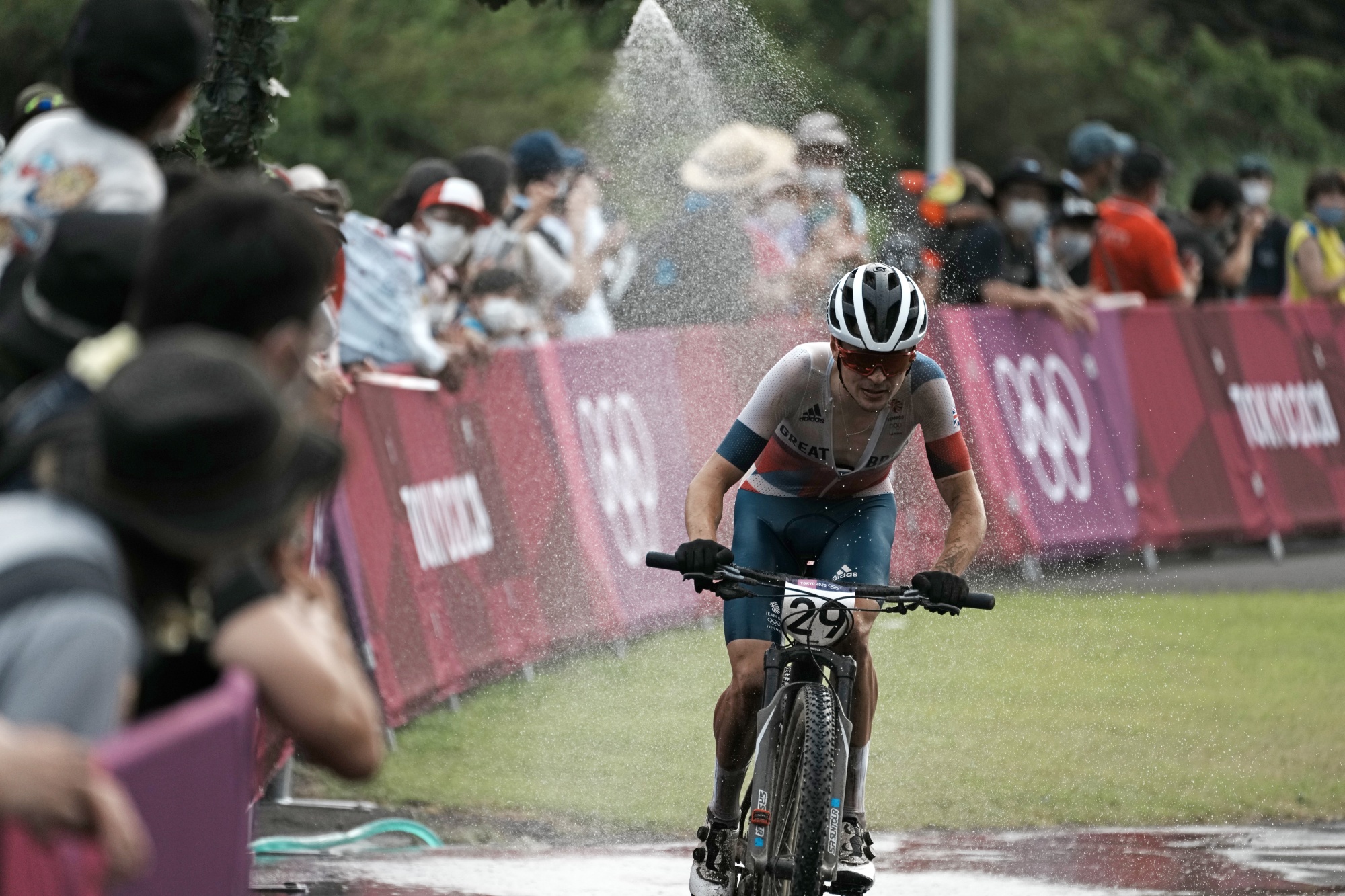
Thomas Pidcock during the men’s cross country mountain bike competition at the Summer Olympics in Japan in 2021. Photographer: Thibault Camus/AP Photo
Still, it’s not enough to simply train in hot conditions and hope for the best. For athletes competing at the highest levels, even small adjustments on race day can be the difference between finishing on or off the podium. That’s why many of them are turning to high-tech sensors to help monitor their body conditions both in training and during a competition.
One key indicator of heat stress is core body temperature, which in a lab or hospital setting is measured by clinicians using a rectal thermometer. This, of course, is not really an option for athletes. While there are experimental efforts to use ingestible thermometers, known as e-pills, they can be expensive and a hassle to deploy. It’s also not necessary, says Ruby: By the time core temperature starts to rise, it’s often too late to prevent problems.
Instead, athletes like Blummenfelt are turning to CORE, a Swiss startup that makes a roughly $300 sensor for tracking heat strain. Founded in 2019, CORE uses a thermal energy transfer sensor — also known as a heat flux sensor — that athletes can wear on the same chest strap they already use for heart rate monitors. Made by CORE’s parent company, GreenTeg, the sensor measures the flow of heat energy from the skin.
Imagine holding a metal wrench in one hand and a piece of paper in another. The surface temperature of each will be roughly the same because they are in the same ambient conditions, but the wrench will feel colder. This is because the thermal transfer from your hand to the metal is faster than it is to the paper. The nerves in your skin are acting as heat flux sensors. CORE’s sensors do likewise, measuring the heat being thrown off by the body during exercise.
“The marketplace is starting to recognize that they don’t need to obsess so much about measuring internal body temperature,” Ruby says. “Let’s measure on the skin and combine that with something as simple as heart rate and athletes can make very smart decisions.”
As an example of the insights that come from sensors, Ross McGraw, head of CORE and a professional triathlete himself, points to cyclists’ habit of zipping up their jerseys and dousing themselves in water to cool off during mountain descents. This technique helps lower body temperatures, but CORE sensors showed that most riders aren’t doing enough of it to prepare for the next climb. “It’s counterintuitive to dump more water on because it doesn’t feel great,” McGraw says. “At that point, you’re feeling chilly.”
Most athletes have other tools in their cool-down arsenal. Hydration is a universal obsession. Some use ice vests before and during events. Blevins brings a special cooling mattress, and at least eight nations will bring their own air conditioners to Paris, where the Olympic Village relies mainly on a geothermal cooling system. At the Tokyo Games, Blummenfelt’s victory became a minor viral sensation because he wore a see-through white outfit, which his coach selected after CORE sensors determined the material kept the racers’ bodies coolest.
The Olympics themselves are also making adjustments. In Tokyo, organizers shifted some scheduling to avoid the warmest parts of the day, and added an education campaign to teach athletes how to avoid exertional heat stroke (EHS). They also installed a “heat deck” at key sites, with medical equipment, inflatable pools of ice, and physicians trained in handling EHS. That setup, which will also be in place in Paris, made it easier to help athletes cool down in under 30 minutes, an important threshold for avoiding significant long-term health impacts.
All of these tactics will be increasingly necessary as the planet warms, especially if the Summer Olympics continue to be held in July and August — often the hottest time of the year in the northern hemisphere. Scientists use the “wet-bulb globe temperature” — which includes heat, humidity, wind speed, sun angle and cloud cover — to quantify the danger rising heat poses to the human body. The higher the reading, the less sweat can evaporate, making it harder to cool down.
It Could Get More Dangerous to Host Marathons in August
Note: Impact under a low-emission scenario (RCP2.6) is represented in the graphic.
Mid-summer timing “wasn’t always the tradition,” says Daniel Scott, professor and research chair in the department of geography and environmental management at the University of Waterloo. The first Paris Olympics in 1900 started in May, and the 1964 Summer Games in Tokyo — the first Olympics held in Asia — took place in October to avoid the city’s humid summer climate. Scott says the current schedule is largely driven by the desire for TV ratings, as there are few other professional sports whose seasons compete for eyeballs in summer months.
But no matter how much athletes adjust for a warmer world, the heat takes a toll. After competing at 40C in India, Mohan needed almost a month to get back to normal. “We are dehydrated. There’s a lot of cramping. We might have diarrhea for a while. We might not be able to eat much,” she says. Competing in extreme heat is “almost like an illness. And it takes time to recover.”