Background motion on
K-Pop Reimagined
The industry is betting on a new internationalized business model that could be a make or break moment for the idol music genre.
Videographer: Nic Davis/Bloomberg
Photographer: Leafy Yun Ye/Bloomberg




RJ
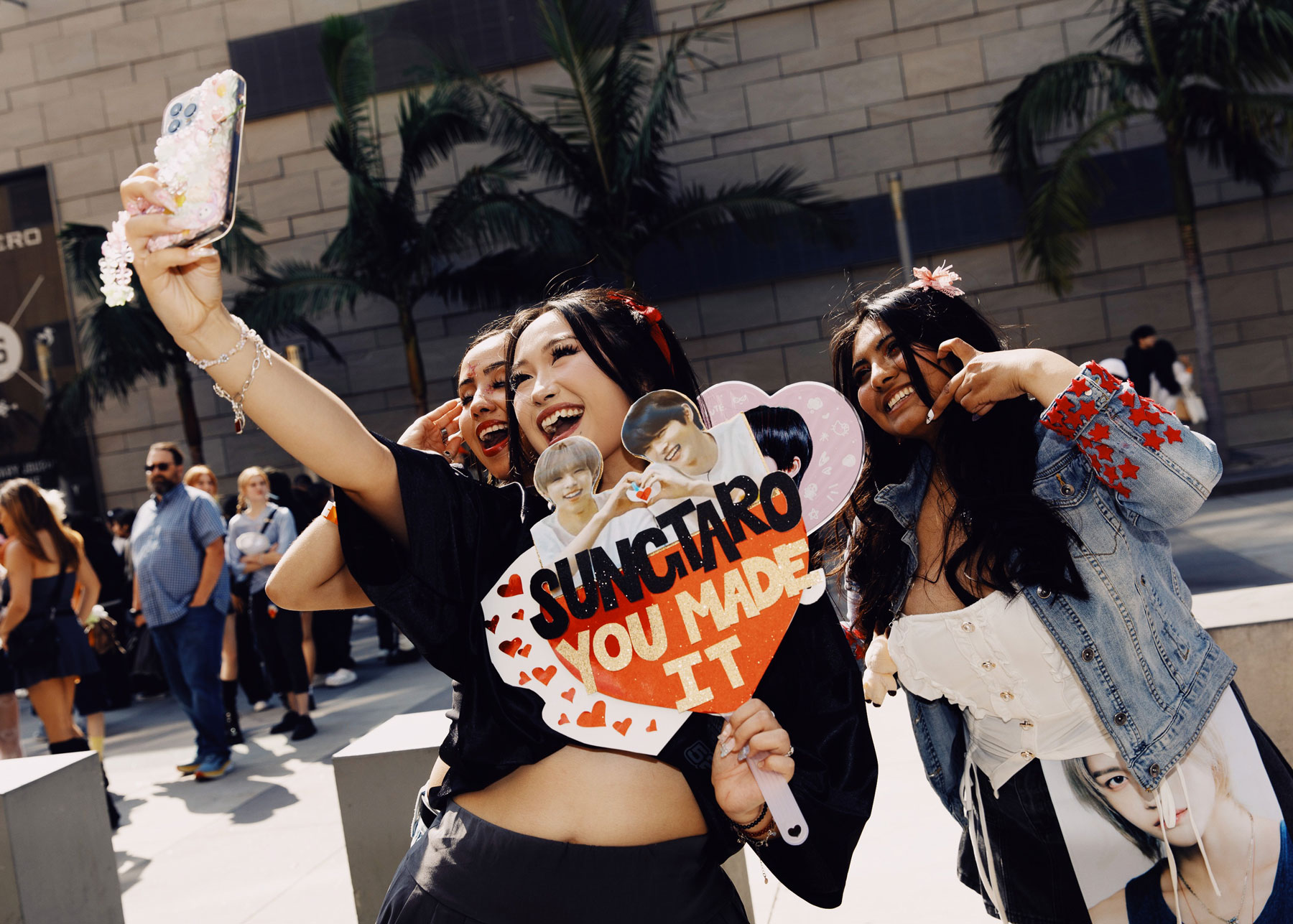
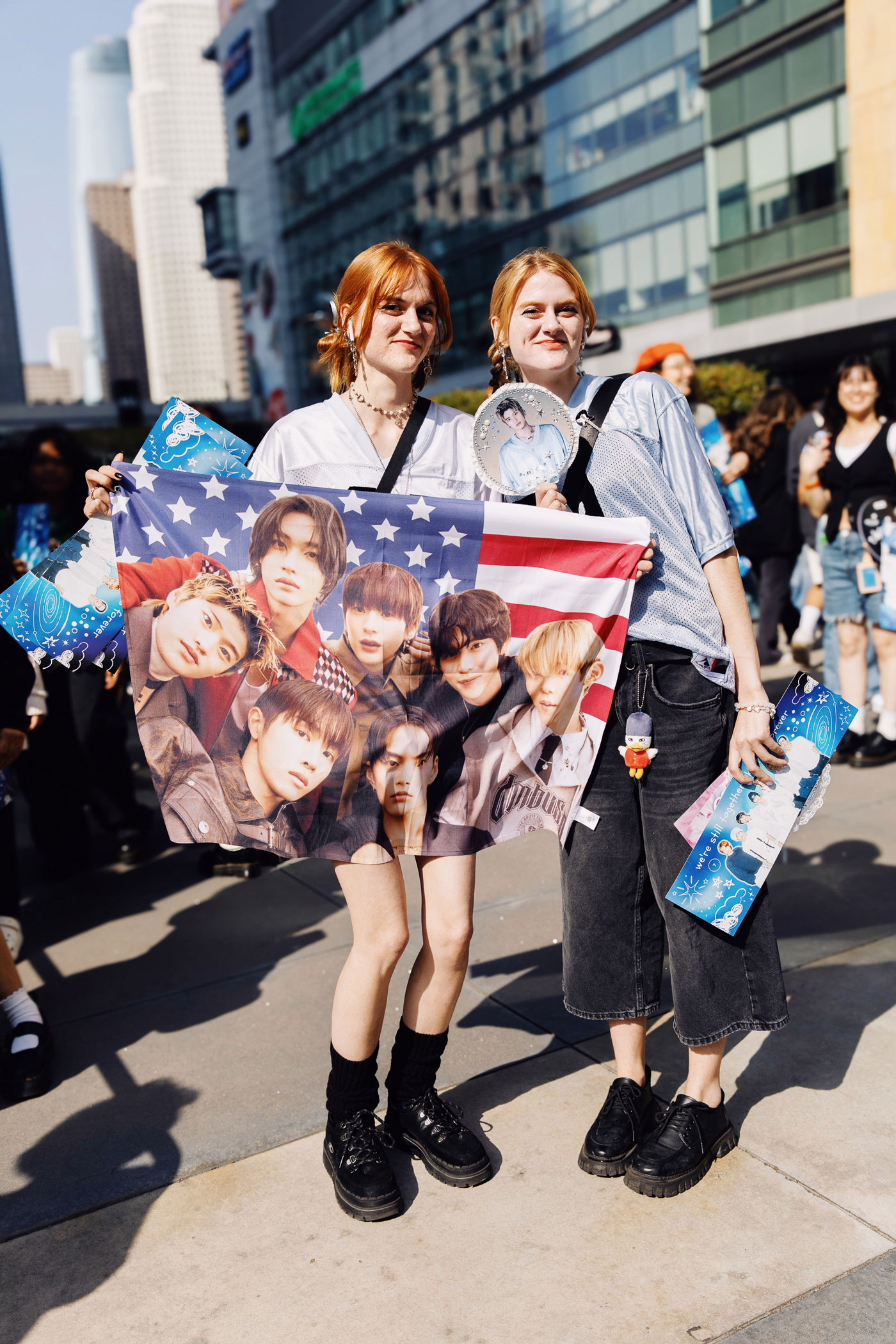
On a breezy May evening in Los Angeles, thousands of K-pop fans mill outside the Peacock Theater. They’re waiting for rookie boy band Riize’s first US fan-concert — a hybrid mix of songs and meet-and-greet events for new groups who don’t yet have the repertoire for a full performance.
Dressed in customized T-shirts printed with names of Riize members, admirers waved the American flag and banners photoshopped with the group’s image.
Emmey Roberts, a college student from Florida, on her first trip to LA, said she’d been following the band since their formal debut. “They're so happy. I love their music, the message it shares,” Roberts said. “They're really inspiring.”
She estimates she spends $2,000 a year supporting — via concert tickets, record sales and merchandise — her favorite K-pop bands.
RJ Hernandez, a 23-year-old hospitality worker from San Diego wearing a custom-made fan jersey, said that Riize are his “ultimate” group. “They are the ones I support the most,” Hernandez said. In all, he reckons he spends about $6,000 a year on K-pop.
Such expressions of devotion, financial and otherwise, aren’t unusual across the K-pop world. Anything that K-pop stars wear, eat, and use — whether it’s a pricey Chanel bag or $5 Downy fabric softener — can instantly draw skyrocketing orders and create new social trends and memes on YouTube and TikTok.
Yet despite the explosive growth of K-pop to a 12.7 trillion won ($9.2 billion) a year business, the industry is at a crossroads. It commands only a fraction of what Morgan Stanley estimates is an overall $130 billion global music market, which includes albums, audio and video streaming as well as concerts. While it has an outsized share of global physical album sales, that market has halved in the last 15 years. The big areas of growth in the international music industry are concerts and streaming — and here K-pop is a relative minnow.
Fame, Yet Limited Fortune
Sources: IFPI (global recorded music revenue); company filings from Hybe, SM Entertainment, JYP Entertainment and YG Entertainment; Hyundai Motor Securities
Note: Annual revenue from Korean companies was converted to US dollars using the exchange rate at the end of 2023. SM Entertainment’s revenue breakdown between physical albums and streaming is estimated by analysts from Hyundai Motor Securities.
Only a few bands, like BTS and Blackpink, have a big enough audience base to fill large stadiums in Europe and the US where ticket prices are highest — and BTS are on hiatus due to compulsory military service. Other groups, while beloved by fans, don’t yet have the scale to compete on the international stage.
With prospects for major gains in its home market limited by demographics — South Korea’s population is aging and shrinking faster than just about anywhere else in the world — the K-pop industry is embarking on a tactical shift. To try and expand its global appeal, it’s consciously trying to become less Korean.
Almost half the K-pop songs released this year had majority English lyrics, according to a Bloomberg News analysis of songs from groups currently or formerly managed by Korea’s biggest entertainment companies.
Sources: Lyrics from Genius, Musixmatch, Bugs, Genie and Melon; Billboard; soundtrack samples from Spotify ("Candy", "Nobody", "Kill This Love", "Butter", "Super Shy").
Notes: Chart shows K-pop songs released by groups managed currently or formerly by Hybe, SM Entertainment, YG Entertainment and JYP Entertainment. Songs released between 1992 and 1994 are excluded due to incompleteness of lyrics. Data as of July 1, 2024. Detailed analysis methodology can be found here.
This internationalization trend is only just getting started. Bang Si-hyuk, the founder of Hybe Co. and the man behind BTS, has been the most outspoken about the need to change, repeatedly declaring it’s time to “take the K out of K-pop”. One of the first tests of its strategy will be the debut of new girl group Katseye, an international collaboration with Universal Music Group’s Geffen Records. The six-member group is US-based and will perform in English rather than Korean.
And Hybe’s biggest rival, SM Entertainment Co. — the company that effectively established the idol group business model in South Korea and the label behind Riize — is also planning to launch idol bands with Western members for the first time this year.
The shift is forcing the industry to grapple with philosophical questions about what K-pop actually is, and why it’s gained such passionate overseas fans. Is it the messages of empowerment and catchy songs? Or is it more about the Korean-language lyrics, cultural references and distinctive aesthetic? Will overseas fans still want the product if any of that changes?
SM Entertainment co-chief executive officers Daniel Jang and Dmitry YJ Tak said in a joint interview they think expansion can be achieved without losing the essence of K-pop’s signature package.
“K-pop is not a genre of music,” said Jang, pointing to the widespread incorporation of styles including hip-hop and dance in existing output. “The characteristics of K-pop are that it is based on group activities, has a strong core fan following, emphasizes on-stage performance, and is composed of multiple members, so each member’s personality and talent are different.”
From South Korea to the US, Bloomberg Originals goes behind the scenes to decode the business of K-pop.
SM Entertainment’s plan is to create two or three new groups each year in multiple regions in partnership with labels which are experts in each local market. (It’s working with RCA Records for Riize’s launch.) That’s going to require a lot of songs and is why, Tak says, SM has established a music publishing company called KMR based in both Sweden and South Korea with over 100 producers tasked with crafting music that is both recognizably K-pop — and tailored to broader tastes.
It’s all part of SM Entertainment’s attempt to reinvent itself. Established in 1995 by Lee Soo-man, it created the first generation of K-pop groups which achieved a cult-like following domestically. Its second wave of artists gained huge popularity across Japan and China. But by the late 2010s it was struggling. Lee’s strategy of only releasing a new band every few years left the company off the pace, while rivals’ bands made big international breakthroughs. In early 2023, he was ousted in a boardroom coup.
In March 2023, internet giant Kakao Corp. won a takeover battle for SM Entertainment, edging out Hybe. “We went through a difficult time last year,” said Tak, referring to the turmoil created by the bidding war. “But we will keep our identity and make bold decisions to lead the industry.”
The deal is still controversial, with two Kakao executives under investigation by authorities over an alleged price-rigging scheme during the tussle. A company spokesperson has repeatedly denied the allegations.
But so far the legal cases haven’t impacted SM Entertainment, which executives say is focused on its ambition to become the No.1 K-pop company by 2025.
First off the block in its internationalized bands strategy will be a UK boy band, produced in partnership with Moon & Back, which will debut later this year. The label is currently auditioning members for a Southeast Asia-based band for next year, the co-CEOs said.
Internationalized Groups
Source: Data compiled by Bloomberg.
Notes: Local members also include those whose birth places are unknown. Chart only shows groups managed currently or previously by Hybe, SM Entertainment, YG Entertainment and JYP Entertainment, excluding sub-units. Analysis focused on original members of each group. NCT only includes members debuted between 2016 and 2019.
It’s a high-risk, high-reward strategy. Debuting an idol group costs millions of dollars, said Kim Hyun-yong, analyst at Hyundai Motor Securities. Aside from the costs of intensive multi-year training, as the industry has scaled up to try and compete globally, marketing costs on streaming and social platforms have also increased. Now spending $10 million dollars on a single band isn’t unheard of.
While the big agencies have a good hit ratio, there are already plenty of groups which fail to break even within their typical seven-year contract. And it’s not yet clear how fans will react to these new-style groups.
“In order to make K-pop more popular, it is giving up a little bit of K-popness,” said Kim Yoon-zi, senior research fellow at the Economic Research Institute of Korea Eximbank. “But the essence of K-pop should come out of Korea and it has to keep playing its role as a headquarters for the next phase of growth.”
Historically, one of the main revenue drivers for K-pop was physical album sales. Fans bought multiple copies of albums — sometimes more than 100 — both as a way to support their favorite bands and to get into lotteries offering the chance to meet artists up close.
Related: The Big Take Podcast
Listen and subscribe to The Big Take on iHeart Apple Spotify The Terminal
Last year the number of such sales hit a record high but there are now signs of decline. Besides the absence of mega stars BTS and Blackpink, one of the reasons is a sudden drop in bulk orders from China: In February exports to China fell 99% year-on-year, according to KB Securities. (It’s not clear why there was such a precipitous decline.)
It’s unlikely that the broader music fan the industry is now targeting will adopt such practices when all other genres of music have gone increasingly digital. Even in Korea some fans think such hoarding practices are outdated because of the environmental impact and financial burden the tradition places on young fans.
The big music agencies are under pressure to find fresh revenue sources and new markets to crack. Hybe, SM Entertainment, JYP Entertainment and YG Entertainment have all seen their shares plummet since a peak last June, sparked in part by concerns over falling album sales.
SM Entertainment hopes that concert revenue can step into the void. By 2025, its goal is to boost the number of concerts to more than 400 a year from 80 in 2022.
This isn’t a trend unique to K-pop: Music moguls everywhere are leaning in to physical shows. But establishing a more regular concert schedule could also help K-pop boost its streaming presence as fans tend to listen to a group’s songs more before and after a show. Plus, of course, they buy merchandise, such as lightsticks and T-shirts.
Rise of the K-Pop Live Experience
Source: Data compiled by Hyundai Motor Securities.
*China data includes concerts hosted in Hong Kong and Macau.
There are also encouraging signs in the all-important streaming market. Sulinna Ong, Spotify’s global head of editorial, said that since 2021 there’s been a 150% increase in K-pop in user-generated playlists, with the US, Brazil and Mexico leading the growth.
Part of the reason for the increase, Ong said, is that younger audiences are far more open to listening to artists from other countries and in other languages — a trend that has also helped the rise of Latin music. Still, she thinks that more lyrics in English will help make K-pop more accessible to a wider audience.
“What makes K-pop K-pop is the sense of community, the fandom connection, the collaboration between the fans as well as the world building around these groups,” Ong said.
K-Pop Is More Popular Than Ever
Source: IFPI Top 10 Global Recording Artists.
Note: IFPI ranking is based on physical album sales, digital downloads and streaming platforms.
Taylor Swift, of course, is one of the few Western stars to have a fanbase (Swifties) comparable in their devotion to K-pop fans. Every idol group has its own fandom — BTS (ARMY), Riize (Briize) — and all work hard on building relationships with these groups. They hold fan-only meetings and consistently communicate on social media through direct messages and live chat, sharing details not only about their new songs but also their daily lives.
Whether fans feel the same sort of connection to the upcoming wave of idols will be the true determinant of the industry’s corporate strategy. Outside Riize’s LA show, where many of the songs were written by Western songwriters, some of the omens looked good. Melissa Naud Oro, an 18-year-old visiting from France, said she liked the new focus on English lyrics: “They’re easier for me to sing.”
Superfan Hernandez, who as well as his $6,000 annual spend also devotes time to making his own band memorabilia to hand out, isn’t quite so sure. “It is kind of hit or miss. I do somewhat like all the K-pop English songs.” he said. “I just do prefer the Korean ones just because that’s where they’re rooted, that’s where the culture is.”