
Nuclear Plant $16 Billion Over Budget Arrives for Atomic Revival
The first newly constructed US reactors in decades will make Vogtle the biggest energy generator in the country
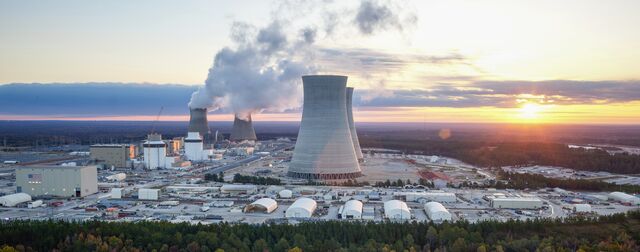
It’s seven years behind schedule and more than $16 billion over budget — but now that Southern Co.’s Vogtle nuclear project is nearing completion, it’s going into service at just the right time.
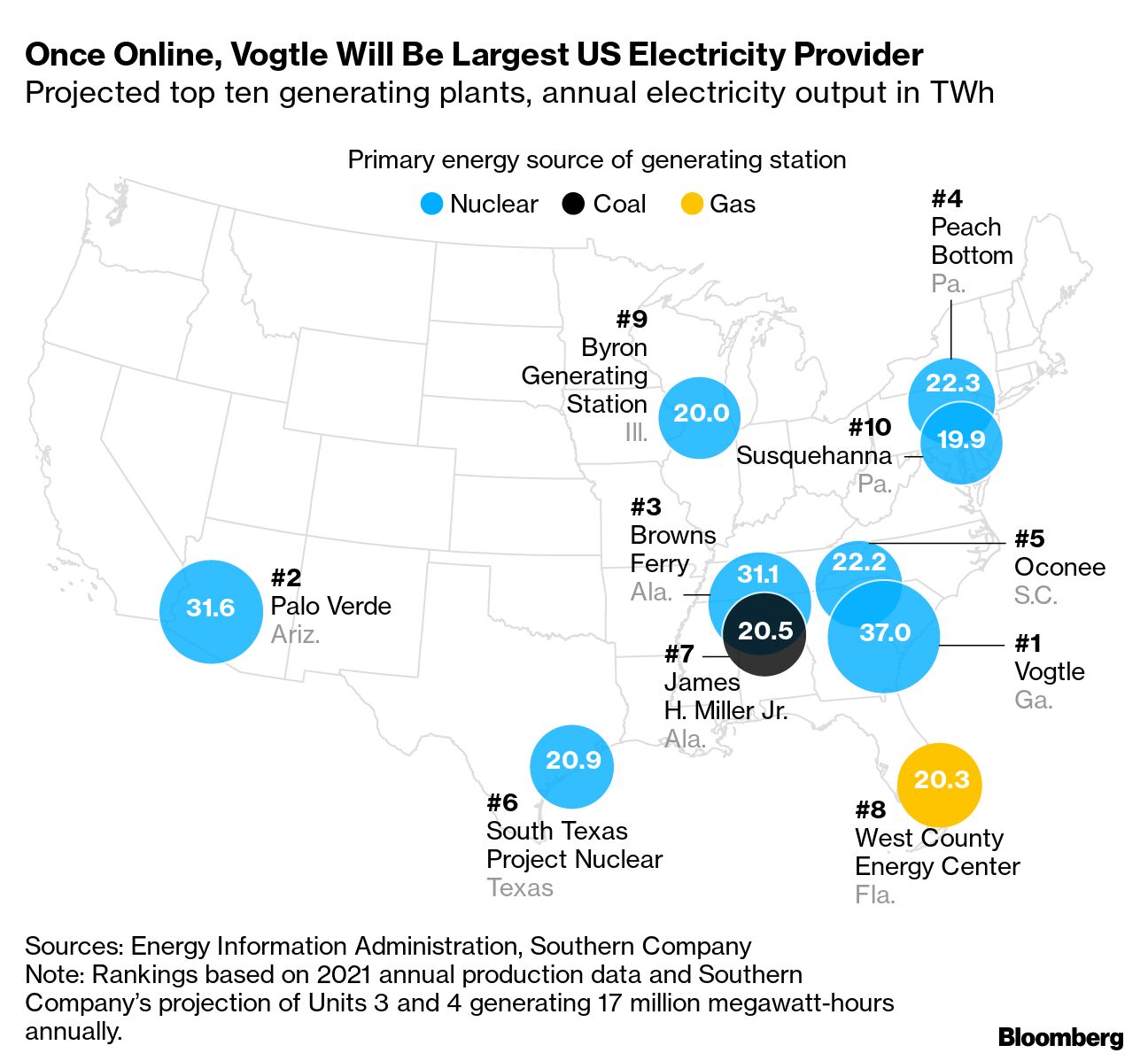
Vogtle is set to become the largest single power source in the US, generating enough energy to keep the lights on for 1 million homes and businesses. And thanks to its nuclear generation, all that electricity will be carbon free. It’s also coming online just as the world has hit an inflection point in the conversation on atomic power.
Once Online, Vogtle Will Be Largest US Electricity Provider
Projected top ten generating plants, annual electricity output in TWh
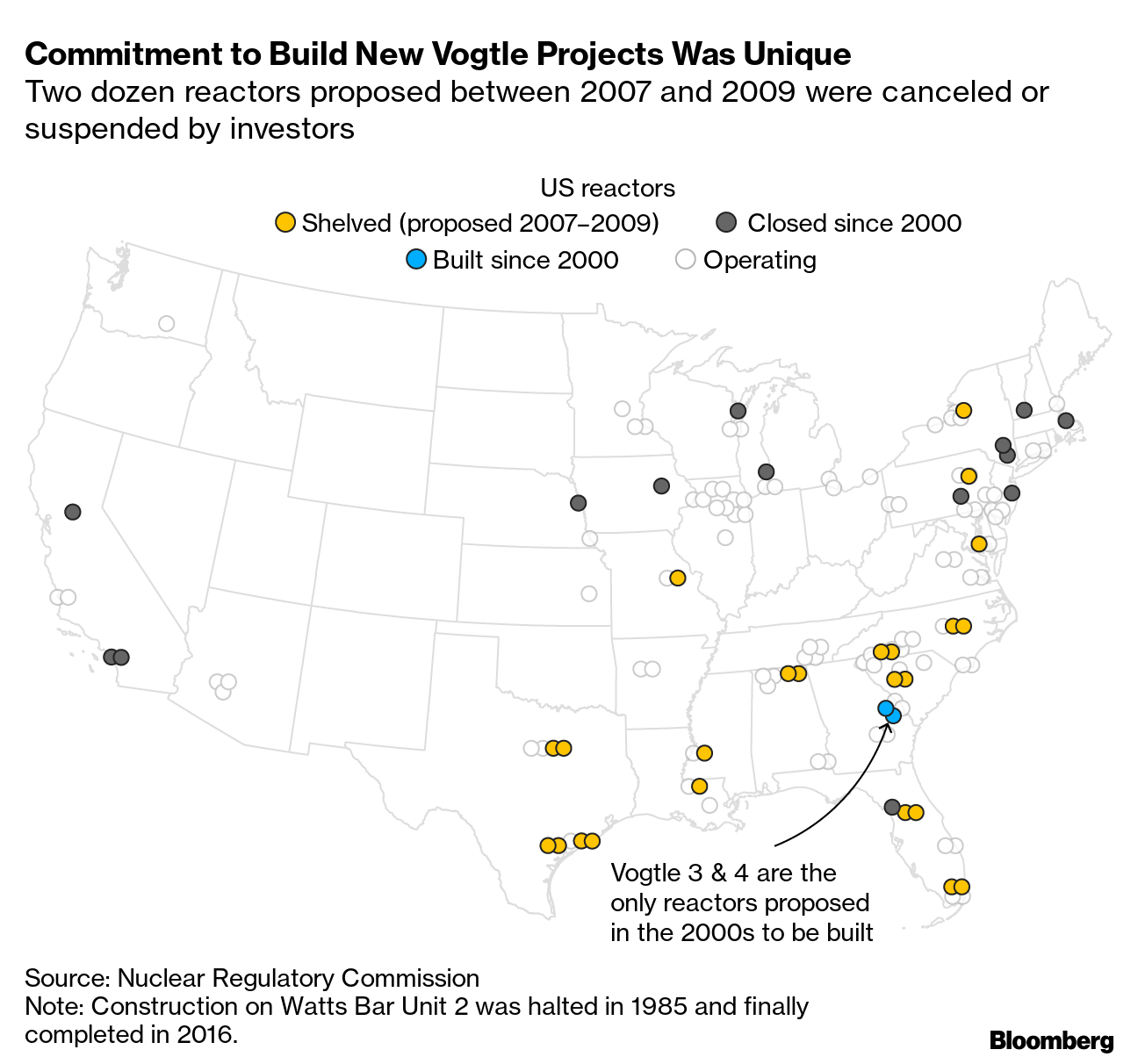
The Vogtle plant in Georgia is an anomaly. It’s a massive nuclear complex that was under construction at a time when the power source was being shunned by much of the world, with the painful sting of Japan’s 2011 Fukushima disaster making atomic energy taboo. More than a dozen US reactors shut down while the Southern project was under construction, as the industry was also beleaguered by competition from cheaper natural gas and renewable wind and solar.
But just in the past year or so, the global tide has started to shift for atomic power. The intensifying threat of climate change is boosting the value of nuclear energy, and there’s a realization that the expensive, long-delayed Vogtle project will play an important role in US efforts to curb emissions.
Vogtle’s New Reactors Are First to Be Built in a Generation
Number of operational commercial nuclear reactors in the US
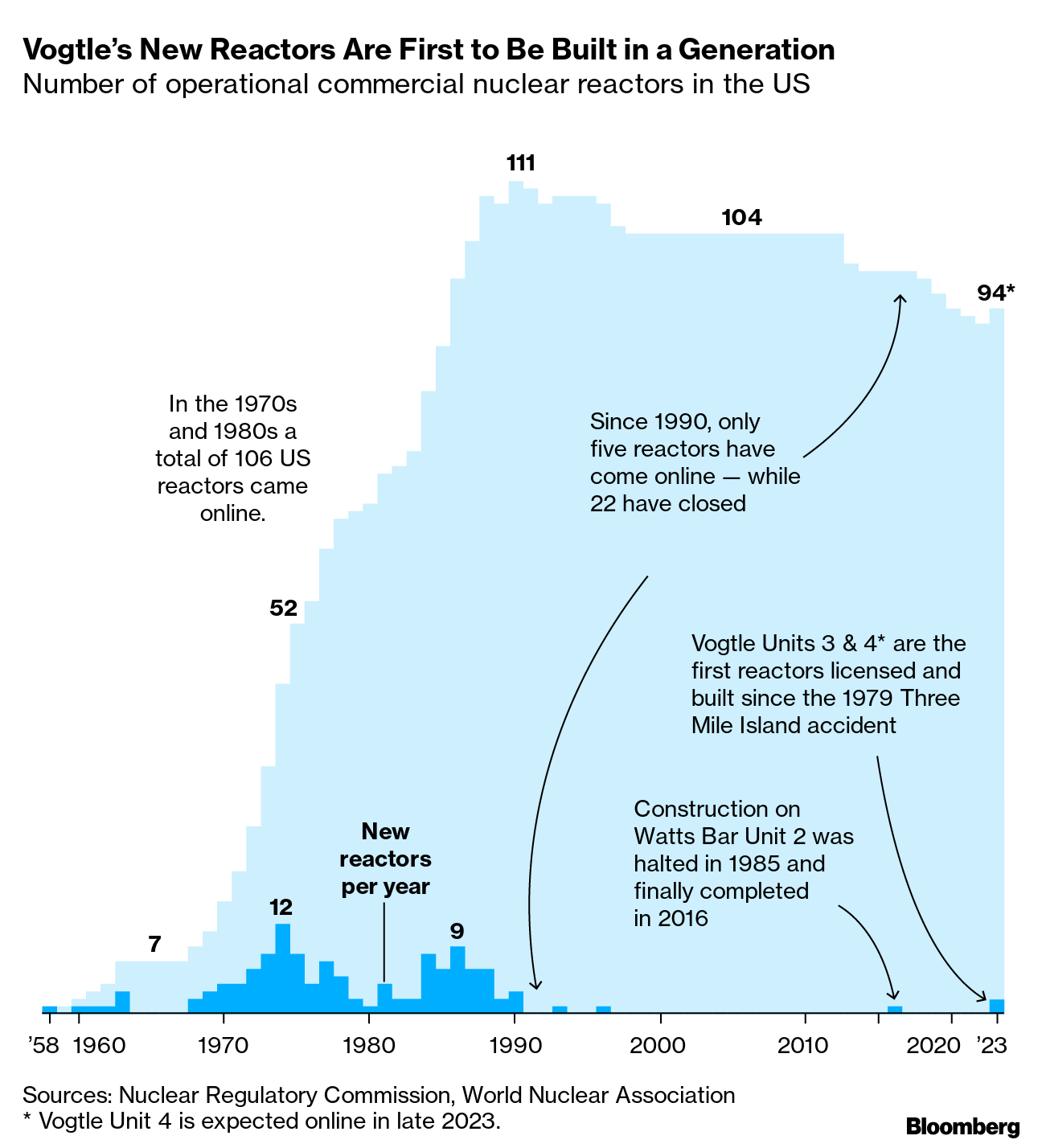
While Vogtle was in development, the vast majority of industry experts were quick to say that it would likely be the last big US nuclear project. But now, that’s less of a decided question.
“We are at a moment when the nuclear renaissance has a chance,” said Jigar Shah, who heads the US Energy Department’s Loan Programs Office. He’s quick to warn though, that the “the climb is still pretty steep.”
More than 70 nations have set net-zero targets, forcing the world to weigh the risks of atomic power, which has no carbon emissions, against uncontrolled climate change. That’s leading to unchartered territory when it comes to betting on nuclear. Across the planet, reactors are now set to run for far longer than anyone expected, with some even considering whether the machines can keep generating electricity for 100 years.
In that context, it’s no wonder that the US industry is once again considering building new massive complexes — long thought to be far too expensive and time consuming to be worth it.
Commitment to Build New Vogtle Projects Was Unique
Two dozen reactors proposed between 2007 and 2009 were canceled or suspended by investors
While no company is currently planning anything comparable to the Southern project in the US, experts say that may change. Breakthrough Institute, an Oakland, California-based research company, estimates that utilities may build as many as five Vogtle-sized reactors over the next 35 years.
“There’s more appreciation for nuclear energy,” said Jessica Lovering, executive director of Good Energy Collective, a pro-nuclear research group. “There’s much more excitement, and it’s much less a question about ‘Do we really need this?’”
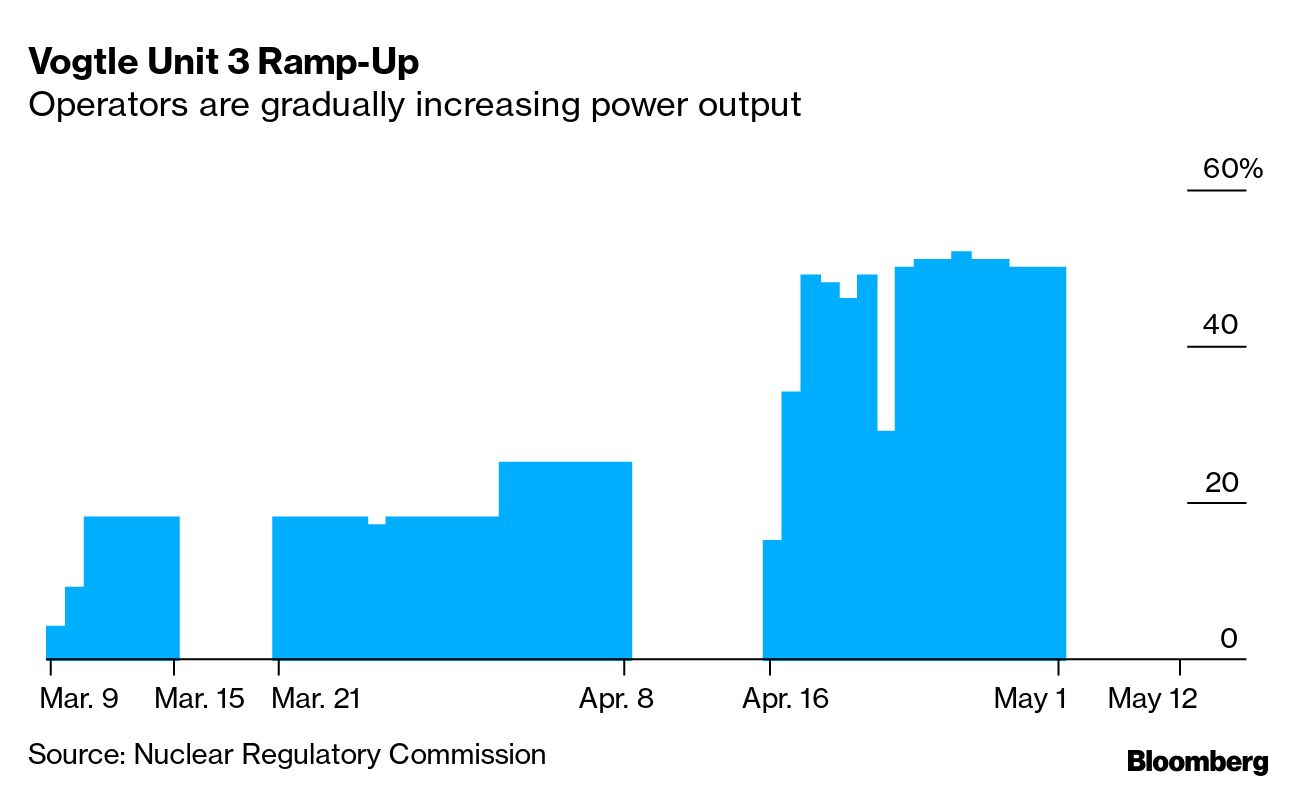
At the Vogtle complex, its Unit 3 is now generating electricity, while Unit 4 is in final testing. Both will join two reactors that have been running since the 1980s to make Vogtle the largest US power plant.
Vogtle Unit 3 Ramp-Up
Operators are gradually increasing power output
Outside the US, there’s been interest in developing new large nuclear complexes. Westinghouse Electric Co., which designed the Vogtle systems, landed its first reactor order in 15 years in October to supply as many as six units in Poland worth more than $40 billion. Bulgaria, Ukraine and Romania followed suit, seeking to dislodge Russian suppliers that dominate the region now.
Read More: Nuclear Power’s Revival Reaches Home of Last Meltdown
The biggest challenge in building major new complexes is the cost. That’s led the industry to pursue the next generation of reactors, smaller designs that can be manufactured in factories and assembled on-site. Dozens of companies are working on systems they say will be faster and cheaper to build.
The Vogtle reactors each have about 1.1 gigawatts of capacity, a typical size for the conventional nuclear plants widely used today. The new designs can range anywhere from 1 megawatt to 300 megawatts, and advocates say that range would give developers more flexibility. Not every project requires 1 gigawatt of power, and systems that are easier to deliver may lead to new applications for nuclear energy, including industrial sites and remote areas.
“We need a huge amount of no- or low-carbon electricity, but you also have to think about where you need it,” said Adam Stein, Breakthrough Institute’s director of nuclear energy innovation.
But we’re still a ways off from smaller reactors actually connecting to the US grid, and it’s unlikely any will go into service domestically before the end of the decade.
Meanwhile, large complexes like Vogtle are more of a known entity.
With Vogtle nearing completion, it’s “a clear demonstration that it’s doable and important and viable and necessary,” said Chris Womack, Southern’s new chief executive officer who helped oversee the project during his tenure as head of the company’s Georgia Power unit.
“We’ve had some challenges. We had some supply chain issues. We didn’t predict Fukushima,” Womack said. “At the end of the day, these Vogtle units are going to be a great asset,” he said, adding “as we go forward and focus on carbon-free issues, nuclear has to be part of that conversation and part of that energy mix.”