Who’s Going to Give Trump the Biggest Run for His Money?
Former President Donald Trump continues to dominate the Republican primary field — in the polls and in the money race.
As his rivals prepare for the first Republican debate in Milwaukee, Trump is planning to skip the stage. He's opting for a one-on-one interview to air at the same time, underscoring that Trump is in a league of his own.
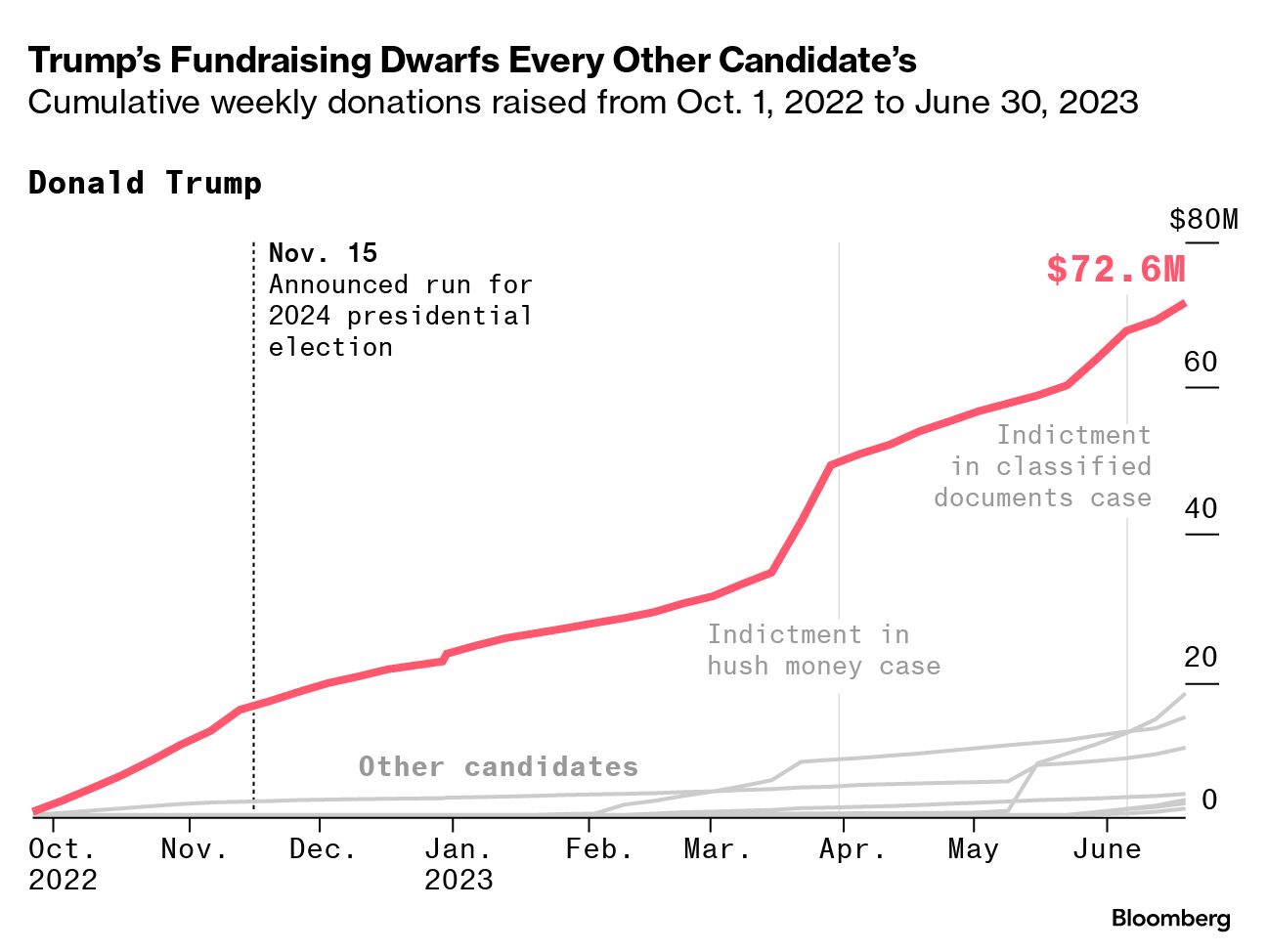
Trump holds more than a 40-point lead in the RealClearPolitics average of national polls and has the money to match. His legions of grassroots donors have poured more than $61 million into his coffers since he officially launched his third bid for the White House in November. That’s more than three times what Florida Governor Ron DeSantis, his nearest rival, has raised since entering the race in May.
Trump’s Fundraising Dwarfs Every Other Candidate’s
Cumulative weekly donations raised from Oct. 1, 2022 to June 30, 2023

Trump donors are increasingly looking at South Carolina Senator Tim Scott, whose base of contributors has more overlap with the former president’s than any of the other contenders in the crowded GOP field.
Trump is fighting four separate indictments, and his mounting legal fees are draining his resources. Many of the GOP’s biggest donors have said they wouldn’t back Trump, preferring a different standard bearer. Here are the candidates building the strongest base among Republican donors who could step up if Trump falters.
Among Trump’s rivals, DeSantis, the only other candidate polling in double digits, amassed the largest number of unique donors — 86,000 — through the end of June, according to his campaign. It opted to bypass WinRed, the party’s usual political action committee for processing online donations, instead using its private, for-profit arm. Those donations, accounting for 14.5% of the total he raised but about 88% of his individual contributors, don’t have to be disclosed under federal election laws and couldn’t be analyzed.
DeSantis Leads GOP Pack as Trump Challenger
Unique donors by candidate

Scott was next with 64,300, followed by former South Carolina Governor Nikki Haley, who had 40,600, with most of their contributors giving less than $200. Support from small-dollar donors is often a key indicator of grassroots enthusiasm, and they also can be tapped over and over again for additional modest sums without hitting contribution limits.
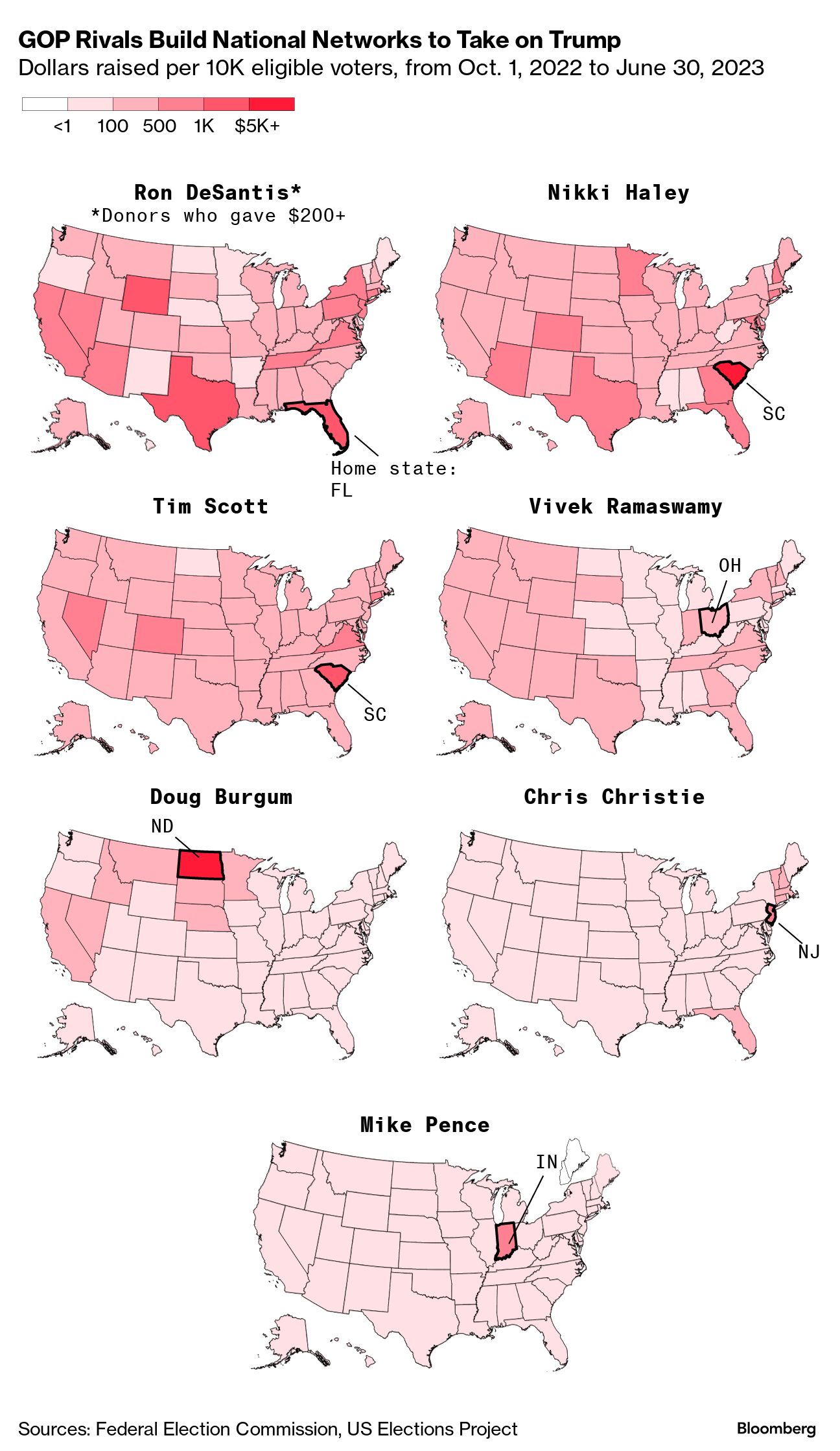
GOP Rivals Build National Networks to Take on Trump
Dollars raised per 10K eligible voters, from Oct. 1, 2022 to June 30, 2023
Those numbers pale in comparison to Trump, who has gotten contributions from more than 450,000 people since he launched his campaign on Nov. 15. Trump’s fundraising operation, which relies heavily on emails of emotional appeals, allows him to raise enormous sums of money even without the support of wealthy contributors.
Because candidates had to show they had 40,000 unique donors with at least 200 in 20 different states to qualify for the debate stage, some resorted to gimmicks to meet the requirements set by the Republican National Committee. North Dakota Governor Doug Burgum, who’s largely self-financing his campaign, gave away $20 gift cards to anyone who donated a dollar, while Miami Mayor Francis Suarez offered donors a chance to win tickets to soccer star Lionel Messi’s debut with Inter Miami in July.
The RNC announced late Monday night that former Arkansas Governor Asa Hutchinson met the criteria for the debate and will join seven other candidates on stage: DeSantis, Haley, Scott, Christie, Burgum, Ramaswamy and Pence. Suarez, who had earlier said het met the thresholds, was not included in the list of participants.
Candidates who didn’t make the debate stage, including Suarez and former Texas Congressman Will Hurd, will likely struggle to gain traction with donors going forward, leaving their supporters to pick other candidates to fund. That presents an opportunity for contenders who perform well in Wednesday’s debate. Candidates next have to report contributions to their campaigns in October. That disclosure will be a key metric of which campaigns have the resources to make it to the Iowa caucuses in January.
While the vast majority of Trump donors — some 92% — have donated to only him, some are flirting with other candidates.
Of Scott’s donors, 40% had also made contributions to Trump, the largest share of any candidate and a sign that the senator might have a leg up in drawing supporters away from the Make America Great Again banner. Among donors to former Vice President Mike Pence, a sharp critic of his former boss, 30% of them gave to Trump.
Trump Donors Flirt With Other GOP Contenders
Share of donors who also contributed to Trump, sized by unique donors
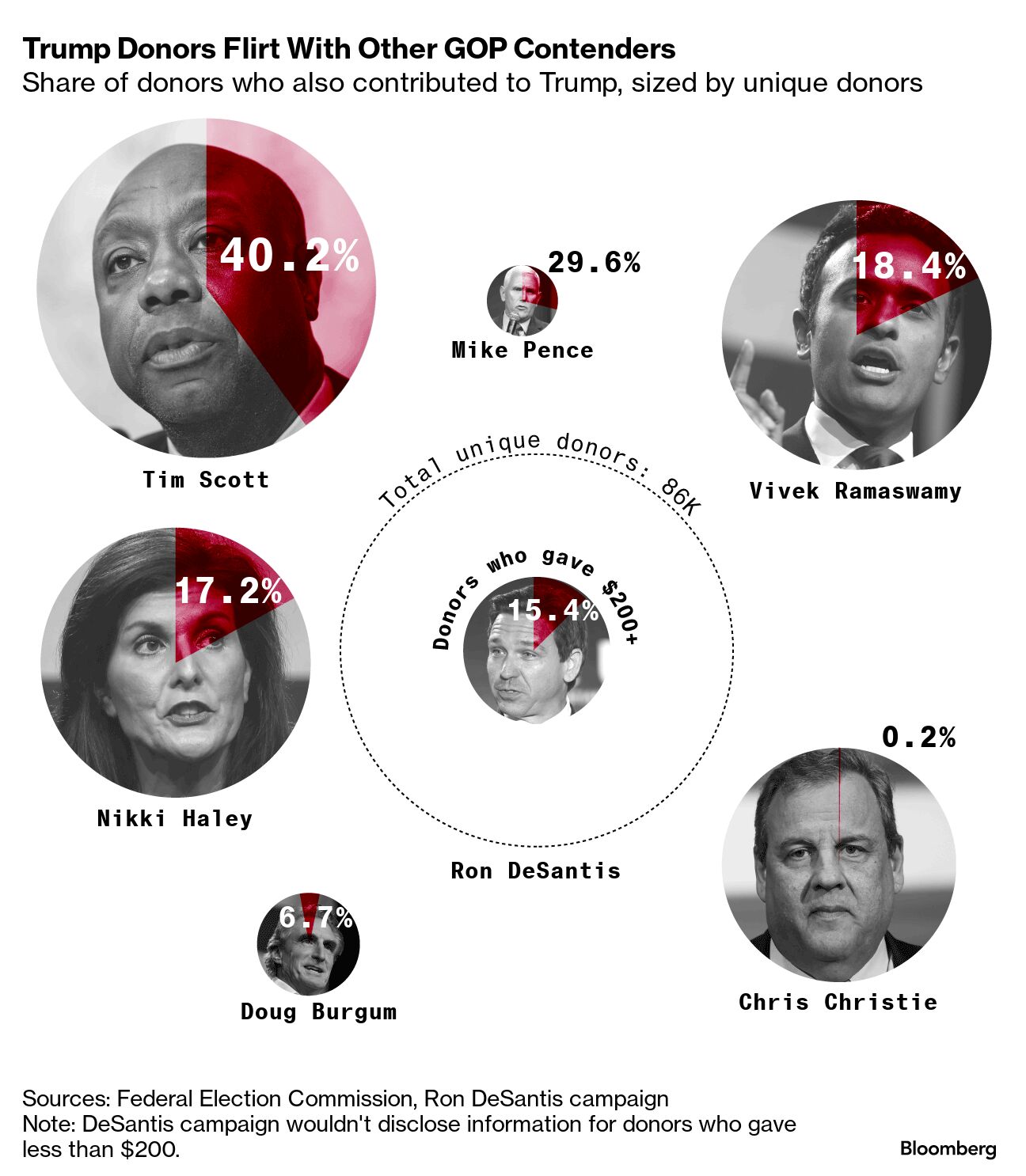
Former New Jersey Governor Chris Christie has also staked out ground as the candidate who will take the frontrunner head on, and donors believe him. Less than 1% of his contributors also donated to Trump, and only 4% supported another presidential campaign.
Many Republicans looking for an alternative to Trump have given to more than one campaign, such as billionaires Home Depot co-founder Kenneth Langone, Continental Resources co-founder Harold Hamm and money manager Kenneth Fisher.
More than half of Pence’s contributors played the field, with 52% of them also giving to other candidates. And Scott saw 49% of his backers also donate to his rivals.
Donors are giving to multiple candidates in part because all are still looking for traction against Trump among voters. After narrowing the gap to 13 points in the RealClearPolitics average in January, DeSantis has lost ground and was trailing Trump by 41.3 points, as of late Monday. No other candidate has cracked double digits.
That raises the stakes for all of them when they take the stage at Fiserv Forum in Milwaukee Wednesday night. Each will make the case to primary voters — and donors — that he or she is the strongest candidate to overtake Trump.