America Wants to Keep Roe—the Supreme Court May Overturn It Anyway
Ketanji Brown Jackson will become the first Black woman to sit on the Supreme Court after Justice Stephen Breyer retires at the end of the current term. But while her addition adds a second Black justice to the bench and boosts the number of female justices to four—the highest number to serve on the court at the same time—the composition of the panel continues to look quite different than the rest of American in gender, race and religion as well as on key policy issues.
Trump Nominees Shape New Balance of Power
The nominating president’s party and the justice’s confirmation year
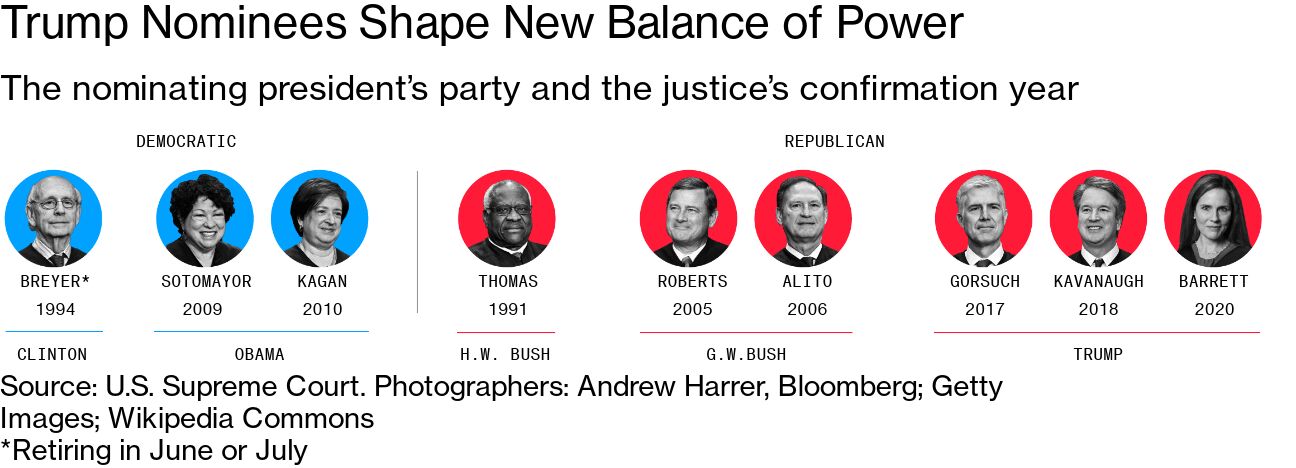
Brown Jackson will join a liberal minority on a court that is mostly white, male and Catholic and is increasingly out of step with the rest of the country on a range of hot-button issues. That split was put on full display with the leak of a draft opinion overturning the Roe v Wade abortion-rights ruling despite the belief of more than three-quarters of Americans that abortion should be legal in some form.
The Makeup of the Supreme Court
How much the justices resemble the U.S. population

The specific religious background of a justice may not be as much of an issue as the way their views reflect a broader conservative or liberal perspective, according to Sam Erman, a law professor at the University of Southern California. The outlook of conservative Catholic judges is often aligned with those of Evangelical Christians, whereas some Jewish justices have been in sync with politically progressive groups, Erman said.
Abortion

Abortion rights, already at risk when Brown Jackson was nominated to the court, could suffer a fatal blow if the leaked draft of an opinion overturning Roe v. Wade proves to reflect the panel's ultimate decision. While Chief Justice John Roberts in June 2020 provided the crucial vote in a 5-4 decision that invalidated a Louisiana law opponents said would have left the state with just one abortion clinic, the addition of conservative justice Amy Coney Barrett later that year may have swung that vote tally in the other direction.
The Affordable Care Act

While the Trump administration continued to push for the court to strike down the Affordable Care Act and Barrett has voiced skepticism about it, the panel last year rejected the latest Republican attack on the law, marking the third time the court has backed central parts of what is widely known as Obamacare.
LGBTQ Rights

In a blow to conservatives in June 2020, the Supreme Court ruled that the Civil Rights Act of 1964 barred an employer from firing someone simply for being homosexual or transgender. “The answer is clear,” Gorsuch wrote in a landmark 6-3 ruling expanding the law. Gorsuch’s decision, based on the text of the statute, was consistent with the views of a slight majority of the American public, who favor the expansion of LGBTQ rights. Whether rulings such as these survive a more conservative court—or whether the high court carves out exceptions for employers—is one of the chief questions in the coming years. The leaked draft of the Roe v Wade decisions has progressives fearing that the court's conservative majority could use the same reasoning to target LGBTG, contraceptive and other rights.
Recognition of Same-Sex Marriage

The court in February agreed to hear an appeal from a Colorado web designer who opposes gay marriage on religious grounds and says the Constitution’s free-speech clause entitles her to an exemption from a Colorado anti-discrimination law. The case could resolve some issues the court avoided when it considered the Colorado law in a clash over a baker who refused to make cakes for gay weddings in 2018. The court sided with the baker on narrow grounds while sidestepping larger questions about whether and when business owners can turn away customers.
It’s unlikely that a more conservative court will reverse a ruling that is now widely accepted and has led to far-reaching change in American society, but the court in coming years may be reluctant to expand the reach of the 14th Amendment’s Due Process and Equal Protection clauses, which were the grounds for the court’s holding in the Obergefell decision that found that same-sex couples have a constitutional right to marry.