How Keeping Quiet About Politics Helped Uniqlo Become China’s Favorite Fashion Brand
On the face of it, the odds Japanese retailer Uniqlo beat to become China’s favorite clothing brand look impossibly high. Chinese shoppers are growing increasingly nationalistic as political tensions with democratic nations mount. Anti-Japanese sentiment in the country is long-standing and pervasive. And competition from both local and global fashion rivals is only getting fiercer.
Nevertheless, the Yamaguchi-based brand known for functional basics like T-shirts, jeans and thermal underwear secured 1.4% of China’s hugely fragmented $350 billion apparel market in 2021—a larger share than any other single brand, and one that has grown from just 0.4% a decade ago.
What’s more, between 2018 and 2022—a tumultuous period which saw some global brands hit by nationalist boycotts in China—Uniqlo remained among the top five women’s clothing retailers on e-commerce platform Tmall. It was the only foreign brand not to lose its standing.
Courting Shoppers
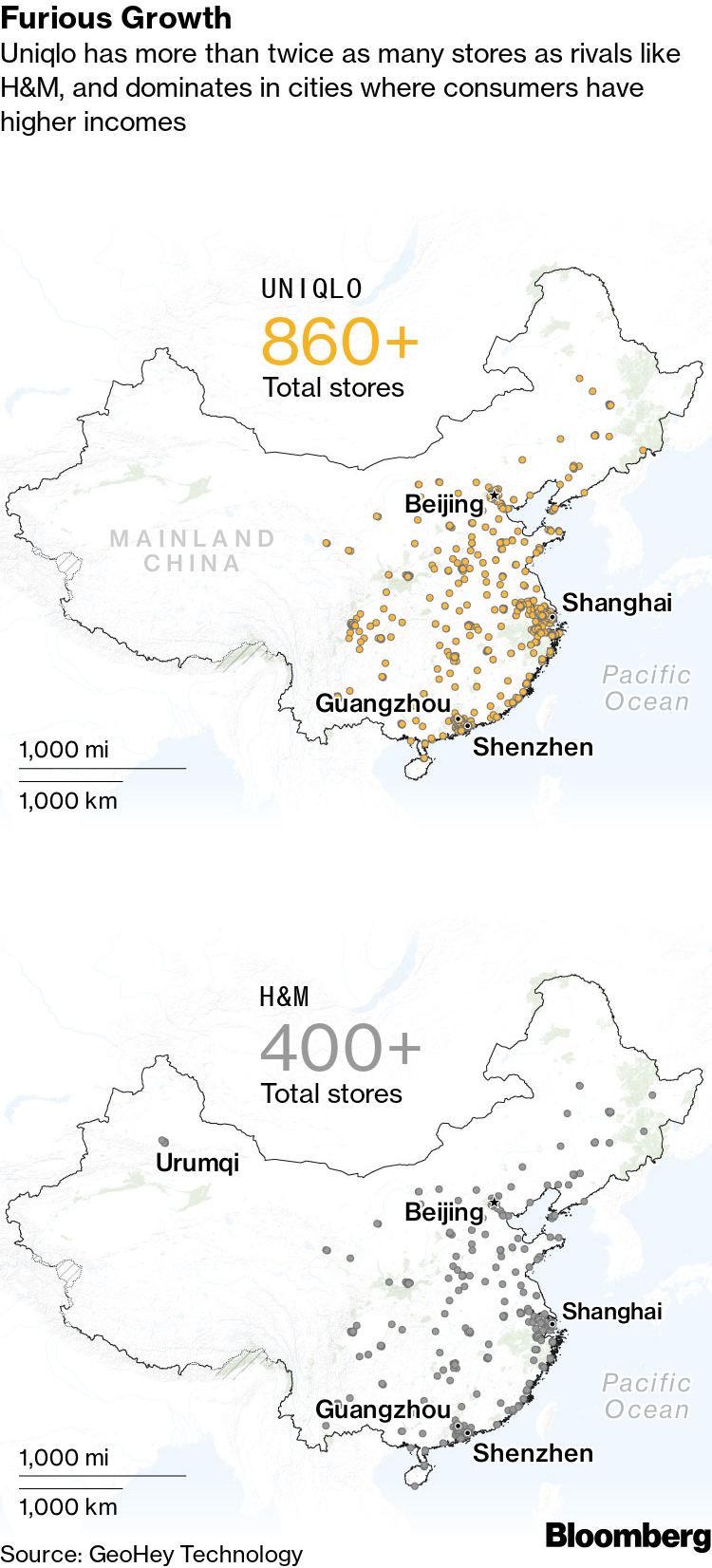
In China’s biggest cities, Uniqlo is more present than other brands

Founded by one of Japan’s richest men and owned by Fast Retailing Co., Uniqlo has found success in China thanks to a mix of factors. Smart product strategy and moving into the market early played their part, but above all it was the company’s political that savvy helped it rise to the top. Uniqlo’s success against the odds is a potential model for foreign brands targeting the country’s growing pool of middle-class consumers, though one fraught with risks—from an increasingly nationalistic Chinese government and people, to political blowback in Western markets.
“The Uniqlo China business could be more important than anything else for Fast Retailing in the future,” said Takahiro Kazahaya, an analyst at Credit Suisse AG in Tokyo. But its continued success “should not be the underlying assumption.”
Xinjiang Silence
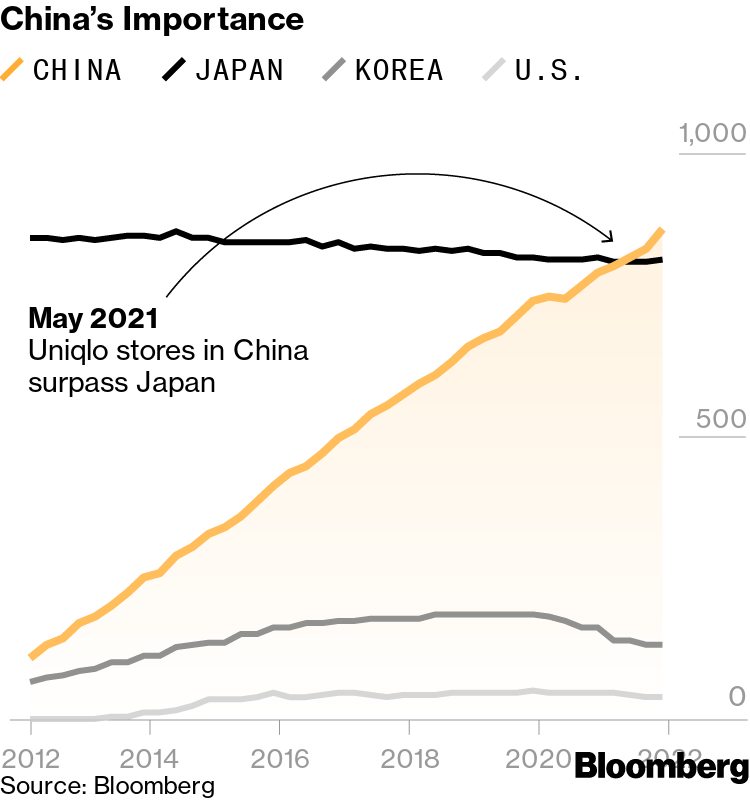
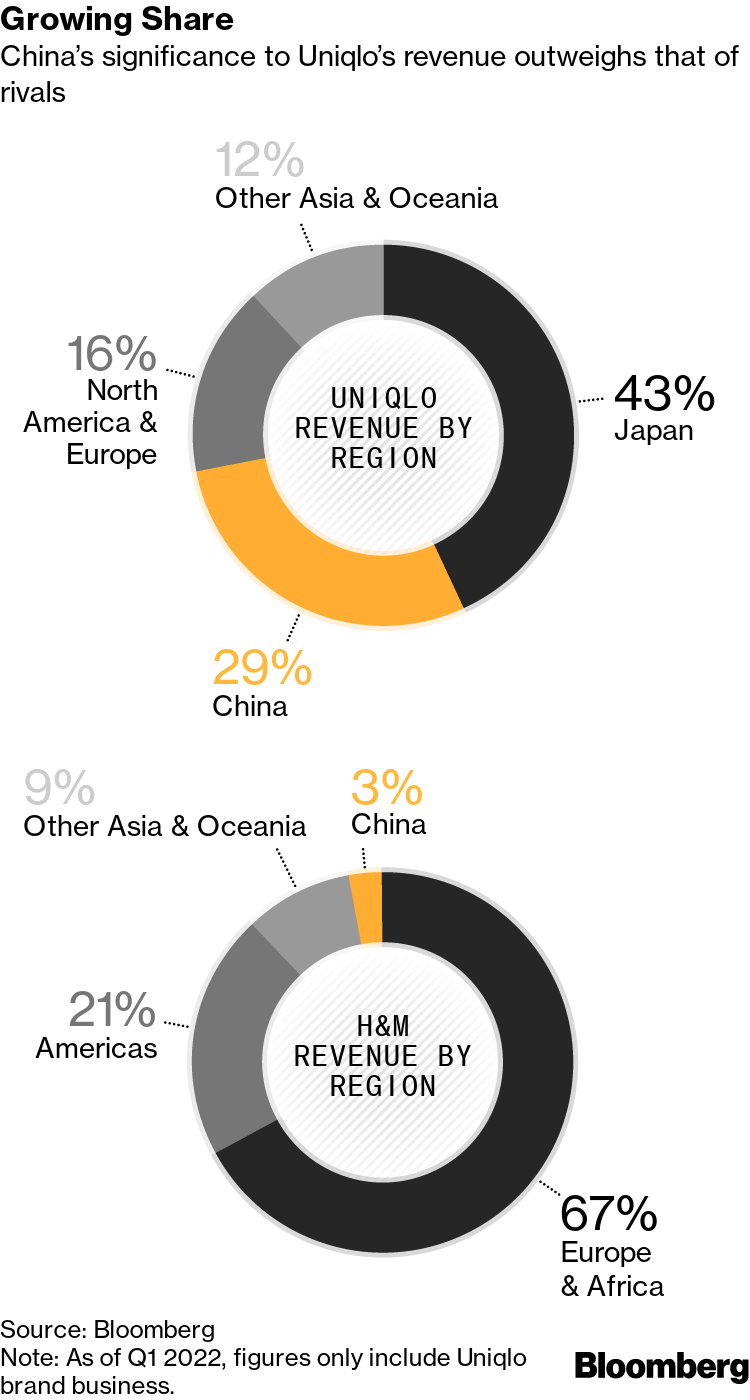
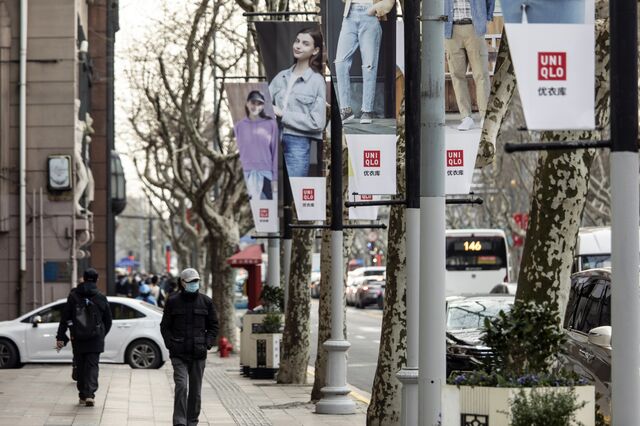
Uniqlo made about a quarter of its overall revenue, 532 billion yen ($4.2 billion), in China last fiscal year. That’s about three times its sales in North America and Europe combined. Meanwhile, the brand’s network of more than 860 Chinese stores is now bigger than its 806-location footprint at home in Japan—a reminder that the world’s second-largest economy is key to growth, as well as sales.
China’s Importance
Chinese shoppers have been won over by Uniqlo’s focus on functional garments such as light down jackets, according to China-based fashion commentator Leng Yun. Quality and attention to detail mean local companies find Uniqlo’s products “very difficult to copy,” she added.
An emphasis on well-made, affordable basics rather than trends has also helped to differentiate the brand from international fast-fashion giants like Hennes & Mauritz AB and Inditex SA’s Zara.
Furious Growth
Uniqlo has more than twice as many stores as rivals like H&M, and dominates in cities where consumers have higher incomes
“It’s not usual to see someone wearing a $4,000 flashy Gucci coat and a $13 camisole shirt,” said Steven An, founder of Shanghai-based CHI Design, a platform that helps promote young fashion designers. “But it happens with Uniqlo’s shirts.”
Fashion lines are not all that set Uniqlo apart in the lucrative–but tricky–Chinese apparel market. There’s also the Japanese brand’s approach to contentious political issues. In particular, the predominantly Muslim Xinjiang region in China’s northwest.
In 2019, concerns about forced labor in the region’s cotton industry had already begun to swirl. But as apparel manufacturers operating in China attracted international scrutiny for their positions on the issue, Fast Retailing and its legendary founder Tadashi Yanai kept quiet.
Pressure on China over alleged forced labor grew throughout 2020. That December, the U.S. barred Xinjiang cotton products from entering the country, and within months the U.K., Canada and the European Union had all imposed sanctions. Japanese officials showed concern about human rights violations in Xinjiang, but stopped short of acknowledging such reports as fact.
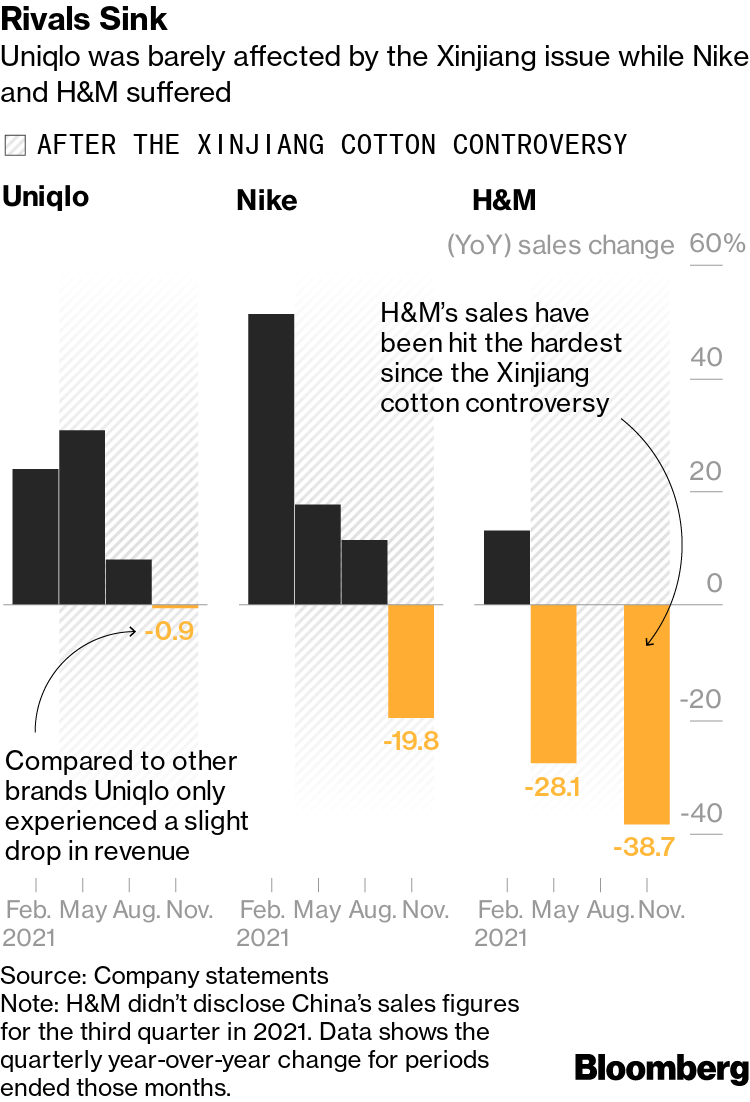
Brands such as H&M and Nike Inc. started publicly expressing unease too. Their comments sparked a nationalistic backlash that led Chinese consumers to call for boycotts and hit brand loyalty and market share to a degree that these companies may never come back from.
Rivals Sink
Uniqlo was barely affected by the Xinjiang issue while Nike and H&M suffered
Yanai took a different tack.
“I want to be neutral between the U.S. and China,” he told Nikkei Asia, in line with the company’s practice of staying out of politics wherever it sells clothes. “The U.S. approach is to force companies to show their allegiance. I wanted to show I won’t play that game.”
As more outspoken peers saw their revenues in the greater China region slump sharply, Uniqlo’s went in the opposite direction, with takings rising 17% in the year ended August 2021.
Growing Share
China’s significance to Uniqlo’s revenue outweighs that of rivals
The label initially took a similar approach to its Russian business following the invasion of Ukraine, albeit with less success. After pledging in early March to continue operations, Uniqlo joined the corporate exodus from Russia just days later.
China’s significant contribution to the brand’s sales “increases the emphasis on ensuring that these consumers are happy,” said Mark Tanner, managing director of Shanghai-based marketing and branding firm China Skinny.
Jason Liang, a 29-year-old architect in Shanghai, is a fan of Uniqlo’s good-value basics who stopped buying Nike and H&M following the Xinjiang backlash. He’s typical of a growing group of Chinese consumers for whom politics is a consideration, a shift that’s having significant consequences for some of the world’s biggest brands.
Liang says it’s a relief Uniqlo doesn’t appear to be one of the “Xinjiang cotton opponents”. If evidence emerged showing the company had taken a stand, “I think I would just stop using it,” he said. “Why do we need a brand that frames our country?"
Credit Suisse analyst Kazahaya expects Uniqlo’s Chinese profits to surpass what it makes in Japan next year, according to a note published in January.
It’s not just consumers. The company also strives to keep China’s officials satisfied. No foreign clothing brand pays more taxes or employs more people in Shanghai, according to a 2021 government statement. Fast Retailing also rented a bigger booth than any of its competitors at the politically important China International Import Expo last year.
While other foreign companies look at diluting their exposure to China and building factories elsewhere, Uniqlo plans to stay put after investing heavily in training workers and building a mature supply chain in the country, according to people familiar with the company’s operations.
In line with its approach globally, Fast Retailing is heavily philanthropic in China. The company makes charitable donations to citizens affected by natural disasters, and regularly partners with local colleges on student design competitions. The company is perceived as a valuable contributor to society—an important consideration for any business aiming to expand in the President Xi Jinping’s China.
Marketing Quality
China is Japan’s biggest trading partner, and many consumers there associate Japanese goods with quality and fine craftsmanship.
Uniqlo has used that link to its advantage, focusing its Chinese marketing on the caliber of its products as well as its high-tech fabrics and designs.
The brand also has relatively deep Chinese roots, as one of the first Japanese apparel makers to begin manufacturing clothing there around the turn of the millennium, said Mike Allen, an analyst at Jefferies Japan Ltd.
Setting up Chinese retail operations at the same time was a relatively low-cost decision—and a prescient one. As the middle class’s rise gained momentum, Uniqlo was already established in the country.
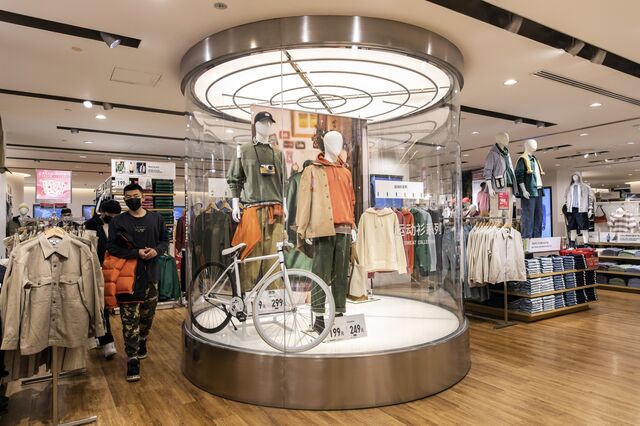
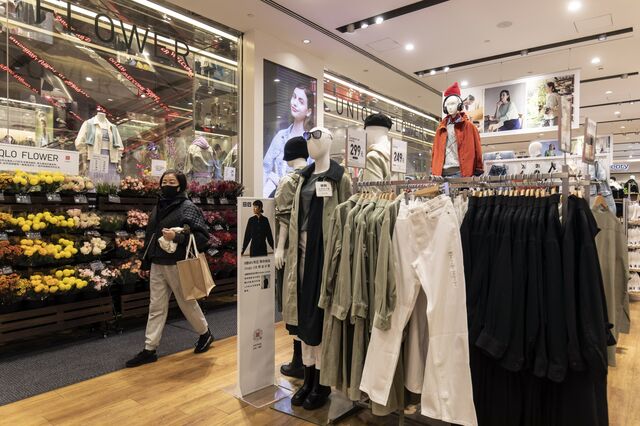
“It was just the right price point for Chinese consumers whose wealth was increasing quite rapidly and who had started to eye high-quality products,” Allen said.
But the Japanese company’s strategy is not without risks.
Turning Uniqlo into the world’s No. 1 brand—as founder Yanai hopes to do—means finding success in both China and the West. That’s increasingly tricky as tit-for-tat hostilities ramp up between Beijing and Washington. Meanwhile, while Xinjiang hasn’t yet resonated with consumers the way the plight of Tibet, say, has in the past, Western shoppers are becoming more and more cognizant of the circumstances under which their clothes are made.
“What happens in China doesn’t stay in China,” said Isaac Stone Fish, founder of research firm Strategy Risks. “Global consumers and regulators can have insight into and take offense at the steps a company like Uniqlo takes to succeed in the Chinese market.”
In January 2021, U.S. customs blocked a shipment of Uniqlo shirts not because the garments had been produced using Xinjiang cotton, but because there was insufficient evidence that they hadn’t been. This experience may become more common after the sweeping Uyghur Forced Labor Protection Bill comes into force from July. It bans goods from Xinjiang unless the importer can prove that they aren't made with forced labor.
It appears “an individual customs officer could theoretically stop shipment of any goods from anywhere unless there is proof that the goods did not pass through Xinjiang,” Allen, the Jefferies analyst, wrote in a December note. “In many cases, the negative would be difficult to prove.”
Fast Retailing didn’t respond to an emailed request for comment for this story.
Uniqlo faces other hurdles in the U.S. and Europe. Its marketing playbook is less effective outside China, where Japanese manufacturing is not as closely associated with quality. The label faces fierce competition in Europe from apparel brands like Primark and Kiabi, and it has never managed to expand beyond the big cities in the U.S.
Newer Challenges
Continued success in China is also not a given.
The country’s strict Covid-Zero policy is a wild card for Uniqlo’s earnings. Frequent snap lockdowns impact its retail sales, and may also dent manufacturing capacity.
Consumer backlash is also an ever-present risk. Over the past decade, brands ranging from Canada Goose Holdings Inc. and Dolce & Gabbana Srl to Toyota Motor Corp. and Nissan Motor Co. Ltd. have faced Chinese consumers’ ire.
The Beijing-Tokyo relationship is already fragile, and it’s unclear if or when it may further deteriorate.
That said, Uniqlo has successfully navigated China’s choppy political waters for years. But the fast-growing competition in the nation’s affordable fashion segment is a newer challenge.
Once, underwear was one of Uniqlo’s strong suits. But for the past two years, the top underwear seller during Taobao’s Singles’ Day shopping festival has been Ubras. The Chinese label, known for its $9 wireless bras, overtook Uniqlo by aggressively marketing to young consumers via live-streaming.
As local and global labels race to capture a slice of the 2% annual growth forecast for China’s apparel market over the next five years, political nous and a solid reputation with consumers may not be enough to keep Uniqlo in the country’s top fashion spot.
“We think that Uniqlo could be losing its appeal to Chinese consumers amidst competition from local players,” wrote Oshadhi Kumarasiri at LightStream Research in a January research note, highlighting a drop in the company’s e-commerce sales in the first quarter.
“There’s more to the declining Chinese revenue than these new Covid-19 restrictions.”