How Xi’s Shakeup Shattered Decades of Succession Rules in China
The president tossed out precedent in promoting key allies to run the Communist Party
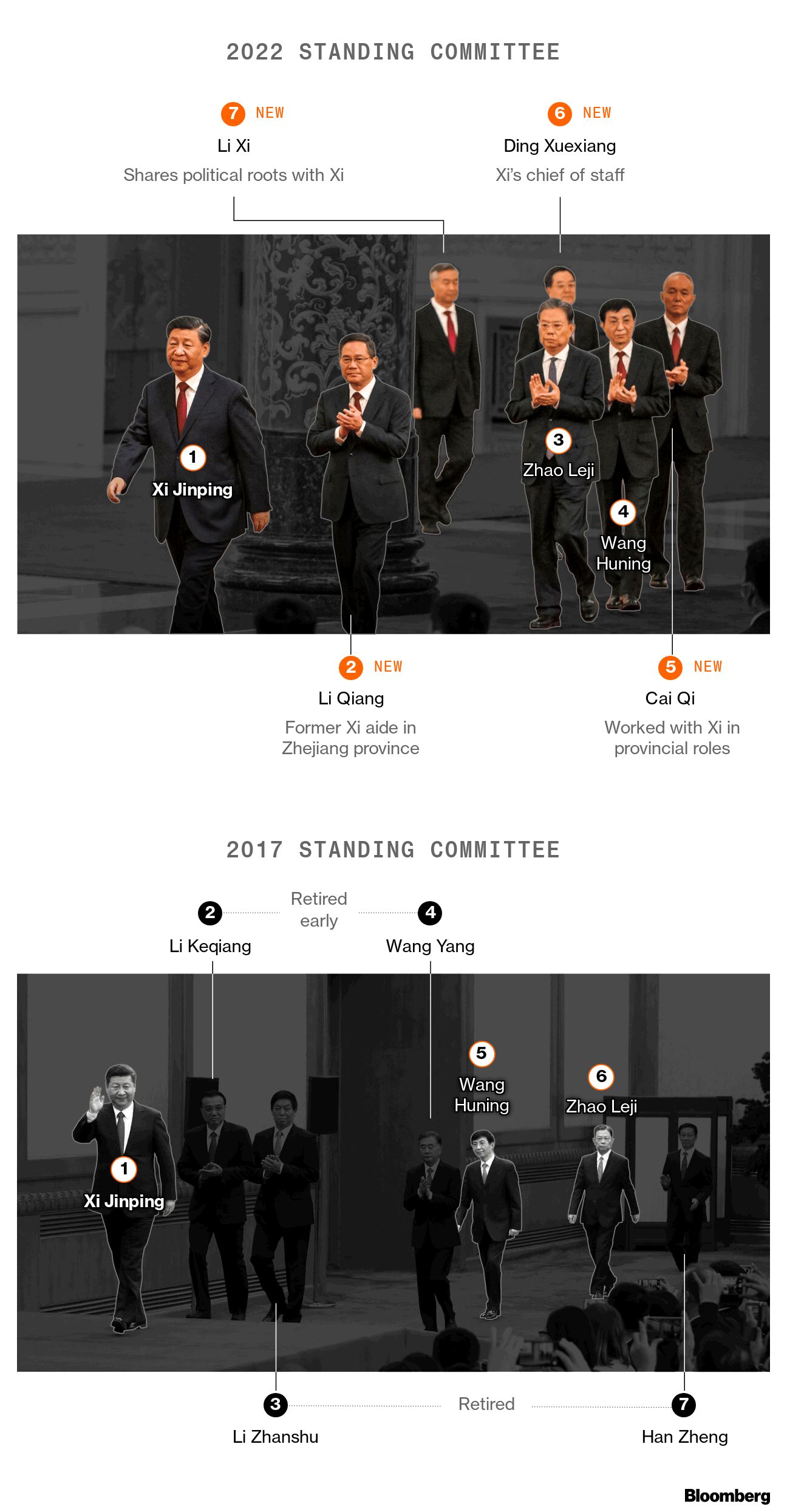
China’s new top leaders look a lot like the old ones: Seven men in dark suits led by Xi Jinping. But the Politburo Standing Committee unveiled Sunday in Beijing shattered decades of expectations about how power is transferred in the world’s second-largest economy.
Just by walking out on the red carpet at the Great Hall of the People, Xi upended the most consequential norm of all: handing over the reins of the Communist Party. Never since late reformer Deng Xiaoping established the current succession system in the early 1990s had one man led the twice-a-decade procession three consecutive times. And by securing a third term, Xi, 69, fanned speculation that he might stay for a fourth or longer.
The line of officials behind him — ordered by party rank — demonstrated Xi’s unquestioned grip over the party. Rules that had offered some predictability within China’s hierarchy, such as seniority and an unwritten retirement age of 68, no longer seemed to matter.
Xi’s Allies Dominate
Loyalty appeared to be the main qualification to reach China’s most powerful body: all but one of the six men behind Xi had careers that overlapped with him before he became president. The one who didn’t helped draft some of Xi’s signature slogans, like the Chinese dream.

Rivals Ousted
For the past 20 years, no one 68 or older had been appointed to the Standing Committee — and nobody 67 or younger had retired. That system, which helped ensure stability in elite Chinese politics, is no more.
While Xi exceeded the age cap for himself, two of his former peers exited early — the first time that’s happened in at least 30 years. Premier Li Keqiang, 67, and former top political adviser Wang Yang, 67, neither of whom were seen as close Xi associates, both got booted.
The lineup also broke expectations that seniority would dictate rank on the Standing Committee. Shanghai boss Li Qiang jumped ahead of two sitting members to claim the No. 2 spot, putting him in line for premier even though he never served as vice premier — a prerequisite for nearly every other head of government. A new Standing Committee member hasn’t been installed higher than an incumbent cadre since at least 1992, when Deng’s succession system was put in place.
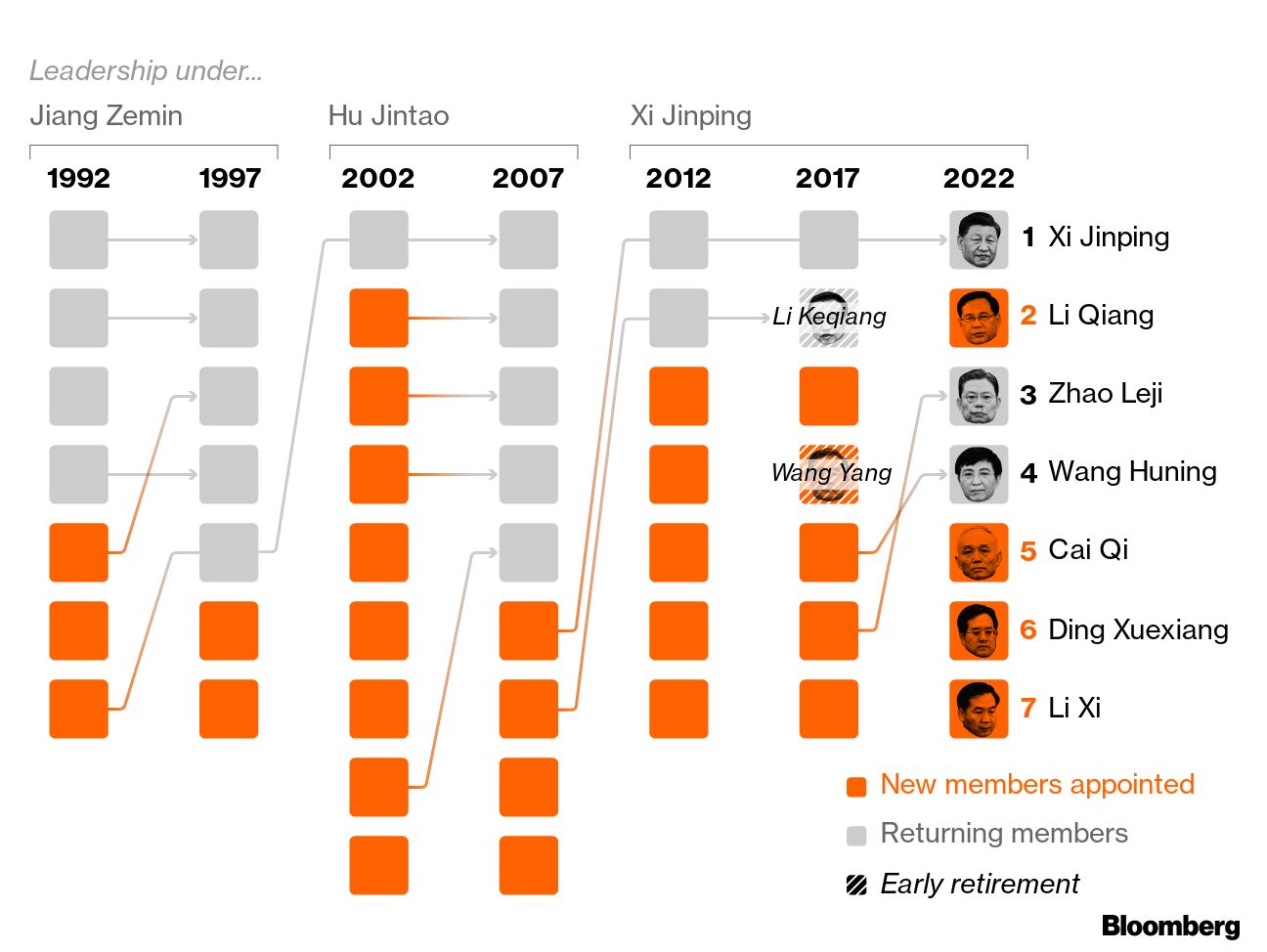
Politburo Surprises
Xi’s plan to break the party’s informal age rule had been widely expected since his 2018 move to eliminate term limits for the presidency, which he would’ve had to give up next year. More surprisingly, People’s Liberation Army General Zhang Youxia, 72, and Foreign Minister Wang Yi, 69, were also allowed to stay on the broader 24-seat Politburo. Both men have played central roles in managing Xi’s geopolitical strategy.
Meanwhile, former Xinjiang party chief Chen Quanguo, 67, who’s facing US sanctions for his role in cracking down on the region’s Muslim minority, retired before he reached 68. He followed a similar path as former Vice President Li Yuanchao, who left one year early during the last party congress in 2017.
Even more surprising was the decision to demote Vice Premier Hu Chunhua, who was once the youngest person appointed to the Politburo over the past three decades and a potential Xi successor. Of the 97 officials appointed to the body during that period, he’s only the third to fail to return. The other two, former propaganda chief Liu Qibao and former Xinjiang party leader Zhang Chunxian, were later appointed to low-profile legislative roles and largely dropped out of sight.
