
A Seattle Commercial District’s Trial by Virus
We tracked a group of businesses in the Capitol Hill neighborhood for a year and a half and were amazed by their resilience.
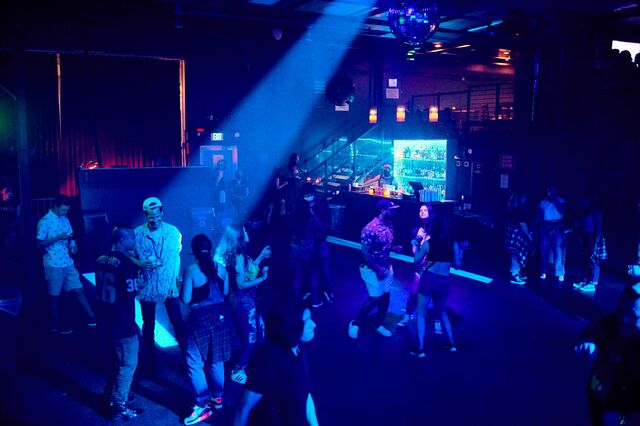
The pandemic changed the heartbeat of urban areas across the U.S.—few more so than the Pike/Pine corridor of Seattle’s Capitol Hill neighborhood. The vibrant-at-all-hours commercial district seemed headed for disaster as the economy shut down in March 2020. People holed up in their apartments, logging on to corporate office jobs at Amazon.com Inc. and other employers that had suddenly gone remote. Restaurants and bars went to takeout. Brick-and-mortar shops tried to make a go of it online. Music venues fell silent.
Then, as protests erupted across the country in June 2020 after the killing of George Floyd in Minneapolis, the neighborhood suddenly came alive again as thousands showed up to demand racial justice. Demonstrators briefly established a cop-free zone called the Capitol Hill Organized Protest (CHOP) across several blocks and in Cal Anderson Park that drew international attention. The city cleared the area a few weeks later after multiple shootings.
The heartbeat changed again in the fall, when a spike in Covid cases triggered new public-health restrictions. As vaccines became available, life slowly started to return to the neighborhood. But the broad reopening this July has been tempered by new fears about the delta variant of the virus. Were new shutdowns imminent?
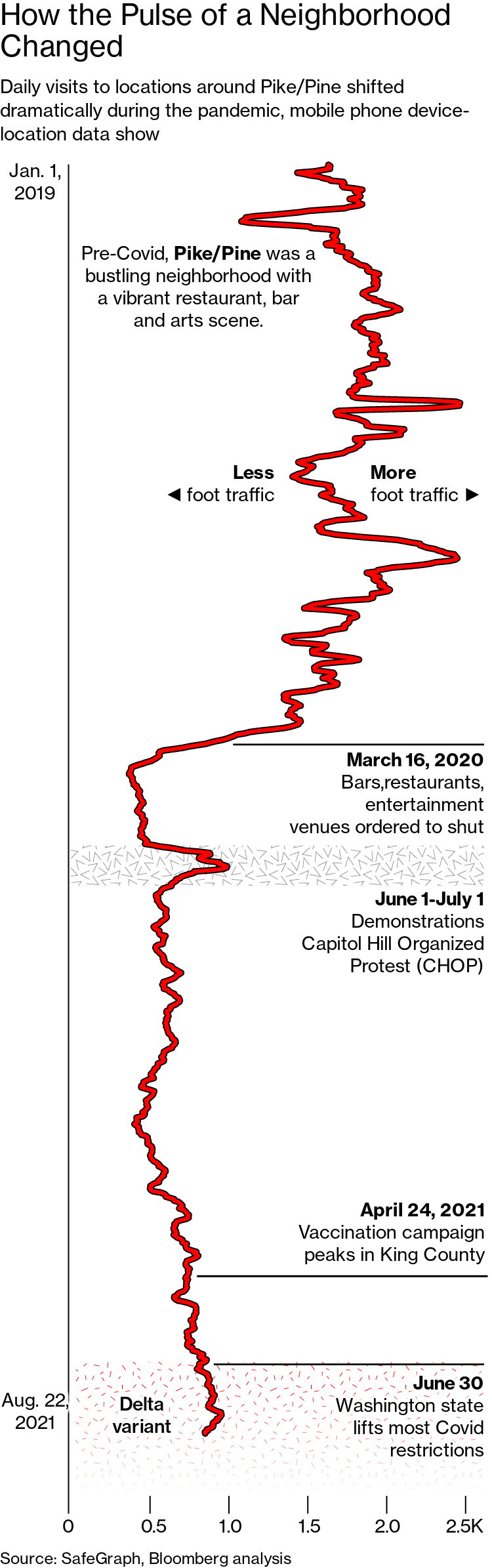
How the Pulse of a Neighborhood Changed
Daily visits to locations around Pike/Pine shifted dramatically during the pandemic, mobile phone device-location data show
Source: SafeGraph, Bloomberg analysis
Through all this, a surprising number of small businesses in the neighborhood managed to survive. Bloomberg Businessweek spent the past year and a half talking with some proprietors to find out how. Much like fighting the virus, it wasn’t a steady progression. Gains were made only to be reversed weeks later. Hundreds of millions of dollars in government assistance, as well as the generosity of customers in a city where the median household income, as of 2019, was $102,500—56% higher than the national average—were key. So was a population ready and willing to get jabs. Now, with more than three-quarters of Seattle residents 12 and up fully vaccinated, street life is returning to Pike/Pine. But, as these four businesses and data about the neighborhood show, things aren’t anywhere near back to normal—and may never be.

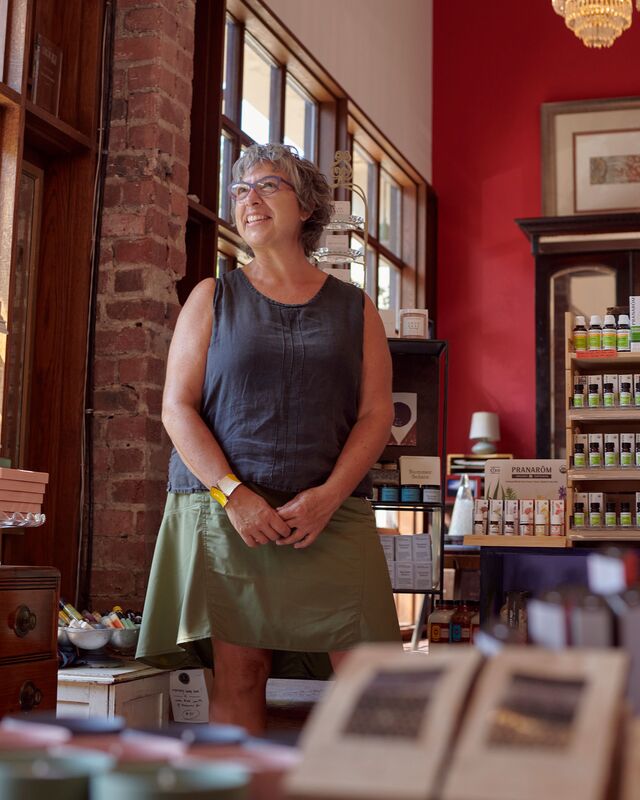
Karyn Schwartz
Pike/Pine Retail
Change in weekly visits from 2019

When we first shut down, and the neighborhood started to be like the Night of the Living Dead, I actually emptied the store out. I wasn’t really sure what was going to happen. My partner also had to shut her business, and we left the city for her house on Whidbey Island. I took all my inventory up there and set up a little fulfillment center. I was coming into the city on Wednesdays and Thursdays to do deliveries and curbside pickup.
Toward the end of April, beginning of May, I started to have a concept of what it could look like to reopen. I wanted to make sure my staff was safe, so that’s why you see two counters. One of them is in the back, and the other is halfway through the store. Because it’s so tiny in here, there was no way to be 6 feet apart without doing that.
I was prepared to reopen right when the protests began. We just stayed completely shut for about six weeks. We never boarded up. I just left the butcher paper on the windows and hoped for the best. I remember having this conversation with my landlord at the time, who is like, “Why aren’t you open? There are people everywhere.” And I’m like, “They’re not really here to shop.” I didn’t want to try to run a business in the middle of that.
That was when one of my employees convinced me to do a GoFundMe. I wasn’t going to, because it was super uncomfortable, but she was like, “I think people would show up for it.” So she set it up, and we raised just shy of $20,000. I was able to pay my employees and my rent and my personal bills for a couple of months. And that carried us through until I got the PPP [Paycheck Protection Program] loan and got the doors open again.
The whole time I’ve been in retail, especially in Seattle, which is like 32 years now, I’ve been one of those people that’s like, “You have to shop local or you won’t have a community.” And then “shop local” became this catchphrase that was super sexy, but people still didn’t really do it. People this year really got it. We had far fewer customers, but they spent more money per sale, so in the end our holiday season was right on target. We’re still probably at like half the number of people, but they spend a little bit more money.
At the beginning of the pandemic, people were—I’m not going to say hoarding, but you know—energetically stocking up on medicines that they thought they might need. I was having to tell people, “You don’t need seven bottles of elderberry syrup.” Like, we don’t even know if that’s going to help you.
For anyone who didn’t live right in the neighborhood, it seemed like the specter of CHOP lasted a lot longer than CHOP did. I mean, I was still getting calls in the fall from people who are like, “Is it safe to be there?” And I’m like, “Oh my God, don’t you read the news?” There was no rhythm of the day, and that persists. It’s just starting to change. My weekend mornings are busy—not pre-Covid busy, but the fact that there are people at all is remarkable.
It’s still really unclear what this neighborhood is going to be. There’s a lot of empty space, and it’s unclear who is going to occupy it. But I will say that it feels like life came back to this neighborhood faster than a lot of other parts of town, and that feels really good. It still feels like a neighborhood.
Where Did Everyone Go?
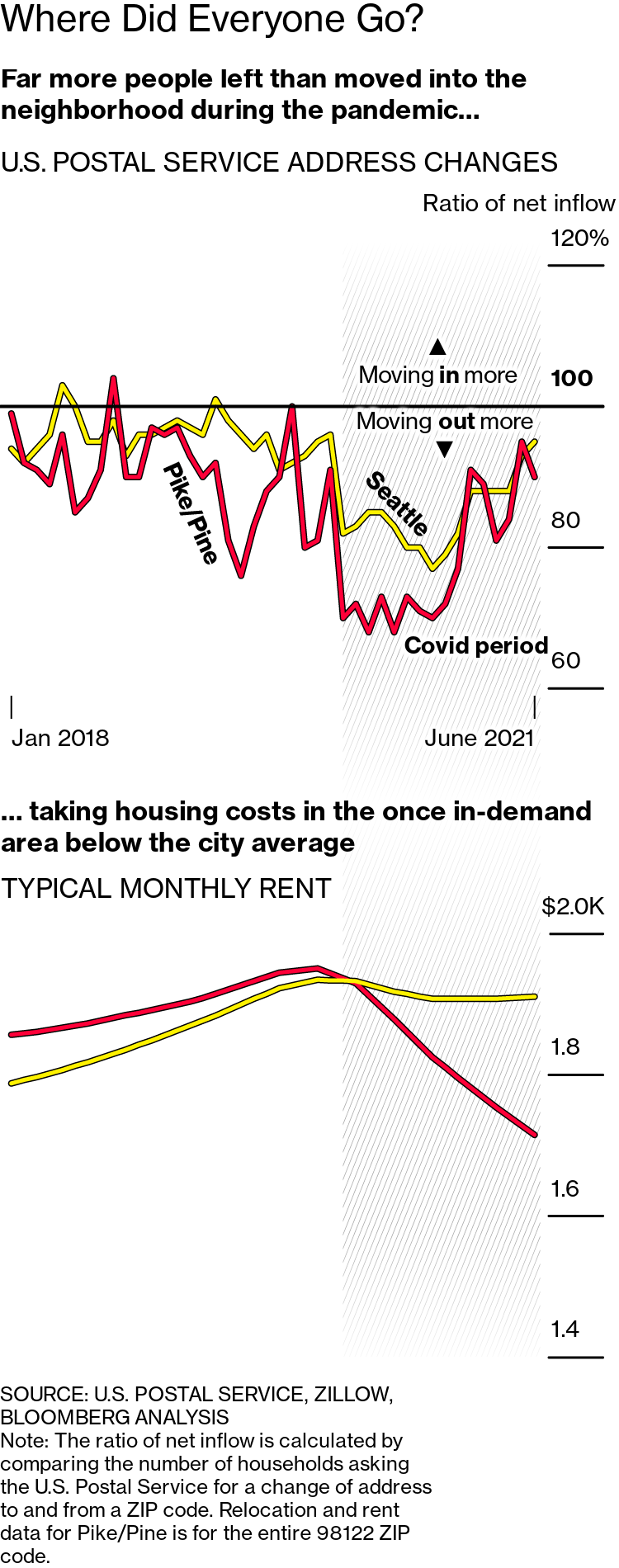
Note: The ratio of net inflow is calculated by comparing the number of households asking the U.S. Postal Service for a change of address to and from a ZIP code. Relocation and rent data for Pike/Pine is for the entire 98122 ZIP code.
SOURCE: U.S. POSTAL SERVICE, ZILLOW, BLOOMBERG ANALYSIS
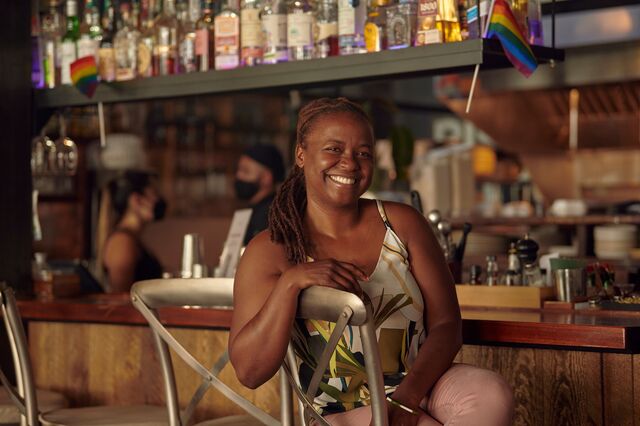
Makini Howell
Pike/Pine Restaurants
Change in weekly visits from 2019

At the beginning of this, when I had to lay off about 30 folks, I also had about $25,000 to $35,000 outstanding in payroll that I had not cleared. I had this massive outstanding amount of money that was about to come crashing, because you send people home and you give them their last check, they’re going to cash that—as well they should. Fortunately, I had personal savings. But there was sheer panic for a minute there.
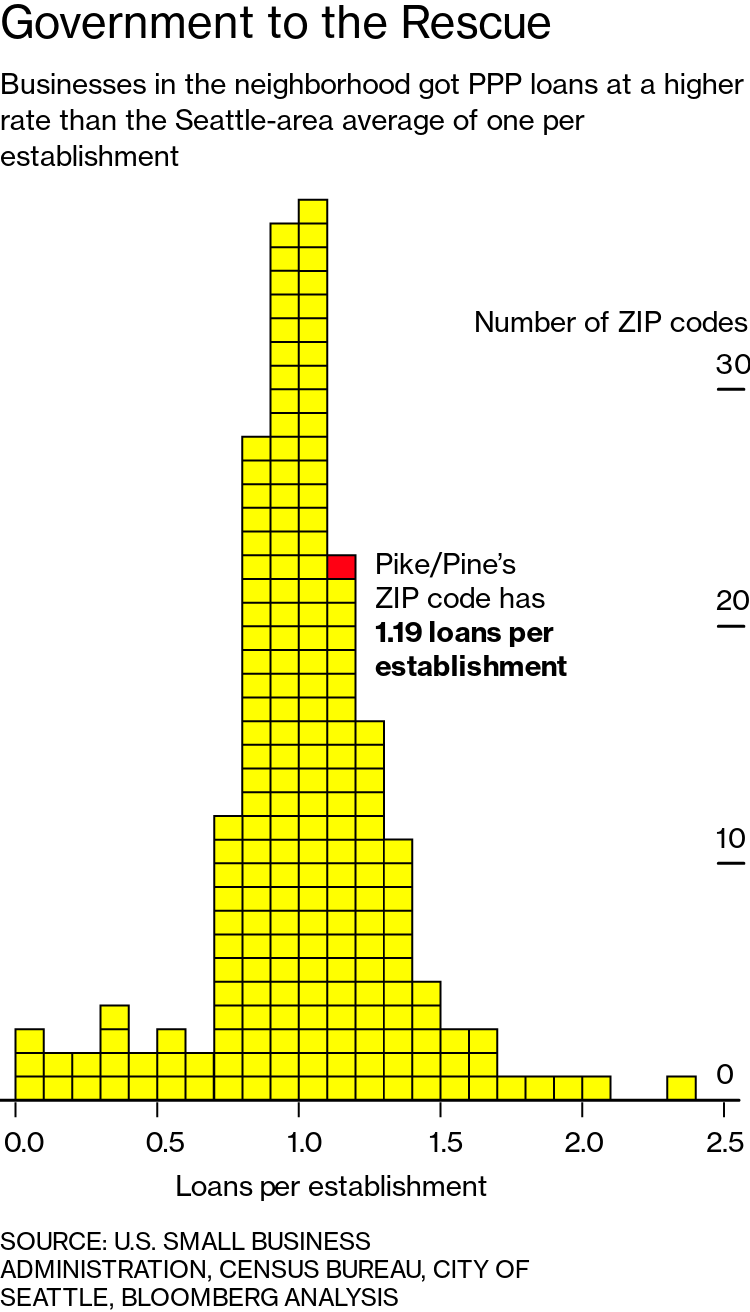
PPP was definitely the bridge. That made it a little bit better. And then my landlady tied our rent to our income, so it was a percentage of income, so we weren’t tied to the normal high rent and not making any money. And all utilities were put on hold by the city, and that was really helpful.
Government to the Rescue
Businesses in the neighborhood got PPP loans at a higher rate than the Seattle-area average of one per establishment
SOURCE: U.S. SMALL BUSINESS ADMINISTRATION, CENSUS BUREAU, CITY OF SEATTLE, BLOOMBERG ANALYSIS
We never actually closed, and I think that was a good thing, because it’s really hard to get back open now if you shut down. We kept the core of the staff and went to takeout. Oh my gosh, we did so many backflips. I used to have a brunch menu, a lunch menu, a happy hour menu, and a dinner menu. All of those are gone. It’s all designed into one menu that takes into account what people didn’t seem to be interested in. I couldn’t sell tofu. I couldn’t sell tempeh. It was hard to sell things that people weren’t sure were good. It was an exercise in letting your ego go as a chef, because you’re doing more approachable things.
To keep busy at the start of the pandemic, we nearly gutted the restaurant and rebuilt it. We redid the back cooking area. We redid the bar. Redid the dish area. There’s an office on top of the dish area now.
Also, during that time, we had to board up because CHOP happened. Seattle really supported Black-owned businesses. There were all these calls that were going out for Black Lives Matter, and everybody was getting tagged all over Instagram. People really showed up, sometimes more than we were expecting. It sort of started all at once. Literally, the day before getting tagged on social, we made maybe $80, $90. The day after, like $3,000, $4,000. The day after that, $5,000, $6,000. The blind spot in that was, if you know that we’ve been here all of this time, like, please support us every day. It can be detrimental if you’re not prepared to go from zero to 60. I have a strong team of people. We were fine. But you don’t want it to turn from “support Black businesses” to “oh, that Black business is incompetent.”
After CHOP, people started to come back to the neighborhood. My general manager found these greenhouses that we put outside. People are now starting to come back into the restaurant, but we’ve had to retrofit it a lot. There’s plexiglass everywhere. There’s cleaning and sanitation and super-restrictive numbers. And to-go is still going. At one point we were able to hire a couple more people back. But a lot of the folks we knew from before, the gap was too long, so they moved away.
I don’t know if we’re ever going to get back to where we used to be. The heyday of restaurants might be over. The pandemic really, really changed things. Customers don’t come out as much as they used to. The food can’t get as creative as it used to. There aren’t as many employees available as there used to be. We’re still not making enough money. Yes, we were given money. But that’s different than being able to make enough money.
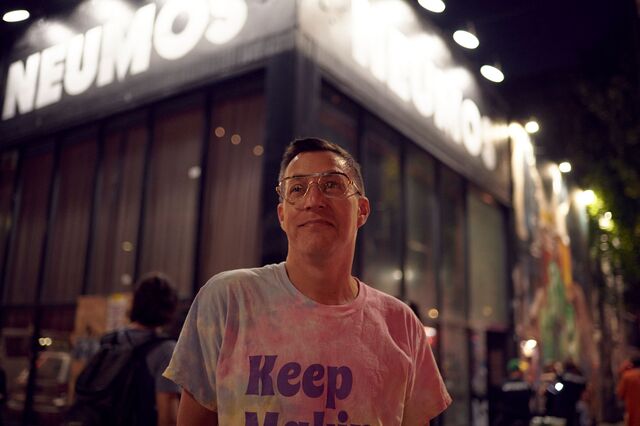
Steven Severin
Pike/Pine Music Venues
Change in weekly visits from 2019

I just reread an article that I was interviewed for six weeks after Covid started. And it was like, “We’ve got another six weeks, maybe 12.” We’re now 476 days in. Nobody thought it would go this long. I was the one among my partners who was the most pessimistic, and I was like, “I bet we’re back Sept. 1.”
A couple of months in, I was starting to come to peace with the idea that, you know, maybe I’m done. You know, 17 years, that’s a great run. Maybe this is my time to write the next chapter. Letting it go would not have been easy. This is what I’ve done my entire life—I started going to shows when I was 13. But it was definitely a strong consideration and might have been inevitable. How are we going to get all this money in order to pay our rent, our insurance, taxes, and everything else? We owe a ton of money for the remodel we did a couple of years ago and the giant sound system we bought.
We tried livestreaming shows, but it just didn’t get enough eyeballs. We talked about making shirts. We had a couple of photo shoots. We tried turning the venue into a place where you could get vaccinated. We were also looking at the club as a spillover space for actual Covid cases, when the hospitals were filling up. That never came to fruition.
It was hard to pivot because I was spending all of my time on NIVA [National Independent Venue Association] and WANMA [Washington Nightlife Music Association]. We and other independent venues ended up fighting for each other. It made it so I felt like I couldn’t step away, because it would’ve sent the wrong signal.
The longer I worked at it, the more progress we started making. It started with getting $750,000 for venues from King County. PPP made it so we knew we’d be able to get further down the road. By the time we got it, we were already working on federal legislation that eventually created the Shuttered Venue Operators Grants.
After the first show back in Neumos this July, I got so many texts thanking me for sticking it through and giving people an outlet again.
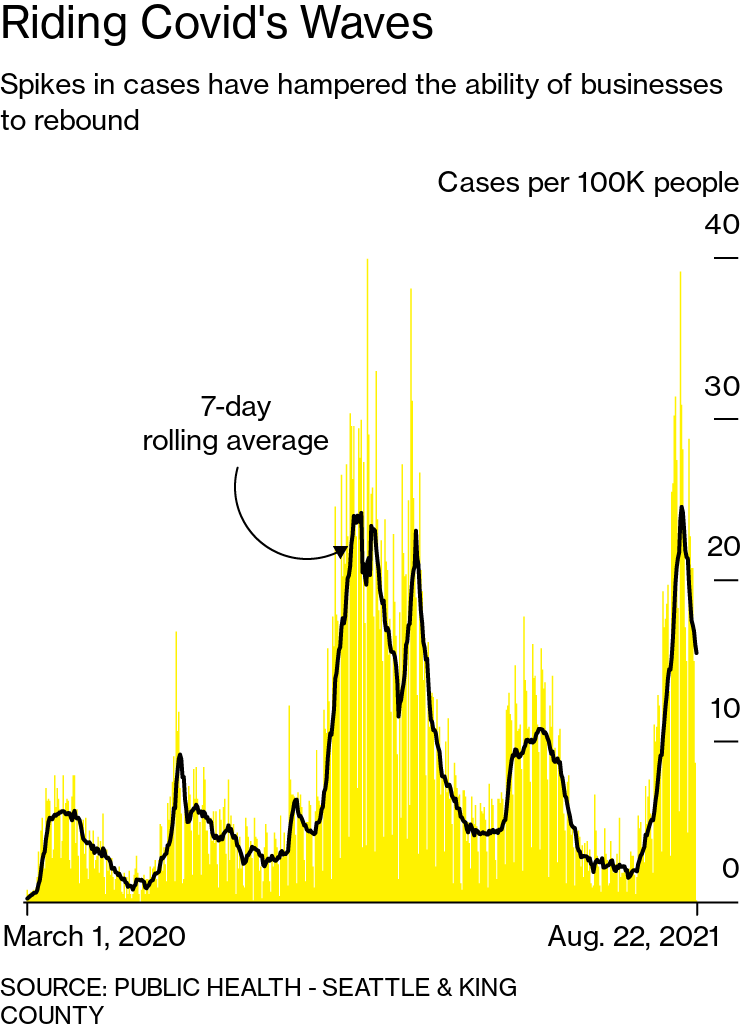
Last week, I would have said sometime next year, things will be back. But this week, it’s not looking good. I just know too many people who have gotten Covid who are vaccinated. There are people who are still not comfortable coming to shows.
Riding Covid's Waves
Spikes in cases have hampered the ability of businesses to rebound
SOURCE: PUBLIC HEALTH - SEATTLE & KING COUNTY
And if masking is required again, the vibe is going to drastically change. You don’t see the smiles. You go to take a drink, you’ve got to pull your mask down. It cuts down on the fun.
We’re rock ’n’ roll. We are your outlet. We are the hedonism you embrace because you work at Amazon 12 hours a day, writing code or whatever you do, and you need to get out. You need to stop staring at your computer. You go, there’s bright lights and your friends, and a couple gin drinks, and it’s all fun. And when you throw a mask on, you’ve got that reminder that there’s Covid.
It’s getting back to that unknown, and that is going to mean that shows are going to cancel, and I am not mentally prepared for that to happen.
Editor’s note: Four weeks after this interview, Washington state reinstated a mask mandate in most public indoor settings.
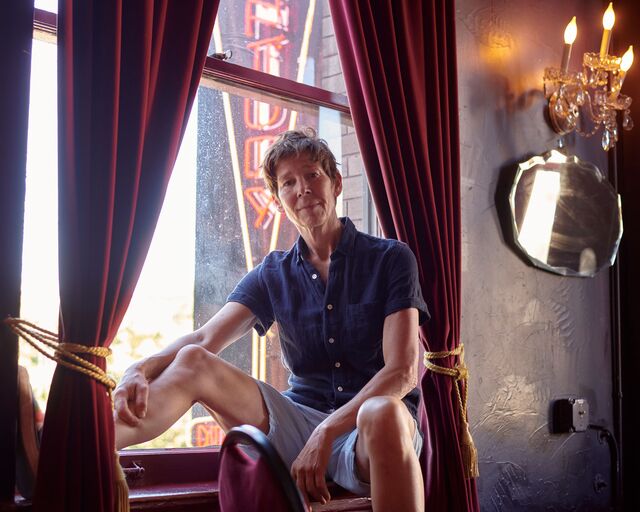
Hallie Kuperman
Pike/Pine Educational Services
Change in weekly visits from 2019
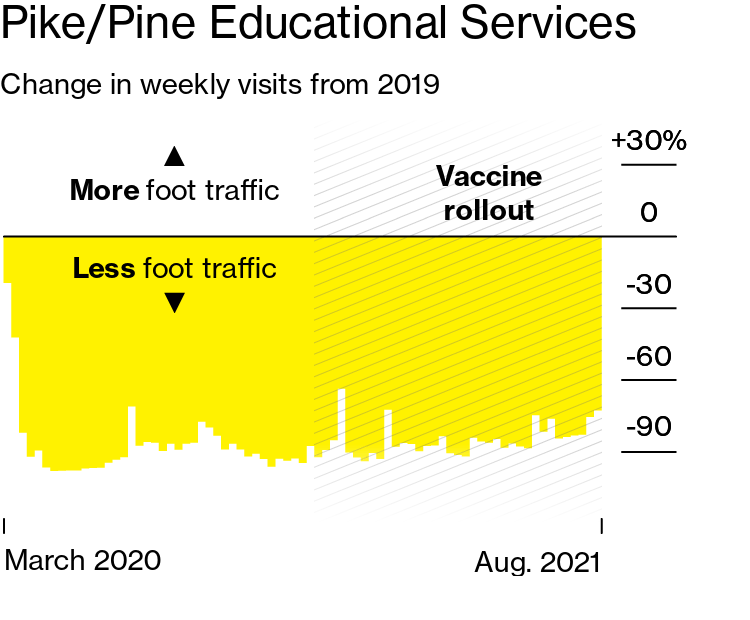
This was a breakeven business. So when the pandemic started, we just didn’t have any money. We applied for the PPP loan. We were one of the first people to get it, which was unfortunate and fortunate. We really just paid a bunch of people never to come to work. It was just a waste of the government’s money, in my opinion, because it didn’t help the business survive. After that, I had to just focus on what we could do, like takeout.
In the summer we did “glamping baskets.” Picnicking is my favorite thing to do, so we bought insulated bags and we would give people a bottle of Champagne and a deck of cards and a CD of bands that had played here—who uses CDs anymore?—and then filled it with food. Our space is on the second floor, so I would sit on the fire escape and lower food down on a little pulley system.
The Tin Table, our restaurant, is small, and the Ballroom is huge. So when indoor dining was allowed, we ended up moving the restaurant into the Ballroom. We did Friday and Saturday dinner. We tried Wednesday through Saturday and weekend brunch, but we couldn’t get the momentum. You can’t make a living on a restaurant being open two nights a week, but at least it was better than being open four nights a week, where we wasted two of those. So financially, it was a good choice. A fundraiser that started in November kept us going. People were extremely generous.
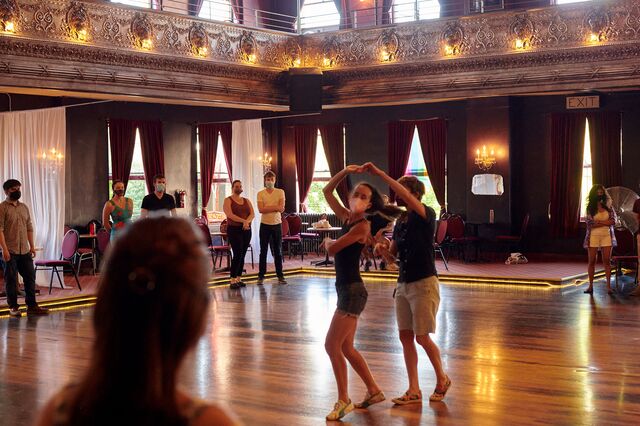
When we restarted dance classes in October, we taught a few days a week. But our normal schedule is usually like three to five classes a night, six days a week. Now we teach two classes a night five days a week, with a 15-minute break in between. That started because we sanitized everything to within an inch of its life, and we let the room air out.
We’re going to start with classes in two rooms a couple of days. That’s lovely. We can use the Ballroom for classes now because the Tin Table is back in the Tin Table space. Even though it feels so great and we have a handful of dances happening, we are so far away from being back to quote-unquote normal.
We stayed open to stay present and connected to our community. But I wouldn’t make that choice again. I would just be like, “OK, I’m on vacation.” Because it’s not like staying open we made enough money to stay open. It’s not worth that kind of energy anymore. We did it really well for a while—adrenaline is a great thing—but I wouldn’t do it again.
Methodology
The mobile-phone device location data used for this story was provided by SafeGraph. Through its data licensing partner Veraset, SafeGraph aggregates data from approximately 10% of devices in the U.S. Since not everyone has a smartphone, the data is not a perfect subset of the population and has been adjusted for sampling bias as well as for daily fluctuations in the number of devices detected.
The data analyzed for Pike/Pine includes more than 350 locations in the SafeGraph Places universe between latitude 47.6116 and 47.6187, and longitude -122.328 and -122.311. The locations are mostly commercial establishments but also include a relatively small number of other types of places, such as schools and parks.
Data for specific industries was calculated by aggregating by North American Industry Classification System (NAICS) codes provided by SafeGraph. The retail chart includes all forms of “retail trade”; restaurants include all “full-service restaurants”; music venues include “promoters of performing arts, sports, and similar events with facilities”; and schools correspond to all locations in the “educational services” sector, such as secondary and trade schools.
Loans per establishment were calculated by dividing the number of PPP loans made in each ZIP code in the greater Seattle area by the number of business establishments in each, according to the U.S. Census Bureau’s 2019 County Business Patterns series. First and second draws from the program are counted as separate loans. Loan data is current as of June 30, 2021. Analysis includes all areas in the Seattle City GIS Program’s Zip Codes file, except for five in which there were either no loans or no Census data for the number of establishments.
—Interviews and text by Noah Buhayar.
—Graphics by Jeremy C.F. Lin.
—Data analysis by Marie Patino and Noah Buhayar.
—With assistance from Andre Tartar