SoftBank Heads for Record Loss After $80 Billion Startup Spree
SoftBank Group Corp. is reporting annual earnings results on Monday. And what a difference a year makes.
About the same time last May, the company posted its highest ever operating profit thanks to Masayoshi Son’s enormous bets on technology startups like WeWork, Uber Technologies Inc. and Oyo Rooms. “Our time has finally come,” Son told reporters and analysts at an earnings briefing in May 2019.
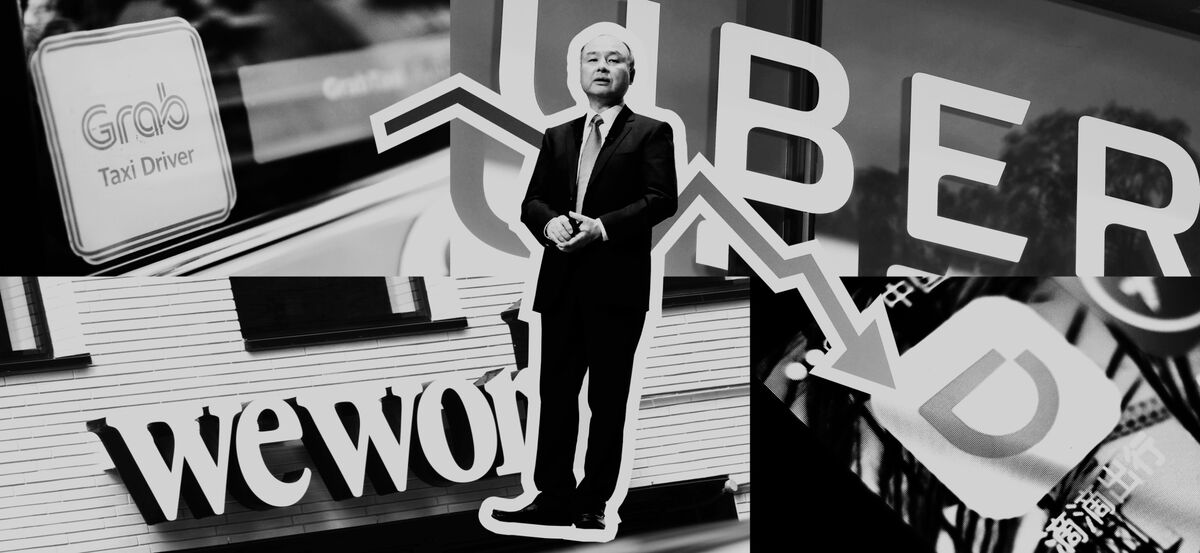
Instead, the year that followed was one of the worst in the company’s history: Uber’s disappointing initial public offering that May was followed by the implosion of WeWork in September and its subsequent rescue by SoftBank. Now Son’s investment portfolio, weighted heavily toward the sharing economy, is looking increasingly shaky as the coronavirus pandemic dries up capital available for money-burning startups.
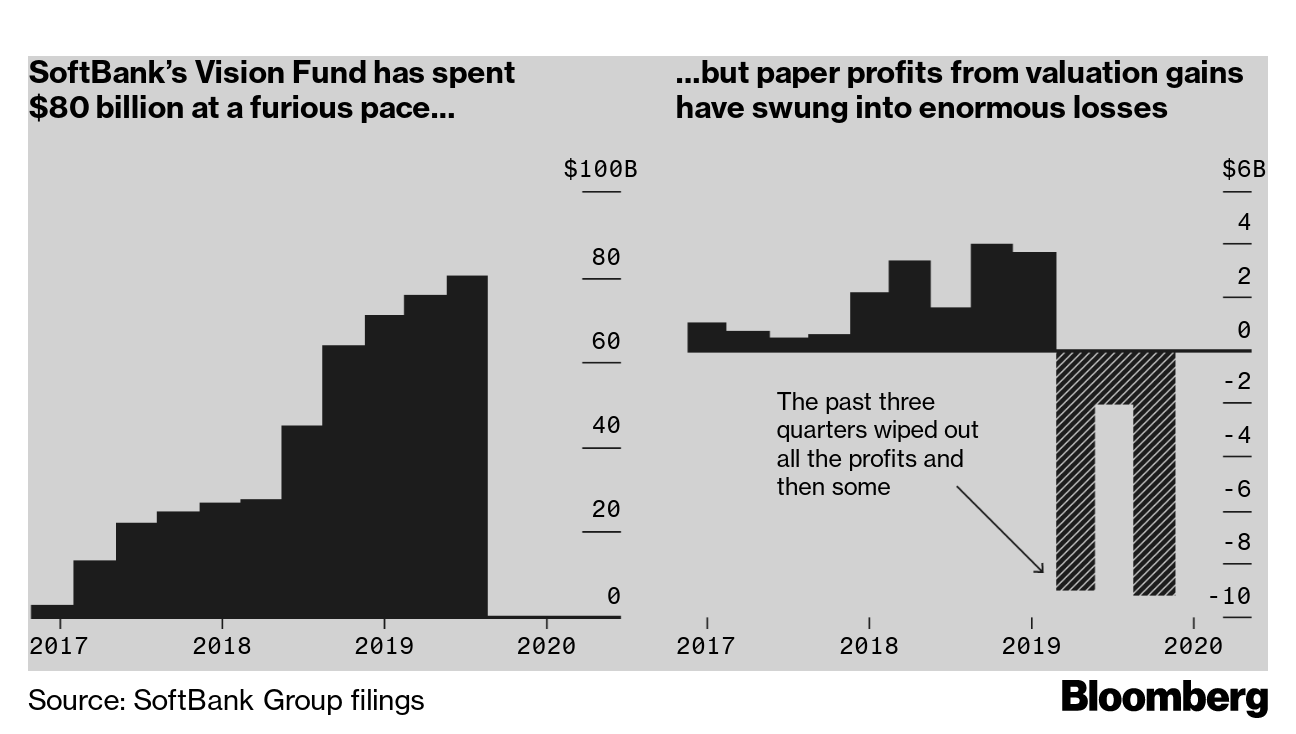
SoftBank expects to book a record 1.35 trillion yen ($12.5 billion) operating loss for the fiscal year ended March 31 when it reports results on Monday. The company’s Vision Fund business, technology investments that contributed more than half of the conglomerates profit a year ago, has swung to a record 1.8 trillion yen loss. The conglomerate’s overall net loss will reach 900 billion yen, SoftBank said last month in a preliminary earnings statement.
Source: SoftBank Group filings
The high-profile problems have already derailed Son’s plans to raise a massive technology fund every few years. Last July, Son said he was close to creating a $108 billion successor to the Vision Fund, with SoftBank chipping in $38 billion. But the WeWork fiasco spooked Saudi Arabia’s Public Investment Fund and Abu Dhabi’s Mubadala Investment Co., which contributed majority of the capital to the original vehicle. And in February, Son conceded that SoftBank will have to use its own capital for the time being.
The Vision Fund’s Big Investors and Biggest Bets
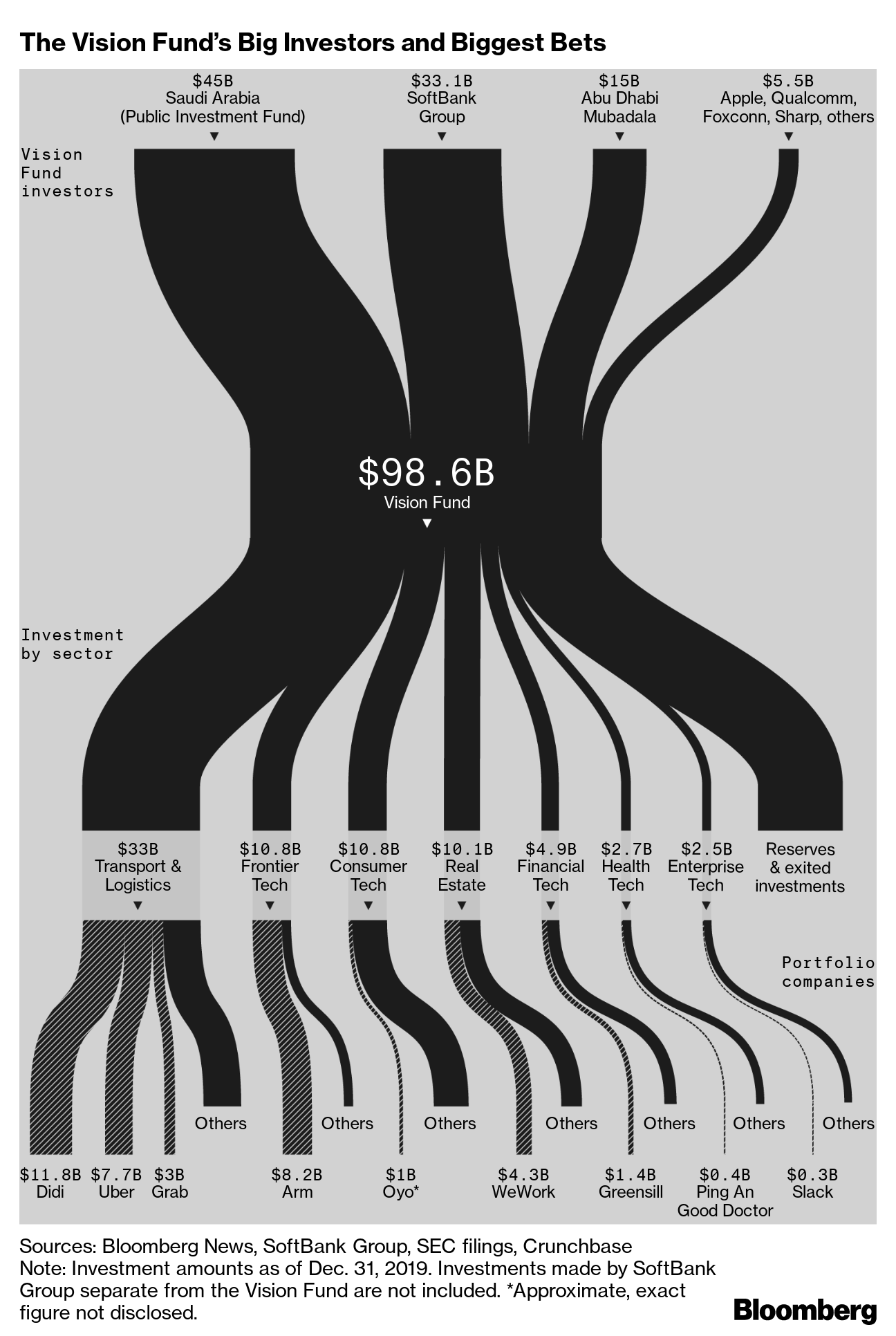
Note: Investment amounts as of Dec. 31, 2019. Investments made by SoftBank Group separate from the Vision Fund are not included. *Approximate, exact figure not disclosed.
Sources: Bloomberg News, SoftBank Group, SEC filings, Crunchbase
SoftBank also expects to record 1 trillion yen in losses from its own investments, including WeWork and satellite operator OneWeb, which filed for bankruptcy in March. The hit related to WeWork accounts for about 700 billion yen of the non-operating losses, including investments and loan commitments.
Last year, after WeWork’s effort to go public fell apart, SoftBank stepped in to organize a $9.5 billion bailout and put its own chief operating officer, Marcelo Claure, in charge of turning around the business. Son has said that making the company profitable was just a matter of closing unprofitable businesses, halting expansion and allowing existing office properties to fill up. Instead, the very premise of office-sharing is in question because of the coronavirus outbreak.
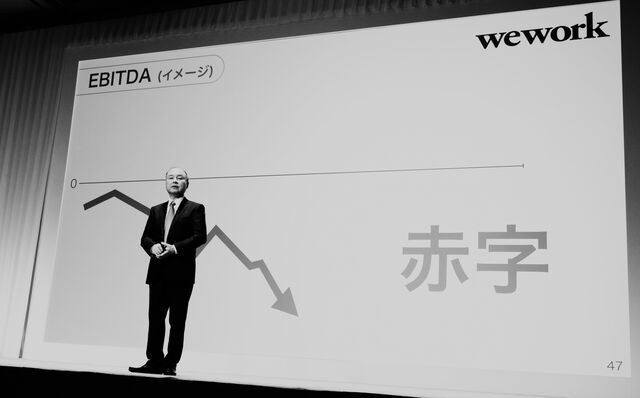
WeWork is now offering some tenants discounts to minimize cancellations following government-mandated coronavirus quarantines, which have forced non-essential employees globally to work from home. The New York-based company also hasn’t paid April rent for some locations and is approaching landlords regarding rent abatements, revenue-sharing agreements and other lease amendments as it seeks to trim liabilities, people with knowledge of the matter have said.
WeWork’s Meteoric Rise and Fall Fueled by SoftBank Cash
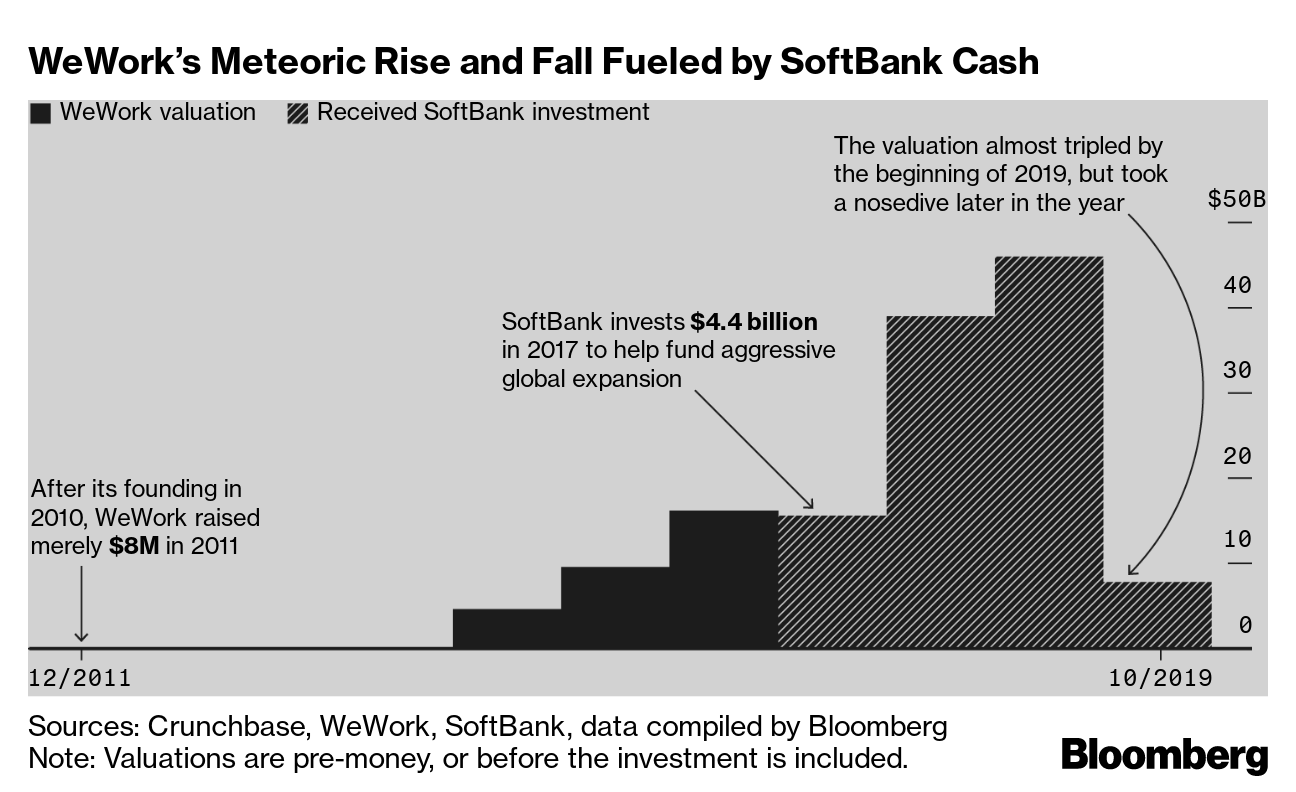
Note: Valuations are pre-money, or before the investment is included.
Sources: Crunchbase, WeWork, SoftBank, data compiled by Bloomberg
At the previous earnings briefing in mid-February, Son declared on stage in Tokyo that SoftBank’s fortunes were turning around after the WeWork meltdown. He highlighted a big surge in the shares of Uber, one of SoftBank’s bigger holdings, explaining that his company would likely be able to book a profit on the stake.
Instead, as the pandemic grounded potential riders, Uber was forced to cut costs to stem losses. The company instituted a hiring freeze in March, withdrew its financial forecast and wrote down some $2 billion worth of investments in April. Those investments include Uber's stakes in Didi Chuxing and Grab—two other ride-hailing companies in which SoftBank has invested. Earlier this month, Uber announced plans to eliminate 3,700 jobs, permanently close 180 driver service centers and shutter food delivery operations in seven countries. Its shares are trading about 27% below its IPO price.
Uber’s Roller Coaster Ride
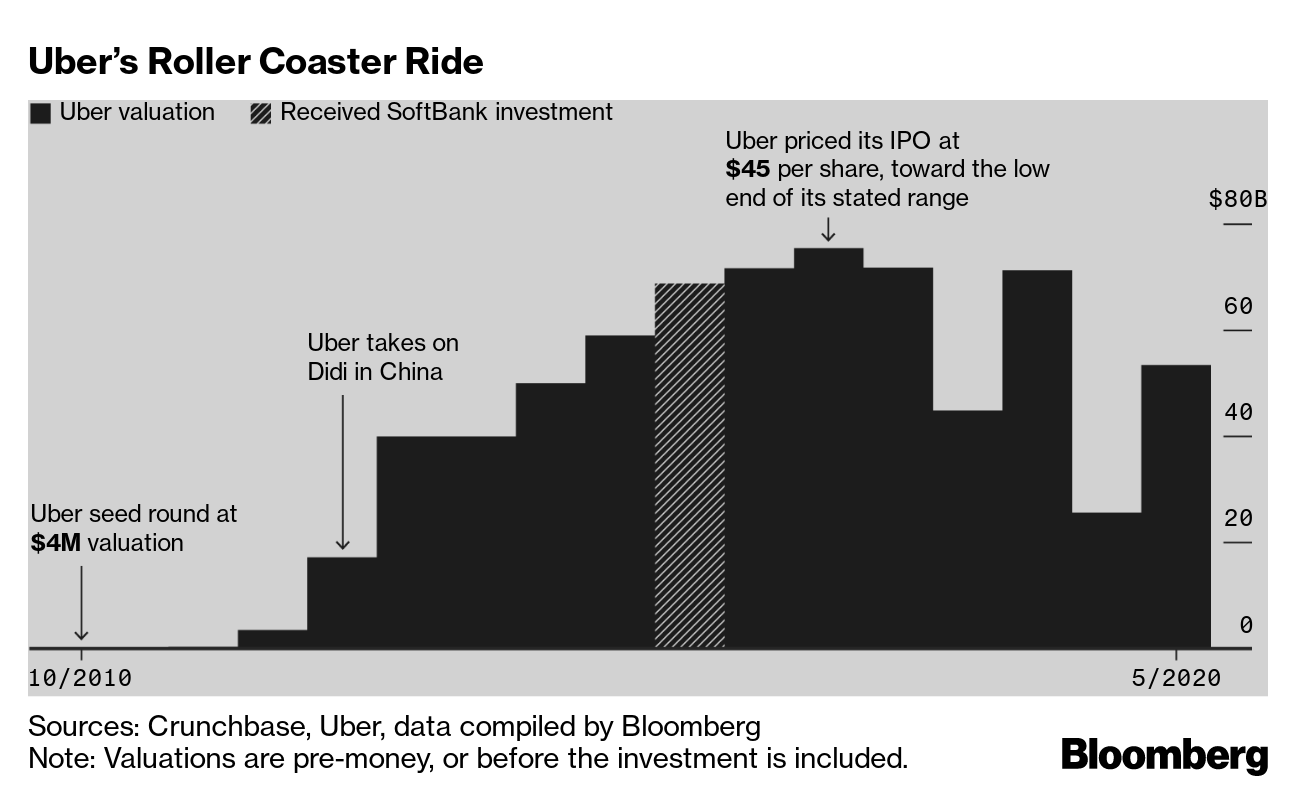
Note: Valuations are pre-money, or before the investment is included.
Sources: Crunchbase, Uber, data compiled by Bloomberg
Son has said he sees the combination of hitching rides via an app and robot taxis as a transportation revolution comparable to that which replaced horse-drawn carriages with cars a century ago. But the troubles at Uber bode ill for the rest of SoftBank’s ride-hailing portfolio at least in the short term. At stake is $18 billion of investments in all of the industry’s major players, including China’s Didi, Southeast Asia’s Grab and India’s Ola.
SoftBank has poured more than $10 billion into Didi, but after two horrendous years, China’s dominant ride-hailing provider is losing the confidence of at least some investors that it can live up to its once-lofty ambitions. In January, even before the virus hit, Didi’s shares were trading privately at as much as a 40% discount to its peak valuation, according to people familiar with matter. Ridership tumbled during the outbreak in China and Didi cut driver subsidies.
Son’s $19 Billion Bet on Ride-Hailing in Question

Note: Valuations are pre-money, or before the investment is included.
Sources: Crunchbase, SoftBank, data compiled by Bloomberg
Grab’s Chief Executive Officer Anthony Tan late last month warned that the coronavirus is creating significant challenges for the Southeast Asian ride-hailing startup that will require “tough decisions” about cutting costs and managing capital. Grab has been trying to offset some of the shortfall in ridership with food delivery. SoftBank invested $3 billion into the company.
India’s Oyo, a hotel-booking service, is another prime example of how the virus is affecting Son’s portfolio companies. Less than a year ago, the billionaire publicly declared its founder Ritesh Agarwal one of the star entrepreneurs backed by SoftBank. Son poured about $1.5 billion into the company and encouraged the young founder to try to become the world’s largest hotel operator by room count.
The Indian company has been expanding rapidly by guaranteeing a certain amount of revenue to hotels if they sign on as franchisees. Today, Oyo is freezing operations around the world and furloughing thousands of employees as it struggles to survive the coronavirus pandemic. Travel has slammed to a halt, leaving hotel rooms empty and losses rising.
Oyo’s Rapid Expansion


Source: Oyo
While it’s common for venture capitalists to lose on many if not most of their investments, the Vision Fund’s misses are magnified by the sheer size of the checks it has written—none less than $100 million. The missteps have also chipped away at Son’s reputation as the technology visionary who turned a $20 million investment in Alibaba Group Holding Ltd. two decades earlier into a fortune now worth more than $130 billion.
Making things worse is Son’s love of leverage. About $40 billion of the Vision Fund’s committed capital is in the form of preferred shares that pay 7% a year, whether the investments make money or not. Last fiscal year that added up to about $860 million in interest payments.
“After a difficult winter always comes spring,” Son said at the previous earnings briefing in February. “The tide is turning,” he added, standing in front of a slide with the same words and a crashing wave. That same day the World Health Organization announced it had a name for the new coronavirus strain sweeping the world—Covid-19.