Moving a Capital City to the Jungle
As a year of fires around the world from Brazil to Australia drew to a close, Indonesia’s capital was having the opposite problem. On the last night of 2019, more than 35 centimeters (14 inches) of rain fell on the sprawling city, causing rivers to burst their banks and inundate thousands of homes. At least 60 people died, with floodwaters rising as high as a single story house.
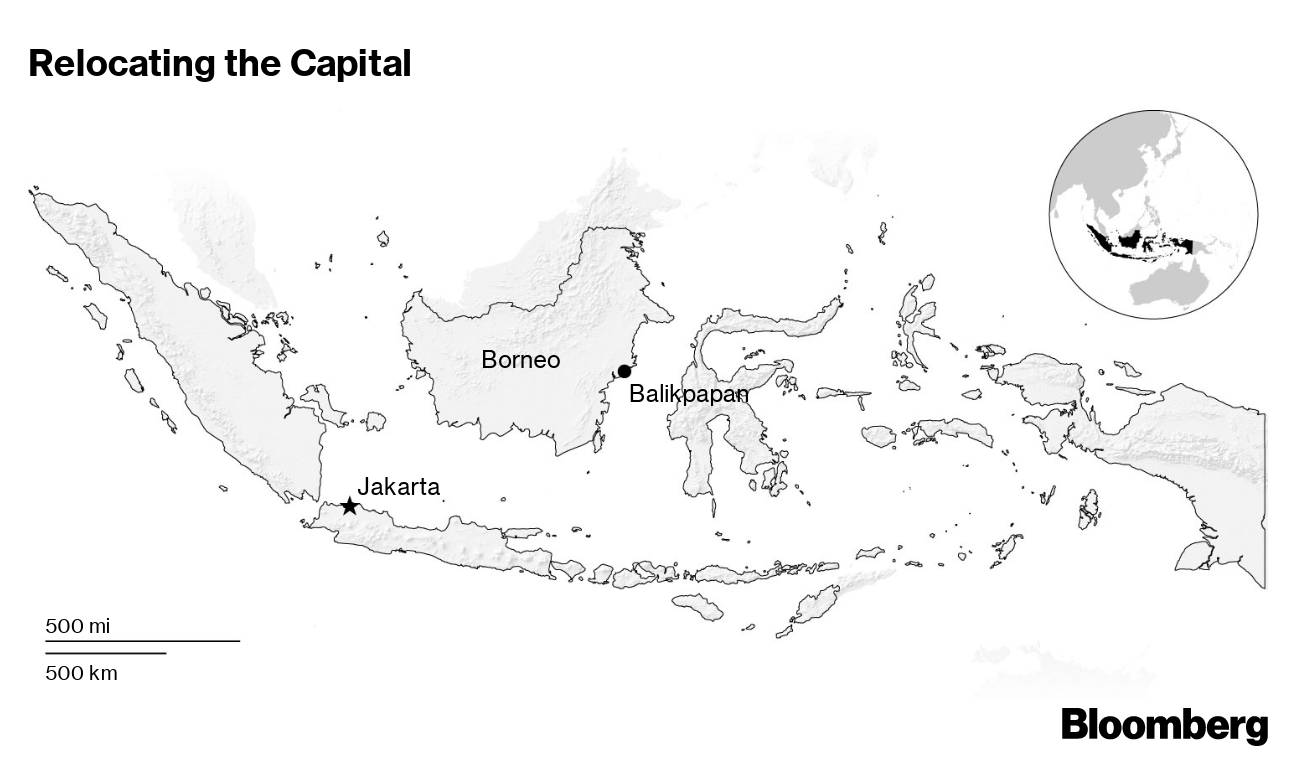
For Jakarta, a city on the island of Java saddled with some of the worst superlatives in the region—most polluted, most congested, fastest sinking—the floods were an old story, the third time deluges have killed dozens since 2007. The problems have become so overwhelming that, even before the latest catastrophe, President Joko Widodo had decided to build a new capital 1,200 kilometers away on the island of Borneo.
Relocating the Capital
Poor urban planning and decades of pumping groundwater from under the capital city set the stage for floods, and efforts to boost the nation’s economy have made an outsize contribution to the global emissions blamed for rising sea levels.
In the past two decades, more than 25 million hectares of tree cover has been lost, much of it logged or burned to plant oil palms. Worse still, Indonesia is the world’s biggest exporter of the bête noir of global warming—power station coal.
Biggest Coal Exporters in 2018

Source: IEA
Ironically, the president’s site for the new capital is near the heart of one of its biggest mining regions. Until forest fires brought global attention this year, Borneo mostly was known outside Indonesia as an exotic place of impenetrable jungle and indigenous tribes. It’s the world’s third biggest island and almost three quarters of it belongs to Indonesia, a region called Kalimantan. The place earmarked for the new capital is in East Kalimantan, a province the size of Louisiana that is almost entirely dependent on natural resources. Locals call it coal country.
The gateway to the region and to the proposed capital is Balikpapan, Kalimantan’s financial heart and a city that owes its existence to petroleum. The former fishing village became a boomtown after oil was found in the region in the late 19th century, during Dutch colonial rule. It has grown into a modern urban center, but the source of the port’s wealth still dominates the shoreline—an oil refinery run by state-owned PT Pertamina.
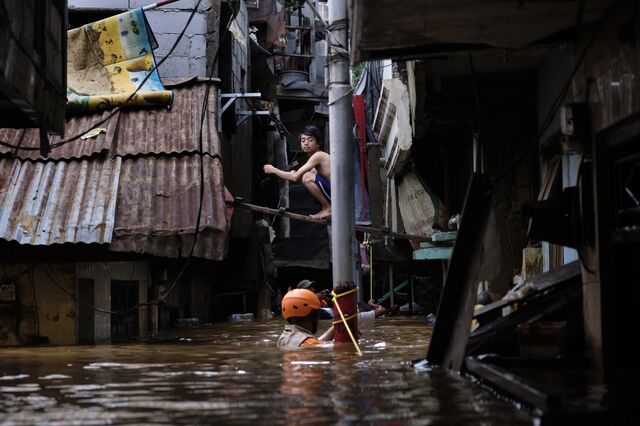
Rescue workers navigate a flooded neighborhood in Jakarta on Jan. 2. With the capital sinking and the sea level rising, flooding is the biggest environmental threat to the capital.
Photographer: Ed Wray/Getty Images
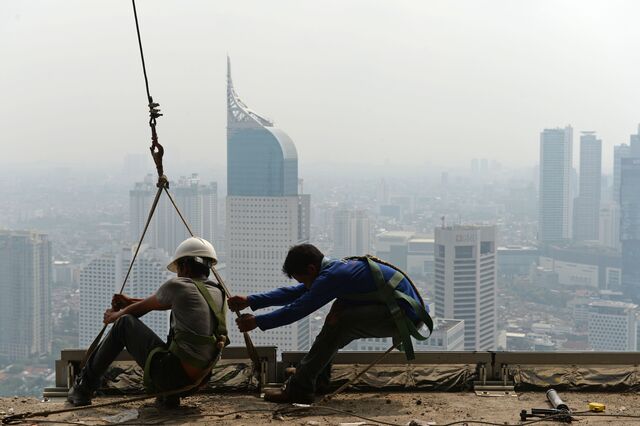
It’s not the only problem. Jakarta’s topography, traffic and periodic haze from forest fires create some of the region’s worst air pollution.
Photographer: Dimas Ardian/Bloomberg
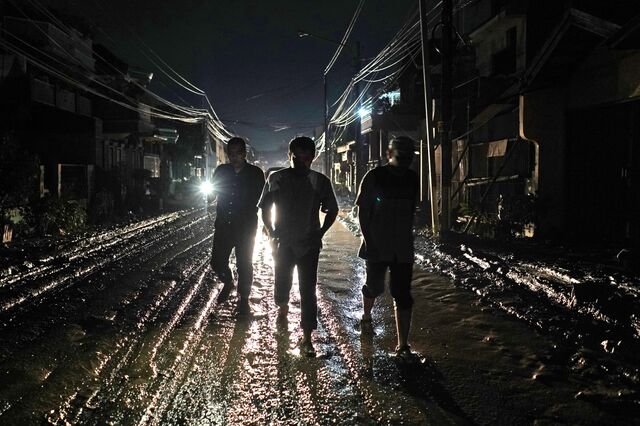
Pedestrians walk along a road after flooding on Jan.3 in Jatiasih, a suburb of the capital. The capital has swallowed up towns around it to create a metropolis that is projected to become one of the world’s three biggest cities.
Photographer: Dimas Ardian/Bloomberg
Sound is off
In March 2018, an accident at the plant dumped about 40,000 barrels of oil into Balikpapan Bay, coating 26 kilometers (16 miles) of coastline in black sludge. It was the worst Indonesian environmental disaster in a decade, killing five fisherman and damaging marine life and mangrove forests.
For six months, hundreds of people who fish for a living had nothing to catch, said Dedy Damhudi, a 47-year-old government fishery coordinator for the area. The company promised compensation, but “it wasn’t enough,” Damhudi said.
PT Pertamina, which didn’t respond to requests for comment, is now expanding the refinery to increase output by more than a third to 350,000 barrels a day.
Oil wells still dot the area but the fuel has been overtaken by coal. At PT Bayan Resources Balikpapan Coal Terminal further up the coast, snaking red conveyor belts stretch out into the bay, carrying the fuel to waiting ships. The company declined to allow access to the site and didn’t respond to e-mailed questions about pollution.
On the other side of the bay, villages still pursue a traditional life based on fishing, but their future is under threat. A boatman ferrying passengers along the coast through a floating mass of plastic bottles and floating waste, stops frequently to clear the trash from the outboard propeller with a long stick each time it gets clogged.
A survey in 2010 showed Indonesia dumped 3.2 million tons of waste into the water each year, including as much as 1.29 million tons of plastic, second only to China. Sakkirang, a 42-year-old fisherman from the village of Manggar Baru said the floating rubbish causes damage to boat engines that the community can ill afford.
But there is a bigger problem. He says coal spilled from loading ships sinks to the bottom of the bay and has cut fish stocks in half over the past five years. “We cannot catch fish down there anymore,” he said. “We don’t know where to go to complain. If we go to the government we are left feeling like an ignored stepson.”
Sakkirang sees little future for his way of life. “We encourage our kids to go to school and not become fisherman like their fathers.”
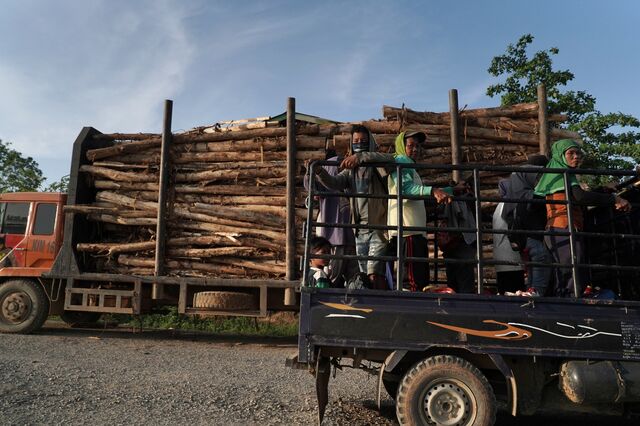
Workers on the back of a pick-up pass a logging truck in Penajam, near Balikpapan. While the region has relied on its natural resources for a century, the new capital would dramatically change the local economy.
Photographer: Dimas Ardian/Bloomberg
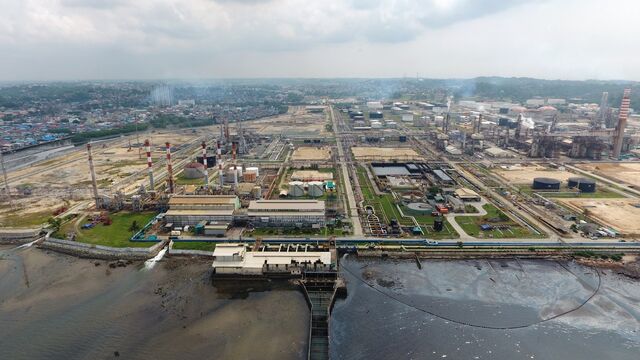
The PT Pertamina oil refinery in Balikpapan dominates the city skyline from the bay. The city dates its anniversary from when the first oil well was drilled in the region on Feb. 10, 1897
Photographer: Dimas Ardian/Bloomberg
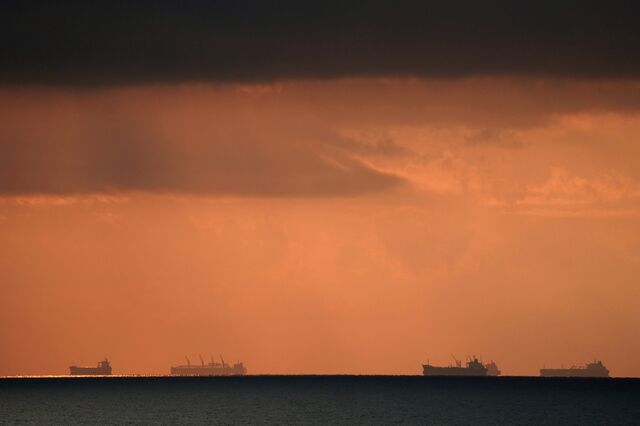
Tankers sit offshore in Balikpapan. The country’s oil exports have declined over the past few decades, while coal sales have soared.
Photographer: Dimas Ardian/Bloomberg
Sound is off
On a winding two-lane road running north out of Balikpapan, the source of all the coal soon becomes clear. Streams of trucks piled high with the fuel overtake one another as they pass one gated mine after another. Many are small pits, independent operations covering a few hectares. Others have as many as half a dozen excavators at work, digging coal that lies only a few meters from the surface.
At one site, workers who asked not to be named for fear of losing their jobs sifted and bagged the fuel, happy to get work from an industry that all but wiped out their traditional way of life. They didn’t know how much coal is moved each day, how much the owners make, nor any idea where the fuel goes.
The mines are everywhere. Some 40% of the province is allocated to mining licenses—more than 1,140 of them—according to government data. And that’s after thousands were forced to shut as reserves depleted or they became victims of a slump in prices in 2016. Many of the 1,735 abandoned holes have filled with water, toxic green pools that have claimed the lives of dozens of children.
“We are trying to fix it,” East Kalimantan governor Isran Noor said in an interview. A production quota was implemented and hundreds of licenses were revoked for companies that broke the rules, but the problem persists because many operations ignore the quotas, he said.
It’s the curse of every developing country that is rich in resources. There’s too much money to be made. Last year, Indonesia dug up a record 557 million tons of coal, worth some $50 billion. The buyers are the power stations in China and increasingly India that drive industrial development. There is also a growing market at home as Indonesia tries to emulate the economic ascent.
The Southeast Asian nation is now the world’s eighth-largest producer of coal-fueled electricity.
“The mines are already open and on a vast scale, so it is not easy to control production and good mining practices,” said Hendra Sinadia, executive director of the Indonesia Coal Mining Association. “With the government planning to move the nation’s capital, I think they will tighten up monitoring.”
The president, known as Jokowi, has tried to wean the nation’s trillion-dollar economy off its reliance on raw materials. Last August he permanently extended an eight-year-old moratorium on the conversion of primary rainforest for commercial uses such as logging or palm oil.
But the push for economic development has driven a relentless destruction of the country’s rainforests, the third-largest in the world behind those in the Amazon and Congo basins. In 1990, forest covered two-thirds of Indonesia, according to UN data. By 2016, that had fallen to less than half. Jokowi’s reforms and efforts to curb corruption have helped slow the rate of destruction, but the nation still lost more forest cover in the past decade than the total area of the United Kingdom.
“It’s a national issue,” said Arief Wijaya, forest and climate senior manager at World Resources Institute Indonesia. “Environmental degradation causes significant natural hazards—floods or drought or fires—that are already becoming more intense.”
Last year saw the worst such fires in four years, which razed an area larger than Yellowstone National Park. For almost two months the smoke spread across the region, covering parts of Malaysia, Singapore and even Thailand with a choking haze that afflicted millions with respiratory illnesses. More than 700 million tons of carbon dioxide was released into the air and the World Bank estimates the fires cost Indonesia $5.2 billion in economic losses.
Fires in 2019

Source: NASA Earth Observatory
The emissions did no favors for the 35 million people who live in and around Jakarta, ranked by Greenpeace in 2018 as Southeast Asia’s most polluted city. Decades of underinvestment in public transport and infrastructure and poor planning and enforcement have contributed to problems, from inadequate sewerage and power to traffic snarls that cost an estimated 100 trillion rupiah ($7 billion) a year in lost productivity. Jokowi has sought to fix the problems, including opening the city’s first metro line in March.
Still, those issues pale in comparison to the flooding.
Jakarta is sinking at the fastest rate of any major city in the world, prompting it to seek solutions that include building a giant sea wall across the bay. Two-fifths of the capital is now below sea level, and some neighborhoods are dropping at a rate of 20 centimeters (8 inches) a year. Climate scientists say 95% of the main city could be underwater by 2050.
And it’s not the only place in the country. Of the more than 17,000 islands that make up Indonesia, as many as 3,000 may disappear in the next 30 years, an official from the Ministry of Maritime Affairs and Fisheries said in 2015. In the past 15 years, an area the size of Jakarta has already gone, according to one government estimate.
“The rising sea level is one of the most serious environmental issues facing the country,” said Arief Wijaya of the World Resources Institute.
Jokowi’s 466 trillion rupiah solution is to move the capital to Kalimantan. Construction on 360,000 hectares of land is set begin this year. The winning design, announced by the Public Works and Housing Ministry in December, envisages a green city inspired by Indonesia’s rich ecosystem.
At a sustainability forum in Abu Dhabi on Jan. 13, Jokowi promised a green city that would be "the best work in energy efficiency and environmentally friendly innovation" and have a population of as many as 7 million residents - 10 times the size of Washington DC. His office in Jakarta said in response to questions on the relocation that the traffic and pollution are part of the reason for shifting the capital, but the move will also help spread development outside of Java Island and reduce inequality in the country.
Other nations have moved their capitals for political or other reasons. Malaysia shifted its seat of government 36 kilometers south from Kuala Lumpur to Putrajaya in 1999 and Myanmar moved from Yangon to Naypyitaw in 2006. But Jakarta may be the first capital to become a victim of climate change as much as congestion and overcrowding.
Flooding in 2050
Areas projected to be under water within 30 years
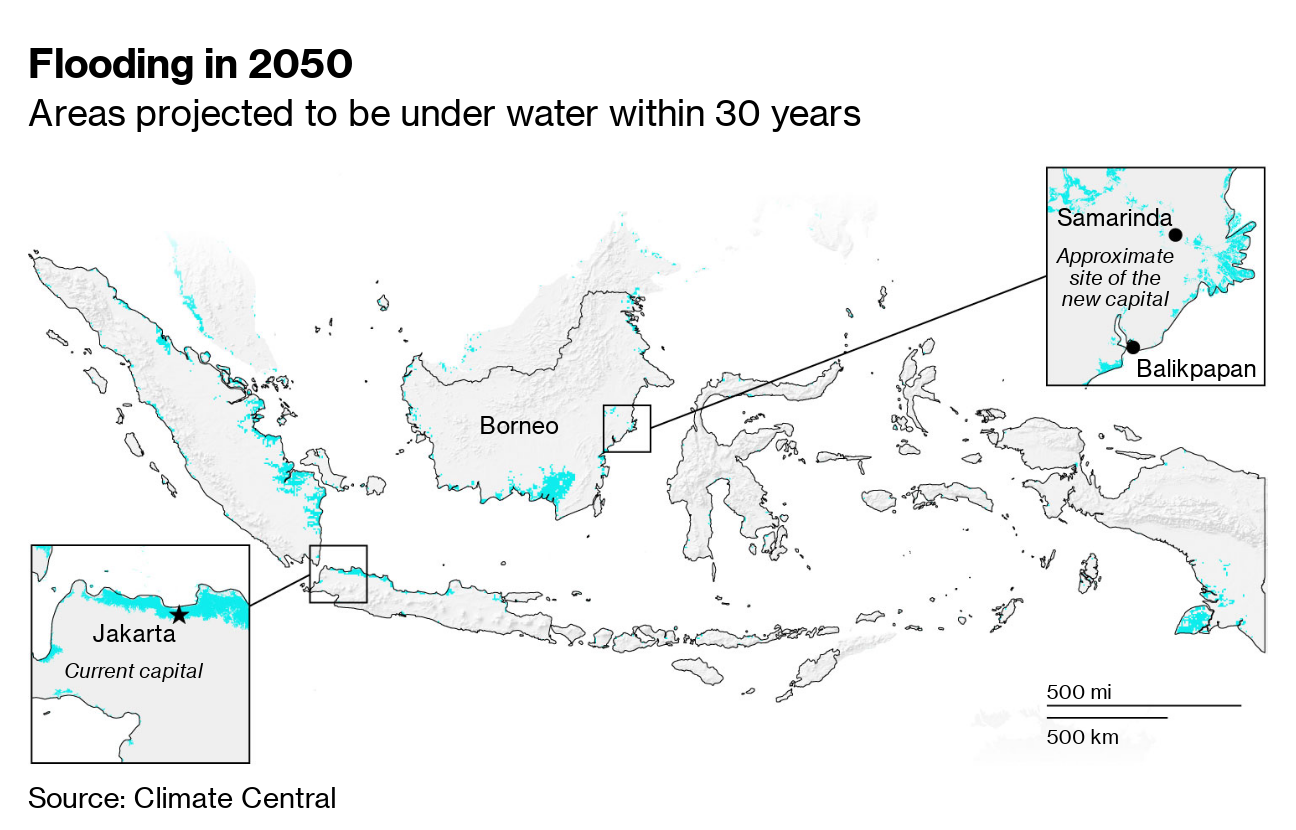
Source: Climate Central
For the local tribes that live in the area of the new city, the prospect is both exciting and unsettling. “We are curious, and worried,” said Fahmi, 28, a member of the Paser Balik tribe in the village of Sepaku, a probable site of the new capital. “Almost everybody here depends on the forests. Many work as hunters, others as farmers, so it is very important for our livelihood.”
Sitting on the porch of his single-story home, he can see the massive track of recently enlarged road that runs to Balikpapan. He said he’s excited to see so much activity coming to his village, but concerned about what it will mean for his tribe. “We want to make sure the government is looking out for our welfare,” he said.
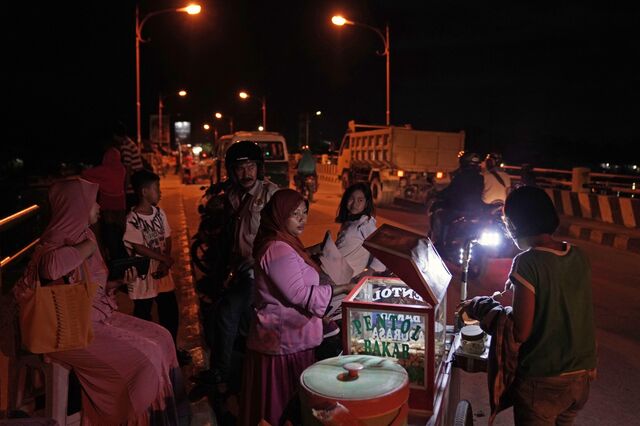
People gather at a food stall on Manggar bridge in Balikpapan. What was once one of the country’s most remote major cities could become the gateway to the new capital.
Photographer: Dimas Ardian/Bloomberg
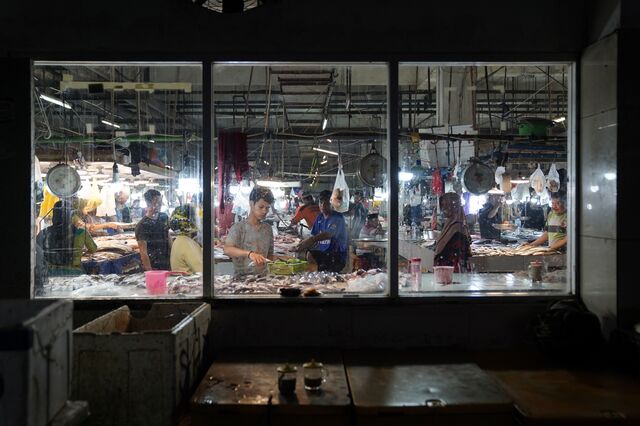
A fish market in Balikpapan. Local fishermen have complained that the expansion of the oil and coal facilities in the port have reduced their catch.
Photographer: Dimas Ardian/Bloomberg
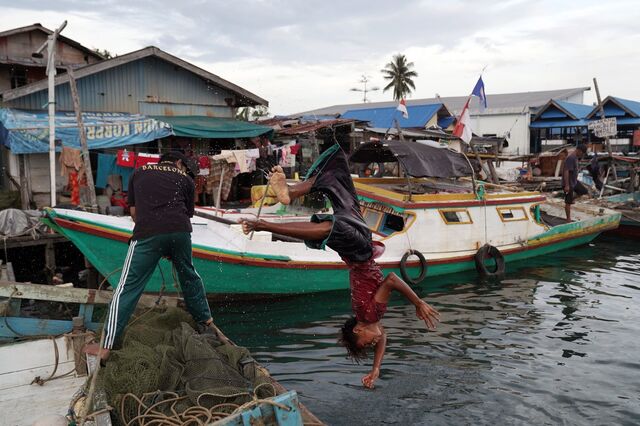
A boy jumps from a jetty in the Manggar area of Balikpapan. Fishing communities fear their industry is under threat from the development in the region, but hope it will bring new employment for their children.
Photographer: Dimas Ardian/Bloomberg
Sound is off
So far, Jokowi’s government has a mixed record on green issues, the result of trying to balance environmental concerns with the need to propel growth and reduce poverty. He gained power in 2014 promising to liberalize business regulations, a policy that some critics said led to greater exploitation of resources and a loosening of controls on the mining sector. A revision to the anti-corruption law passed in September sparked protests in Jakarta on worries the bill would weaken the Corruption Eradication Commission’s ability to pursue environmental crimes.
At the same time, the president has cracked down on some environmentally damaging practices, including implementing a moratorium on clearing peatland and requiring stricter disclosures for plantations and mining contracts. The anti-graft agency has targeted the coal industry and was partly responsible for the closure of many small mines since 2016, when it found that more than 4,000 license holders in four provinces weren’t paying their taxes.
Jokowi’s most controversial move came in August, when he promised to ramp up the use of biofuel made from palm oil, undermining efforts to curb deforestation and contributing to a 40% jump in palm oil prices.
Deforestation
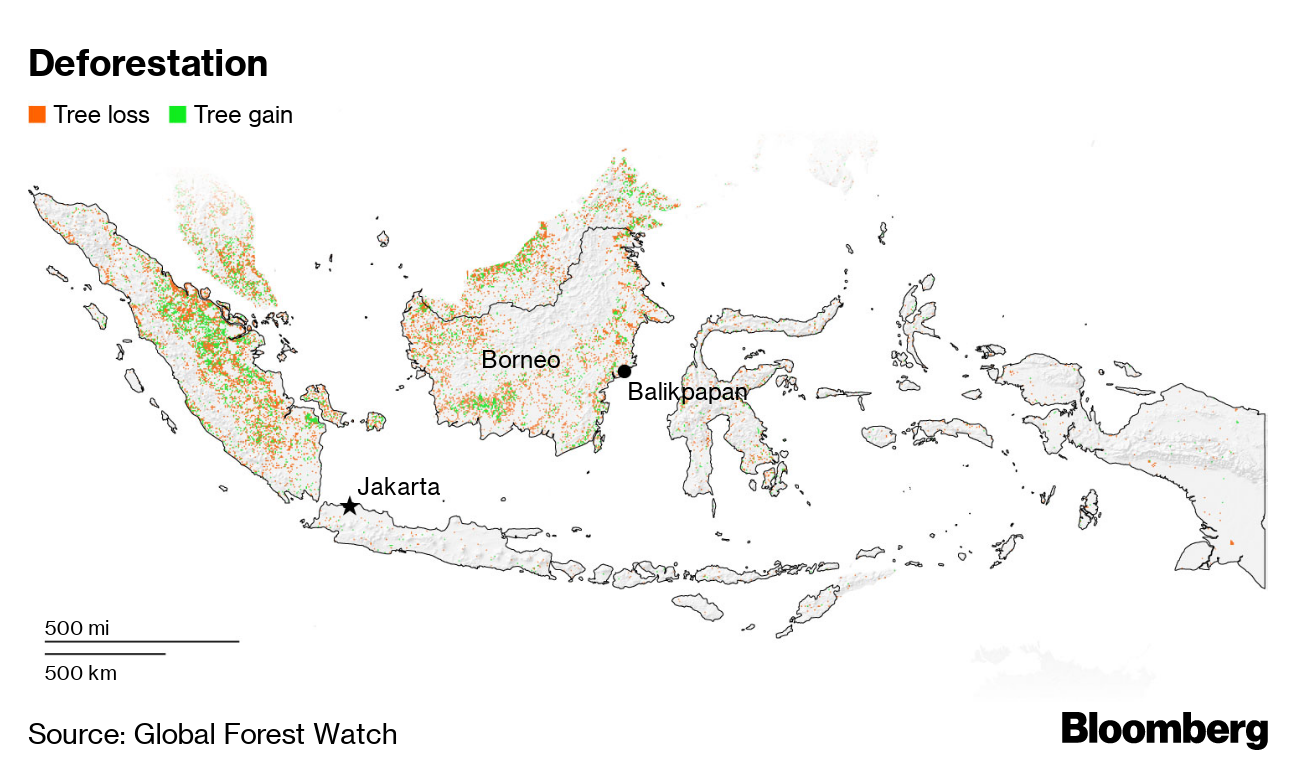
Source: Global Forest Watch
“We called these situations the two faces of policy. Some are good, and others make things worse,” said Boy Jerry Even Sembiring, research and policy manager at local environmental NGO, the Indonesian Forum for Environment. “The root of the problem is there is no holistic evaluation on natural resource licenses based on environmental concerns, human rights and the social condition.”
Caught in the crossfire is one of the most biodiverse places on earth. Indonesia is home to 12% of all mammal species, more than anywhere else. Deforestation has depleted wildlife by as much as 90% in some areas. Borneo is one of the last refuges for animals such as orangutans, sun bears, Sumatran tigers and pygmy elephants.
An hour and a half’s drive east from the site of the proposed capital there’s a dirt track off the coal-clogged highway where the searing tropical sun soon becomes shaded by the canopy of tall trees. The rumble of traffic gives way to a chorus of tropical insects and birds. In the center of this oasis is Samboja Lodge, an eco-tourism resort and wildlife sanctuary for critically endangered species run by the Borneo Orangutan Survival Foundation (BOS).
Since 1991, the BOS has been rescuing animals, rehabilitating them and then releasing them back into the wild. Now the problem is that there isn’t enough wild. “To find a secure forest is hard in Indonesia,” said Agus Irwanto, program manager at the lodge.
The rehabilitation of an orangutan can take eight years, but most just end up staying because there’s no other viable habitat. With more than 120 orangutans and only 1,800 hectares—about a fifth of the area of Disney World—the refuge is near capacity. And the patch of preserved forest is attracting other refugees—hundreds of displaced macaque monkeys that get into the enclosures and steal the food.
“There is no land anymore, so the macaques find their way here, and their numbers are growing rapidly,” Irwanto said. Samboja has become a kind of Noah’s Ark in a sea of coal mines. Like the rest of East Kalimantan—the fishing villages, the forest tribes, the coal mines—the prospect of a new capital built in their midst raises concerns as well as opportunities.
“When the government changes, policies change,” said Irwanto. “This forest is protected now, but we don’t know about the future.” He remembers a tract of forest in nearby Berau Regency that was once a viable habitat for the wildlife. “Now it’s gone, all gone, cut down for mining.”