Elon Musk Aims His Flamethrowers Away From Tesla's Cash
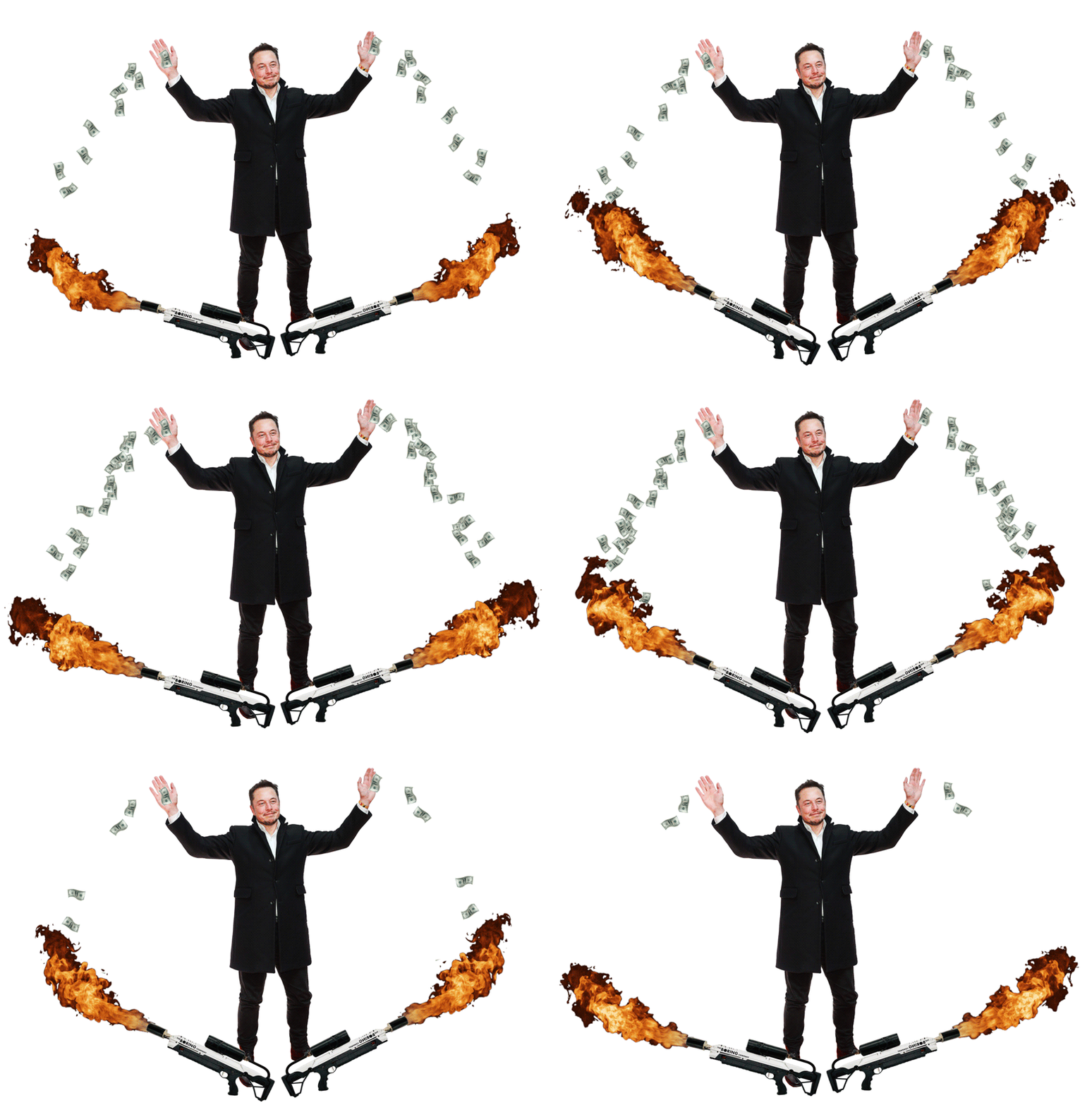
Elon Musk is making the case Tesla Inc. can put all the talk of pyromania in the past.
The money-losing maker of electric cars has for years turned heads with its tendency to burn through cash at rates reminiscent of Model S sedans in “Ludicrous Mode.” That era still isn’t over, but the Tesla chief executive officer has pulled several levers lately to more credibly claim that its days are numbered.
On Wednesday, Tesla reported negative free cash flow of about $740 million for the three months ended in June, a meaningful amount of progress from burning through more than $1 billion in three of the previous four quarters.
The company still can’t afford for much longer to keep blazing through its cash balance at the clip it has been over roughly the last year and a half.
Fortunately for Musk, there are signs of major progress on Model 3 sedan production after a prolonged struggle to manufacture as many as he’d hoped. The pick-up in the number of those cars leaving the factory means more money coming in to replenish Tesla’s coffers.
A major development toward stemming the tide was Musk’s move to rein in Tesla’s cost structure by making the biggest job cut in the company’s history. He announced the dismissal of 9 percent of employees in June.
Musk said the belt-tightening was needed because duplication of roles had crept up while the company grew and jobs were created that could no longer be justified. Tesla had added employees faster than it boosted revenue in three of the last four years. This includes more than doubling the workforce in 2017, when the company was scaling up for Model 3 production and took on employees from SolarCity Corp.
As Tesla’s employee count more than tripled from 2014 to 2017, revenue per employee stagnated. General Motors Co. and Ford Motor Co. each bring in about 2.5 times as much revenue per employee.
-
Automotive
-
Industrial
-
Technology
Keeping production momentum going while getting spending in check is the recipe Musk is counting on to deliver profit and positive cash flow in the second half of the year. The CEO said on a conference call Wednesday that he’s “highly confident” this will be doable in the third quarter.
Musk also said he’ll use the cash Tesla generates to start to pay down the $9.5 billion in outstanding debt on its balance sheet. The company has a $920 million convertible bond that matures in March.
Importantly, Tesla also is in a position unique within the auto industry of collecting hundreds of millions of dollars from customers before they even take delivery of cars.
The company started taking $1,000 reservations for the Model 3 when Musk unveiled a prototype in March 2016, accounting for much of the almost $1 billion in customer deposits that Tesla reported two years later.
That sum ticked down a bit to $942 million as of the end of the second quarter, as Tesla converted deposits into deliveries. But Musk noted in a letter to shareholders the figure didn’t reflect deposits made after the company opened up the ability to configure and order a Model 3 to everyone last month.
Tesla's earnings report Wednesday left skeptics changing their tune, even if only slightly. It’s possible the company will turn a profit in the third quarter by lowering costs, delivering higher-priced Model 3s to customers and selling regulatory credits to other automakers who need to meet electric-vehicle mandates, according to Brian Johnson, an analyst at Barclays with the equivalent of a sell rating on Tesla.
Evercore ISI, which rates the stock a hold, still has Tesla losing money in the third quarter, but then turning a small profit in the last three months of the year. And Musk may confound those who've said he’ll have to go back to the markets for more funding, analyst George Galliers said Thursday on Bloomberg Television.
“They’re looking to prove that they can go it alone,” he said.
of transportation.