THE RETIREMENT COUNTDOWN

Daydreaming about life after work is one thing; making sure you’ve got enough capital for that eventual reality is another thing entirely.
Retirement planning and saving can feel like a long climb toward a distant summit, one where the paths you choose along the way — saving, investing, managing taxes, shaping your lifestyle — influence how arduous your journey will be. And while the right steps put you on a steady path, it's possible to take a wrong turn or tumble off a cliff.
This guide is designed to help you stay on track at every age and stage — avoiding tax traps, ensuring you don't fall behind and avoiding other people's mistakes. Whether you’re just setting off on the journey, approaching the halfway point or preparing for the final ascent, the goal remains the same: Reach the summit with enough strength and resources to enjoy the view.
Start Early, Pick Wisely

BIGGEST MOVES
Start tax-efficient savings. Listen, don’t feel pressured to squirrel away every penny while you’re in your late 20s or 30s. Enjoy life! You’re only young once and the fact that you’re reading this guide suggests you’ve got the right goals in mind. That says, this early phase of your career is a perfect time to maximize savings to capitalize on the magic of compound interest.
Aim to save at least 15% of pre-tax income or your expected annual earnings if you’re self-employed. (Consider any employer match a sort of bonus savings amount.) Workers in employer-sponsored retirement plans such as 401(k)s or 403(b)s should attempt to capture the full company match if one is offered; not doing so is the equivalent of forfeiting free money. In 2026, the contribution limit for 401(k)-type retirement plans is $24,500, which would be a 15% savings rate (before any company match) for someone earning about $163,000.
Additionally, if your income allows, max out your annual contributions to an individual retirement account (IRA), which is capped at $7,500 in 2026 for those under 50. Self-employed? Consider opening a solo 401(k). One big perk: You can potentially shelter up to $72,000 a year, far more than most workers can stash in a typical 401(k). Many contributions are tax-deductible, depending on the plan’s structure.
Set the right asset mix. When you’re young, with so many years of earning ahead of you, you can afford to take some risks. As long as you have an emergency fund (three to six months of expenses), allocate heavily to stocks. If your employer auto-enrolls you into the default plan option in your 401(k) — likely a target-date fund1 with an asset mix keyed to your assumed retirement age — your holdings will gradually tilt from stocks to bonds as retirement approaches. That doesn’t mean it will be stock-light; many 2030 funds still hold 50% or more in equities.
“I started contributing to my 401(k) as soon as possible and began maxing it out around age 26. I want my money on autopilot so I have it in a 2060 target-date fund, which is mostly in stocks. I also do a yearly back-door Roth through my financial adviser.” —Susan Ferguson, 31, cybersecurity software account executive, New York City
TAX TIPS
Hedge with a Roth. Roth accounts, whether IRAs or 401(k)s, offer a strategic counterweight to traditional retirement plans by reversing the tax treatment: contributions are made with after-tax income. That means investment gains and withdrawals in retirement are tax-free, unlike 401(k) distributions, which are taxed as ordinary income in retirement. (If you’re under age 59 ½ and pull the investment gain portion out before the account’s been open five years, you’ll pay income tax and a 10% penalty though.)
For those in lower tax brackets early in their careers, prioritizing Roth contributions can bring significant long-term advantages, particularly if future rates rise. The ability to directly contribute to a Roth phases out as incomes rise, and is eliminated entirely for singles with income above $168,000 and married couples filing jointly with income topping $252,000. But savers at those income levels aren't necessarily shut out. Moves such as as backdoor — and mega-backdoor! — Roth contributions provide alternative entry points for those willing to navigate the additional complexity.
Leverage HSAs. For those in high-deductible health plans, Health Savings Accounts (HSAs) offer many tax advantages. For 2026, HSA contribution limits are $4,400 for self-only coverage and $8,750 for family coverage; those 55 and older can also make a $1,000 catch-up contribution. Those amounts are tax-deductible and investment growth is tax-free. HSA funds used for non-medical purposes before age 65 incur income tax and a 20% penalty. But after age 65 that penalty disappears and non-medical withdrawals are taxed at ordinary income rates, similar to a traditional IRA. If your cash flow allows, consider paying medical costs out of pocket and letting your HSA money grow. You can reimburse yourself years later, tax-free, as long as the expense happened after the HSA was opened — so save those receipts for medical expenses. So long as you have receipts, you can reimburse yourself for these expenses from the HSA later — even a decade or so down the line.
HOW TO CATCH UP
Create an ‘income surge’ system. If you’re in your 20s or 30s and haven’t been able to save as much as you want, bonuses, tax refunds and side income all present opportunities to accelerate long-term savings. Remember that you will owe taxes on the bonus and side hustle, so be sure to budget accordingly for that. After you’ve paid down any high-rate credit card debt and built an ample emergency reserve, a great use of “extra” money would be to open a Roth IRA, a standard brokerage account or an HSA, if you’re eligible. The goal isn’t to simply save more, but to diversify your investments across pre-tax, after-tax and taxable accounts. And then remember to reward yourself by spending 10% to 20% of any windfall on something fun.
MISTAKES
Bypassing benefits. Don’t be on autopilot during open enrollment periods at your workplace; these are crucial windows to adjust your planning. If your employer doesn’t offer a health savings account (HSA), see if it offers flexible spending accounts (FSAs). You fund these accounts with pre-tax amounts taken out of your paycheck and then can reimburse yourself for out-of-pocket medical, childcare and commuting expenses with those untaxed dollars, which helps your money go farther.

Ignoring lifestyle creep. Whether in an app or with a spreadsheet, track your spending — not to nickel-and-dime yourself so much as to spot drift. When your salary rises, redirect part of that raise into savings, perhaps boosting your 401(k) contribution, before you see your higher salary going mostly to lifestyle upgrades. For higher earners, budgeting should function less as a constraint and more as a tool for optimizing cash flow and increasing long-term flexibility.
LIFE ADVICE
Grow your earning potential. Consider whether it’s worth investing in advanced degrees and certifications or making lateral transitions with upside potential. For some, launching an independent venture could be a path to success. Whether you’re at a big company or self-employed, being this far out from retirement means the goal is the same: build your assets — skills, networks and equity — so they can appreciate over time and stay relevant.
Get Guidance

BIGGEST MOVES
Build your team. As you enter your 40s, professional advice can go a long way. A certified financial planner (CFP) can model cash flow, stress-test your portfolio and help you balance taxable, tax-deferred and after-tax accounts. Start your search at platforms like the National Association of Personal Financial Advisors, Garrett Planning Network or XYPN (the XY Planning Network), where you can find fee-only financial advisers. One important note: You’re looking for a fee-only2 planner, who is paid solely by you, not a fee-based one, who may also earn commissions. Pair that with a tax adviser who can help evaluate moves such as Roth conversions.
Strategize on asset location. Optimize returns by paying attention to which assets make sense for which accounts — taxable, pre-tax or after-tax. Setting up a taxable investment account makes sense even if you can’t put a lot in it yet. Bonds fit best in tax-deferred accounts such as an IRA or 401(k), where you won’t owe annual tax on interest. Outside of your 401(k), tax-efficient assets like broad stock index funds are often best held in taxable investment accounts, where long-term capital gains taxes on appreciation will likely be lower than ordinary income tax rates you’d pay when withdrawing from traditional 401(k)s or IRAs. Growth stocks are especially well-suited for after-tax Roths: the appreciation won’t be taxed when you withdraw money, so long as you hold the account for at least five years and are 59 ½ or older. The goal is to let the money compound so you have a mountain to withdraw from much later in your life.
Protect your earning power. Your earning potential is your greatest asset, so insure it accordingly with disability and, if appropriate, life insurance. Disability insurance pays a percentage of your salary — often around 60% — if you become unable to do your job. Employers may offer short-term and long-term disability insurance as a benefit, either covering or paying part of the lower costs afforded by a group policy. But remember that that employer-provided life or disability policy underwrites the entire employee group, usually without knowing the individual health conditions of its members. (The policies often do not require a medical exam, though — a benefit for those with health conditions.) It may be that if you’re healthy you could find a lower premium or better coverage for the same price with a policy outside of your employer, says George Gagliardi, founder of Coromandel Wealth Strategies.
For life insurance, Gagliardi favors a term life policy, in part because your need for life and disability insurance declines as you get older — and any inheritance you may get in your late working years may remove the need for the insurance. These policies provide coverage for a set period — be it 10, 20 or 30 years — and are often the more affordable life insurance plans. Coverage should be sized to replace income and cover debts and dependents’ needs.
TAX TIPS
Vary your tax treatment. Achieving true diversification isn’t just about calibrating the right mix of stocks, bonds, cash and other assets in your portfolio; it’s about how your accounts are taxed. In a brokerage account, you’ll likely pay a 15% capital gains tax3 when selling appreciated securities held longer than a year. In tax-advantaged accounts like 401(k)s, money grows tax-deferred and you pay at your regular income tax rate when withdrawing after age 59 ½. Then there are Roth accounts, where contributions are made with after-tax dollars and can be withdrawn tax-free. A blend of all three gives you flexibility later so that you aren't tripped up by surprise taxes after your working years.
HOW TO CATCH UP
Be hands-on with savings. A “set it and forget it” mentality will not necessarily serve you well long-term. Try to make sure the percentage of your salary going into your 401(k) increases each year — some plans do this automatically, so check with your company. And remember to capture every dollar of an employer’s match program since that’s effectively free money. Also, when you switch jobs, increase your contribution rate from the company’s default rate for new entrants, since the default rate at your new plan may be a lower percentage of salary than you were deferring before. Hopefully your new position came with a raise — celebrate by saving a little extra!
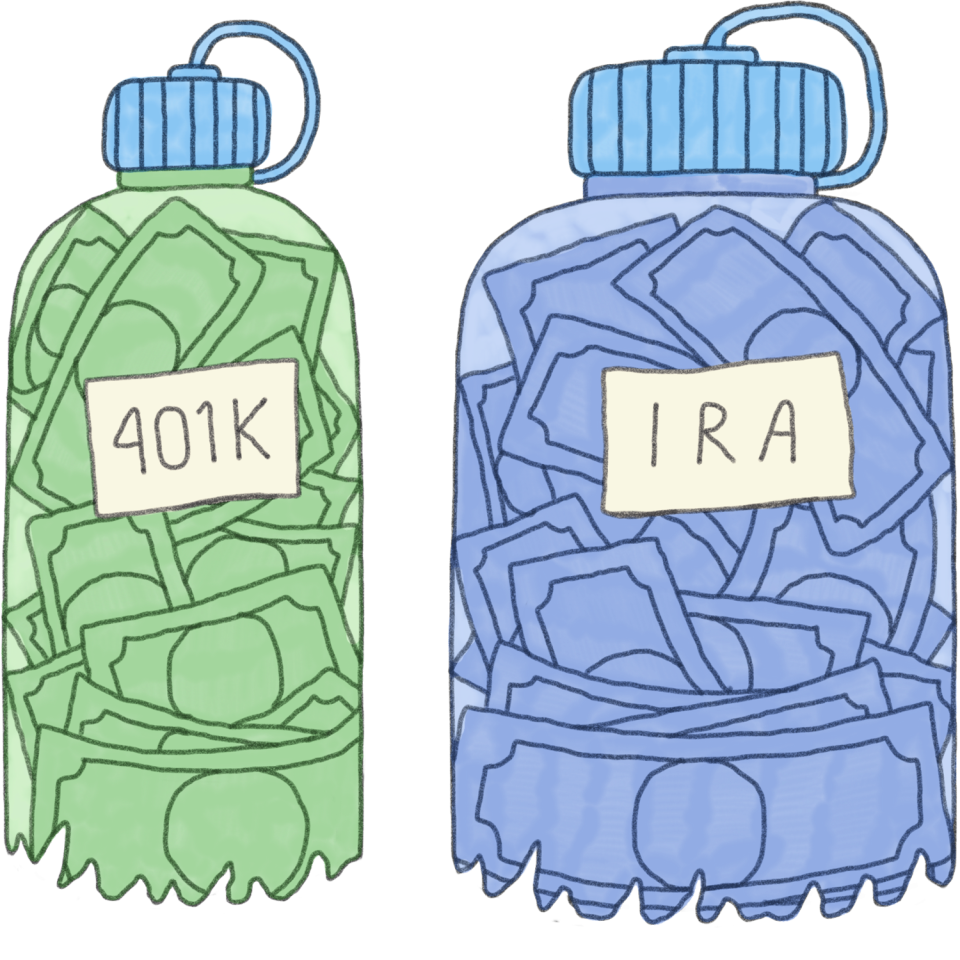
Max out your tax-advantaged accounts. With two decades to go, this is the prime window to accelerate savings. Couples who can afford it should aim to max out both their workplace retirement plans and their IRAs each year, if eligible. In 2026, that means up to $24,500 per person in a 401(k) and as much as $7,500 per person in an IRA. Fully funding these tax-advantaged accounts supercharges long-term growth and, if an IRA is a Roth, adds flexibility when it’s time to tap the money.
MISTAKES
Dropping the ball with 401(k)s. The price for cashing out 401(k)s when switching jobs is high. You pay income tax — and, in most cases, a 10% penalty if you’re not 59 ½. If you do a direct rollover into an IRA or your new employer’s plan, you avoid that.4 If that money comes straight to you, you have 60 days to roll it into one of these tax-advantaged plans to avoid penalties and tax.
“I’m playing catch-up with retirement savings, after having to withdraw money twice during the last recession. Paying off student loans made it hard to save more. I feel that I’m back on track, but won’t meet the retirement number some guidelines say I need. I’ll retire in another country to offset costs.” —Jenifer Daniels, 47, organizational designer and brand strategist, Detroit, MI
Having fee blindness. Nobody likes to pay more than they need to, though lots of investors do. Check your 401(k), IRA or other accounts to see what the expense ratios are on your investments. A 2024 fee study found that active US equity funds had asset-weighted average fees of 0.60% vs. 0.11% for passive funds (and you can find index funds with fees below 0.05%). Higher fees will eat into your earnings over time, and there’s often little reason to overpay in an era where fees can be almost microscopic. The big index fund providers all offer investments with fees below 0.05%, so if there’s a low-cost fund available from a reputable company that mimics a higher-fee product you already own, make the switch in your 401(k) or IRA.
LIFE ADVICE
Talk money with your partner. Financial compatibility goes beyond long-term goals like retirement or estate planning. Couples should also discuss their money histories, short-term priorities and spending habits. Set a regular time to check in — ideally tied to something you enjoy, like a walk or going out for a cocktail.
How you start the conversation matters, says Douglas Boneparth, founder of Bone Fide Wealth and co-author of Money Together with his wife, Heather, the firm’s director of business and legal affairs. Begin with what money moves worked recently, not what didn’t, and connect near-term goals to longer-term visions, whether that’s travel, lifestyle or other life goals. You can also use this time to think about whether it makes sense to have money conversations with other family members — particularly parents — to clarify how they envision their later years and what planning they have in place.
Discipline Meets Dedication

BIGGEST MOVES
Fence off retirement savings. These days, it’s not uncommon for people in their 50s to provide financial support to adult children. Helping family can be generous and meaningful — as long as it doesn’t come at the expense of your own financial security. Marguerita Cheng of Blue Ocean Global Wealth puts it plainly: “It is certainly okay to help your kids, but don’t do it to the point where it is hurting you.” When housing is expensive and job markets are tough, parental support can be a huge help as long as it comes with guardrails and a budget. Remember that ensuring you have a comfortable retirement will benefit your whole family in the long run, and the only way to achieve that is, as the saying goes, to put the oxygen mask on yourself first.
Ballpark future needs. How will you know how much is enough for retirement? Some financial services firms peg your “retirement number” to a multiple of your annual income, and raise that multiple as you get older. Broad rules of thumb — like having enough savings to replace roughly 80% of your pre-retirement income, often measured by your final working-year salary — can be useful starting points. Your actual needs, though, will depend on spending goals, your health, lifestyle and where you will live, among other things.
Start by tracking what you spend now, then model how it could shift in retirement, depending on where you want to live or how much you’ll travel. Next, look at what you can expect from Social Security by creating an account on its website and using the SSA’s online calculator (remember that as much as 85% of it may be taxed). The percentage of pre-retirement pre-tax income that Social Security replaces falls as earnings rise. For example, a household earning $250,000 a year would see about 18% replaced, compared with 37% for a household earning $80,000, according to data cited in a J.P. Morgan Asset Management report. The gap between that reliable income (and any other income sources like a pension) and your projected spending is what you may need to draw from your portfolio every year.
Plan for long-term care. Figuring out how you would pay for possible long-term care later in life is essential, especially since Medicare generally doesn’t cover extended LTC costs, according to the National Association of Insurance Commissioners. Hybrid “asset-based” policies — which combine life insurance with long-term care coverage — have grown in popularity. One example of a bare-bones joint policy for a healthy married couple in San Francisco, both 55, would require a one-time payment of about $90,500, according to Waterlily, an AI-powered tool that models LTC costs and insurance options; buying at 65 would raise that to roughly $135,000. If one spouse needs care, the policy typically allows early access to the death benefit, with additional LTC funds available if costs exceed it. Such a policy purchased at 55 could provide about $370,000 for long-term care, with roughly $28,000 left for heirs, according to Waterlily. Some wealthier retirees instead “self-insure,” setting aside assets to cover potential care costs.
TAX TIPS
Make the most of market dips. Roth conversions are a way to turn tax-deferred savings accounts into after-tax money. A significant stock market drop can be a good time to convert. With your traditional IRA down in value, the taxable amount of the conversion is lower. (By the same logic, a Roth conversion can make sense in a low income year, such as during unemployment.) You’ll need a good cash stash to do this and ideally should also maintain an emergency fund of at least six to 12 months of living expenses, or maybe more if you’re single. Any recovery in assets when the market bounces back will happen in your Roth and you won’t have to pay taxes when you withdraw that money later. Some 401(k)s even allow you to convert money within the plan.
Harvest tax losses. Selling long-term investments at a loss can offset capital gains in your taxable portfolio and reduce ordinary income by up to $3,000 a year. It’s an especially helpful move for near-retirees in peak earning years since IRS rates for capital gains are either 0%, 15% or (rarely, unless you are very wealthy) 20%, depending on your income and filing status. Such tax-loss harvesting can soften the bite for older investors selling good-performing stocks when they’ve decided it’s time to de-risk their portfolios. Many financial services firms, and notably robo-advisers that use exchange-traded funds, have automated services that opportunistically tax-harvest your portfolio over the course of the year. Betterment and Wealthfront both offer the service.
HOW TO CATCH UP
Step up your contributions. Many 401(k)-type plans allow savers age 50 and older to make “extra” contributions above the standard IRS limit of $24,500 for 2026. Those 50 and up can add another $8,000 into accounts, bringing the allowable pre-tax savings total to $32,500. Americans between age 60 and 63 can contribute a total of $11,250 as a “super catch-up” amount in 2026. However, that “extra money” may no longer be able to go into your 401(k) plan on a pre-tax basis as it could in 2025. If your wages topped $150,000 in 2025, your “catch-up” amount must go into an after-tax Roth 401(k) account in 2026, so it won’t reduce taxable income for the year. Savers 50 and older with IRAs can add $1,100 more than the basic cap of $7,500.

Downsize earlier. Selling the big house or trading in a car doesn’t have to wait until retirement, especially if you want more financial flexibility. Financial planner Sophia Bera of Gen Y Planning advises making a move while you’re still drawing a paycheck. “Downsize earlier, and if you have a smaller mortgage, maybe you pay cash for your next home and get to retirement goals sooner,” she says. The costs of upkeep for a big home accumulate quickly, she added, and many homeowners don’t realize how much money maintenance eats up until they track it. Making the shift while you’re still earning will also make it far easier to qualify for a new mortgage than it would be post-retirement.
MISTAKES
Trying to time markets. When markets are volatile, emotions can seep into our money decisions. That can lead us to mistakes, like buying high and selling low. Many strategists point out that valuation is a poor timing tool for investors. If you have a long horizon, stick with a well-diversified portfolio, preferably in a low-cost index fund or target-date fund. Selling in tumultuous times may relieve immediate stress but it leads to the hard decision of when to reinvest. Many investors who retreat to cash in turbulent times sit there for too long and miss the powerful early phase of a rebound.
Loading up on company stock. Your company is already the source of your income. Should you consider more exposure than that? You may feel you understand your company, but the unexpected can happen. Recall the lessons of Enron,5 when many employees’ retirement savings were wiped out. Consider selling company stock gradually and shifting that money into a low-cost index fund. If most of your portfolio is US-based, explore adding some international diversification.
LIFE ADVICE
Invest in your health. Health care is one of the biggest financial unknowns in retirement, and those costs are rising every year. Fidelity estimates a 65-year-old retiring in 2025 will spend about $172,500 on medical costs during retirement, excluding long-term care,6 with Medicare premiums making up roughly 44% of the total and most of the rest coming from out-of-pocket expenses. Be aware that some supplemental insurance, such as Medicare Advantage, may not be taken at some providers. Staying healthy through preventive care, regular checkups and everyday habits can help limit costs and sharpen estimates of how much you’ll need to save. This is also a good time to review health care directives and other estate plans.
“My retirement savings are on track, and I’ve maxed out my 401(k) every year that was possible and live below my means. But having health insurance tied to full-time employment is a huge blocker to retirement, and exchange-based family insurance is outrageously expensive and provides more limited coverage.” —Jennifer Martin, 57, consultant, Minneapolis
Bring It All Together

BIGGEST MOVES
De-risk your portfolio. Welcome to your 60s, a decade when many feel more than ready to retire. It can be a tricky time: financial planners call the five years on either side of retirement the “red zone,” because changes in the markets can ravage retirees' portfolios. This “sequence of return risk” is triggered when, on a prolonged slump, a near-retiree heavily invested in stocks may have to sell during a downturn to meet expenses. Selling low at that moment can dent a portfolio so much that it can't fully recover, even when markets rebound. Having a well-diversified portfolio and rebalancing regularly can help mitigate this risk.
Some planners guard against potential panic-selling at an inopportune time by separating a client’s money into buckets keyed to different time horizons and levels of risk. A cash bucket might hold one to three years’ worth of needed income in short-term Treasuries, money market funds, certificates of deposit and high-yield savings accounts. A second bucket could hold five to eight years of investments in high-quality bonds and solid dividend stocks. A third bucket intended for 10 years and beyond can stay invested in equities.
Fend off inflation with TIPS. Stocks can provide long-term inflation protection, which is essential during a retirement that may last 30 years or more. As you de-risk your portfolio, you’ll need additional tools to preserve purchasing power. Treasury Inflation-Protected Securities (TIPS) adjust principal based on a consumer price index and pay a fixed semiannual coupon. (I-bonds are another option and provide inflation-linked interest, although you can buy only up to $10,000 a year through TreasuryDirect.gov.) You can buy individual TIPS — maturities available are for 5, 10 and 30 years when you buy direct. Many investors use mutual funds or exchange-traded funds that hold the securities. For example, iShares offers defined-maturity TIPS ETFs that let you build a ladder — buying ETFs with bonds that mature in different years — so you have some funds becoming available regularly while keeping inflation protection. These investments may not outperform other investments unless inflation is unusually high.
Strategize on Social Security. Those born in 1960 or later get their full promised Social Security benefits at age 67. Create an account with the SSA to see the size of your benefit and use a tool that shows how monthly payments increase the later you claim, up until 70. Claiming Social Security at 62 reduces benefits by roughly 30% compared with claiming at full retirement age. Waiting until 70 increases payouts by 8% a year from 67 to 70. Coordinate decisions with a spouse — the higher earner might want to wait longer to claim so their benefit grows and can better support a surviving spouse.7
TAX TIPS
Model out distributions. Starting at age 73, most people must take required minimum distributions (RMDs) from traditional IRAs and 401(k)-type plans. The resulting income taxes can be significant, though moving more assets into after-tax Roth accounts earlier in life can ease the burden. Advisers can estimate your future RMD amount or you can use calculators from providers such as Fidelity Investments and Charles Schwab. For someone born in 1960 who has $1.5 million in a pre-tax account at year-end 2025 that earns 5.5% annually, Fidelity’s calculator estimates an RMD of about $99,000 at age 75 in 2035, assuming no earlier withdrawals. (In 2033, the age at which most people must start taking RMDs rises to 75.)
Mind your Roths. Approach Roth conversions cautiously in your early sixties. You’ll be enrolling in Medicare at age 65, most likely, and Medicare Part B and D premiums rise for higher-income enrollees. Premiums are based on your tax return from two years prior. Since a Roth conversion increases taxable income in the year of the transfer, converting at 63 may trigger a higher initial premium. Premiums reset as your income normalizes, although the short-term cost can be a surprise.
“In recent years, I’ve switched all of my 401(k) contributions to the Roth option. I honestly feel like taxes are now the lowest they are going to be. I max out my health savings account and never touch it. Back in 2005 I didn’t love that my company was switching us to an HSA, but then realized it’s an additional way to save for retirement.” —Colleen Graham, 54, research analyst, Tucson, Arizona
HOW TO CATCH UP
Harness higher savings caps. Savers between age 60 and 63 can contribute even more than the usual $8,000 catch-up 401(k) amount for people 50 and older, if their employer has added this option to their plan. In 2026, these older savers can contribute $11,250 as a “super” catch-up amount. Those making over $150,000 in wages the prior year will need to put that money in the after-tax Roth option, however.
Update a financial plan. If you haven’t updated your financial game plan recently, review it to confirm the assumptions still hold and adjust as needed. Running new scenarios for inflation and investment returns can reveal whether your risk tolerance or market conditions have shifted. If you don’t have a plan yet, building one now provides an objective look at what lifestyle you can afford in retirement and what moves will strengthen your position. A simple, one-time plan may cost around $2,000 to $3,000, although plan costs can run much higher.
MISTAKES
Overpaying for insurance. When you originally bought your policies, you likely had a lot of future income, lifestyle and education expenses to protect. As children become independent and retirement nears, you may not need such large life or disability policies. You could wind up paying for more coverage than you require and may save money shifting to a policy better aligned with your current needs.
Delaying estate planning. If you haven’t considered your will and end-of-life plans, this is a red alert: do so now. It will ease the burden on your executors, family and heirs. Make sure you have an updated will, a durable power of attorney for financial and legal decisions if you become incapacitated, a living will and a healthcare power of attorney. Review these documents every few years and after major life changes, since beneficiaries and circumstances may have shifted. Confirm that beneficiaries on all accounts are current.
LIFE ADVICE
Play with the numbers. With about five years to go, start modeling your retirement income. The classic 4% rule assumes withdrawing 4% of your portfolio in the first year of retirement and adjusting that amount for inflation annually. The rigidity of that approach may not serve you well. More flexible strategies vary withdrawals based on market performance — spending less in downturns and perhaps a bit more in strong years — to help portfolios last longer and adapt to real life.

Network beyond your job. Layoffs are increasingly common, and a network that’s primarily made up of colleagues at work can leave you in a tough spot if you lose a job. Be sure to keep building connections beyond your workplace by attending industry events, scheduling coffees with peers at other companies and former co-workers and staying active in professional groups. A broader network can open doors to consulting or part-time work later — and provide social ties that last well beyond your career.
Rehearse Your Future

BIGGEST MOVES
Test-run your spending. In your 60s, as you approach the retirement finish line, live on your projected monthly retirement spending for six months or more to see how your plans for spending hold up. To arrive at a retirement budget, estimate monthly income from pensions, Social Security and other reliable income to figure out how much you’ll have coming in as a solid base. Then calculate what taxes you’ll have to pay on those amounts so you know how much you really have available. That’s your baseline income that will dictate how much you need to pull from savings each year to meet necessary monthly expenses as well as discretionary spending on travel, meals out, classes and hobbies.
If you already maintain a precise budget, you may not need a trial run. For the rest of us, the exercise often reveals whether you need more or less than expected to support your target retirement lifestyle.
Prepare for Medicare costs. Medicare premiums rise with income, so review the thresholds to avoid surprises — especially surcharges (AARP has a good explanation and breakdown here). In 2026, premiums, which are based on a two-year look-back at your taxes, start to rise at $109,000 for singles and $218,000 for couples. Retirees who want broad access to doctors and hospitals may opt for Medigap, which helps cover deductibles, copays and coinsurance that Medicare does not. Medicare Advantage plans are another option, although they often require staying within a network. Before choosing an Advantage plan, confirm that your doctors participate since insurer directories can be out of date.
Guarantee some income. For retirees who want predictable payments, annuities — contracts issued by life insurers and typically sold through agents or financial advisers — can provide guaranteed lifetime income. Because policies can be complex and costly, make sure you understand what you get for your money. Annuities for Dummies by Kerry Pechter provides a good impartial grounding of how different products work.
One approach is a deferred annuity such as a commission-free fixed indexed annuity, which is designed to provide steady growth while preserving principal. The longer you wait to begin payments, the lower the upfront cost. A 60-year-old who wants $80,000 a year starting at age 80 could secure that income with about a $97,000 upfront payment, according to David Lau of DPL Financial Partners, a commission-free insurance platform. The insurer has two decades to invest the money — and some buyers won’t live long enough to collect — which keeps the price relatively low. Starting income sooner is far more expensive. A 60-year-old who wants $80,000 a year beginning at 65 would need to invest closer to $625,000. “Basically, your assets here are available until they are depleted by the withdrawals and once they are, the benefit of this annuity is that it’s still going to pay,” says Lau.
TAX TIPS
Factor in taxes on Social Security benefits. Many savers don’t realize that up to 85% of their monthly payments will likely be taxed. To determine whether yours will be, add half of your annual benefit to your adjusted gross income from sources such as pensions, wages, interest, dividends and capital gains. If that adds up to more than $44,000 for married couples filing jointly or tops $34,000 for singles, up to 85% of the benefit may be taxed. You can opt to have federal taxes withheld directly from your Social Security benefits through the Social Security Administration’s voluntary tax withholding, which can help you stay current on federal taxes and lower the chance of a year-end tax bill. If too much is withheld, you receive the difference.
Tilt toward after-tax savings. If you approach retirement with most of your savings in pre-tax accounts, consider building up savings in an after-tax Roth account, perhaps using the option in your company’s 401(k). Odds are that the bulk of your assets are in accounts such as 401(k)s, 403(b)s and IRAs, and the tax-deferral you’ve benefited from by contributing on a pre-tax basis over a long career may be less valuable once you start drawing income. Adding to a Roth account within your employer plan or building up a regular taxable investment account can ensure easy access to money when needed before retirement or help manage tax brackets during retirement. And with Roths there are no required minimum distributions like there are with 401(k)s. For highly successful professionals, the years before retirement may be your highest-earning era — so putting money away pre-tax often makes the most financial sense. But you may want to consider taking a hit and paying more in taxes for a few years in order to have more financial flexibility when managing taxes later in life.
HOW TO CATCH UP

Build a Social Security “bridge.” If you retire in your early- or mid-60s, some planners recommend pulling from savings — often taxable accounts — for a few years, if possible, to avoid taking Social Security early and locking in a lower benefit for life. Drawing on savings provides an income “bridge” to enable you to get higher Social Security benefits for the rest of your life. Every month you wait beyond age 62 increases your future benefit. If you wait beyond your full retirement age of 66 or 678 you will earn an extra 8% a year in benefits until age 70. Income from a part-time job or side hustle is another obvious answer if you don’t have as much saved as you want. If you’re thinking about a side hustle, try and set it up well before you retire, if your work allows, even if that’s just doing networking and informational interviews to get tips from experienced side-hustlers.
Secure a bigger pension payout. For those fortunate enough to have a pension waiting for them at retirement, check whether delaying payments beyond when you are first allowed to claim can similarly increase your eventual benefits. Some plans echo the Social Security model, with longer waits resulting in higher payouts, up to a point — usually age 70, like Social Security. Some retirees start earlier due to concerns about a plan’s financial strength or their own longevity, so act according to your comfort level.
“My wife and I would be doomed if not for my government pension. We’ve saved a decent amount, but not enough to retire on for at least another five to 10 years. But thanks to a defined benefit government pension and retiree health care, I was able to take federal retirement in 2024 and start a small law practice to supplement pension income. I feel for other Gen X-ers who don’t have what I did, and for future generations.” —Owen Martikan, 60, retired federal government attorney, San Anselmo, CA
MISTAKES
Paying off a low-rate mortgage. The idea of entering retirement without a mortgage is appealing and the psychic benefit may be worth it for some people. But paying it off may not be the best move if your interest rate is low and the payoff depletes your cash cushion. Also, the mortgage deduction can still be valuable for itemizers who generate taxable income in retirement, since the interest deduction can reduce taxable income and lower the federal tax bill.9
LIFE ADVICE
Practice retirement. The people who enjoy retirement the most have something to retire to, says Sophia Bera, founder of Gen Y Planning. “We spend a lot of time trying to get to a certain number or racing to get to be done with work, but far too little time thinking about what we actually want retirement to look like,” she says. Bera suggested imagining an ideal week and experimenting with pieces of it now: “Maybe you want to walk dogs for an animal rescue organization or foster a cat — how can you do that once a week or once a month now to see if you like that organization?”
Finish Strong

BIGGEST MOVES
Note Medicare deadlines. For most people, the initial enrollment period for Medicare stretches from the three months before you turn 65 to the three months after the month you turn 65 — a seven-month window. Some people are automatically enrolled in Medicare Part A (hospital insurance) and Part B (medical insurance) if they claimed Social Security before age 65. Others need to actively enroll and often do so online. People who don’t sign up for Part B but decide they want to later likely face a permanent late enrollment penalty. Signing up for Part B can be delayed without penalty, however, if a person or their spouse is still working and has employer coverage that meets Medicare standards. Part D for prescription drug coverage is optional, though most people need it. If you do not sign up for Part D go without it or without qualifying employer coverage for more than 63 days after your enrollment period, beware — missing Medicare enrollment windows can trigger permanent penalties.
Build a retirement “paycheck.” Once you identify how much you likely can safely spend each year in retirement — maybe playing around with the 4% rule or looking into a more dynamic approach — you or your adviser can craft a monthly paycheck out of your savings. Some retirees move the annual amount they’ll need into a separate high-yield savings account and have automatic transfers go into their checking account each month or so. That’s how Fritz Gilbert, a 63-year-old retiree who launched The Retirement Manifesto blog, does it. He uses a bucket approach with his money, and at the end of the year replenishes the “safe” bucket of two to three years of annual income, where he and his wife’s “pay” comes from, by seeing what portfolio assets have done well and are now overweighted in his portfolio. Then he sells the overweighted positions. He and his wife also set up a separate reserve to be funded every year for possible big-ticket car and house expenses. If you have a financial adviser, their firm may offer a service to sell securities in your portfolio throughout the year in tax-effective ways, and transfer funds to you regularly.
“When I was working, my wife and I saved aggressively and didn’t budget the rest. In retirement, we wanted something easy that didn’t require us to do a budget and that would be within our safe withdrawal of about 3.5%. We move a year’s worth of spending from our cash bucket into a high-yield savings account, divide it by 12 and get a monthly ‘paycheck.’ If we need to transfer money into checking, we know we need to cut back.” —Fritz Gilbert, 63, retiree and blogger
Plot a withdrawal strategy. For many people, there’s a rough logical order for which accounts to withdraw from in retirement to minimize taxes and make your money go farther. Many retirees start with their taxable accounts at brokerage firms, paying long-term capital gains tax on profits and realizing capital losses to offset gains. Next, they tap tax-deferred accounts such as IRAs and 401(k)s where withdrawals are taxed as income. (Starting at 73, there are required minimum distributions from those accounts.) Retirees tend to access after-tax Roth accounts last since their tax-free growth is so valuable later. Exceptions arise when pulling from pre-tax accounts would hike your tax bill and a modest Roth withdrawal would keep your bracket lower.
TAX TIPS
Check out municipal bonds. For investors seeking tax-efficient income, municipal bonds — issued by states, cities and other local entities — can be worth a look. For comfortable earners in states with higher taxes, such as New Jersey, New York or California, these bonds can deliver strong after-tax returns when held in taxable accounts. The interest on muni bonds is exempt from federal taxes, and if you buy bonds from your home state, interest is often free from state and local taxes. For a married couple living in New York and earning $325,000, a municipal bond paying 4% works out to about the same as earning 5.7% in a taxable account, according to Bankrate’s tax-equivalent yield calculator. Rising interest rates can hurt bond prices and defaults are possible, though rare.
Save heirs tax hassles. If you intend to leave retirement accounts to heirs, plan ahead to reduce their tax burden. For example, for most non-spouse beneficiaries, a traditional inherited IRA has to be drained within 10 years from your death, and paying income taxes on withdrawals can hit your heirs in prime earning years when they are in high tax brackets. (There are complicated rules around whether beneficiaries must take required minimum distributions.) Non-spouse beneficiaries of inherited Roths face the same 10-year deadline, but withdrawals are tax-free, which is a major advantage.
Take the new deduction. Those who are 65 or older can reduce taxable income with the new $6,000 ($12,000 for married couples filing jointly) deduction that will be available for four years, starting with 2025 taxes. The deduction, which is on top of the standard deduction, starts to phase out for singles with modified adjusted gross income topping $75,000 for singles and $150,000 for joint filers. At incomes of $175,000 for singles and $250,000 for married couples the deduction phases out entirely.
HOW TO CATCH UP
Look into a reverse mortgage. If you are house-rich but cash-poor, financial planners may suggest downsizing or opening a home equity line of credit as a standby for emergencies. Another tool is a reverse mortgage on your home, which is allowed for those over age 62. To qualify, you don’t have to own your home outright, though you should have significant equity in it, typically at least 50%. These loans pay you using your home equity while you continue living there. The lender is repaid only when you sell, move or die, though closing costs can be high. Many of these mortgages are made under the federal Home Equity Conversion Mortgage (HECM) program. Homeowners must continue to pay property taxes and insurance premiums, and keep their home well-maintained.
Another option: Some states, including California, Illinois and Massachusetts, allow eligible low-income older homeowners to postpone all or part of property tax payments. Interest is paid on the amount, which is secured by a lien on the property.
MISTAKES
Underestimating inflation’s bite. Inflation hits retirees especially hard since healthcare costs rise faster than general inflation — and as we age a greater chunk of spending often goes to healthcare services. While headline inflation often runs near 2% to 3%, planners may use 5% to 7% when modeling future healthcare expenses.
Feeling too growth-shy. If you’re around 60, you may want to bring down your level of portfolio risk. Some planners suggest trimming equity exposure to about 50% as retirement nears. Other planners favor around 70% in equities for clients with strong savings cushions. Many popular target-date funds with assets allocated for a 2030 retirement date have equity stakes ranging from 51% to 62%. Regardless of allocation, reducing the riskiness of a portfolio helps protect those who may have limited earning years to build back savings and who don’t want to be forced to sell stocks into a downturn. That says, retirees also need the typically higher returns from stocks to sustain what could be 30 years in retirement.
LIFE ADVICE

Explore your options. Create a list of organizations you may want to engage with in retirement. Contact them to see what you can do with them now, and what you could get involved with once you have more free time. You can browse opportunities on sites like Idealist.com or pointsoflight.org. Many states let seniors audit university classes at reduced rates, usually starting between the ages of 50 and 65. Lifelong-learning programs, such as those through the Osher Lifelong Learning Institute, offer courses, lectures and social events for adults 50 and older. Annual fees vary widely, generally from about $65 to $375.
YOU DID IT!

Congratulations — welcome to the rest of your life. Whether you’re stepping away from full-time work or easing into something part-time, retirement is less a finish line than a new stretch of trail. The climb may be behind you, but the journey isn’t over, so stay engaged with your finances and take the long view.
Retirement brings its own mix of challenges and adjustments. The transition can feel unstructured and, for some, it can mean a smaller social circle. Give yourself room to settle into this new stage while protecting your health, relationships and sense of purpose.
The important thing is that you decide your next direction. Time to enjoy your next meaningful phase of life.
Further reading
-
A diversified investment fund that automatically shifts from riskier to more conservative assets as you approach a chosen retirement year. If you’ve been automatically defaulted into a TDF, look under the hood and familiarize yourself with how your fund is invested.
-
Fee-only planners aren’t paid commissions for products sold or referrals made, so you skip any potential conflicts of interest. You’ll pay a flat fee or retainer, a project-based fee or an hourly or monthly amount. If the arrangement becomes a longer-term one, they may charge a percentage of assets that they manage for you.
-
If you have any short-term gains on securities you’ve held for less than a year, those are typically taxed at your regular income tax rate instead of the capital gains tax rates of 0%, 15% or 20%, depending on your taxable income.
-
Since your employer likely withheld 20% for taxes from that amount, you must add that back in from your savings or be taxed on that amount. When you file income taxes, the IRS will see a 20% overpayment and refund it.
-
Enron declared bankruptcy in December 2001 after years of hiding massive losses that masked the company’s true financial health. Employees saw their retirement savings wiped out as the plan held a heavy allocation to Enron shares that workers were often prohibited from selling. When the stock collapsed, retirement accounts collapsed with it.
-
Fidelity assumes the retiree enrolls in Original Medicare (Parts A and B) and Medicare Part D.
-
Social Security survivor benefits allow a widow or widower to receive the higher of their own benefit or the deceased spouse’s benefit. This makes the higher earner’s claiming strategy especially important. When the higher earner delays claiming, their monthly benefit grows through delayed retirement credits, which in turn raises the survivor benefit available to the spouse who outlives them.
-
The exact full retirement age depends on your birth year. For those born in 1960 or later, the full retirement age is 67, and for those born before that, it ranges from 66 to 66 and 10 months. Check for your age here.
-
To claim the mortgage interest deduction, you must itemize it on your IRS Form 1040 rather than take the standard deduction. Itemizing only makes sense when your total deductions exceed the standard deduction, so many retirees who have paid down their mortgages or have fewer deductible expenses no longer qualify.