
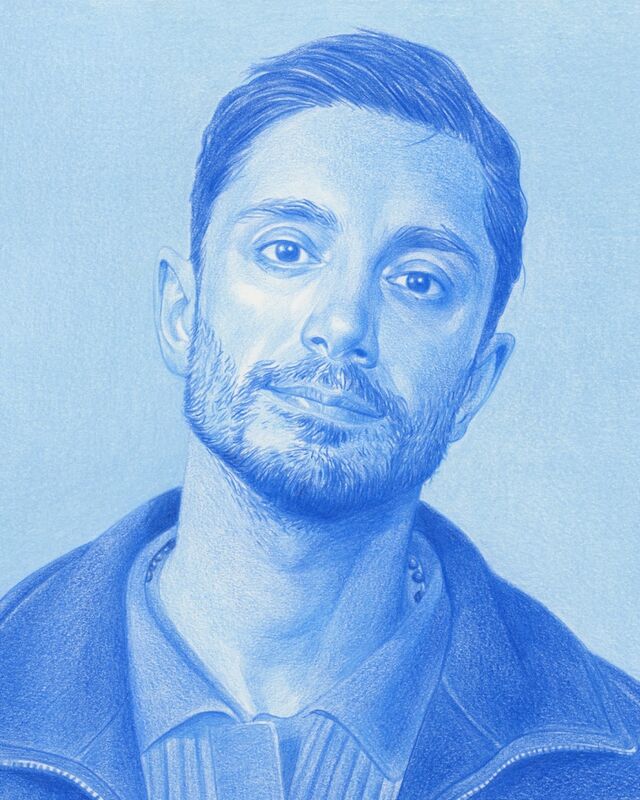
Riz Ahmed: ‘Just Like Hamlet, We’re Being Gaslit’
The actor’s latest projects subvert Hamlet and James Bond, centering his British-Asian identity in stories he says speak to a fracturing of values.
A new version of Hamlet is out now in US cinemas, with British actor Riz Ahmed as the tortured prince. Known for work that includes the Oscar-winning The Long Goodbye, and for challenging his industry on diversity and access, he talks here about projects past and present and the enduring power of Shakespeare.
This conversation has been edited for length and clarity. You can listen to an extended version in the latest episode of The Mishal Husain Show podcast.
Your new film Hamlet is based on the play written more than 400 years ago. How do you think it relates to our world today?
A timeless story like Hamlet never goes out of fashion. It’s about family, love, loyalty, loss and how you do the right thing.
I can’t help but feel it’s actually more relevant now than ever. I think there’s a reason why it’s bubbling up in [the] collective unconscious. You’ve had our film, Hamnet and also Grand Theft Hamlet — the play staged in the video game world.
We’re turning to this story right now because Hamlet is a character going through a version of what we all are at the moment — he’s grieving the illusion that the world was a fair place. He’s grieving the loss of his father, yes. But his father represented a certain way of doing things, perhaps flawed, but not as shamelessly unjust, brazenly corrupt, as the regime that his uncle sets up. We are all grieving this illusion that the world had some semblance of fairness and justice. 1
1 I confess to being a little suspicious of modern reimaginings of Shakespeare — productions can sometimes appear to go for a novel take just for the sake of it. But I found this Hamlet, directed by Aneil Karia, compelling. The dynamics originally set in the Danish court seemed to easily transfer to a present-day British-Asian family, helped by an intimate, fly-on-the-wall filming style.
You mean because of what’s happening in the news?
Because of what’s happening in the world, absolutely.
In what way?
It does feel like the old order is falling apart, doesn’t it?
We lived in a world where you just didn’t do certain things. You didn’t say certain things. People in public office would conduct themselves in a certain way. There was accountability. We came off the back of the Second World War setting up international systems — multilateral organizations. These things are crumbling. 2
2 In prior Weekend Interviews, both Mark Carney and David Miliband spoke of ruptures in the post-war order. “With all that’s going on in the world today,” Miliband told me, “suddenly the period 1945 to 2026, in Western Europe, doesn’t look like the norm — it looks like the exception.”
That’s bringing it to the micro-specificity of the news cycle. To bring it back to the emotional level — which is where I hope my work operates — I think we are all feeling a sense of shock, grief and loss.
To take the parallels further — just like Hamlet, we’re being gaslit about it. We’re being told there’s nothing wrong; this is business as usual and how things should be. Ultimately, Hamlet realizes we are complicit in the new regime of injustice. We are feeding the fire [with] the fuel of outrage that seems to be characterizing our politics.
One of the central questions of the play is, Is it the world that’s gone crazy, or is it me? We are living in a very unstable time, just as Hamlet was. There’s some solace we can gain from turning to these canonical stories.
Watch the trailer here.
You’ve been thinking about doing Hamlet for a long time, I think.
I first had the idea very precociously when I was about 17.
I got a government-assisted place [at] a private school, where I felt very much like an outsider, for many different reasons.
I had an inspirational English teacher called Mr. Roseblade. He took me under his wing. 3
3 A teacher strikes again in one of these conversations! Both scientist Fei-Fei Li and playwright James Graham spoke to me of how teachers changed their lives.
He gave me this play and said, I know you think Shakespeare is everything you’re on the outside of. Actually, this character in the heart of this play feels like an outsider as well. So much so, he doesn’t even want to be in this play. He’s stuck in a revenge tragedy, and he’s not sure he wants to take revenge.
More than just emotional similarities to how I was feeling as a teenager, I found massive parallels with my own lived experience as a British Asian. It was really mind-blowing. This is a story about who you can and can’t marry, everyone squabbling over the family business, ghosts and spirituality. 4
4 I had never thought about Hamlet like this, but it struck a chord. Ahmed and I share similar heritage as his grandparents, like mine, moved from India to newly formed Pakistan in 1947. In the 1970s, his parents then left Karachi for London.
All of these elements made me think, Wow, this story’s for me. It really reframed who can be in the stories at the heart of our culture and who those stories belong to.
So back then, as a 17-year-old, I had this dream of trying to democratize this play and crack it open for a wider audience.
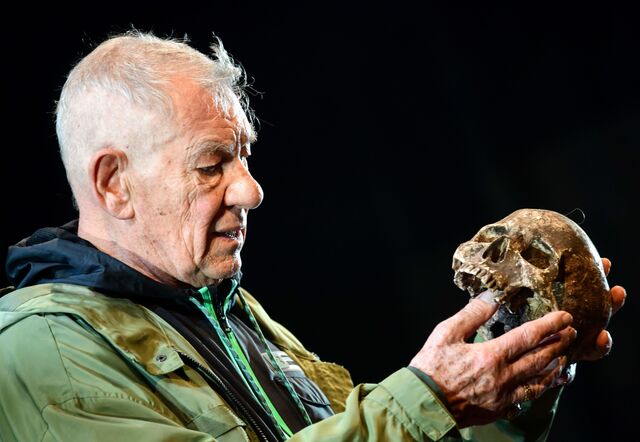
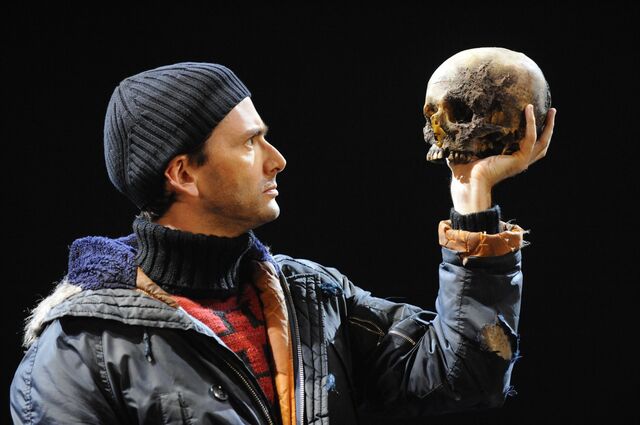
You’ve made parts of it more elusive to some audiences — parts of the dialogue are in Hindi. In setting it within a British-Asian family, you’ve introduced a different dimension. 5
5 The use of language is interesting in this Hamlet — and in Ahmed’s other current project, Bait, where the characters often move between English and Urdu. In Hamlet, a crucial speech by the ghost of the dead king is delivered entirely in Hindi. It reminded me of Hamnet director Chloé Zhao, whose first language is Mandarin, saying recently that you don’t need to understand every word of Shakespeare to be moved by it.
I wouldn’t say it obscures it. What people connect to more than similarity to their experience is specificity. If something feels authentic, that’s what pulls people in. It renders it more vivid and grounded.
By being Hamlet, you get to say some of the most famous lines in the English language — the “To be, or not to be” speech.
It is really fascinating, isn’t it? Even people who don’t know or care for Shakespeare know those words. They’re probably the most famous words ever written, in any language ever. The play itself has been performed continuously since it was written, somewhere around the world. 6
6 Shakespeare wrote Hamlet in the final years of Queen Elizabeth I’s reign, a time when the fact that she was childless was causing uncertainty about the future of the kingdom. Within the play, this particular speech comes as Hamlet, a prince of Denmark, is in crisis following the murder of his father.
That speech is massively misunderstood. We think it’s about suicide, broadly speaking, right?
If Hamlet takes a stage, he’s pointing a dagger at himself. But actually, he should be pointing the dagger outwards. It’s a far more confronting and radical speech than we’ve been taught and is traditionally performed. It’s actually a speech about resistance. Do I have the courage to fight back against injustice and oppression, even if it means I might lose everything? I might lose my life.
Hence “slings and arrows of outrageous fortune” and “arms against a sea of troubles.” 7
7 From William Shakespeare’s Hamlet, Act 3, Scene 1:
“To be, or not to be, that is the question:
Whether ‘tis nobler in the mind to suffer
The slings and arrows of outrageous fortune,
Or to take arms against a sea of troubles
And by opposing end them.”
The active verb is take arms. What happens when you oppose a sea? It drowns you. What he’s saying is, I can fight back, but I know this will only end one way, with my death.
The way we tried to film it was, I hope, as radical as those words invite us to imagine. Hamlet is driving down a motorway at 100 miles an hour in a BMW towards a massive lorry. If the speech itself is a game of chicken, when he is daring himself to go to the edge, that’s how we wanted to film it. I hope that it invites people to reimagine and revive the radical DNA of this play.
Part of the pace and the energy was dictated by the fact that we [could] only find a certain stretch of motorway in which to film it. Historically, if you watch that speech in most films, it’s about five minutes. [Instead] it was like, Okay, you’ve got two minutes and 40 seconds.
What I find as an actor is the fewer decisions I’m making, the better. It’s authentic. I’m not acting — I’m reacting. The best things happen in life when there’s an element of surrender, when we are forced to resort to instinct, rather than planning.
We’ve been talking about Hamlet, a great iconic character. Your other new project, Bait, also has a great iconic character — James Bond — as part of the storyline. 8
8 Ahmed created and co-wrote this six-part black comedy, out now on Prime Video, where he stars as a British-Pakistani actor dealing with untoward events just as he is auditioning to take over the role of Bond from Daniel Craig. In real life, Ahmed himself has been spoken of as a future Bond.
I guess I’m interested in stepping into the canon — these archetypes — and subverting them, complicating them and, if anything, adding vulnerability to them.
Often these characters become archetypes and suits of armor that we wear. I’m really interested in how can we humanize them with vulnerability.
When we first had the idea of tying together all the personal themes of Bait — and it is a very personal show — we had the idea of putting that all into the vessel of James Bond. Everyone said, There’s no way you’re gonna be able to do it. To Barbara Broccoli’s credit, I think she saw [that] the show’s not about Bond. It’s about a feeling that a lot of us can relate to, that life sometimes feels like one big audition. With LinkedIn and Zoom calls, we’re always performing a more put-together version of ourselves. 9
9 Ahmed had to run the idea for Bait past Broccoli, daughter of the original Bond film producer and longtime steward of the franchise alongside her stepbrother Michael G. Wilson. Last February, Broccoli and Wilson handed creative control to Amazon in deal reportedly worth $1 billion, following distribution rights acquired through MGM Studios. Denis Villeneuve is directing the new film, but who will play Bond is still under wraps.
Your character — a huge role is within his grasp and then his life starts to fall apart. You said it was personal. How much of yourself did you bring to it?
Oh, so much. Not because I wanted [it] to be a therapy session or feel solipsistic. I just wanted to be as authentic as possible, because that’s how people end up relating to things.
My character has a panic attack in a music venue in London. I had a panic attack in that exact venue. I burst out of those fire escape doors into that same alleyway where we recreated that scene. My character gets jumped and attacked in a park in Wembley. That exact thing happened to me — or a version of it — in that park. My character is approached by the security services, after becoming a bit more well known as an actor. They say, Hey, do you wanna come and work with us? That’s happened to me several times. 10
10 This was interesting because Ahmed has put on record a much darker version of interacting with British intelligence, as he returned to the UK from a win for his first film, The Road to Guantanamo, at the 2006 Berlin Film Festival. “British intelligence officers frogmarched me to an unmarked room where they insulted, threatened, and then attacked me,” he wrote, describing his arm being twisted “to the point of snapping.”
It was quite scary. It felt quite vulnerable to go there and share that. But I thought, If I’m going to tell a story about a character who needs to learn how to take the mask off, then I’ve got to do that myself.
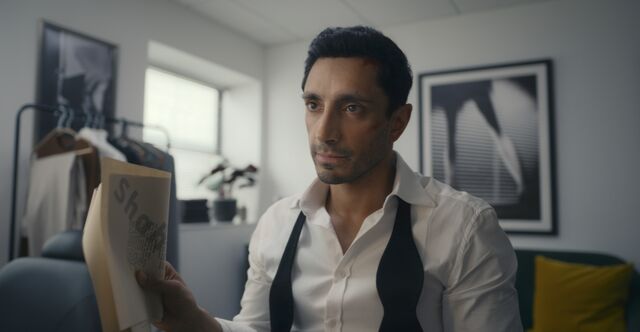
There’s a moment that stuck in my mind where your character turns around to his family and says, “You don’t understand me... I’m trying to make a difference. I’m trying to change the world, so that people don’t look at you and think you are worthless.” I wondered if that was personal? At the time you went into the industry, there weren’t very many actors of your background and heritage. If there were, they were playing stereotypical post-9/11 roles. 11
11 Long before 9/11, Professor Edward Said wrote of portrayals of Islam and Muslims being synonymous with terrorism and hysteria. Ahmed was 19 when the 9/11 attacks took place, but older actors such as Art Malik (who stars as Claudius in Hamlet) have spoken of turning down “exploitative” post-9/11 roles. Ahmed’s own big break came in 2010 when he was cast in Four Lions, a satirical comedy about hapless would-be suicide bombers.
What I love about that speech — it needed to feel both like there was a nobility and also a deeply offensive condescension. That this character was motivated by both those things.
As an artist, there is often that combination. You need to have an ego to think you have something to say, and something to offer. But if that ego gets too big, rather than offering and giving, you want to get something. You want to get that round of applause. You want to get that praise. You want to get those accolades.
Our character, Shah, is walking that fine line. Certainly, I’ve been through periods in my life where what I think I’m seeking is other people’s approval.
Or acceptance?
Yeah. Whether for myself or for my community.
I’d go as far as to say that the pendulum keeps swinging back and forth. You need that hug from the culture one day, and the next, you feel you can give yourself that love.

Get the Bloomberg Weekend newsletter.
Big ideas and open questions in the fascinating places where finance, life and culture meet.
By continuing, I agree to the Privacy Policy and Terms of Service.
Is that because as an actor, the next role is always doubtful? Or is it also because of worries that society or the industry is rolling back on progress?
I do think these things work in cycles. Culture works in cycles. History works in cycles, for better and for worse.
We’ve been through periods where dominant culture wants to regressively assert its narratives, and we’ve gone through periods of greater collective self-confidence when we are able to let a thousand flowers blossom. Things never really stay in one gear for too long, so I’m not too concerned about that.
What I am interested in, however, is the democratizing of the tools of storytelling. Some of the gatekeeping is no longer as effective as it was. Right now we have different kinds of gatekeeping. It’s algorithmic. Seeing consolidation across social media might undo some of that democratization. But actually, it’s fascinating to see how these kids picking up their phones can have a bigger audience than some of these institutions.
Do you remember the book of essays, The Good Immigrant? It’s 10 years old. In a piece for it called “Airports and Auditions,” you wrote: “Since I was a teenager I have had to play different characters, negotiating the cultural expectations of a Pakistani family, Brit-Asian rudeboy culture, and a scholarship to private school. The fluidity of my own personal identity on any given day was further compounded by the changing labels assigned to Asians in general.” Did acting come to you as an extension of what you were doing in your life?
A hundred percent. I look back and realize I was playing different roles — or at least different versions of myself.
Speaking in Urdu, wearing shalwar kameez at home, wearing Reebok Classics and fake jewelry on the street corner, or school uniform — a tie that belonged to Clive House, named after “Clive of India.” 12
12 Robert Clive, 1725-1774, was a key figure in the colonization of India. By the end of his life, he was known in Britain as “Lord Vulture” because of his reputation for avarice and asset-stripping. A statue of Clive was nevertheless installed outside the Foreign Office in London in 1912 and remains there today.
I look back, and it was confusing, but actually really enriching. For a long time I thought of code-switching as this cross to bear, but also [a] kind of superpower. I was forced to explore these different versions of myself. Now, my hope for myself; my hope for the next generation is they don’t have to code switch so much, and get to bring all of themselves into any room they enter.
That desire to change portrayals of ethnic minorities is explicit in this essay. You talk about various stages of ethnic minority characters — stereotype, subversive portrayal, and then the “promised land” — where, you write, “my name might even be Dave.” You’ve got there, right? What is still elusive? 13
13 In “Airports and Auditions,” Ahmed writes: “Stage one is the two-dimensional stereotype — the minicab driver [or] terrorist [or] cornershop owner… Stage two is the subversive portrayal, taking place on ‘ethnic’ terrain but aiming to challenge existing stereotypes…. And stage three is the Promised Land, where you play a character whose story is not intrinsically linked to his race.”
It’s interesting. I don’t think of the “promised land” as necessarily a destination. It’s something we have to build — at least I’m realizing that now.
Hence producing [and] writing, more than acting?
Not so much more. I see it all as extensions of storytelling.
I’ve been rapping and making music since I was a teenager and think of that as storytelling. I think of producing and writing scripts as storytelling. I think of acting as storytelling. I guess I am aware that the promised land I want to see might be something that me and others have to build — hence short films like The Long Goodbye or Hamlet or Bait.
I don’t know if that feels elusive. That feels exciting. That feels like the work that lies ahead.
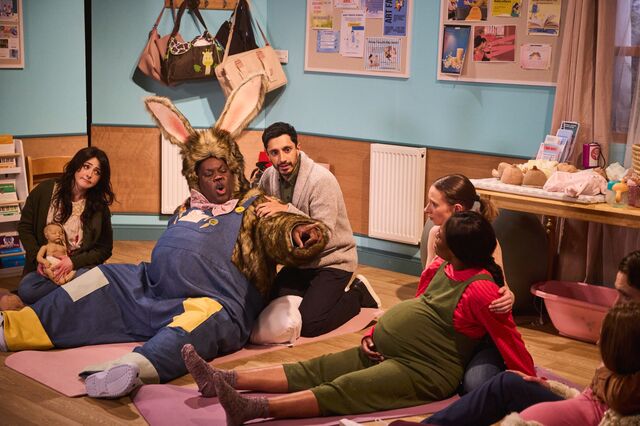
You are part of the lineup on Saturday Night Live UK. What does it represent to you? 14
14 Ahmed’s episode on April 4 featured a monologue making fun of his choice of intense roles and a parody of the British show Traitors. Ahmed received positive reviews for his performance, with one reviewer describing the episode as “watching great comedy at its very best.”
I think it’s a really cool opportunity to take this institution and do it our own way, with British humor. That feels exciting to me. I grew up on all these sketch shows, The Real McCoy, Goodness Gracious Me, Harry Enfield, The Fast Show. Possibly, those sketch shows are bigger influences on me than any film.
But they’ve moved into the past, haven’t they? That kind of show is not really part of British comedy anymore.
It’s an interesting point, and I think that’s a shame. If it requires an American institution to lend us their brand in order to revive that tradition here — there’s such a rich tradition — I’m all for it. Sometimes you need a shot in the arm to remember who you are. I think that we do sketch comedy pretty well here.
What else are you working on that you can share?
I did a film [Digger] with Tom Cruise, directed by Alejandro Iñárritu, who made Birdman and The Revenant, and is such an incredible, visionary director. That experience was really unique.
Why?
You’ve got this combination of obsessive perfectionists. The level of focus, attention to detail, and care they brought to every single thing floored me. Particularly Tom — his energy is that of a world-class athlete — inexhaustible reserves and constantly kind of quarterbacking it.
I remember on one of the first days of rehearsal, I tried something out with the character that didn’t quite work. Alejandro said, No, no worries, but we’ll keep going. Tom stopped the rehearsal to say, Riz when you try things like that — when you are creating in that way and taking swings — I love it. Don’t ever stop doing it. He gave me a round of applause for making a mistake. I just thought, This guy’s an inspirational leader and it’s no coincidence that he’s in the place he is in, because he just cares so much. That was a real lesson. It was really inspiring.
Speaking of being inexhaustible, this is part of Bloomberg Weekend, so I have to ask — husband, parent — what are those days like?
My weekends are very simple. Having breakfast together. Going for a walk. My kid loves going to the fishmongers — just as I did, weirdly.
Something that I’m rediscovering is the importance of boredom. The adrenal rush of being constantly active is an addiction like any other. Trying to find ways of downshifting my nervous system to appreciate stillness, it takes effort.
What I’m discovering is [that] the bigger boundary to keep is internal, rather than external. If I tell people, Hey, don’t contact me here, they usually won’t. But there’s a part of me that wants them to. There’s a part of me that wants to keep riding the wave of activity. That’s a learning curve I’m on.
Are you storytelling to your child now?
Yeah, my child loves stories.
The story is something magical and spiritual. It’s the most profound, powerful technology we’ve ever created as humans. Stories are where we find ourselves — and how we recognize our similarities with characters who seemingly are nothing like us.
(Corrects spelling of Digger in fourth question from the end of the interview.)
Mishal Husain is Editor at Large for Bloomberg Weekend.