
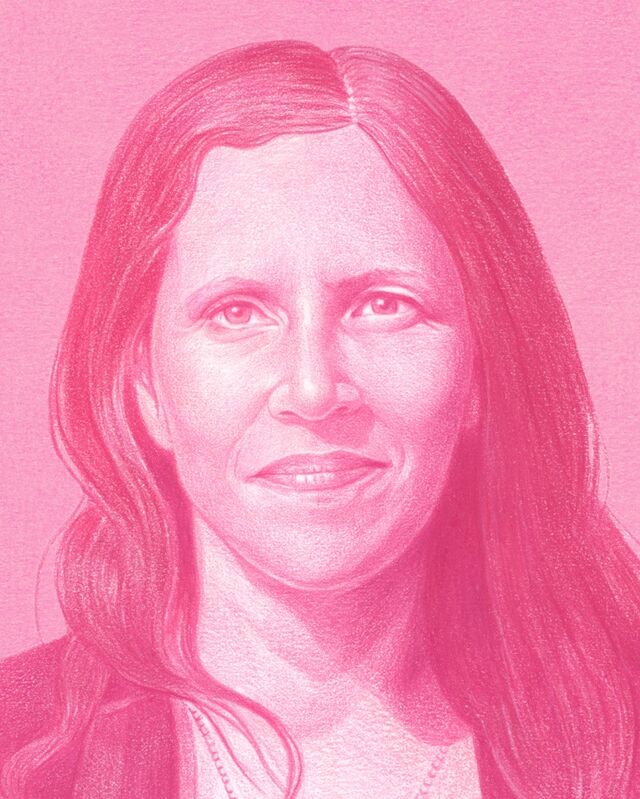
The Filmmaker Who Trains Her Lens on American Power
Laura Poitras talks about the BAFTA-nominated documentary that took her decades to make, Snowden’s secrets, and life on a US terror watchlist.
The killing of two American citizens by federal agents in Minneapolis, little more than two weeks apart, has made January a dark month for many across the United States. Officials in the Trump administration were quick to accuse both victims of impeding law enforcement, even referring to them as “domestic terrorists.” It’s a label that filmmaker Laura Poitras finds chilling.
Poitras has been producing and directing documentaries for more than 20 years, winning both an Oscar and a Pulitzer Prize for work relating to whistleblower Edward Snowden and mass surveillance. She has her own experience of being regarded as a threat by the US government, and spent time on a terrorist watch list.
Her work has long trained an unflinching lens on the American state. It’s little surprise, then, that Poitras’s latest film profiles Seymour Hersh, an investigative journalist whose career has been defined by exposing abuse and official deception. Cover-Up, co-directed with Mark Obenhaus and now on Netflix, traces Hersh’s life from his roots on the South Side of Chicago, through his scoops of the 1960s to his current journalism on Substack, and was nominated this week for a BAFTA award. In our conversation, Poitras also reflects on the role of citizen journalism in places like Minneapolis.
The first part of this conversation was recorded after the death of Renee Good in Minneapolis, but before that of Alex Pretti. It has been edited for length and clarity. You can listen to an extended version in the latest episode of The Mishal Husain Show podcast.
Tell us how Seymour Hersh made his name during the Vietnam War, and the massacre he uncovered.
He’s a legend in investigative journalism in the United States. He’s exposed really dark secrets and hidden truths about this country.
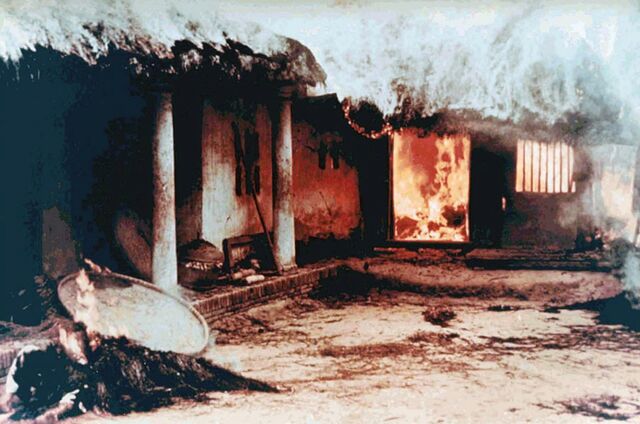
Sy fell in love with journalism in Chicago. He began as a copy boy and then worked his way up, covered civil rights and transferred to Washington. His first really big story — which he received the Pulitzer Prize for — was about the massacre in My Lai, where the US military killed an entire village in cold blood, including children and babies. Over 500 civilians were murdered.
He was [a freelancer] at [The Associated Press], reporting on the Pentagon. People started to say things to him like,Vietnam was “murder incorporated.” He got a tip that there was going to be a court martial of a soldier, Lt. William Calley. He tracks him down and goes on a long journey to expose a horrible atrocity — and it [was] not isolated. 1
1 Hersh was 32 when he broke the story of My Lai in 1969. At 88, he’s still prolific, publishing weekly on Substack from his home in Washington, DC. In Cover-Up, we see him at his desk surrounded by stacks of papers. The US Army's official count put the death toll from My Lai at 347; Vietnam, which counted casualties differently, commemorates 504 victims.
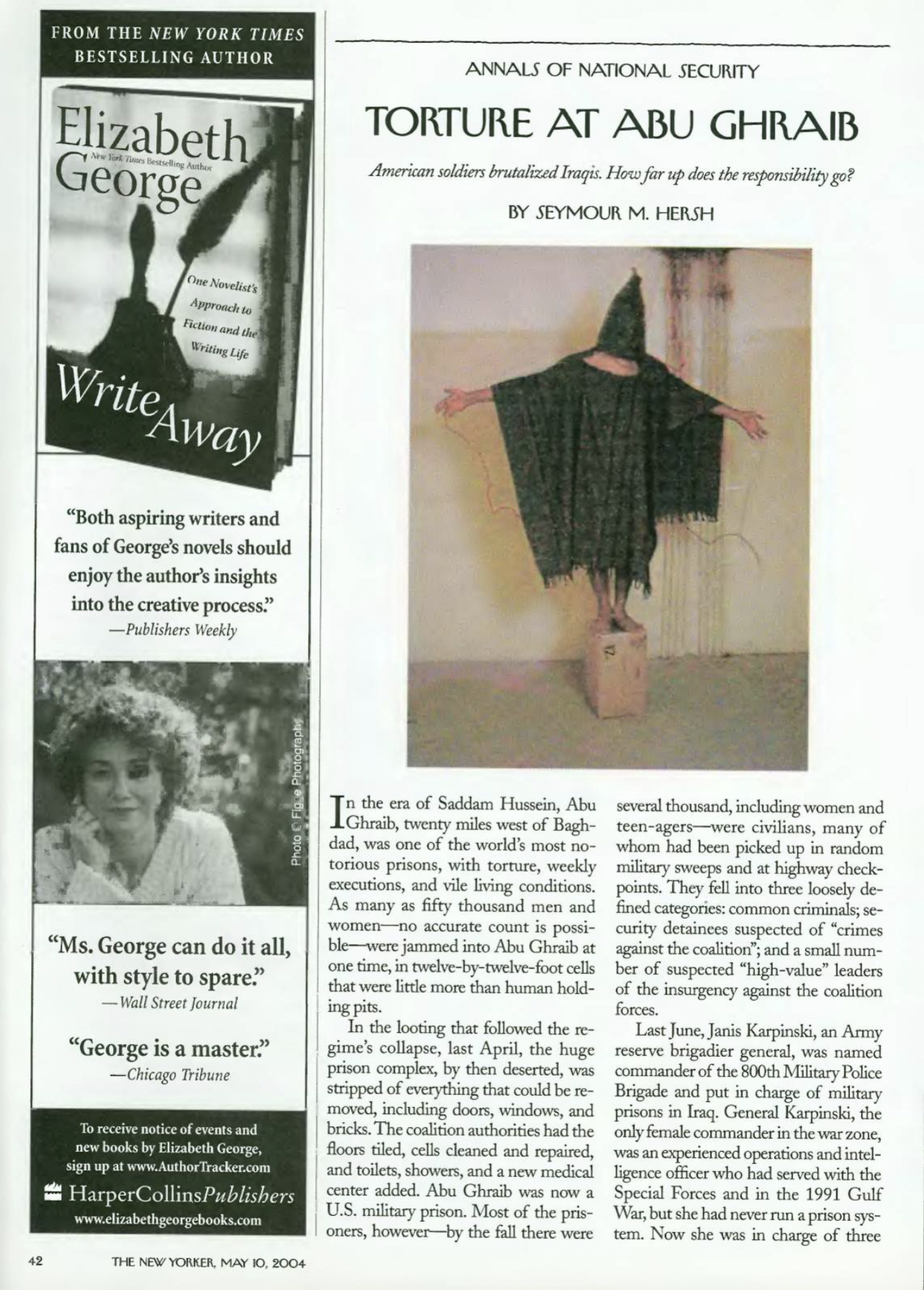
You’re a younger generation [but] you have something in common — you’ve both won Pulitzer Prizes for your work. I also wondered if the moment you have in common is the Iraq War. Hersh did incredible work uncovering the torture of prisoners at Abu Ghraib prison in Iraq, and you were working on Iraq at the same time.
Exactly. I’d known Sy’s stories, but he really [came] on my radar in the years after the 9/11 attacks, where he was asking very hard questions. Why are we going to Iraq? What is the connection between oil and money? What is the connection between the neocons and Halliburton, and all these defense contractors?
In 2003, [I decided] to make a film in Iraq. In the spring of 2004, Sy publishes evidence of torture in Abu Ghraib in the New Yorker. I went right after that, for eight months, and followed an Iraqi family. I talked my way into documenting the prison after Sy’s photos. 2
2 Soon after the US-led invasion in 2003, Hersh heard reports of brutality at a prison taken over by the US military. He was told that CBS was investigating, but the story wasn’t getting airtime. Hersh obtained an Army report into the treatment of detainees, and graphic images of abuse. In Cover-Up, he recounts telling CBS that if they didn’t run the pictures, he would publish his piece and reveal that the network was holding back. CBS then broke the story in April 2004; Hersh’s New Yorker piece ran shortly afterwards.
[When I] came back to the US, [I] called Sy and said, I’d like to make a film about you and your work and investigative journalism. I felt the US public was being failed by our legacy media in its coverage of the “War on Terror” — which includes Guantanamo Bay prison, the Iraq War, secret rendition sites and torture. The press kind of stood back and I think repeated the government’s talking points. Sy wasn’t doing that. He’s never done that. 3
3 In 2006, President George W. Bush publicly acknowledged that the CIA had used what he called “an alternative set of procedures” to question suspected terrorists, insisting they were “lawful and necessary.” A 2014 US Senate report found that the CIA had misled the US government and Congress on its detention program. Senator Dianne Feinstein said it was her personal conclusion that “under any common meaning of the term, CIA detainees were tortured.”
Did you see Hersh as a kindred spirit?
Yes. I think we’re both looking for the truth wherever it takes us, without fear or favor.
Sometimes that gets us on the bad side of the US government. We’ve both done that, so I think he respected my work. Of course, [I] respected his.
All of my films are really looking at people who are bringing forth information that shifts our consciousness.
Hersh has been wrong. He didn’t believe that Bashar al-Assad used chemical weapons against his own people [in Syria]. He was taken in by fake documents about JFK and Marilyn Monroe. He’s been criticized for often using unnamed single sources.
Obviously we needed to include those stories in the film. People make mistakes; journalists make mistakes. It’s very hard to know who to trust. 4
4 In 2013, Hersh questioned whether Assad was responsible for a nerve gas attack on a rebel-held area, basing this on unnamed intelligence sources who believed rebel groups also had access to sarin. The following year, investigative journalists at Bellingcat linked weapons used in the attack to the Syrian military.
I have friends who were tortured in Syria. It’s not journalism that I would defend. In terms of the JFK reporting, he actually never published the forgeries. He [fell] for them for a while, but caught them before they were published.
The truth is that sources always have motivations. We don’t know what they are.
Sy wasn’t always that comfortable when we were asking about those stories, but he also respected us.
You put to him that he was too close to Assad himself, because he’d met him a few times — and he acknowledges that. There are other uncomfortable moments, and in fact [he calls] it off in the middle of filming.
Right. I first asked him [to film] in 2005 and we began production in 2023. So it took a little while for him to warm up to the idea. It was very hard for him, [but] he was very committed to the process. He never turned away from a question.
[But] yeah, he did quit the film. 5
5 During filming, Hersh briefly walked away from the project after becoming uneasy about the presence of sensitive reporting materials and the risk of exposing sources. He later returned, with the exchange becoming a pivotal scene that speaks to his lifelong sensitivity around sources.
He lets you see boxes of documents. There are names in those documents and it makes him uncomfortable.
Totally. I mean, you’re a journalist as well. If somebody was looking at your notes—
We agreed at the beginning that we had an obligation to protect his sources as filmmakers [and] my reputation on source protection is very good. [But] there [were] a couple of notebooks he thought he had separated and they had gotten mixed in.
Of course it was very tense, but we felt confident that he would come back. He’s known for being volatile. You know what I love about Sy? His resistance. As a documentary filmmaker, you should be really suspicious of somebody who would be eager to have a film made about them. I like that he’s very upfront about what he’s feeling in the moment. Some people would smile and then leave a message and say, I’m thinking about quitting. Sy says it on camera.
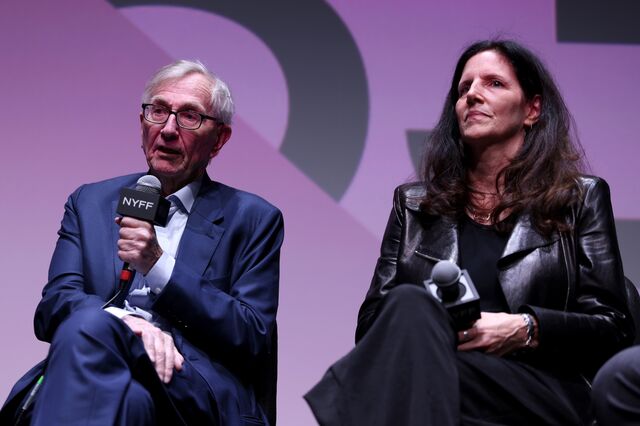
I wonder if another thing you have in common is that you could be accused of focusing too much on the ills of your own country — that your lens is often turned on America and America’s abuse of power, whether internationally or domestically. Why is that?
Right. One of the things about this film — and Sy’s reporting at its best — [is] it’s fact-based. He says in the film, At some point, it doesn’t matter what I believe. It matters what I can prove.
I think we should all focus on the cultures that we know. I don’t think it’s my role to make work in cultures that I don’t understand or don’t know. The US is a global power and I think there’s a myth of American exceptionalism that needs to be undone. Look [at] what’s happened in Venezuela. Those are the actions of empires, right?
You made a trilogy of films after 9/11. Perhaps we are living in a similar world now? The war in Iraq was outside the international order and the United Nations. Venezuela also takes us into a realm outside [norms].
I have a feeling of dread and anxiety about what the US is doing — about the long-term consequences of these actions.
Regime change never works out well, even if you’re talking about a dictator who’s hated. There was no love for Saddam Hussein, but people don’t want to be occupied. People want self-determination. They don’t want to be run by the United States. This is just basic.
This idea that we’re going back to this sort of regime-change foreign policy is terrifying to me — [as is] the failure of legacy media.
I don’t think it’s news that the CIA is capable of kidnapping anyone on the planet. What we should be asking is, Why are we doing this? What are the long histories of these kind[s] of foreign interventions?
The administration would say,We are acting in the US national interest, because we don’t want Venezuela’s resources used by China or Russia.
The US doesn’t have the right to steal resources from other countries. The action of regime change — I think it’s against international law. I’m not going to defend it. 6
6 “What we’re not going to allow is for the oil industry in Venezuela to be controlled by adversaries of the United States,” Secretary of State Marco Rubio told NBC on Jan. 4, one day after the US raid that resulted in Nicolas Maduro’s capture. “This is the Western Hemisphere. This is where we live.”
You would call it regime change?
Well, what would you call it?
The person who is supposedly in power is Maduro’s deputy.
Did you listen to the press conference that Trump did after [seizing Venezuelan President Nicolas Maduro], where he says, We’re running the country now? I mean, how is that not regime change?
We pretended there was a connection between 9/11 and Iraq. There was a cover story. In Venezuela there isn’t one. We’re taking over the country to steal the oil. It’s all very blatant. 7
7 Trump spoke of US interest in Venezuelan oil before and after the capture of Maduro, while other US officials have cast the operation as law enforcement. In a recent Weekend Interview, Democratic Senator Jeanne Shaheen said there was no clarity on plans for Venezuela and that the US had replaced “one repressive dictator with another.”
The film you made about Iraq under occupation led to [a discovery that] you were under surveillance by US authorities. Take us through it.
Once I started showing the film at film festivals, I started being detained and interrogated at US airports. It continued for six years. Internationally, I was detained at least 50 times, and domestically maybe another 40.
You don’t get a letter that you’re on a terrorist watch list. The first time it happened, I was transiting in Vienna. There was a loudspeaker. I was asked to report to security. All of my luggage was taken. I was put in a van. Everything was searched. I was questioned by the head of security at the airport in Vienna. Ultimately I said, What are you doing? He said, Well, you’re on a list. And I said, I’m on a list? Whose list? He said, Your country’s list.
We have a threat scale from one to 400. I was at 400 on their threat scale. That was intimidating.
In 2012, I decided to leave the United States because I felt I couldn’t work safely going through this border. I relocated to Berlin and was there, sort of in exile, for three years.
Get the Bloomberg Weekend newsletter.
Big ideas and open questions in the fascinating places where finance, life and culture meet.
By continuing, I agree to the Privacy Policy and Terms of Service.
You did, in the end, get an acknowledgement from the US government.
They didn’t volunteer to tell me I was on a terrorist watch list. I had to sue the government. I have got back about a thousand documents of my FBI file — heavily redacted. All of my emails, bank records, et cetera, had been subpoenaed.
What was it like reading that FBI file?
You see the extent of it. They were sending FBI agents to my film screenings and writing up reports of what I said in conversation. So it was validating. I knew it was happening, I had the evidence, but the government would never acknowledge it.
As a filmmaker and as an artist, I used it in my work. I hung it on museum walls.
I talk about it a lot because usually the people who are put on these lists aren’t white women who’ve won journalism and film awards.
Edward Snowden revealed the extent of mass surveillance [and] you were the person that he reached out to.
Ed was at NSA [National Security Agency]. He knew that I knew about surveillance, how dangerous it was, and that I’d been directly impacted. I also had a lot of skills in terms of encryption and source protection. Once you’re stopped at the airport a few times and your computer and phone are taken away from you, you learn how to protect things.
He wasn’t interested in me making a film. He saw me as somebody who could protect him and collaborate with news organizations to break the story. That was his motivation. 8
8 Snowden is a former US government IT contractor who in 2013 leaked highly classified information that showed the NSA was gathering the phone records of millions of Americans and tapping into servers run by major tech firms such as Facebook, Google and Microsoft. He also revealed that both the US and UK were intercepting internet data and eavesdropping on allies.
[Did] you trust that he was genuine, or did you think this was some kind of ruse or scam, given what you were living through at the time?
I had a spectrum of reactions. One was, I think it’s legit. And, Holy sh*t. We’re in danger. A lot of danger. Another part of me [thought] it really could be FBI entrapment — because the FBI does do that — so I better be careful in what I say. Or, he could be crazy.
I basically assumed that it was legit and went into a very extreme mode of digital security. We communicated through encrypted email. I had a separate computer that was purchased with cash. I would go to random cafes to use the internet — what Snowden would call disassociat[ing] your metadata or divorc[ing] your metadata. It took five months, then I finally saw the documents [and they] were staggering.
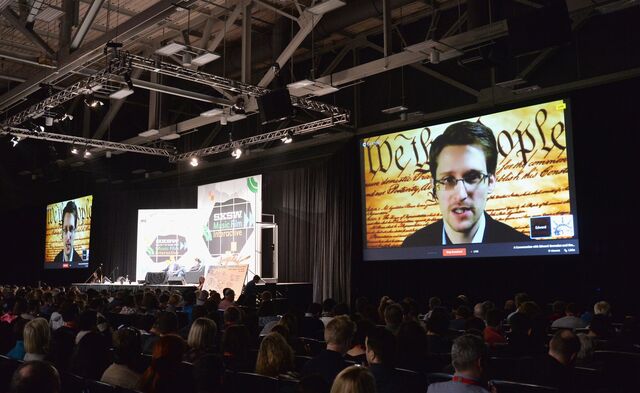
Snowden went on to get asylum in Russia, a country that is far from free. There is an irony in that.
As [has] been well reported, he was actually on his way to Ecuador. He was in transit and the US revoked his passport. He was not planning to seek asylum in Russia. US pressure on European allies not to provide asylum was profoundly intense.
Are you still in touch with him?
I am. [We’re] on the board of the Freedom of the Press Foundation. We provide digital security training for journalists. We have a secure drop — a system for sources to anonymously leak to newspapers.
I’m very happy he’s not in a US prison. He ultimately agreed for me to film him because I convinced him that he needed to explain his motivation for exposing this information around global mass surveillance. If he didn’t, the government was going to create the narrative.
He doesn’t want to live in a world where everything is surveilled. He believes that the public should know the extent of its surveillance programs.
There was such a huge outcry about it at the time, and yet look at where we are today. Haven’t most of us normalized surveillance? We’re surrounded by CCTV, facial recognition. We assume we’re being surveilled all the time.
Does that mean we shouldn’t, as journalists, inform the public? I know you’re not saying that.
Surveillance is ubiquitous, [but] people should know their rights and there are ways you can opt out. When you go to the [airport], at least as a US citizen, they want to do the biometric scan. I opt out. People don’t know they can opt out of those things.
A lot of the things you care about are really important, but isn’t the battle lost on some? I don’t know to what extent a younger generation would care about their data being used.
If you’re planning to participate in a demonstration right now in this country, I think you are going to care about how to avoid being surveilled. If you’re living in [an] authoritarian regime, you know how dangerous surveillance is. It really is a question of if you perceive your government is a threat to you.
I’m not saying it’s easy, but I believe we need to take these measures.
Cover-Up has this long sweep of history, from Vietnam to Gaza. Is the film about the present day as much as it is about history?
It’s very much about the present day. I could have made other films, but I really feel this urgency around the importance of investigative journalism, the responsibilities of legacy media, and drawing connections across time — cycles of impunity. There are lies and no consequences. Had there been, I think we’d be in a different moment.
But there were consequences, right? Soldiers involved in the abuse at Abu Ghraib or My Lai [were charged]. The USA Freedom Act came in after evidence on mass surveillance in the country.
Soldiers were charged, but the chain of command [wasn’t]. The people who often face consequences are the whistleblowers.
Nixon resigns before they impeach him, and then he’s pardoned by Ford. I think that cycle has to end.
It’s hard to imagine a president these days choosing to step down in pretty much any circumstances. [It] feels like that age is gone.
Hopefully not. Sy says it in the film: Given the stakes, we can’t just lay down in despair.
We have press freedom in our Constitution. It’s a right. We have to exercise that right. We have the right to be critical of the US government. It’s not illegal. We have to maintain those rights and use them wisely.
We’re also in an age where, through phones, we have evidence from many angles, often of the same incident.
Yes. The cold-blooded killing of Renee Good — where she was doing the protected right of assembly and protest — we know what happened to her because it was documented by citizen journalists. George Floyd was killed two miles from there. We know that because of a citizen journalist. Facts matter.
What’s very scary to me right now — particularly being labeled a terrorist threat [myself] — is that the Trump administration called [Good’s actions] “domestic terrorism.” That’s terrifying. This is playbook authoritarianism. The rights that people have are taken away and people are labeled as national security threats — the enemy within.
After the news that federal agents had shot and killed another US citizen in Minneapolis, Alex Pretti, I was compelled to reach back out to Poitras. The below is taken from our second conversation.
When you heard the news of what happened to Alex Pretti, what was your immediate reaction?
The immediate reaction — it’s horror. This was an execution. He was shot from behind while being held down on the ground.
Then waiting for the government narrative and listening, knowing that they were going to lie about it. But the extent of the lie was actually quite shocking, of how they tried to distort and create a narrative that did not align in any way with the facts that we could see with our eyes.
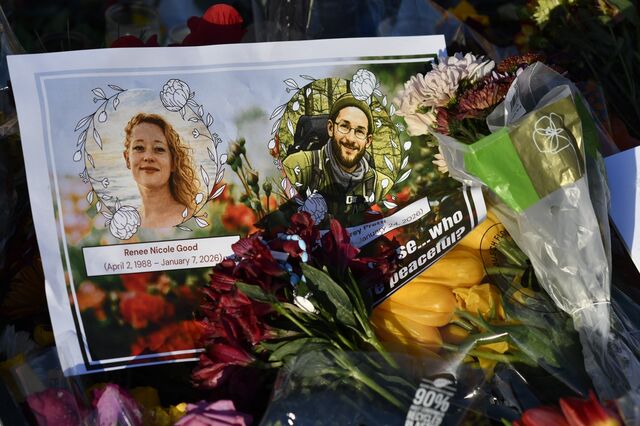
The use of the “domestic terrorist” label again, the portrayal of Alex Pretti as being someone who had gone armed to a protest — all of these kinds of characterizations.
They’re lies to create a narrative that does not align with the facts because they killed somebody. And what they’re trying to do is create a state of terror, killing people using their protected rights of demonstrating or documenting ICE on the street.
I mean, these are rights that we have in this country. It’s outrageous. It’s also not a surprise. It’s kind of the playbook.
Do you believe in reflecting another point of view? What you see as parroting an authoritarian narrative, others might see as reflecting the official position, which is also important to understand — what the administration is doing or trying to do.
Well we have evidence that you can see that this person was not a threat, that he was on the ground, that he was shot from behind. So no, I don’t think you should reflect something that’s a lie. That’s clearly a lie.
Do you think this is a turning point for ICE and for the perception of how it’s been operating?
In terms of the international reputation of the United States, I think that has clearly shifted. I think people look at what’s happening and they see these are masked paramilitaries that are executing protestors on the streets. I think that’s very clear. Whether it’s a tipping point in this administration, I think this is their policy. Their policy is state terror. 9
9 After public outcry following Pretti’s death, state and local officials have called for independent investigations into both killings and a reduction in the federal presence. Trump sent border czar Tom Homan to Minneapolis to oversee the response; on Thursday, Homan told reporters he aims to cut the number of immigration officers in Minnesota and conduct more targeted operations, while emphasizing that Trump remains committed to his anti-immigration policies.
Are there people — neighbors, relatives, friends — who you think are changing their minds because of what’s happened in the past few days?
I think that the videos that we see that were taken by people that day are undeniable. I think anyone seeing a person being shot from behind is going to be outraged [by] that. And yes, I do hope it creates a tipping point. Whether or not that’s going to change the policies of this administration, that I’m much more skeptical of.
There is something positive that’s happened since we last spoke. You’ve had the news that Cover-Up has been nominated for a BAFTA. Congratulations.
I appreciate that. I believe Sy’s body of work is meaningful. It asks us to [be] skeptical of government power, which is what he does and which is what we’re trying to say in the film. So yeah, it’s meaningful.
Is that what you think has led to the nomination — that theme, that [his] life’s work is speaking to people right now because of the moment?
That’s what I would hope. That’s why we made the film, because I think Sy’s body of work teaches us so much about how we navigate the present, and the role and the obligation of journalists to be dogged and adversarial and unrelenting in questioning state power.
Have you spoken to him about Minneapolis?
Yeah. And he’s writing about it right now, probably as we speak.
But most people, truth be told, aren’t resisting. What’s the impact of that on you when you feel as strongly as you do?
In Minneapolis, there are people who don’t identify as activists who are coming together because they’re seeing kids being kidnapped off the street. I think people do stand up when they’re confronted with that.
We don’t even know the names of anyone who murdered — who executed — Alex Pretti. Will we ever know those names?
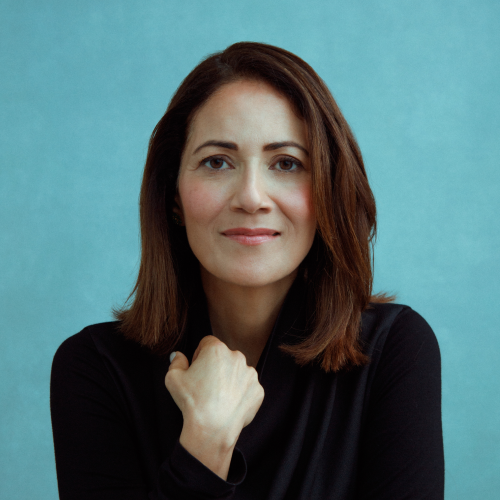
Mishal Husain is Editor at Large for Bloomberg Weekend.