

Can Congress Still Check the Commander in Chief?
Sen. Jeanne Shaheen, the top Democrat on the Senate Foreign Relations Committee, discusses Venezuela, NATO and the limits of congressional power as global crises multiply.
If your job is tracking American foreign policy, that currently means dealing with a lot of urgent, active situations. How deeply is the US already involved in Venezuela? How far might the Trump administration go in backing protesters in Iran, or in trying to cement American interests in Greenland?
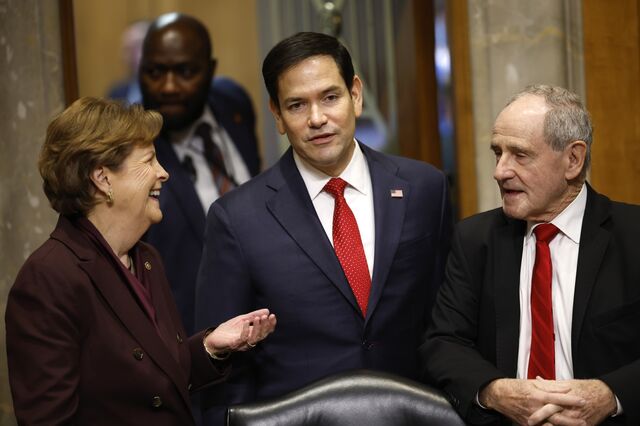
Those questions are why we turn this weekend to one of the most prominent foreign-policy voices in Congress. Jeanne Shaheen, a New Hampshire Democrat who has served in the Senate since 2009, is the ranking member on the Foreign Relations Committee. Her years on the panel mean she knows Secretary of State Marco Rubio well — and help explain why she’s alarmed enough to have traveled to Denmark with a congressional delegation to reassure allies.
Shaheen has access to classified briefings, and a reputation for working across party lines: She was among the Democrats willing to compromise to end last year’s government shutdown. She was in her Capitol Hill office when we spoke on Jan. 13. While the international situation is fast-moving, her thoughts take us inside the world of congressional power — and its limitations.
This conversation has been edited for length and clarity. You can listen to an extended version in the latest episode of The Mishal Husain Show podcast.
You are back in Washington after the holidays. There’s an abundance of news in the United States and beyond. What’s on your mind?
I just came from a briefing with the Armed Services Committee on the operation in Venezuela, so there’s a lot of concern about that. That operation has really raised concerns with our allies and partners.
What I am most concerned about right now [is] ensuring the actions of this administration don’t undermine our partnerships around the world, because they have been so critical to America’s national security, to our strength and to the international order.
I know that you are heading to Denmark.
I co-chair, along with Republican Thom Tillis, the Senate NATO Observer Group. There is very real concern about the potential impact on NATO.
Denmark and Greenland share our values. They’ve been our allies since before World War II. Denmark has always been there in support of the United States.
What we’ve heard from Danes and Greenlanders [is that] anything the United States is interested in doing in Greenland, they would be happy to partner with us on. We’ve had a treaty with Greenland since 1951 that allows us to have bases there. In fact, we had 17 at the end of the Cold War and we’ve closed 16 of those. 1
1 After a meeting of top diplomats in Washington, Danish Foreign Minister Lars Løkke Rasmussen said a “fundamental disagreement” remained on Greenland, while announcing a high-level working group. The one remaining US base on Greenland is Pituffik, on the northwest coast, while the abandoned bases include the Cold War-era Camp Century.
That’s the route we should be taking: It should be diplomatic. We should be engaging in conversations if there is an interest on the part of this administration in additional operations there.
Are you taking the White House seriously when it says that military action is not out of the question on Greenland?
I hope that’s just rhetoric from the president, but we don’t know.
The rhetoric itself raises real concerns from our European allies. We will have a chance to listen to those concerns. We’ll have a chance to respond — to think about how we move forward together.
What can you do as a congressional delegation — or indeed as Congress — unless you detect there are enough Republican senators who feel as strongly as you do on this?
Well, we can continue to raise the issue. Senator Tillis and I [made] a bipartisan statement on behalf of the Senate NATO Observer Group, where we pointed out concerns about what the president was proposing. We need to continue to do that. 2
2 Other Republicans who have been vocal about the president’s stance on Greenland include former Senate leader Mitch McConnell, along with Senators Lisa Murkowski and James Lankford. (Notably, Tillis and McConnell are retiring and neither Murkowski nor Lankford are up for reelection in 2026.) Some of Shaheen’s Democratic colleagues are discussing using votes on other bills and measures to deter the administration from further military action.
Has NATO already been irreparably damaged? It is unprecedented for one NATO ally to threaten the use of force against another.
No, I don’t think so. We have a very strong alliance. What we’re hearing in Congress is a response to the administration’s comments that is helpful for our allies.
The briefing you’ve just been to was about Venezuela. I wonder how much of this talk on Greenland [and] the possibility of military strikes on Iran is because the administration is emboldened by what it’s done to Nicolás Maduro.
Oh, I don’t know. I’m not sure President Trump needs anything to embolden him.
One of the rationales that the administration has given for going into Venezuela was to address the footholds that China, Russia and Iran have had for other operations throughout the hemisphere. What I’m concerned about is that the president’s statements actually undermine those efforts, because of what he said about Greenland and [the] insults to our allies.
Did you end that briefing with more or less concern about Venezuela?
I think there are a lot of unanswered questions about America’s role in Venezuela going forward — about the need to maintain a flotilla [to] interdict oil. We all have an interest in trying to shut down that shadow fleet, but there are costs involved. 3
3 A ‘dark fleet’ of almost 1,500 tankers carry illicit oil from Russia, Iran and Venezuela around the world, evading sanctions. Since the Maduro operation, the US military has been tightening the blockade on Venezuelan oil and has seized at least six tankers.
My constituents in the state of New Hampshire are worried about the cost of living. For any dollars that we’re spending in the Caribbean, the administration [is] not focused on the domestic concerns in the United States.
We have about 20% of our ships in the Caribbean right now. We have 15,000 men and women in our military. Anytime we have that many people in an area of operation, there’s the potential for escalation.
What the administration has done is replace one repressive dictator with another repressive dictator. While I appreciate the need to try and avoid some of the mistakes made when we went into Iraq, we need to see some goals and objectives, a timeline for what’s going to happen [and] a focus on democratic elections. We haven’t seen any of that yet. 4
4 Shaheen was not in the Senate when the US went to war in 2003, but had just stepped down as governor of New Hampshire. Initially supportive of regime change, she said in 2004 that President George W. Bush had misled the nation.
Is that concern shared with Republican colleagues, at least some of them?
It is.
Senators have been prepared to say that they’d like the administration to get congressional approval before taking further military action on Venezuela. Do you think more Republicans will join those already moving on that front?
I doubt that we will see more — but certainly if you talk to people behind closed doors, there are a lot of concerns being raised. 5
5 While five Republicans initially joined Democrats to advance Jan. 8 legislation opposing further US military action in Venezuela, the resolution failed after a series of fiery phone calls from Trump to GOP defectors. All but three Senate Republicans ultimately voted to block a resolution, with vice president JD Vance cast the tie-breaking vote.
This was an administration that came to power saying there’s going to be no more foreign wars.
I certainly think those who are up for reelection this year recognize that there are a lot of concerns among constituents about the reversal.
We should talk about Iran. As you and I are speaking right now, President Trump has said that “help is on the way” for Iranians who are protesting. What do you think he means by that?
It’s not clear yet.
He has talked about putting tariffs on countries that aid Iran. I think that should be considered, because we do want to continue to sanction the regime in Iran for the repressive tactics they’re using against their own people.
It’s not clear beyond that — and beyond diplomacy — what else the administration might be thinking about. 6
6 In recent days, Trump has weighed options ranging from meetings with Iranian officials to military strikes. At the same time, US allies in the Gulf are reported to be lobbying against the use of force, fearing disruption to the oil market and regional instability.
One concern I have is that military action against the regime might produce further backlash against demonstrators — and might move demonstrators to be more supportive of [the regime]. So bombings in the country should be very carefully considered.

A 25% tariff on goods coming from countries that do business with Iran would affect China primarily, but also US allies like the United Arab Emirates [and] Turkey.
It would.
Is that still the right thing to do?
We’re looking at how to put pressure on the regime in Iran. I’m not particularly concerned about what happens to China’s trade.
I’m certainly happy to entertain [UAE’s] concerns and talk about what they might be willing to do to better pressure the Ayatollah, and the government of Iran, to stop attacking their citizens.
China and Middle East Would Be Affected by New Tariffs
Top 10 partners for Iran in total trade, 2024
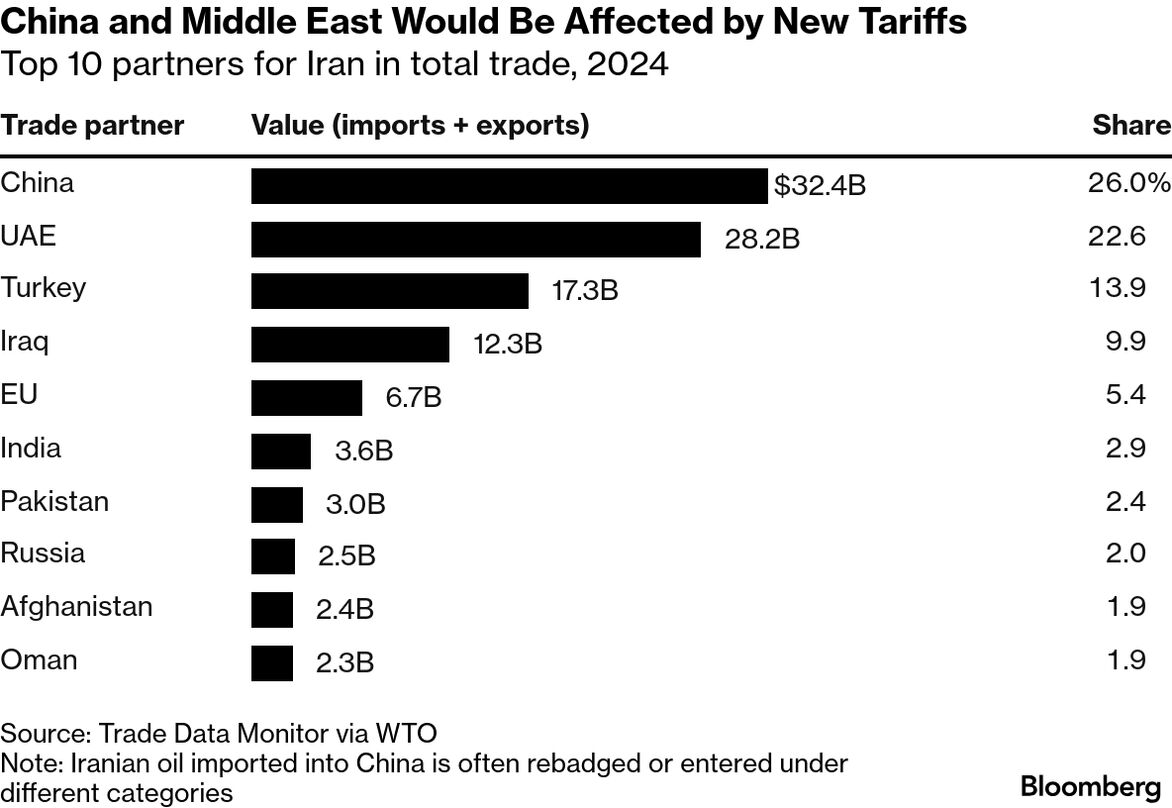
On China, it would be only a couple of months on from the administration’s “truce” on trade. It’s a potential source of economic instability.
President Trump often makes statements without having a lot of data and discussion to back them up. So it’s not at all clear what he might ultimately do.
Certainly we need to have an understanding with China about trade in ways that don’t just benefit China, but also address the US concerns about how China is operating. 7
7 October trade talks between Trump and Xi Jinping lowered the average effective US tariff rate on China to 30.75% from 40.77%. In a Weekend Interview, White House trade adviser Peter Navarro denied any US “softening” toward China, but stressed the importance of maintaining open lines of communication. Trump is set to visit Beijing in April.
You’ve represented the state of New Hampshire for nearly 17 years in the Senate. When someone as senior as you has these questions about US policy, what do you do? Is there an open line to your Republican counterparts, or do you — formally or informally — seek some kind of understanding from the White House? How does it work?
All of the above.
I talk to colleagues, both Democrat and Republican. I raise concerns when we have hearings or briefings. I send letters to the White House [and] administrative agencies. I try and talk to officials in the administration when I have concerns about policy decisions they’ve made. I try to make the case with reporters in the media when I disagree with the administration.
I did that, by the way, not just with this administration, but with the Biden administration and the Obama administration. 8
8 Shaheen understands the art of Congressional horse trading. In July, she reportedly backed the nomination of Mike Waltz (of Signal-gate fame) for UN ambassador, after securing an agreement with the administration to release $75 million in foreign aid.
But it’s got to be an easier relationship for you when there’s a Democrat in the White House?
It’s easier — but in some ways it creates more challenges when I criticize my own president than when I criticize the president of the other party.

Get the Bloomberg Weekend newsletter.
Big ideas and open questions in the fascinating places where finance, life and culture meet.
By continuing, I agree to the Privacy Policy and Terms of Service.
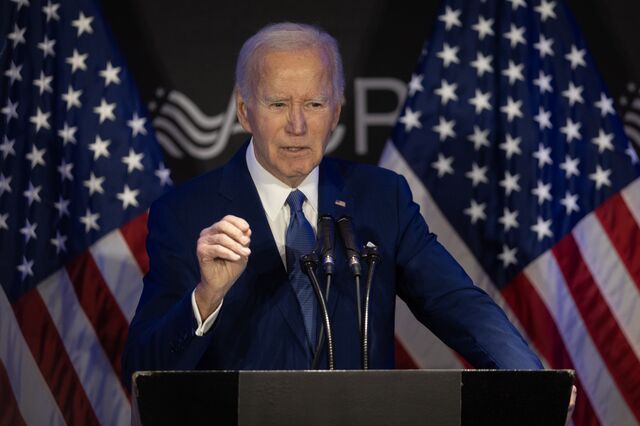
As you look back on the last year of the Biden presidency, do you think I should have paid more attention or spoken out? I could have served my party better by being more open?
I had a number of private conversations with White House staff [and] others around the president about my concerns. If I had raised it openly sooner, would that have made a difference? Maybe. I don’t know the answer to that.
Have you thought about that a lot, given how dramatic the last year, the use of executive power by President Trump, has been?
No. I’ve thought more about the president’s illegal use of executive power.
And do you have confidence [in] the courts? We’ve got the tariff case coming up before the Supreme Court.
I don’t know the answer to that. We’ll just have to wait and see.
I wonder how alive you are to people’s disappointment — anger, even — with how little Congress has been able to do in this past year? 9
9 An October poll from Pew Research Center found two-thirds of Democrats were frustrated with their own party — far more than the equivalent number of Republicans frustrated with the GOP and largely driven by a perceived lack of pushback against the Trump administration.
I certainly share that frustration. I was part of an amicus brief with respect to the tariff issue at the Supreme Court. I have legislation that would constrain the ability of the president to enact those tariffs. We think about it every day: What can we do to address the policy decisions this administration is making?
But what I say to my Democrat friends is, Boy, you better get engaged. You better start working. We’ve got midterm elections coming up. If you don’t like what’s going on in this country, you need to get busy. That’s what our democracy is about.
When I was in graduate school, I had a professor who used to talk about the fact that we have a revolution in America every four years. It’s called the presidential election.
A lot of people didn’t pay attention. They believed what Donald Trump said when he was campaigning about his focus on domestic issues, about his intent to address [the] cost of living. Sadly, he hasn’t done that. I hope people are paying attention and that they’re going to work harder in this upcoming election for alternatives.

You are still known as one of the bipartisan-minded lawmakers. You work with Republicans when you need to. I wonder if you think that your party needs more like you — prepared to work across the aisle — or more of the firebrand like Alexandria Ocasio-Cortez or Zohran Mamdani? 10
10 Shaheen’s tendency to reach across the aisle was learned through local politics in her notably purple swing state. She was elected governor of New Hampshire in 1997 by appealing to independents. Today, the state’s governor is a Republican and the party holds a majority in the legislature, while Democrats have won New Hampshire in eight of the last nine presidential elections.
That’s what the voters are going to decide.
One of the great aspects of our presidential selection process for me has been the New Hampshire primary — historically the first presidential primary of any state in the country. It’s been not only fascinating but I think really important to require candidates to engage with voters. The candidate who may have the most name recognition, be the best funded, have been involved the longest, isn’t necessarily the candidate voters think is the best person to be president.
Voters in New Hampshire have really been pretty effective. They picked Jimmy Carter, way back. They picked John McCain when he was running against George W. Bush [in 2000]. 11
11 New Hampshire’s claim to going first is a bit of a technicality. Iowa traditionally goes first and New Hampshire second, but Iowa uses a “caucus” format, which involves public in-person meetings rather than a standard ballot vote. Fun fact: Shaheen was almost Al Gore’s running mate in 2000 — and has suggested she might have swung the election his way had he picked her rather than Joe Lieberman.
You must have a preference about the kind of candidate you’d like to see in 2028.
I’d like to see someone who has executive experience, that’s able to run things — somebody who shares my values. I do think it’s important to have someone who is able to talk to people who don’t agree with them.
As governor in New Hampshire, I had a legislature that was Republican. If I was going to get anything done, I had to figure out how we could work together and compromise. That’s the story of America. That’s the way Congress is supposed to work.
It’s unfortunate that what we’ve seen in the last decades has been more partisan, at a time when my constituents in New Hampshire say to me, Why can’t you guys just work together to get things done?
But I wonder if the rules have completely been upended and what you’re talking about is an older model. You say the way to get things done is compromise. It’s not the way Donald Trump gets things done — far from it. He doesn’t talk to people who don’t agree with him.
Well, he does a little bit. He called Elizabeth Warren [about affordability], so he’s beginning to figure out that he better talk to some of us, because he is getting in real trouble when it comes to the American voters.
While he doesn’t operate in the same way that our presidents have operated historically, I hope he’s an aberration, because I don’t think that his leadership style is good for America.
Let’s talk about the Affordable Care Act and health insurance subsidies. You were one of the Democrats who helped bring the government shutdown to an end a couple of months ago, when you worked on a compromise with your Republican colleagues and were criticized for that. Your own daughter, who’s running for a congressional seat, felt she couldn’t support your position. What did you actually get out of that compromise given that we still don’t have a deal on extending those subsidies? 12
12 Last year’s 43-day government shutdown was the longest in US history. Democrats made health insurance the central issue, demanding an extension of tax credits that make premiums cheaper for millions of Americans. Shaheen’s group was accused by fellow Democrats of compromising without gaining meaningful concessions.
We don’t, yet. I’m still hopeful that we’re going to be able to get something done. We’ve had a working group that’s been meeting for about a month now to see if we can’t reach a compromise and we’re almost there.
The reality is that the government shutdown was putting at real risk so many Americans: 42 million lost food assistance; 2 million federal workers were missing paychecks. So it was important, I believed, to get the government up and running again, and to address the premium tax credits.
What we heard from our Republican colleagues was that they were not going to do anything to address those premium tax credits until the government opened up. And we’ve been meeting almost since the government opened to address those premium tax credits and, as I said, I’m hopeful that we can get something done.
Is it possible that we have another shutdown? There’s another deadline looming.
I’d be surprised. We are working on appropriations bills. We will have funded almost all of the government by the end of January.
Tell me how it felt to be on the other side of such an emotive issue from your daughter. She talked about your granddaughter Ellie being diagnosed with type 1 diabetes — a serious chronic condition — when she was only 8 years old. How it changed her life.
I applaud Stefany’s run for Congress. She is an independent thinker. She is a hard worker. She understands the healthcare system and so many other challenges we face. I want her to do anything that’s going to help her get elected.

But healthcare is so personal, isn’t it? People think of it in terms of their own care, their relatives’ care.
That’s why I thought it was important to make a stand on that issue. We were not going to be successful until we opened the government up again.
How fraught were the discussions within the family?
Not at all. I’ve been involved in politics for 50 years in New Hampshire. My kids all grew up with my involvement in politics. They understand how those decisions are made. We were very open about the reason I was taking my position, and the reason Stefany was taking hers.
I wonder if you do have this sense that the torch needs to pass to a new generation — what Kennedy said at his inauguration? You’ve got quite a few colleagues on Capitol Hill who’ve served for much longer than you. 13
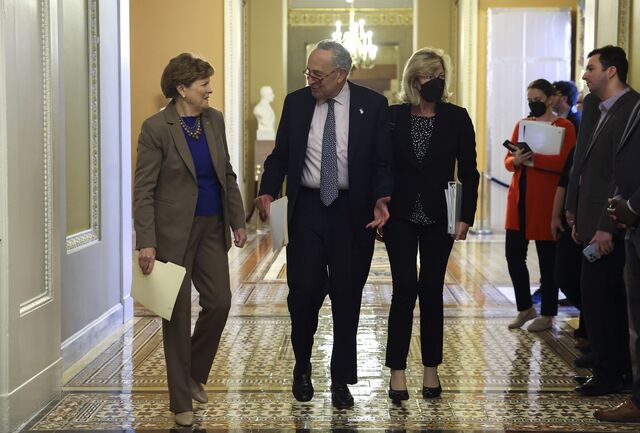
13 Senate Minority Leader Chuck Schumer, who has served in Congress since 1981, draws particular ire from frustrated Democrats over what they see as weak resistance to Trump. He faced calls to resign over his handling of the government shutdown, and Daily Show host Jon Stewart branded him a “human flat tire.”
Everyone has to make their own decision about what’s good for them personally.
For me, I thought it was time. By the end of my term, I’ll have served in elected office for 30 years at the local, state and federal level. It will be nice to have a little more flexibility to do the things I haven’t had a chance to, because of the demands of the job.
Will you leave office feeling that America’s place in the world is more uncertain, or more perilous, than when you entered the Senate in 2009?
I don’t think we know the answer to that yet. 14
14 In her nearly 20 years on Capitol Hill, Shaheen has witnessed a resurgent China, the rise and fall of ISIS and Russia’s invasion of Ukraine. And that was all before Trump’s second term. On the other hand, I think back to the early days of the Obama presidency, amid a global financial crisis and more than 175,000 US troops deployed in Iraq and Afghanistan. There was quite a lot of uncertainty and peril then, too.
What would you need to see to know the answer to that in the next few months?
I’d like to see the Democrats take back the House. I’d like to see that NATO has a very strong summit this summer. I’d like to see continued work with our allies and partners.
I will do everything I can to try and make all of that happen.

Mishal Husain is Editor at Large for Bloomberg Weekend.