
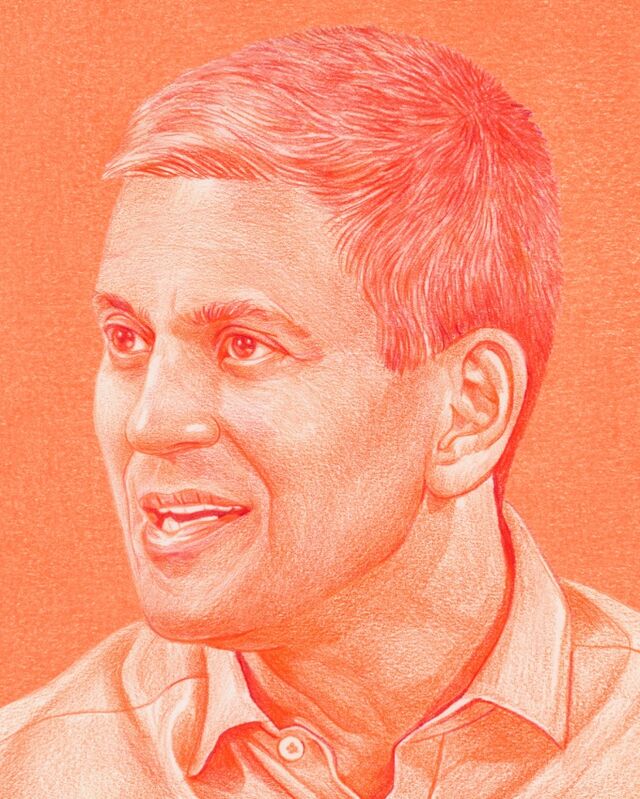
David Miliband Has a $1 Billion Budget Only for Crises
The head of the International Rescue Committee on facing up to today’s global conflicts, Trump’s plans for Gaza, and Keir Starmer’s problems.
Leading an international aid organization these days must sometimes feel like coming up against a brick wall. There’s the constant, painstaking work of documenting humanitarian need for current and potential donors, only to face the reality that powerful governments are cutting back on giving.
With an annual budget of more than $1 billion, the New York-based International Rescue Committee (IRC) is among the world’s largest humanitarian agencies. Its 2026 “Emergency Watchlist” cites 20 urgent crises — from Haiti to Sudan to Myanmar — and it has been led for more than a decade by David Miliband, a former UK foreign secretary whom some regard as the prime minister the country never had.
The IRC role gave Miliband new purpose after politics became deeply personal: His bid to lead the UK’s Labour Party ended in dramatic fashion in 2010 when he lost out to his own brother. Now Miliband sees his old friends and contemporaries back in power, but making decisions on foreign aid that he finds painful.
Our discussion took place in London, before the release of the Epstein files put Prime Minister Keir Starmer under extreme political pressure. But it ranged far beyond Britain, from geopolitical realities to leaders he has known — his former boss was Tony Blair — and Miliband’s own heritage.
This conversation has been edited for length and clarity. You can listen to an extended version in the latest episode of The Mishal Husain Show podcast.
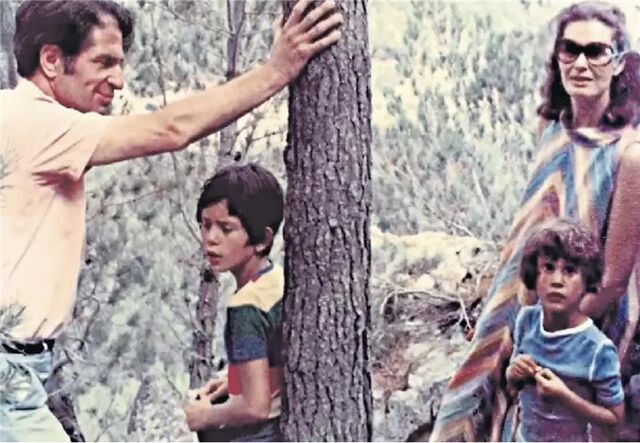
I found myself thinking about your parents — both from Jewish families, both born in areas of Europe occupied by the Nazis — and the connection to the work you do today. When was the moment you became aware of how differently they grew up compared to you?
From an early age. My dad’s family story involved a lot of trauma and tragedy, but he came to the UK in 1940 [as a] 16-year-old.
On my mother’s side, she found it much more difficult to talk about. In fact, she didn’t talk about it. She lost her father in a concentration camp, and her mother sent her as a 12-year-old to the UK in 1946 on her own. I think that for her, the trauma was too great.
When I went to apply to be the CEO of the International Rescue Committee, I said my parents were both refugees. So I felt in some way, I was closing a circle — helping people whose circumstances I could relate to through the experience of my parents.
She named you after her father, your murdered grandfather.
Yes, he was David Kozak. In 2016 I got an email from a voluntary society in southwestern Germany saying, We’re convinced that we’ve located records that show your grandfather was brought [to Hailfingen-Tailfingen concentration camp] from Auschwitz in November 1944, and was killed in January 1945. So I was able to go with [my] brother, my mother and her sister to finally, 70 years later, mark the loss of her father.
How did you feel standing there?
I felt the weight of terrible trauma. You just think, There but for the grace of God, really. It’s a feeling of emptiness on one side, and fortune on the other.
Also — January 1945. [As] camps are being liberated elsewhere.
It’s obviously far from the only story of this kind.
Do you think about this heritage when you come face to face with people in desperate situations?
You don’t need family heritage to bond with [a] person. There is one element though. I grew up in a middle-class family in the 1970s and 1980s. We lived in a democratic country. With all that’s going on in the world today, suddenly the period 1945 to 2026, in Western Europe, doesn’t look like the norm — it looks like the exception.
It’s a narrow corridor — the one between a state that’s too strong and dictatorial, and a state that’s too weak and you’ve got anarchy. I was lucky enough to grow up in this narrow corridor.
I found myself reading back a speech you gave in 2007, when you were British foreign secretary. You say there are “fewer countries at war than ever before… more trade, more travel, more connections between people… aspiration unleashed.”
[Laughs] Oh goodness. It was still [an] optimistic time. It was before the financial crisis. It was after the really difficult problems in Iraq. 1
1 By summer 2007, Iraq still saw around 30 bomb attacks a day. However, Miliband expressed cautious optimism when visiting Baghdad in 2008, and signaled the UK’s intent to reduce its troops deployment around Basra in the south of the country.
It was after Vladimir Putin’s Munich Security Conference speech in February 2007, when he said the collapse of the Soviet Union was the greatest catastrophe of the 20th century. So the drums were beating, but there was still a sense of a tide of history.
You had the enormous wave of democratization of the 1990s, the release of Nelson Mandela and the end of apartheid. The global system had just united behind the idea of the responsibility to protect if states were oppressing their own citizens. State sovereignty was a foundation of the international system; so were human rights.
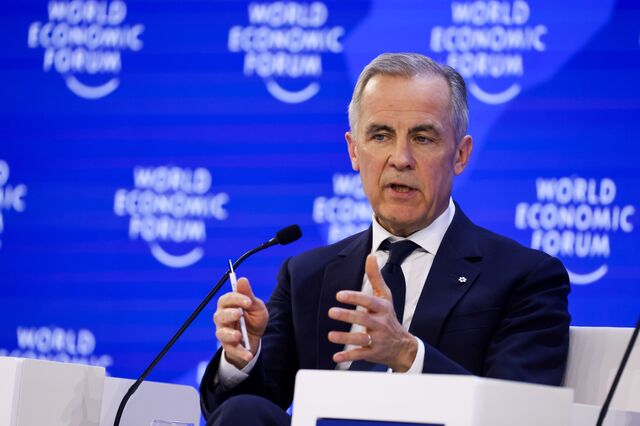
I wonder whether you think Canadian Prime Minister Mark Carney was right when he talked at Davos about the rules-based order being partially false — that there were always exceptions. 2
2 In a widely cited speech delivered as President Trump was stoking concerns over Greenland, Carney spoke of “a rupture in the world order, the end of a pleasant fiction and the beginning of a harsh reality.” His Weekend Interview last October now reads like a rehearsal: Carney told me we’re “in an economic crisis. It’s a fundamental shift in the world. It’s not a transition, it’s a rupture.”
It was a very significant and very important speech. You use the word “exceptions.” I think that’s probably generous.
I wrote a piece in Foreign Affairs two and a half years ago, which said the Ukraine war had united the West, but divided us from the rest. The rest saw the emphasis on territorial integrity [and] sovereignty as being honored in the Ukraine case, but not in enough other cases.
I still think the idea that, alongside the rights of states, there are rights of individuals — which was the essential lesson that the post-war pioneers took from the interwar period — [is] an important lesson.
The elephant in the room in this conversation is the United States. That is the big change, isn’t it, in the last year?
It’s not the only change [but] it is the biggest change yet.
The US was the anchor of the global system. [That doesn’t mean] it got everything right, but it was the anchor — and the anchor’s being pulled up.
Do you have anyone in the Trump administration that you speak to?
We talk to people in and around the administration, but I don’t want to exaggerate it.
I think there’s a very strong feeling they’ve got a mandate for what they self-describe as a revolution in America’s role in the world, where they want to think globally in economics, but not in politics. They’re going to think about the Western hemisphere. Their message is, Get used to it.

Get the Bloomberg Weekend newsletter.
Big ideas and open questions in the fascinating places where finance, life and culture meet.
By continuing, I agree to the Privacy Policy and Terms of Service.
What can you say in response?
I make the case that it’s in the strategic interest, as well as the moral interest, to address crises. 3
3 Miliband has his work cut out for him. At a February 2025 House Foreign Affairs Committee hearing on “The USAID betrayal,” Republican Representative Brian Mast mentioned Miliband’s seven-figure pay at the IRC — which received grant funding from USAID — as an example of “the theft, the larceny that is going on” at the agency.
You have worked with previous administrations. A lot of that was around people coming across the US-Mexico border. What do you think of the way that ICE [Immigration and Customs Enforcement] has been behaving?
We’ve been a major partner of the US government on refugee resettlement. That’s been stopped. That partnership is over. We serve asylum seekers and migrants who’ve crossed the border. We’re in 17 states, but not in the state of Minnesota, so I can’t speak to the details [of events in Minneapolis].
What I know from the people we serve, and the people we employ, is that they’ve fled real danger. That’s how they’ve got their asylum claim processed and been given the right to work. They are living with a question mark about their own status and whether or not their own story is going to be believed. That creates a lot of fear. 4
4 According to ICE data, as of late January more than 70,000 people are currently in detention, up from around 40,000 a year earlier. Of those, around half have no criminal conviction or pending charge, but were detained purely for alleged immigration violations.
Let’s talk about the places you’ve put at the top of your Emergency Watchlist: Sudan — a conflict in which more than 10 other countries are involved — and Occupied Palestinian Territory, a multi-generational conflict. Can you only deal with the immediate need, rather than find ways to end these?
Yes, in short. Remediation of desperate suffering is our business — health, water, sanitation, nutrition, livelihoods, protection of women from sexual violence, recovery of women from sexual violence.
We plead guilty to treating the symptoms. By treating the symptoms, I would add, you can sometimes prevent further destabilization down the road.
You go to these places, sit with people, and hear their stories. Be honest about how it feels to walk away — do you also feel relieved sometimes?
I want to spend more time talking to the clients — the people in need — and more time talking to our staff, who are often also in need. We’ve got 500 people working for us in Sudan; 485 of them are Sudanese.
I don’t want to sound cheesy about it, but the courage, the tenacity, the ability to laugh as well as to cry, that’s the most inspiring thing. Someone once said, If you look at the statistics, you get depressed. If you talk to the people, you have hope.
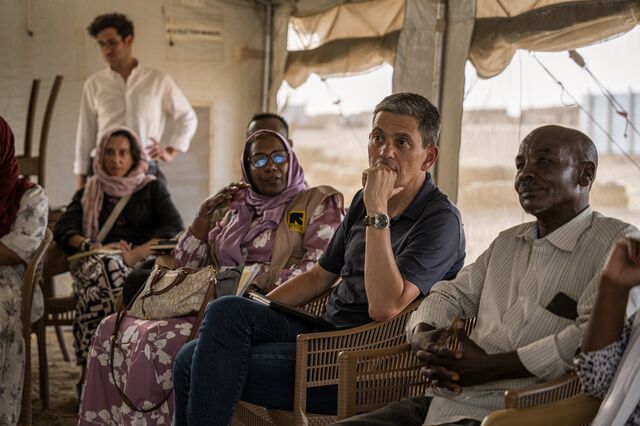
I’ve seen it as a journalist, but also know that privilege of being able to walk away. There are these moments which make you think, I can’t explain why my life is so fundamentally different. It’s luck of the draw. 5
5 There was one particular place I was thinking of here: the Rohingya refugee camp in eastern Bangladesh, where I traveled in 2018 for the BBC. I saw the makeshift conditions in which hundreds of thousands of people lived after streaming across the border from Myanmar the previous year, as well as abuse of the vulnerable.
It’s total luck of the draw, of course. So you can explain it.
Or can’t deal with it, maybe. Do you grapple with that?
You remember the stories. You feel the sense of tragedy.
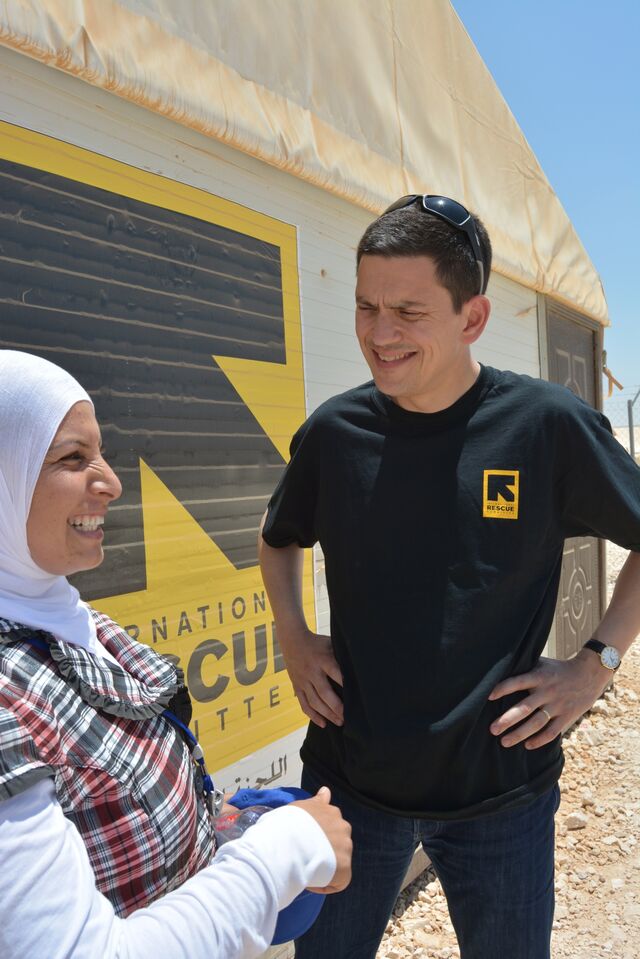
The first trip I did with the [IRC] was to meet Syrian refugees in Jordan. They wanted to talk to me. To cry in front of me. To tell their stories.
Then I said to them, Do any of you think you’ll go back to Syria? Suddenly, these beaming smiles came through the tears — the sense that they’d not given up. So what conceivable grounds did I have to [give up]?
Do you have any idea where that group [is] now?
A million people have gone back to Syria. I don’t know those specific ones, [but] there have been returns to Syria from Jordan.
I’ve struggled with not keeping up and following the stories of people.
That’s a powerful point. You do ask yourself what happened, and of course you don’t know.
The late Pope [Francis] said that the world was suffering from the “globalization of indifference,” which is a pretty serious charge. I don’t know if one’s allowed to argue with the Pope, but the sense I have is that people are struggling with how to make a difference, not that they’ve become indifferent.
Jared Kushner has set out his plans and his vision for Gaza. What do you think of it?
Well, it would be good if it could happen. We have a team of Gazans who are working for us. Their concern at the moment is a long way from what was on [Kushner’s] slide.
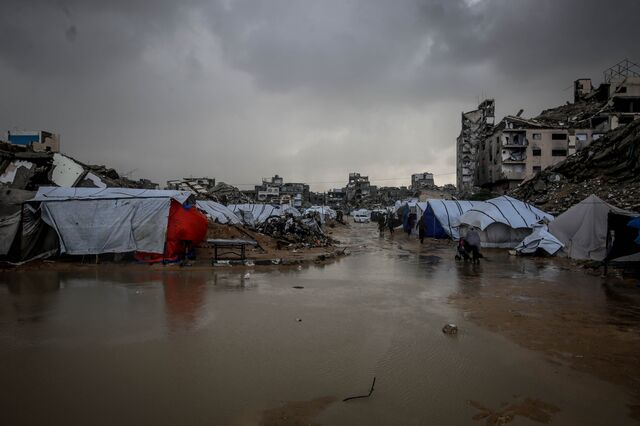
The fact there’s a ceasefire is a blessed relief and gives a chance to make inroads on the needs — although people are still being killed.
The aid deliveries are not yet reaching the level that’s promised in phase one of the plan that was published, and we need that. 6
6 Trump and Kushner’s “New Gaza” plan envisions hotel towers, housing, industry and leisure complexes, at an estimated cost of $70 billion. “Let’s just plan for catastrophic success,” Kushner said at Davos.
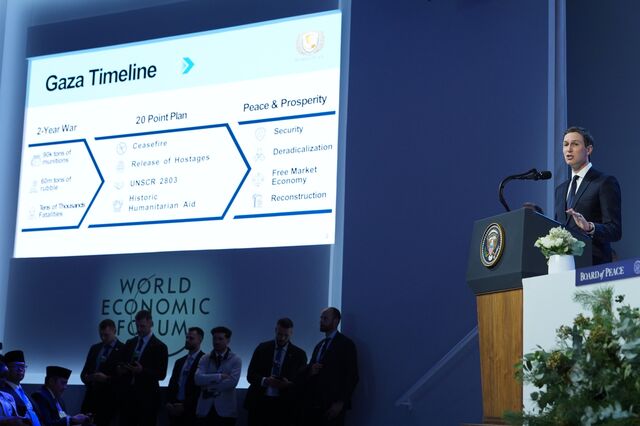
Kushner set out a coastal tourism zone with tower blocks and residential areas. Are you sure those are for Palestinians?
There’s obviously a very real concern that, at the moment, the Israeli Defense Forces are more or less down the middle of Gaza. West of the line is where the Palestinians are, east of the line there are very few. What was actually projected [at Davos] was for the whole of Gaza.
It’s got to be for the 2 million people who are living there now. The promise to them is that they will have a life that is wholesome and connected to the rest of the world and the rest of the Palestinian state. It’s so important to be practical about the distance from where we are today.
Given that so much is unknown, is it the right moment for Tony Blair to back the administration’s plans? 7
7 The former British prime minister said in January that he was honored to be appointed to Trump’s Board of Peace, and labeled the 20-point Gaza plan an “extraordinary achievement.” However, Blair has distanced himself from Trump’s demand for a $1 billion payment for permanent membership of the Board.
[Laughs] You [should] get him on your show. He’s more than capable of talking for himself.
I saw him briefly last week. He’s been committed for a very long time to the idea that there cannot be security for Israel unless there are rights and dignity and statehood for Palestinians — and there cannot be statehood and dignity for Palestinians unless there is security for Israel.
I say to him every time I see him, This is what we’re seeing today. He says, I’m on it. I want to hear it. I want to be on it. That’s the truth.
But you need to get him on your show. He’s got talent that guy. He’s got a future ahead of him.

He is on the Executive Board of the Board of Peace, which feels like an alternative to the United Nations. Is it? 8
8 Speculation about Trump’s wider intentions for the Board were fueled by its draft charter not mentioning Gaza. Vladimir Putin was among the leaders invited to join, though he’s still deliberating. Argentina, Hungary and Turkey accepted, while the UK and France declined — the latter citing concerns about the future of the UN.
Well the Gaza element of it was mandated by a UN Security Council resolution.
I think we need a stronger UN, not a weaker UN. The UN is only as strong as its member states allow it to be. The gridlock in the Security Council since the [2014] Russian invasion of Crimea has undermined that institution. But it’s still got unique legitimacy and credibility. If the American anchor has been pulled up on the global system, we need to put out more buoys to stabilize the boat, and the UN is an important part of that.
Do you think the US is trying to circumvent it by setting up the Board of Peace?
I have to stick to my lane.
USAID has been shut down. In the UK, a Labour government — run by people you know well — is choosing to fund its defense pledges by taking money from the aid budget. What did you think when you saw that last year?
I didn’t like that, obviously, and I said so.
The needs on our watch list are growing, but there’s been a 50% cut in humanitarian aid in the last year.
I’ve had to figure out how [the IRC remains] on the front foot. We’re focused on the role of the World Bank, because [it] has a critical role in fragile and conflict states where disbursement is difficult. We’re focused on the European Union, which has not cut its aid budget running to 2028, and they’re increasing the budget 2028-35. 9
9 The IRC’s operating revenues surpassed $1.5 billion in 2024, but it was forced to cut its budget by $400 million last year, largely due to US funding reductions. A Feb. 2 study in Lancet Global Health calculated that if severe defunding of aid continues, the world could see 22.6 million extra deaths by 2030.
These are your friends in the UK government who are making these decisions. Sum up your emotions. Disappointment?
Yes.
Disgust?
No. They don’t pretend that this is a choice they wanted to make. They do it in sorrow rather than in glee.
And to keep the Americans happy because the defense spending pledge is important?
I think the defense pledge is driven by the actions of Russia more than the actions of America.
There’s still an issue [of] how much of the so-called overseas aid budget is going to support for refugees in the UK.
Too much?
10 In the UK, the government plans to shrink overseas aid from 0.5% to 0.3% of economic output by 2027 to cover an increase in the defense budget. Of the aid budget, roughly one-fifth is being used to pay for housing refugees and asylum seekers in the UK.
As you look at the Labour government now, 18 months after getting elected, what is your analysis of what’s gone wrong for them? 11
11 Nigel Farage’s right-wing populist Reform UK has topped the polls since April 2025, while Labour recently slipped behind the main opposition Conservative Party for the first time since its election in July 2024. The left-wing populist Green Party has also surged in popularity.
It’s not all gone wrong. It’s been a very challenging period and there have been mistakes made.
I think that the world has changed very fast since [Labour] wrote their manifesto. When the world changes, you have to change, and that’s the process they’re undergoing at the moment. They’re going to have to amp up the dosage on some of the interventions [in] areas like Europe.
To get closer to Europe?
Much [closer]. And they’re going to have to explain what they’re doing.
When I was in politics, people used to say, If you’re explaining, you’re losing. If you’re not explaining, you’re not on the pitch. There’s work to be done, but I know them to be high-integrity, very methodical, quite self-critical, and very determined.
Would you guard them against having an agenda set by Reform UK on issues like immigration?
I’ll confess to being an Arsenal supporter, and Arsene Wenger once said his philosophy of management was: Never set your game plan by what you think the opposition are going to. The Arsene Wenger answer would be: Don’t take your agenda from Reform; take [your] agenda from the people you’re trying to serve.
Nigel Farage could be the next prime minister of the UK. Would a new leader make a difference to Labour’s fortunes?
[Laughs] I’m not going anywhere near that. We’ve got a Labour leader. He won a general election with [a] majority of 145.
What did you think when they blocked [Manchester Mayor] Andy Burnham from running as an MP? 12
12 Since I spoke to Miliband, the pressure on Starmer’s leadership has only increased, after further details emerged about links between his former US ambassador, Peter Mandelson, and Jeffrey Epstein. Mandelson was effectively the UK’s deputy prime minister for part of Miliband’s tenure as foreign secretary. It now appears that he was leaking sensitive government information to the disgraced financier.
I wouldn’t have done it.
Why? Because it creates bad blood?
No — he’s a talented leader, and you want your talented people on the pitch scoring goals.
You care deeply about your party and your country. I wonder where you see [as] home?
Home is [in the UK]. I still sound like an Englishman in New York. I feel very committed to this country. It’s given my family everything.
So has America felt like home? Your sons were born there.
Our kids were born there [and] adopted there. 13
13 In 2010, Miliband opened up about the adoption process: “Everybody’s first reaction when you talk about adoption is, How could somebody ‘give away’ their children? But actually when you meet the people and understand what it is, you realize that they are doing something of incredible love and sacrifice, not of abandonment.”
I first went to America in 1977 as a 12-year-old for a year with my family. The country’s an extraordinary place. It’s a teeming, thriving, driving, ambitious place.
And seductive? I would say it’s very easy to become attached to it.
It’s sincere. They’re sincere when they swear at you in New York.
What do you think your next job will be?
I want to make sure I’m doing something that does the maximum to advance things I believe in — consistent with the absolute loyalty and commitment I made to my family to be there for them.
I feel very lucky to be leading the International Rescue Committee and grateful they’ve put up with me.
Is there something in politics that you yearn for — that kind of power?
You have more power in government, but you have more blockages on doing anything about it.
If you’re in an NGO, you see the people. The danger is you lose sight of the big picture. Doing my job, 34 million people last year got help. Did I transform their lives? Not necessarily. Did our teams give them a chance in life? Yeah, they did.
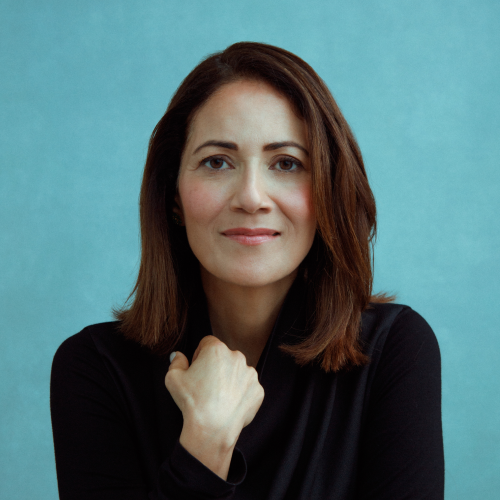
Mishal Husain is Editor at Large for Bloomberg Weekend.