During an all-hands meeting at Apple in January, an employee asked about a spate of executive moves. The company’s chief operating officer recently retired, the chief financial officer and general counsel took smaller roles as a way to prepare for their own retirements, and in a single week in December its heads of artificial intelligence, user interfaces and environmental initiatives all announced their departures.
While part of the exodus was related to Apple Inc.’s well-documented struggles in AI, it also reflected a logical transition at a company that turns 50 on April 1. Apple stock has made everyone at the top of its org chart fabulously wealthy, and many are entering the stage of life that often inspires people to prioritize finally spending some time with their families instead of the next generation of iPhones. In his response to the employee’s question, Tim Cook, the company’s 65-year-old chief executive officer, struck an atypically reflective tone. “When people get to a certain age, some,” he said, “are going to retire,” letting the word “some” hang out there in a way that suggested he wasn’t talking about himself, drawing laughter from the audience. “The thing we have to do is make sure that Apple moves on” and reaches the “next level and the next level and the next level.” Cook added that he spends “a lot of time” thinking about “who’s in the room” in 5, 10 and 15 years. “I am obsessed with this.”
Cook, who’s run Apple since taking over from co-founder Steve Jobs in 2011, probably doesn’t expect to be in the room himself for another 15 years. While he’s given no indication of an imminent transition, he’s made it clear he wants his heir to come from within the company so he can serve as a mentor. The central candidate is John Ternus, senior vice president for hardware engineering, who oversees development of the devices that generate roughly 80% of Apple’s revenue. At 50, Ternus is also younger than many of the company’s other senior leaders, meaning he could be in the top job longer.
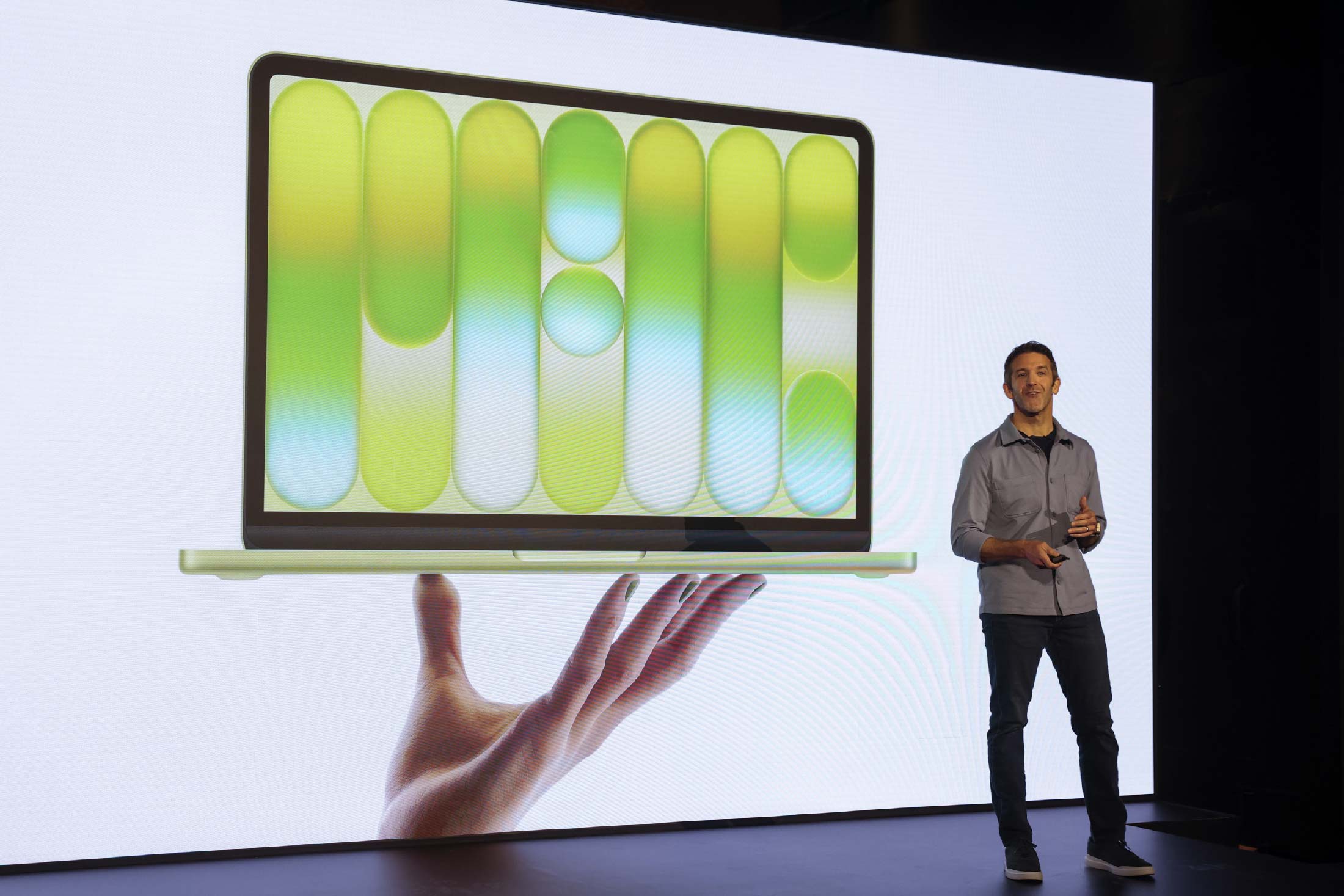
Ternus has spent about half his life at Apple. He cut his teeth developing computer monitors, oversaw product design for the original iPad and eventually took over development of the Mac. Since getting the top hardware engineering role in 2021, he’s overseen an expansion in Apple’s product lineup, improving quality and focusing on functional improvements around battery life, performance and connectivity. Earlier this month, when Apple held an event in New York to announce the MacBook Neo, a $599 laptop, it was Ternus, not Cook, who did the big reveal. The next day, Ternus also appeared on Good Morning America to talk up the device, the type of media appearance Cook has generally done himself.
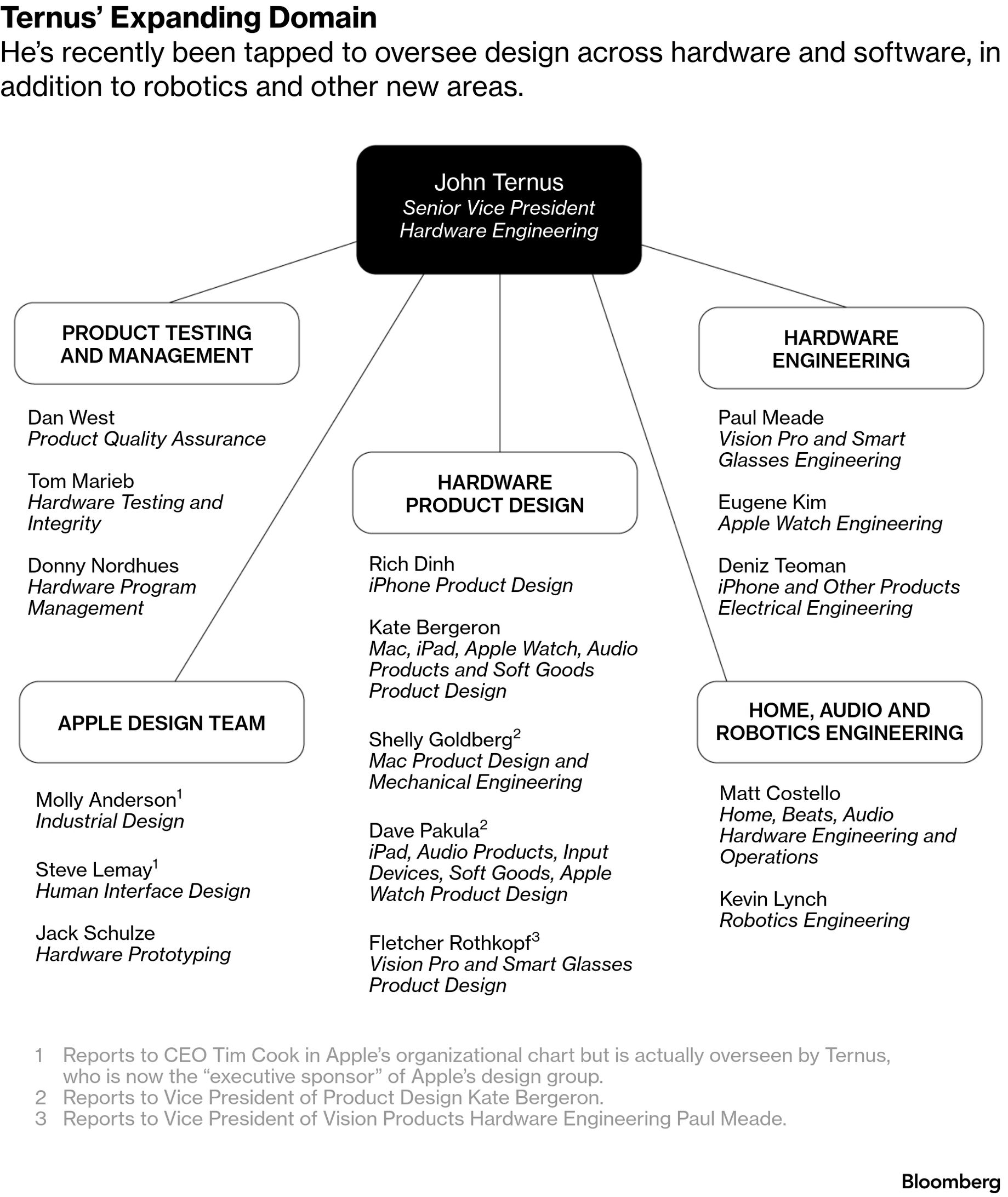
Such public signs of confidence in Ternus have been accompanied by a steady expansion of his portfolio. Last year he took control of a secretive unit developing robots, including a tabletop device with a screen that swirls to focus on a speaker moving around the room during a FaceTime call. (It’s slated for release as early as next year.) He has taken a bigger role in Apple’s product marketing, sometimes personally editing copy for the website and product event materials, and has become central to the company’s work to make its devices more environmentally sustainable. Ternus has also assumed oversight of the hardware and software design teams, making him the key liaison between Apple’s vaunted design organization and senior management—meaning he’s already one of the most influential people in the company’s history.
Ternus’ Expanding Domain
He’s recently been tapped to oversee design across hardware and software, in addition to robotics and other new areas.
Current and former employees and executives who’ve worked closely with Ternus, most of whom requested anonymity to discuss the inner workings of a famously secretive organization, say he has made a mark on Apple’s hardware portfolio, reversing a trend of declining product quality as the company prioritized thinness and sleekness over performance. “He is a very meticulous engineer and a judicious executive,” says Tony Blevins, the company’s procurement chief until 2022, who describes Ternus as an “outstanding and obvious choice” to succeed Cook. Apple declined to comment or to make Ternus available for an interview.
Ternus, known for his steadiness and political acumen, is well-liked among Apple’s leadership. He’s won the support of multiple members of Cook’s senior staff, many of whom have acknowledged Ternus is most likely to become the next boss. Co-workers describe him as a good communicator who empowers employees, a management style that echoes Cook’s. A cycling and car-racing enthusiast, Ternus is known to take his colleagues to upstate Washington for off-road rally car racing. His love of motor sports notwithstanding, Ternus, like Cook, is risk averse and reluctant to, as one person close to him puts it, “upset the Apple cart.” As one longtime executive says: “If you think Tim Cook’s doing a good job, then you’ll think John Ternus is going to do a good job.”
The main case against Ternus may be that Apple needs someone more willing to shake things up. Although its products helped define the past 50 years of consumer technology, thriving for another 50 will inevitably require the company to transform in ways that aren’t entirely clear today. On AI, Cook’s successor will likely inherit a company that’s fallen behind competitors.
Ternus has yet to prove he can shepherd a truly new class of products to market, or push the company into its next growth phase. He’s also been criticized for not doing as much as previous hardware chiefs to implement breakthrough technologies. During a 2023 television interview, Ternus also laughed off the idea that Apple should worry about being late to generative AI. When Apple Intelligence, the iPhone maker’s take on modern AI, came soon after, it was such a disappointment that some industry watchers began calling for Cook’s job. Almost two years later, Apple has failed to introduce any competitive AI services. It has several times delayed the release of a more capable version of Siri, which will, somewhat embarrassingly, depend on technology from Google.
Apple’s devices have AI-processing capabilities thanks to the strength of its hardware teams, but the most exciting AI software features are coming from apps made by OpenAI, Anthropic, Google and others. Ternus recently defended Apple’s AI work while acknowledging some people think the company is behind. “If we’re doing it right, people won’t even necessarily notice or think about it,” he told Good Morning America.
Ternus knows he needs bolder products and a strong approach to AI, a person close to him says. He’s been leading work on a set of unreleased AI-powered home devices, as well as wearables—such as glasses, AirPods and a pendant—equipped with cameras that use computer vision to understand their surroundings. He’s been a proponent of the development of a nearly 20-inch-wide foldable iPad, which could either represent the future of laptops and tablets or end up as a wacky experiment that never sees the light of day. Ternus is also overseeing the biggest set of iPhone revamps in the product’s history, including a foldable model this year and a version with an edge-to-edge screen that could arrive as early as 2027, for the device’s 20th anniversary.
More Than Just iPhones
Apple’s revenue by segment
Source: Bloomberg
Note: Financial years ending in September
It’s not yet clear what kinds of AI-forward devices will catch on—other companies have released some big flops—and Apple faces formidable competitors including Meta Platforms Inc. and OpenAI. Still, such hardware projects could play to Apple’s strengths, as well as Ternus’. “He’s the only person on the executive team with a track record of delivering integrated hardware-software products and an age that gives him runway,” says someone familiar with the candidates. He’s the best choice, this person says, if Apple intends to maintain the strategy it’s used for the past half-century to become the world’s leading consumer-electronics company. But “if Apple is shifting to more software, services and cloud, and less hardware,” this person says, “that justification becomes a lot less strong.”
Whereas Jobs was a product innovator and Cook is a supply chain genius, Ternus ensures the gadgets are actually developed. He came up through the product development ranks and deeply understands the work that goes into it. He’s highly technical, often drilling into tiny details in meetings, and he likes to say Apple’s culture is based on hiring engineers who will push past the boundaries they are given. This could make him a much different CEO than the last two. “If the customer was going to see it, Steve needed to see it, down to the icons,” says a longtime Apple executive who worked with all three men. “Tim doesn’t participate in the product development.” Cook focuses more on supply chains, strategy and financial performance. Ternus, this person says, “is a real engineer.”
Before taking on his current role, Ternus distinguished himself by overseeing the expansion of the iPad line with new models, as well as shepherding development of the AirPods and the company’s first 5G phones. In 2021 he replaced Dan Riccio, his mentor, as hardware chief. While Apple’s hardware and software teams have a history of infighting, they’ve developed a symbiotic relationship under Ternus’ leadership. His close partnership with Craig Federighi, senior vice president for software engineering, helped the company get through a contentious period early in Cook’s tenure. His ability to coordinate close work between Apple’s hardware and software teams was also pivotal to its ability to transition the Mac from Intel Corp. chips to its own processors, and to release new types of products, such as iPads with OLED (or organic light-emitting diode) displays.
In the early days of the iPad, Ternus argued the device’s hardware capabilities weren’t used to the fullest because its software platform—the same as the iPhone’s—wasn’t taking advantage of the tablet’s more powerful processor and bigger screen. He pushed internally for a new operating system and eventually persuaded Federighi to build it, enabling features such as desktoplike multitasking that make the iPad more appealing for productivity. Ternus was also instrumental in creating iPad accessories such as a stylus and keyboard, as well as their magnetic charging and pairing systems.
There have been some notable stumbles too. Ternus was a driving force behind the Touch Bar, which replaced the top row of physical keys on MacBook Pro keyboards with a touchscreen. “He shoehorned it in, arguing it was something different, a good marketing idea,” says someone familiar with the work. It failed to gain traction, and Ternus killed it. His next typing fiasco was known as the butterfly keyboard. It was intended to enable thinner devices but was uncomfortable to use and noisy, and it performed so badly that it led to class-action lawsuits, including one Apple settled for $50 million.
Ternus’ relationship with the industrial design team, which came up with the ideas for both the Touch Bar and the butterfly keyboard, has been strained at times. His Cookian eye for cost-cutting can conflict with the designers’ disregard for cost. Before Riccio left his role, some top designers advocated that he be succeeded by Tang Tan, then the company’s head of product design for the iPhone and Apple Watch. (Tan is now hardware chief at OpenAI, which employs many former Apple designers.)
Despite his reputation for personable management, Ternus has at times broken with that style in ways that raised eyebrows internally. Late in the lead-up to the release of the Vision Pro headset, for instance, engineers uncovered a flaw that threatened one of the device’s marquee features: the ability to stream ultralow-latency audio from the headset to AirPods, a capability central to Apple’s pitch of a seamless experience for immersive video and gaming. The problem stemmed from a missing wireless frequency in the then-newest AirPods Pro. The only practical fix was to ship a revised version of the earbuds, which the company did at the end of 2023. That meant that anyone who wanted this feature on the $3,500 Vision Pro, released in February 2024, had to spend another $250 on new AirPods that added the ultra-low latency support and not much else.
The debacle reverberated through multiple teams, including hardware, software, testing and the Vision Pro group. People involved say Ternus alienated some people on staff by focusing initially on finding out whom to blame. In the aftermath, a senior AirPods executive was reassigned. The episode, one person says, “ran through the social fabric of the company.” But the incident also stood out in part because it was an outlier under Ternus’ leadership—a throwback to the department’s cutthroat culture before he took over. In general, “Ternus looks at mistakes as systematic problems that could be solved with better leadership instead of by putting the onus on engineers,” says someone who worked for him. Also, this person adds, Ternus is a “nice guy.”
If Ternus does take over for Cook, he’ll face much the same question Cook did when he took over for Jobs: Can Apple find its next megahit device? When the company has taken swings at big new product categories in recent years, Ternus has often been in the conservative camp. He was circumspect about Apple building a car, fearing it would distract the company, drain profits and pull engineers from core products. He was similarly wary of the mixed-reality headset that became the Vision Pro, drawing on his experience of trying to create a virtual-reality head-worn device at a startup in the 1990s. In both of those cases his skepticism was prescient. Apple eventually killed the car, and the Vision Pro has been a bust.
Ternus was also reluctant to invest too deeply in home devices a decade ago when the first Amazon.com Inc. Echo and Alphabet Inc. Google Home speakers arrived, because he believed the category wouldn’t be a profit driver. He opposed adding a camera and more advanced sensors to Apple’s original HomePod speaker, fearing it would push up development costs. The device failed to catch on, and Ternus has since taken some responsibility for Apple’s falling behind in the category. He’s now leading the charge on a trio of home products, including the robotic device dubbed J595, an AI home hub with facial recognition called J490 and a small sensor for managing home security known internally as J450.
Bloomberg News first identified Ternus in 2024 as the leading candidate to replace Cook, but the race to become Apple’s next CEO is far from settled, (The options, though, are limited by Cook’s preference to promote internally.) The most logical alternative would be Sabih Khan, another multidecade veteran, who recently became COO—the same job Cook had before he ascended. Executives have discussed the idea of Khan assuming responsibility for the sales division, which reports to Cook and did so before he became CEO, as a possible test for the larger job. Former COO Jeff Williams, who retired at the end of last year, was previously widely seen as Cook’s successor.
Cook seems content to leave everyone guessing. He hasn’t shared his retirement plans with even some of his closest lieutenants, many of whom say change doesn’t feel imminent. Still, they noticed when, early in the Covid-19 pandemic, Cook started showing up to videoconferences from a gigantic mansion in Palm Desert, a popular destination for retirees in Southern California. (He paid $10 million for the property in 2019.) These days, Cook is known to come into Apple’s offices in Cupertino most weekdays, even on Mondays and Fridays that many on-campus employees choose to work from home.
If a transition does happen while Donald Trump is still president, there’s the uncomfortable question of how Apple will manage that relationship, given that Cook has spent years wooing him. That responsibility likely wouldn’t fall to Ternus or any other successor, according to people close to the company. Many of Cook’s colleagues say that, even if he retires as CEO, he’d continue serving as Apple’s chief diplomat indefinitely.
While he may not be traveling to the White House with Cook, Ternus is spending much more time in the spotlight. Increasingly, he’s accompanying other executives on international tours, meeting with employees at far-flung offices, preparing for meetings with regulators and talking with the local press. He’s also introduced headline products such as the iPhone Air and served as a key face of the company when it released the iPhone 17 line. As Apple plans to throw itself an elaborate 50th birthday party at its headquarters in Cupertino, California, you can expect to see Ternus center stage.