
‘I Feel Like I Spent Half of My Life in This War’
Ukraine’s most famous writer, Andrey Kurkov, reflects on life under bombardment, fading solidarity and the risks of a hasty peace deal.
Ukrainian President Volodymyr Zelenskiy is under intense US pressure to hold elections and accept a peace deal with Russia within months. But in Ukraine, and among its allies, there remains deep skepticism that Russia is truly interested in a durable peace.
That tension looms over this weekend’s Munich Security Conference, where political leaders and defense officials are gathering amid growing uncertainty about the war’s trajectory and US resolve. Meanwhile, Ukrainians are experiencing a brutal winter in which attacks on energy infrastructure have left millions with no heating and intermittent power.
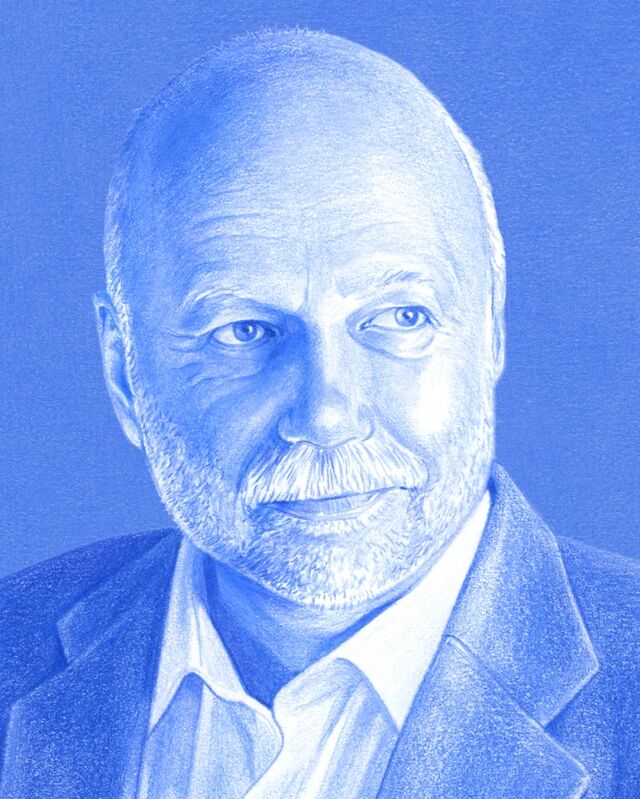
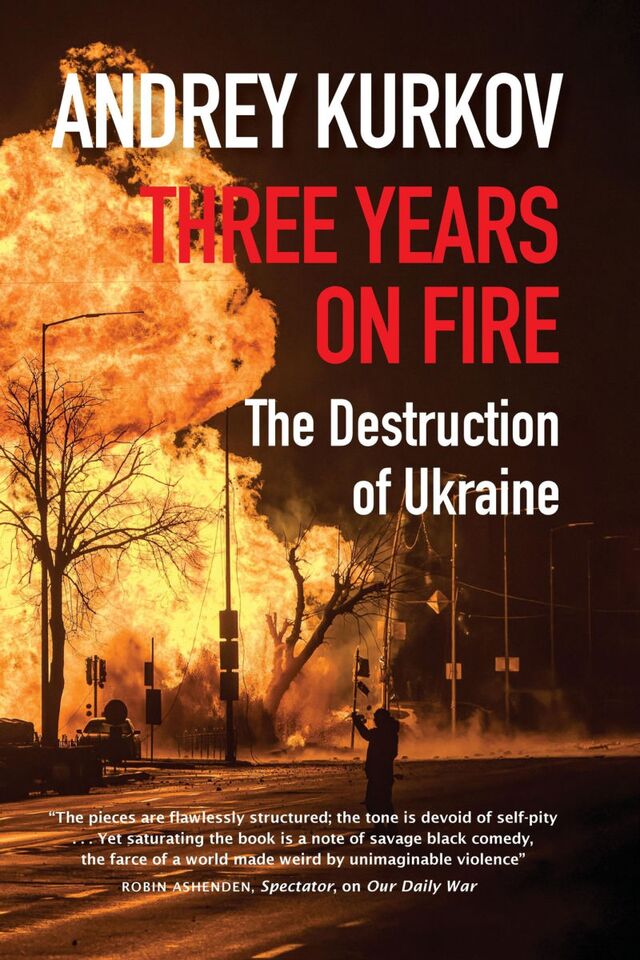
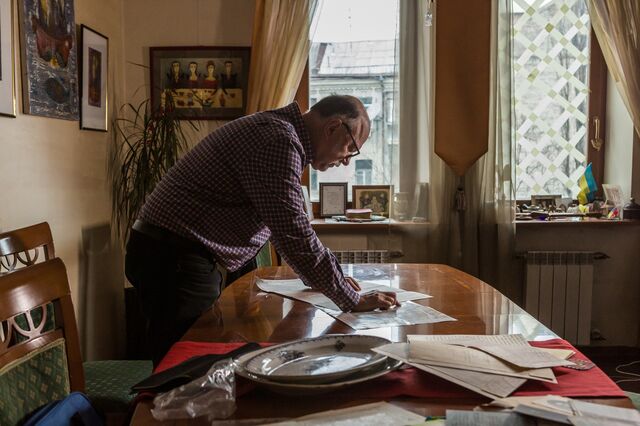
Celebrated writer Andrey Kurkov has lived that reality in recent months in Kyiv, his home city. Best known for his 1996 novel Death and the Penguin, set in post-Soviet Ukraine, Kurkov has also written extensively about the current war, publishing three volumes of diaries alongside his fiction. While he’s been determined to remain in Ukraine throughout the conflict, the present conditions have been hard to bear, and he spoke to me from a writer’s retreat in France. He plans to return to Kyiv in the spring.
This conversation has been edited for length and clarity. You can listen to an extended version in the latest episode of The Mishal Husain Show podcast.
What was your last day in Kyiv in mid-January like before you left for France?
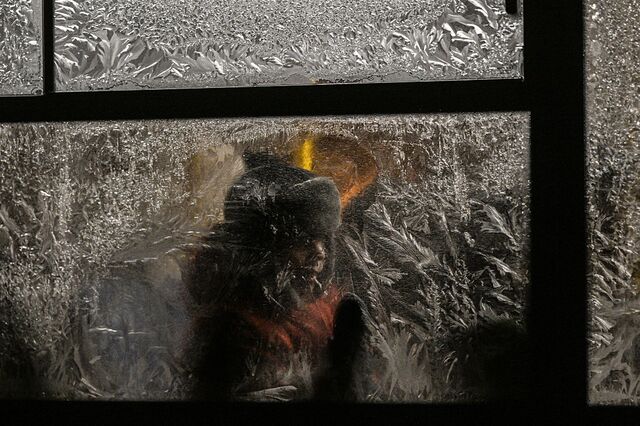
It was a very hectic day. We had almost no heating and there was no electricity. The temperature in our flat went down to 2C [35F].
We are used to not sleeping — listening to explosions and air alerts, and then in the morning having a lot of coffee, going to work, even theaters and cinemas in the evening.
[But] when we left, concerts were canceled because the venues were unheated. Cafes started including the price of [running] generators in the bill.
Could you write inside the apartment? Were your hands able to function?
It was impossible to write at home. I was writing mostly in the cafes, but this also became difficult. Not sleeping because of the explosions is a different thing from not sleeping because of the cold.
When you have three hot water bottles and big plastic Coke bottles filled with boiled water in your bed, I don’t think it is very good for your health. When the hot water bottles go cold, you feel it immediately.
Could you think about anything other than the need to stay warm?
I was thinking about springtime. Many Ukrainians are now not thinking about the war; they’re thinking about when the warmth comes back — when the cold is gone.
Lots of my friends are in Kyiv, and I did feel a bit guilty leaving — but if I stayed there, I wouldn’t be able to work properly. I would probably [still] be able to give angry interviews. [Laughs]
Thanks to Russia, [winter] became the main enemy. The winter allied with Russia. 1
1 This winter is Ukraine’s coldest in more than a decade, with temperatures in Kyiv falling to lows of -20C [-4F] and grim reports of elderly people and pets freezing to death. Russia’s winter offensive has turned these cold temperatures into a tool of war, targeting Ukraine’s power infrastructure and leaving millions without reliable heat. Kyiv Mayor Vitali Klitschko has estimated that 600,000 residents fled the capital in January.
I read what you wrote about the heroic plumbers, who work to repair the infrastructure.
We had cases of these people collapsing because they didn’t have sleep for three [or] four days. They were going from one accident to another. They had heart attacks and several died. You can consider them victims of the war — of Russian aggression — because they were saving civilians.
Can I ask you to remember February 2022? Nearly four years ago, as the full-scale war began. What does this anniversary represent?
I feel like I spent half of my life in this war.
There was much more despair then, than now. War became part of daily life. You never know who will be killed tomorrow, and you live [one] day at a time.
At the same time, it doesn’t make me sad. I lost the feeling of fear which paralyzed me when I heard the first explosions in Kyiv. This is life now. If you cannot stand it, you become a refugee. If you decide to stay, you have to ignore the fear — because fear stops you from functioning.
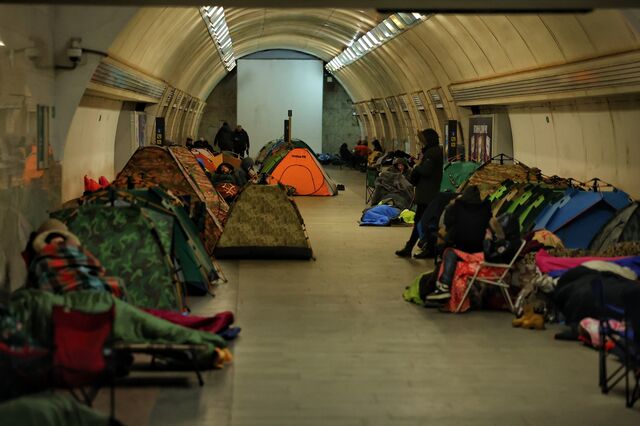
You learn new rules of survival. When you hear the air alert, you check if it’s drones or missiles, where they are flying, the chance they will hit the area around you. Then you decide whether you go in the corridor, the bomb shelter or the metro station.
I do wonder what you think has been lost in this period. Even if there was more despair in 2022 than there is now, this does feel like a particularly perilous moment. So when you think about the period ahead, are you fearful of what it will hold for Ukraine?
I am worried.
After the full-scale invasion, there was much more solidarity among Ukrainians. The nation was consolidated. We had one enemy. We managed to liberate the Kyiv and Kharkiv regions. There was some kind of faith that we can withstand — we can defend the country.
Russia Controls Swaths of Ukraine After Four Years of War

Now, we have Ukraine fragmented. [An] unknown number of people remain in the occupied territories. We don’t know what is happening to them. Some of them are happy to be under Russian rule. Some of them are not. We have soldiers on the front line. We have refugees abroad. We have displaced people who are extremely unhappy. We still have more than half of Ukraine living at home, but listening to the explosions and seeing neighboring houses in flames and now without heating.
These Ukrainians should be reconnected after the war. It can be done only if all democratic countries unite to help Ukraine be reconstructed. 2
2 Russia is “paying an extraordinary price for minimal gains,” according to a recent analysis by the Center for Strategic & International Studies, which also estimated that the two sides’ combined casualties could reach 2 million by the spring of this year. Russia’s economy is also starting to fracture as a result of war spending and despite massive fiscal stimulus.
Over these four years, you’ve become much more of a journalist, commentator and interpreter of Ukraine to the outside world. For a while you found it hard to write fiction. I know it’s returned to you, but do you miss your old life? When you could devote yourself more fully to your imagination, rather than the real world?
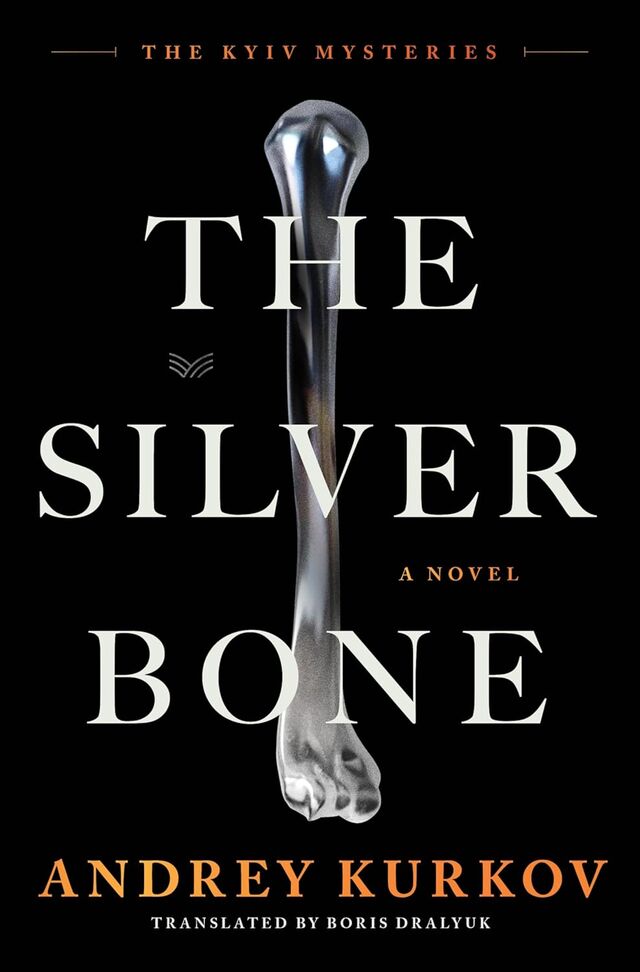
Yes, definitely. Psychologically, I suffered a lot when I couldn’t continue the novel about Kyiv in 1919 — which was finally finished in November 2024. 3
3 The book is part of Kurkov’s historical crime series, The Kyiv Mysteries, inspired by a trove of KGB documents he received from a friend. Kurkov’s fictional detective loses his right ear, but the ear retains its ability to hear. In this way, Kurkov’s style reminds me of our Weekend conversation with Salman Rushdie: Both men draw on the absurd, and write with a keen sense of place — Kyiv for Kurkov, Mumbai and Cambridge in Rushdie’s most recent book.
When you say that you couldn’t finish the novel, was that [in part] because it felt indulgent to retreat into your fiction?
It [was] a sinful thing, because writing fiction is a pleasure. Writing nonfiction is a duty.
The main reason was that I couldn’t get distracted from reality. I was following the news. I was following stories of friends, relatives, neighbors and people I never met before. I was part of the war.
When you write fiction, you have to be able to [get] away from reality for several hours a day, and then return by the end of the working day. This was impossible.
What’s your assessment of the war? Who’s winning?
Nobody’s winning. I don’t see winners here.
I think Trump wants to be a winner — but he’s not a peacemaker, he’s a business dealer. He wants to have a business deal with Russia, and Ukraine is an obstacle.
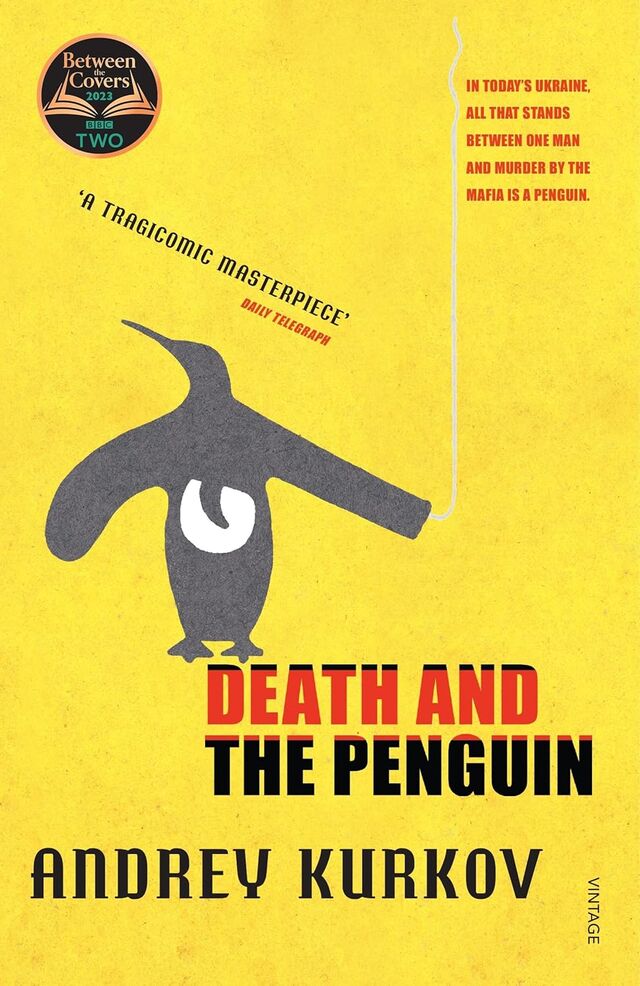
You grew up in the Soviet Union. You’ve seen a big moment of transition earlier in your life and wrote about it — it was the backdrop to your novel Death and the Penguin. Are these moments, in all their extremity, where you find inspiration?
Yes. It’s probably my destiny, and the destiny of most Ukrainians, to live through tragedies. But this time actually, Ukrainians are fighting; they’re defending their land, they’re defending their freedom.
I don’t think there will be any easy time in the near future, so we as Ukrainian writers have to describe everything we witness and look for historical parallels. 4
4 Kurkov was born near what was then Leningrad in 1961 and continues to write fiction in Russian, while choosing Ukrainian or English for nonfiction and journalism. Death and the Penguin was an international bestseller, capturing the chaotic and often lawless reality of the former Soviet Union in the 1990s. Having lived in Moscow in 1992, I found it very evocative of that period, when people had to be inventive and discover new ways to survive as the system they knew disappeared.
I know your parents moved from Russia to Ukraine. You are an ethnic Russian. Russian is your mother tongue. Are there friends in Russia who you lost because of having different opinions on this war?
I lost them during [the] Orange Revolution. 5
5 When Putin-backed candidate Viktor Yanukovych declared victory in fraudulent Ukrainian presidential elections in 2004, protests erupted, ultimately bringing pro-Western politician Viktor Yushchenko to power. Yanukovych remained in frontline politics and was elected president in 2010, but he was deposed in 2014 and fled to Russia.
That was the moment when Ukraine started to assert a more European identity.
Yeah, it was 2004–2005. [There were] already signs that Ukraine would never go back to the Soviet past, or to a Russian authoritarian system.
What did you think as a young man, seeing the Soviet Union come to an end? Did you have a vision of Ukraine as an independent, sovereign nation?
I naively became very optimistic. I thought, Ukraine is much smaller than Russia. It’ll be much easier to make Ukraine a civilized European country [with] democratic values and rules.
Of course, these hopes of mine were crushed by the first post-Soviet years because we had a mafia-run state with huge inflation. I remember that my parents were afraid to leave the apartment in the first weeks after the collapse. The country was changing.
I have a feeling that I’ve lived in five or six different Ukraines since 1991. I don’t know which Ukraine we will come back to after the war. It will be another Ukraine — very different, with lots of dramatic stories.
Do you feel that you have been changed by these four years?
Everybody was changed.
I stopped valuing material things. I was always a collector — stamps, old coins, ancient newspapers, old vinyls and gramophones. Suddenly all of that became useless and not important.
Before the war, I couldn’t write violent scenes, I avoided blood. Now, it is very easy for me to describe violent situations, because violence became a normality.

Get the Bloomberg Weekend newsletter.
Big ideas and open questions in the fascinating places where finance, life and culture meet.
By continuing, I agree to the Privacy Policy and Terms of Service.
Political figures from many countries are gathering for the Munich Security Conference. What would you say to them if you had a slot on that stage?
I would tell them to think about other measures to have an influence on Putin to stop this crazy war, to stop killing people by cold, missiles, drones [and] thermobaric bombs.
We are living in the 21st century. Russia prefers the Middle Ages. Putin will not stop unless he’s forced to stop.
To smile and say that we should try to find a common language with Russia doesn’t make sense. The only language Russia would understand is economic pressure, diplomatic pressure, military pressure — and solidarity, which is becoming elusive.
I don’t feel that the US government is supporting us. They want to put an end to the war for different reasons. Europe is now more involved, but we want more from Europe.
The latest we’ve heard from President Zelenskiy is that the US wants the war to end by June. When you hear those words, what goes through your mind?
That America will try to push Zelenskiy to accept the loss of territories — practically to accept capitulation camouflaged as some kind of peace deal.
Nobody talks about a just peace. Once unjust results of the war are legitimized [and] the seizure of neighboring countries’ land is accepted, we will continue seeing wars like this — whether it will be Russia or somebody else. 6
6 Kurkov is most likely referring to Crimea, seized by Russia in 2014, and Donetsk and Luhansk in the east of Ukraine. All three territories would have been recognized as Russian under a 28-point peace plan drawn up by US and Russian officials and obtained by Bloomberg in November. It’s worth reading — even though Ukraine quickly pushed back — as the language is deeply revealing of the pressure the country is under.
So would you want President Zelenskiy to stand absolutely firm in the face of pressure like that?
If Ukraine gives in, Russia will not stop. Putin will not stop. There will be a break of two or three years — or two or three months — and there will be another demand for Ukraine to give up more land, to accept becoming less independent [and] economically weak.
In the end, Europe will say: No, we cannot help you anymore because you are not really doing enough to defend yourself. Your population is not motivated [and] you are tired.
That’s a terrible picture. This will be a shrinking country, with shrinking freedoms and shrinking importance [in] the world.
How widely do you think your view is shared? There is some evidence from polling that because of the grinding nature of the war and harsh conditions, more people are coming around to the idea that giving up some territory might be a price worth paying.
Let’s define what it means to give up the territories. The idea that territories are not returned to Ukraine, but not turned into Russian territories — like a free economic zone — can be acceptable. 7
7 The US has suggested that any buffer area created by Russian and Ukrainian troops pulling back from the battlefield becomes a free economic zone in which businesses could operate and people could live and work under a special legal and tax regime.
Generally, 50-60% of Ukrainians still support Zelenskiy. I think he should be firm, and try his best to defend Ukrainian interests.
Do you still have confidence in him as Ukraine’s leader? I know you didn’t vote for him. But when you saw how he handled the moment of all-out war four years ago, you started to feel differently.
I think it’s my duty as a citizen to support the officially elected president in this situation.
I don’t know whether I will vote for him if he takes part in the elections after the war, but [right] now I think we should be consolidated around the existing power.
He didn’t show signs of weakness. He didn’t show readiness to compromise. He’s still defending Ukrainian interests.
How damaged has he been by the country’s corruption scandals?
Less than expected, but I have a feeling that he’s now alone.
I think this question of corruption in the top circles of the Ukrainian political elite will reappear after the war. 8
8 Zelenskiy’s chief of staff and chief negotiator, Andriy Yermak, resigned in November amid an anti-graft investigation. Corruption has been a longstanding problem and Zelenskiy’s attempt to seize control of Ukraine’s anti-corruption agencies triggered mass protests last year. “War is like a black box,” Finance Minister Sergii Marchenko said to me in a Weekend Interview. “People operate in a different reality, and I don’t know any other countries that don’t have problems with some mismanagement or corruption during war.”
When you are a citizen facing the hardships of war, and you learn that people are accused of embezzlement, how does it make you feel?
I’m very angry and upset. I don’t have much trust generally in the Ukrainian political elite. I remember when Ukraine was completely corrupt from the traffic police level. Yushchenko managed to get rid of this grassroots-level corruption, but corruption in the political [and] business elite remained. It is good in a way that we have these scandals regularly, because they show that this corruption is uncovered.
Do you still have confidence in European allies? They obviously sound very different to the US, but do you think that [support] could ebb away?
If you listen to the prime minister of Hungary, [Viktor] Orban, of course you will immediately become a pessimist. But we are listening to the politicians who are saying nice things and promising more help — that’s how we get our energy and relative optimism. 9
9 Orban has ramped up rhetoric opposing Ukraine joining the European Union ahead of Hungary’s April elections. He faces a fierce contest from opposition leader Péter Magyar, who is leading in the polls. While pro-EU, Magyar recently said he would not support a “fast track” of Ukraine into the bloc.
Of course, I understand there are limits. Time is the main question — how long the European Union can be supportive of Ukraine. The rise of extreme-right political forces and the possibility of the AFD party in Germany [winning] a majority is quite frightful.
Are you preparing yourself for another four years of this?
I hope that the war will be over this year or next year. This is my dream.
I was born 16 years after the end of the Second World War. I remember Kyiv didn’t have traces of war — everything was new. When [this] war is over, it will probably take another 10 years, maybe more, to remove the scars visible on the ground [but] not from people’s heads. 10
10 The World Bank estimated that Ukraine’s recovery would cost more than $520 billion over the next decade. In April last year, Ukraine signed a deal guaranteeing the US a share of profits from its natural resources in exchange for continued investment in its defense and reconstruction.
Society will probably be split [between] those who left and those who stayed. The number of collaborators and traitors is something that will be discussed after the war a lot.
What about your humor, and the nation’s humor? I know you’ve mentioned Ukrainians being able to find humor in ordinary situations, that soldiers were filming funny videos on the front line to try and keep morale up. Is that still the case?
Unfortunately, the soldiers’ humor was gone six or seven months [after the] full-scale invasion, but humor still plays an important role in society. It is used for psychological defense — as a medicine. Something that keeps you motivated and hopeful.
How do you keep your energy up, let alone your spirits, at a time like this?
My friends, my readers, my connection to the world, my desire to write, new ideas that I have. Coffee — I drink too much. [Laughs]
But I know a lot of people who are suffering — they have nobody to motivate them, they have financial problems. These people are weary. These people have no hope.
Is it part of your job to keep sharing hope, to the best of your abilities?
Yes. The main thing is not to share bad news. Unfortunately, many social network users in Ukraine love to share bad news. Things are bad, but when you share bad news, you are multiplying this feeling.
But where’s the good news these days? Is it in the individual resilience?
The fact that the Ukrainian participant of Eurovision was chosen a couple of days ago with a brilliant song; Ukrainian skiers are taking part in Olympic competitions; Ukrainian writers are in Paris reading their poetry. 11
11 Ukraine will be represented at this year’s Eurovision by Leléka, whose song “Ridnym” touches on the acceptance of fear, and of change. On Thursday, Ukrainian skeleton racer Vladyslav Heraskevych was disqualified from the Winter Olympics in Milan after refusing to stop wearing a helmet honoring athletes and coaches killed in the war.
Ukraine is becoming more and more engaged in different spheres of European life. This is my hope — that we are part of Europe.
Mishal Husain is Editor at Large for Bloomberg Weekend.