Don’t Freak Out
About a Recession
Risks of a US downturn in the coming year have receded, thanks largely to the AI boom.
The US economy has been in something of a Through the Looking Glass era for the past few years: Nothing is as it seems. In terms of inflation and the labor market, there’s been a curious disconnect between people’s lived experience and the data. At several points, tried-and-true recession indicators have flashed red. The legendary yield curve (which tracks US Treasury Bond yields and has correctly predicted every downturn since the 1970s) inverted in 2022, and the Sahm rule (a formula based on the unemployment rate) was triggered in 2024. But each time the economy has ducked and weaved past obstacle after obstacle, like Alice’s time-pressed rabbit.
It happened again this year. Recession worries peaked shortly after “Liberation Day” in April, when President Donald Trump unveiled a raft of tariffs, scrambling companies’ trade and investment plans. Bloomberg’s monthly survey of economists found expectations of a downturn in the coming year jumped to 40% in the wake of the announcement, from 20% around Inauguration Day. But then US stocks roared back, Fortune 500 companies continued to rake in record profits, and AI powered such a frenzy in data center construction that there’s been talk that the country is undergoing another industrial revolution (the fourth, in case you’ve lost count).
But even as some parts of the economy grew tremendously in 2025, other parts looked alarmingly weak. Hiring stagnated, the housing market stayed in a deep freeze, inflation began creeping up, and consumers’ expectations soured (though they continued to spend money). As Alice remarked during her wanderings through Wonderland: “How puzzling all these changes are! I’m never sure what I’m going to be, from one minute to another!”
As we march into 2026, the questions loom: Where is this economy headed? Can we keep the Red Queen of recession at bay once again?
Fears of Recession Decrease
Forecast probability of a US recession within one year, based on bank forecasts and surveys conducted by Bloomberg
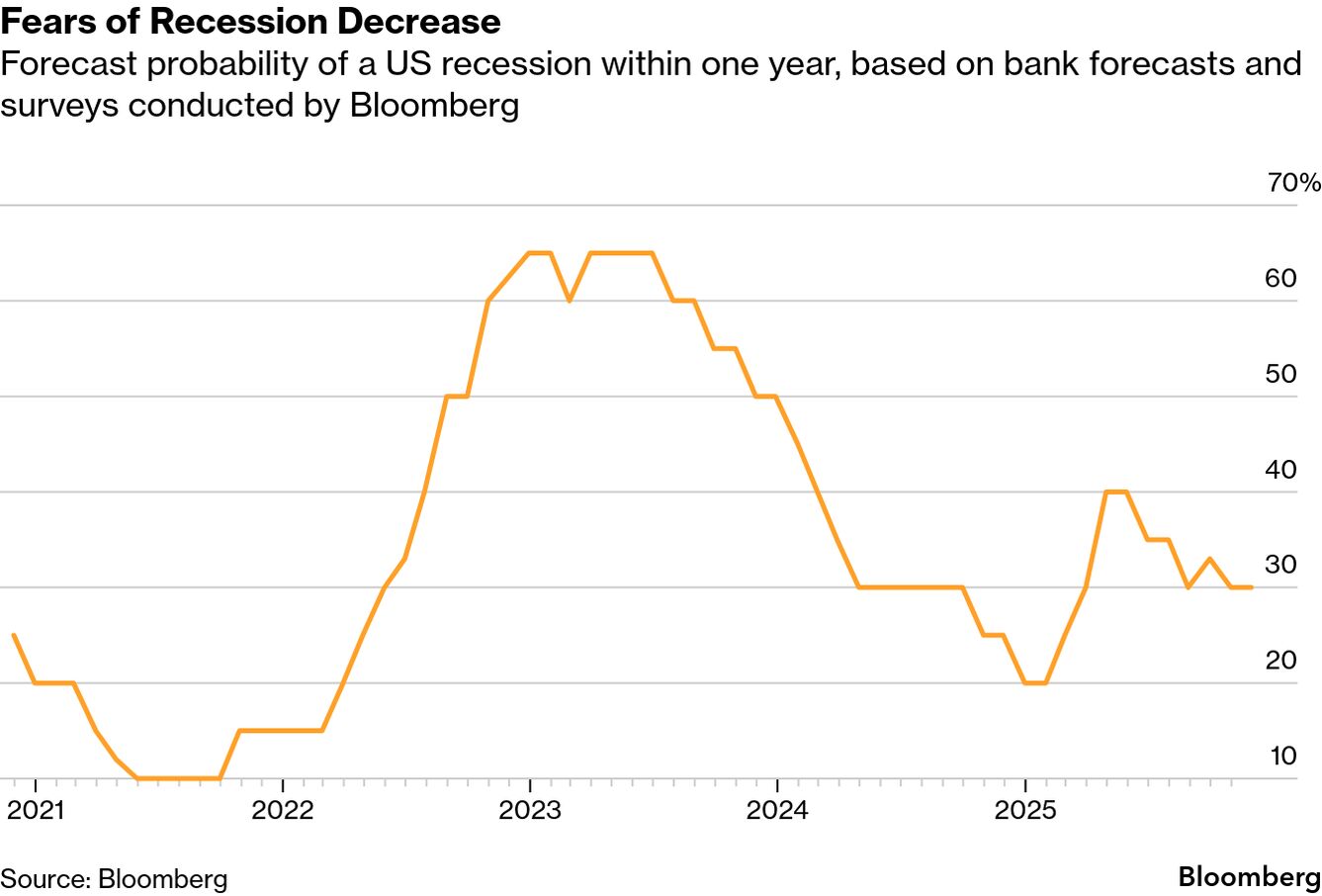
“I think we’ll most likely get through 2026 without a downturn,” says Mark Zandi, chief economist at Moody’s Analytics. “But nothing else can go wrong. Like, nothing. We’re pretty much on the edge.” Moody’s puts the risk of a 2026 recession at about 42%. (Zandi says in a healthy economy that number is more like 15%.) Analysts Bloomberg surveyed are also tepidly optimistic, forecasting 2% gross domestic product growth and a 30% chance of recession.
That outlook for the economy rests on four pillars: the labor market, inflation, the consumer and artificial intelligence. If any one of those falters or moves in the wrong direction, Zandi says, “we’re toast.”

The Labor Market
“There’s no room for me here! … I’m stuck, and I don’t know what to do!” —Alice
The job market spent much of 2025 in a kind of dead calm. The most recent data show unemployment and layoffs near historic lows, but hiring is also at its lowest level in decades—a highly unusual combination. Typically, if hiring drops off, layoffs spike, and vice versa, explains Daniel Zhao, chief economist at job-search site Glassdoor LLC. But the stagnation has persisted, and it’s been very hard on workers. “They feel stuck,” he says. “For people who are not currently in a job, it’s hard to find that job. For workers who are in a job, many feel like they can’t ask for a raise or promotion, because they are totally focused on job security.”
Zhao expects 2026 will see some kind of movement, though he says it’s still unclear—partly because of the delay in official data releases caused by the government shutdown—if that will mean an uptick in hiring or a pickup in layoffs. Whichever way the job market turns, it’s likely to take the whole economy with it.
Inflation
“It takes all the running you can do, to keep in the same place.” —The Red Queen
In April the Trump administration’s tariffs threw a big curveball at companies and entire countries. Many economists predicted disaster, fearing the duties would force importers to raise prices and compel businesses to cut back on investment and hiring to protect their profit margins. But so far the dire forecasts have not manifested. “ The economy is more resilient than a lot of economists expected,” says Daryl Fairweather, chief economist at online real estate brokerage Redfin. Still, she doesn’t call herself optimistic. “I’m actually pretty sad about the state of the economy,” she says. “Imagine how strong the economy could be, how many people companies would be hiring, if we didn’t have all these headwinds against us.”
Although tariffs did not kneecap the economy as Fairweather initially feared, they did strap a serious set of ankle weights on it. By pushing up inflation, they’ve forced the Federal Reserve to cut interest rates more slowly than it otherwise would have. Fairweather estimates the chance of a 2026 downturn is around 33%.
Meanwhile, the economic drag from tariffs seems poised to ease in 2026: Many of Trump’s duties have been reduced or deferred, countless exemptions have been granted, and the US Supreme Court could rule to do away with many of the import taxes entirely.
The Consumer
“I can’t explain myself, I’m afraid, sir, because I’m not myself, you see.” —Alice
The consumer has long been the load-bearing beam of the US economy—people buying things accounts for about 70% of GDP. Throughout 2025 consumer spending remained strong but with a troubling caveat: The wealthiest 10% of consumers now generate nearly half of all spending in the US, according to Moody’s Analytics.
“I think the bottom half of the economy is already in recession to some extent,” says Evan Sheehan, consumer products leader at Deloitte, adding that this puts the US economy in a precarious position. One big risk is that households that feel flush because their stock portfolios have increased in value over the past few years could sharply cut back their spending in the event of a market rout.
Artificial Intelligence
“We’re all mad here.” —The Cheshire Cat
Without a doubt, AI was the engine powering the 2025 economy, not to mention the markets: The Magnificent 7—Alphabet, Amazon.com, Apple, Meta Platforms, Microsoft, Nvidia and Tesla—all deeply involved in AI, now make up more than a third of the total value of the S&P 500. This troubles Moody’s Zandi. “We seem to be getting over our skis,” he says. “The market is very reliant on AI and thus very vulnerable.”
Still, right now the promise of AI is powering business expansion and startups and even, according to Redfin’s Fairweather, propping up the construction industry (building AI data centers). As long as that promise holds, Zandi says, so will the economy. “But we’re in this very tenuous place.”
Will 2026 bring a recession? Signs point to no; as long as the fundamentals hold and investors keep their heads, the odds will likely play in our favor for another year. Or, as Tweedledee explained to Alice: “If it was so, it might be; and if it were so, it would be; but as it isn’t, it ain’t.” Sounds like an economic forecast to me.