
The French Account
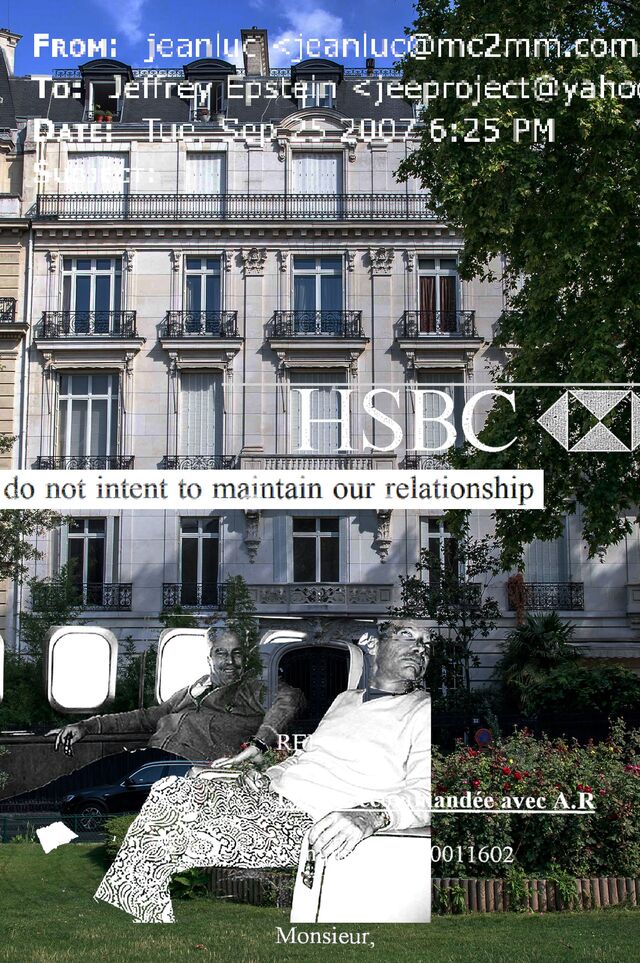
An HSBC branch in Paris closed Jeffrey Epstein’s account in 2007 after the bank flagged suspicious activity, including transactions tied to a French modeling agent.
A French branch of HSBC closed a bank account maintained by disgraced financier Jeffrey Epstein in 2007 after compliance officers flagged transactions for suspicious activity, including payments tied to a modeling agent later accused of rape and sex trafficking, according to two people familiar with the matter.
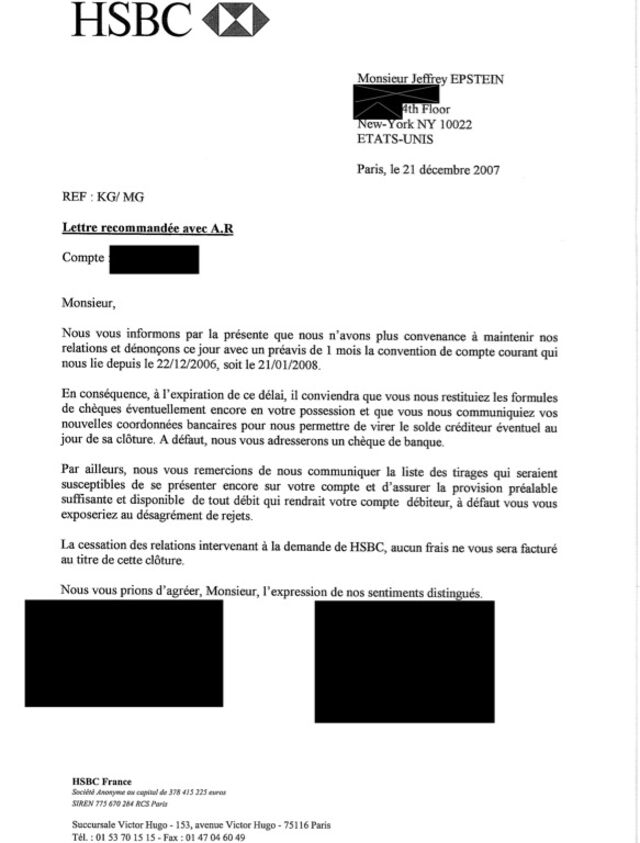
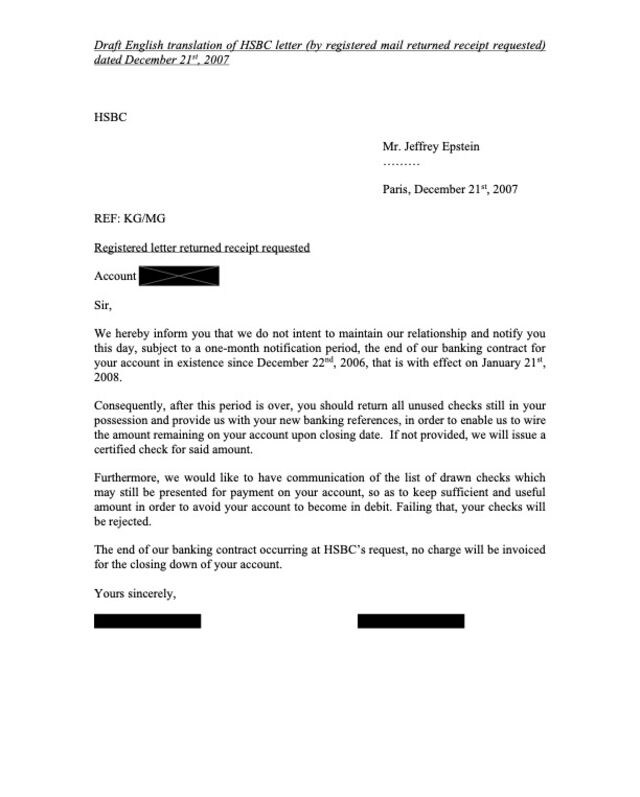
The previously unreported closure, which HSBC officials announced to Epstein in a letter dated Dec. 21, 2007, is the only known instance of a major bank closing one of his accounts before he pleaded guilty to sex offenses in a Florida state court in 2008. Documents released earlier this month list accounts he had at several financial institutions — including HSBC’s Swiss private-banking arm.
“We hereby inform you that we do not intent to maintain our relationship,” the letter said, according to an English translation from one of Epstein’s attorneys. It was signed by two HSBC officials who managed and oversaw accounts of high-net-worth clients at a Paris branch just minutes from Epstein's palatial flat near the Champs-Elysées. The letter, which Bloomberg obtained in a trove of 18,000 emails from Epstein’s private Yahoo account, provides no reason for closing the account, saying only that it was “occurring at HSBC’s request.”
An HSBC spokesman declined to comment. But two people familiar with the matter told Bloomberg that the bank closed Epstein’s account because employees in its compliance department raised red flags. Their concerns included financial transactions involving young women associated with the French modeling agency MC2 and its owner, Jean-Luc Brunel, the people said. They asked not to be named because they’re not authorized to discuss the matter publicly. (HSBC also declined to comment about suspicious payments connected to Brunel).
Major banks that moved money for Epstein have come under intense scrutiny this year by congressional investigators as they probe what financial institutions knew or had reason to suspect about the man’s sex trafficking operations. The revelation that one bank took initial steps to stop doing business with him before the end of 2007 will likely add to questions about other institutions.
Last week, such questions gained renewed attention. The House Oversight Committee released thousands of emails that had been held by Epstein’s estate, including one in which Epstein alleged that President Donald Trump “knew about the girls.” Trump and Epstein were friends before they fell out in the mid-2000s, and the president has denied knowing anything about Epstein’s sex crimes. As disclosures from the new email cache hit, Trump responded by directing Attorney General Pam Bondi to investigate Epstein’s ties to some prominent Democrats — and to JPMorgan Chase & Co., the largest bank in the US.
Following the Money
Last month, Bloomberg reported that federal investigators in Florida spent 18 months in 2007-08 investigating Epstein for money laundering and other financial crimes alongside their sex-crimes probe. The money laundering investigation, which had never been recounted publicly, ended when Epstein pleaded guilty to two state-level charges in Florida in 2008 and registered as a sex offender. The scope of the financial-crimes probe remains unknown. But another person familiar with the investigation who did not want to be named because of ongoing legal questions involving Epstein’s case said federal prosecutors were in the midst of untangling Epstein’s many offshore accounts when the investigation was closed.
According to a review of US Treasury Department records by the Senate Finance Committee, major banks facilitated more than $1.5 billion in payments for Epstein over nearly two decades, which he used to traffic women or “engage in dubious transactions indicative of money laundering.”
On Thursday, Democratic Senator Ron Wyden, the ranking member on the Finance Committee, released a memo that accused JPMorgan of underreporting the amount of suspicious activity associated with Epstein’s accounts over nearly two decades. (Banks are required to report when they suspect a client’s account is being used for illegal activity.)
The memo, prepared by Wyden’s staff, said between 2002 and 2016 JPMorgan filed seven suspicious activity reports with the Treasury Department’s Financial Crimes Enforcement Network “flagging only $4.3 million.” After Epstein was arrested in 2019, the bank filed two more suspicious activity reports dating back to 2003 that identified more than 5,000 additional suspicious wire transfers to and from Epstein's account totaling about $1.3 billion. Wyden has called on the Treasury and Justice departments to investigate whether the bank knowingly withheld information from financial regulators in violation of federal law.
JPMorgan spokesperson Patricia Wexler said in a statement to Bloomberg that the bank “acted appropriately” by filing suspicious activity reports “as early as 2002.”
“We regret any association we had with the man, but did not help him commit his heinous acts,” she wrote. “The second the government finally made public the sex trafficking details in 2019 – information they clearly had for years – we identified for law enforcement a range of Epstein’s past transactions intended to assist with the investigation.”
Epstein’s French account wasn’t the only business he conducted with HSBC. His name was listed alongside several bank accounts, including three with HSBC’s Swiss private bank, according to court records unsealed last month in response to a request by The New York Times and The Wall Street Journal. The details were contained in one of the suspicious activity reports filed by JPMorgan in 2019, though that document doesn’t reveal the time frame during which the accounts were active. A spokesperson for HSBC declined to comment on the revelation earlier this month.
More generally, HSBC, Europe’s largest bank, has paid billions of dollars in fines to settle enforcement cases that alleged anti-money laundering failures at its branches around the world. The most famous was a 2012 case in which HSBC paid a $1.9 billion fine and entered into a deferred prosecution agreement with the US government after it admitted to failures that allowed drug cartels to use the bank to launder nearly $900 million between 2006 and 2010.
In regard to Epstein, compliance officers at HSBC found that the French account had numerous round-dollar deposits and withdrawals were suspicious and bore hallmarks of money laundering and other financial misconduct, the two people familiar with the matter said. Compliance staffers also flagged that Epstein’s stated business purposes for the withdrawals were dubious. A due diligence review on Epstein turned up “Informations défavorables,” or negative information, on Epstein in US media after news reports covered his arrest in Florida, the people familiar said.
It’s unclear what specifically raised alarm bells for HSBC compliance officials. The bank debated whether to file a suspicious activity report with Tracfin, France’s financial intelligence unit, the people familiar with the matter said. It’s unknown whether that report was filed.
The French Connection
Epstein maintained an extreme jet-setting lifestyle, splitting his time between his limestone mansion in Manhattan, an opulent estate in Palm Beach, a sprawling ranch in New Mexico and his private Caribbean island. He also owned a luxurious apartment in one of the most exclusive neighborhoods in Paris, with touches of Versailles and views of the Arc de Triomphe.

The exact nature of his business in France is unclear, but the emails obtained by Bloomberg show a flurry of activity related to his Paris residence. They also show that Epstein had deep connections to Brunel, who helped launch the careers of supermodel Christy Turlington and the actress Sharon Stone, and the Frenchman’s once-acclaimed modeling agency, MC2. One of Epstein’s assistants was brought onto the agency’s payroll, the emails reveal. They also reveal numerous discussions among Epstein, Brunel and Epstein’s attorneys about financing arrangements for MC2 and various business development proposals. (It’s been previously reported that Epstein bankrolled MC2 and provided financial support to Brunel.)
The two clearly had a close relationship, which in the emails is shown through friendly banter about life, strategy about business rivals, Croatian models and industry gossip. One day after Epstein signed the non-prosecution agreement, Brunel sent him a lament:
Their relationship soured after Epstein’s criminal case in Florida. In 2015, Brunel sued Epstein, claiming the sex crimes prosecution damaged MC2’s reputation. In August 2019, just days after Epstein was found dead in his jail cell, Paris prosecutors opened their own investigation into whether there were French victims and perpetrators tied to the American financier’s crimes.
A year later, Brunel was arrested as he was about to board a plane from Paris to Dakar. He was charged with rape of minors over the age of 15 and jailed. One of his main accusers was Virginia Giuffre, who was also one of Epstein’s most outspoken accusers. Giuffre died this year.
Brunel was found dead in his jail cell in 2022, in an apparent suicide.
‘Account activity’
On Jan. 15, 2008, a few weeks after the HSBC letter was sent, Epstein’s personal attorney in New York, Darren Indyke, and his legal representative in Paris, Marie-Joseph Experton, traded emails about the closure of Epstein’s account. Experton said she would try to get to the bottom of it. Experton declined to comment for this story.
Three days later, Indyke sent Epstein an email under the subject line, “Important.”
An attorney for Indyke, in his role as the Epstein estate co-executor, said that his client’s email to Epstein was subject to the attorney-client privilege and that Bloomberg should not “publicly disclose the email itself or report on its contents.” The lawyer also demanded that Bloomberg “immediately send such documents to the Estate and destroy any copies in its possession.” (Bloomberg declined.)
Global banks are generally prohibited from disclosing to their customers why accounts are shuttered, especially if the reason stems from suspicions of money laundering or other possible financial crimes.
The email’s reference to “an Arab/Jewish thing” is unclear. There wasn’t a response from Epstein in the inbox.
In its letter, HSBC instructed Epstein to provide the bank with “the list of drawn checks which may still be presented for payment on your account, so as to keep sufficient and useful amount in order to avoid your account to become in debit.”
“Failing that, your checks will be rejected,” the letter said.
More than a decade later, on July 6, 2019, Epstein was arrested at the Teterboro Airport in New Jersey. He was returning on his private jet from Paris.
Stay connected: Don’t miss hearing about upcoming reporting: Sign up for the weekly newsletter written by Bloomberg’s senior investigative reporter Jason Leopold.