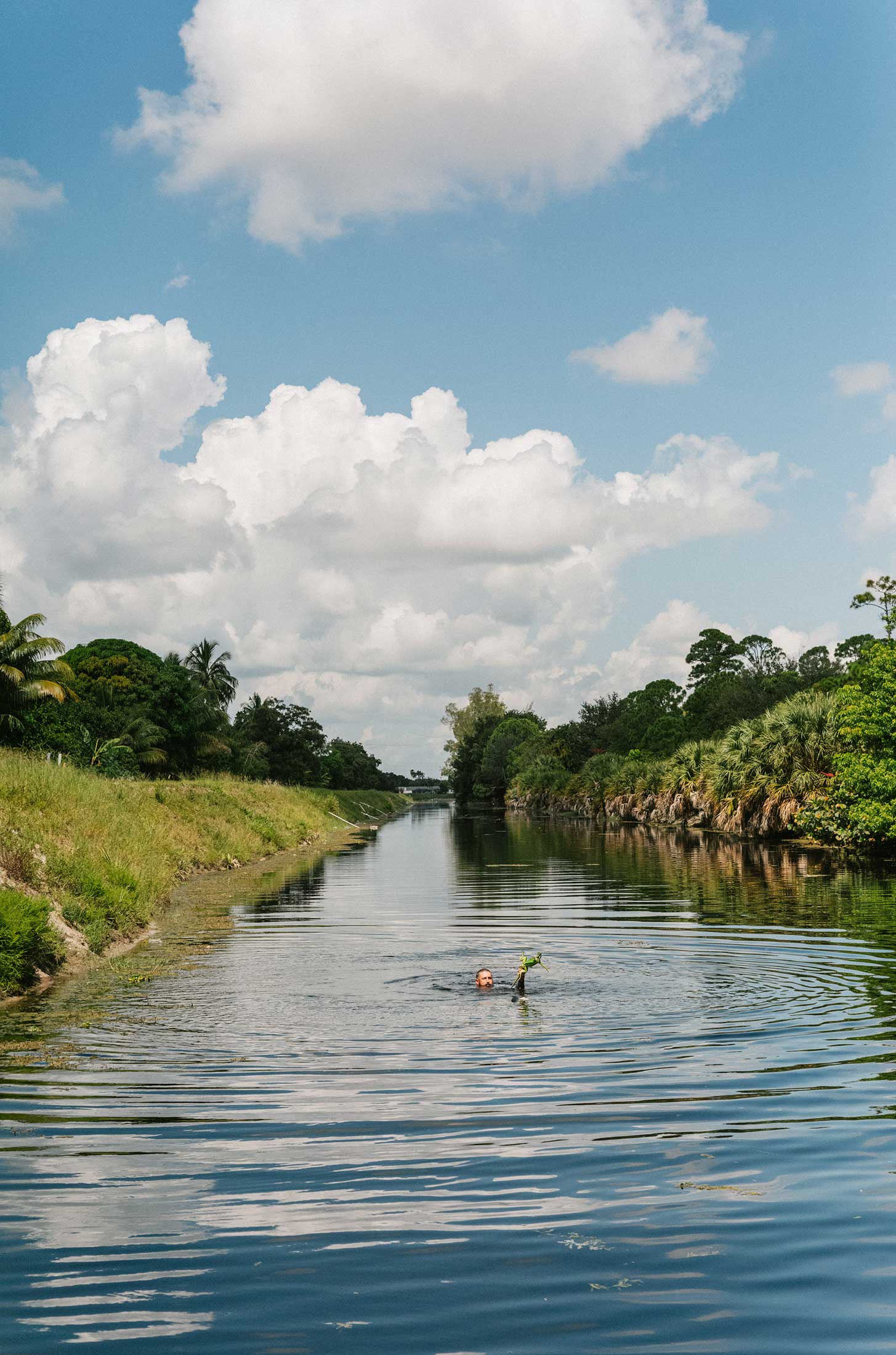
One Instagram-famous hunter is out to stop them.
Few creatures are more conspicuous than the green iguana. Four feet in length with a spiky back. The distended belly of a middle-aged football fan who’s just chugged his way through a bucket of Coors Banquet. A long tail adorned with black rings. A fanlike flap of skin—the dewlap—that hangs beneath its jowls. Gnashing teeth. Sharp claws. Beady, black eyes.
I had my sights trained on those eyes. It was half past noon on a weekday in late July, and I was in prime lizard-hunting territory: downtown Lake Worth Beach, Florida. Specifically, the canal waters off 14th Street. The sun was high, burning my forehead a deep lobster red. Four of us had been riding in a 20-foot johnboat when we spotted the iguana chilling atop an embankment. The driver, Rio Faitella, cut the engine, and we glided onto the bank. I’d never hunted before, though I have family members in Pennsylvania who treat deer season like a religious holiday.
Our guide, Mike Kimmel, a Rasputinish figure with a long, brown beard that hangs past his clavicle, delivered a simple instruction: “Hook him,” he said. “He looks like he’s wise.”
I understood pretty quickly: We’d seen the iguana, but the iguana had also seen us. I’d have to creep slowly. I crawled up the embankment, to a position far to the right of the lizard, and dropped to one knee. I raised the muzzle of my air rifle, loaded with eight rounds of .30-caliber pellets, and got him in my scope. “Whenever you’re ready, drill him,” Kimmel said.
I took my time. I breathed in. And in the space between heartbeats, I suppressed the trigger. The round exited with a crack and hit the iguana’s skull. Its body bounced, then slumped to one side.
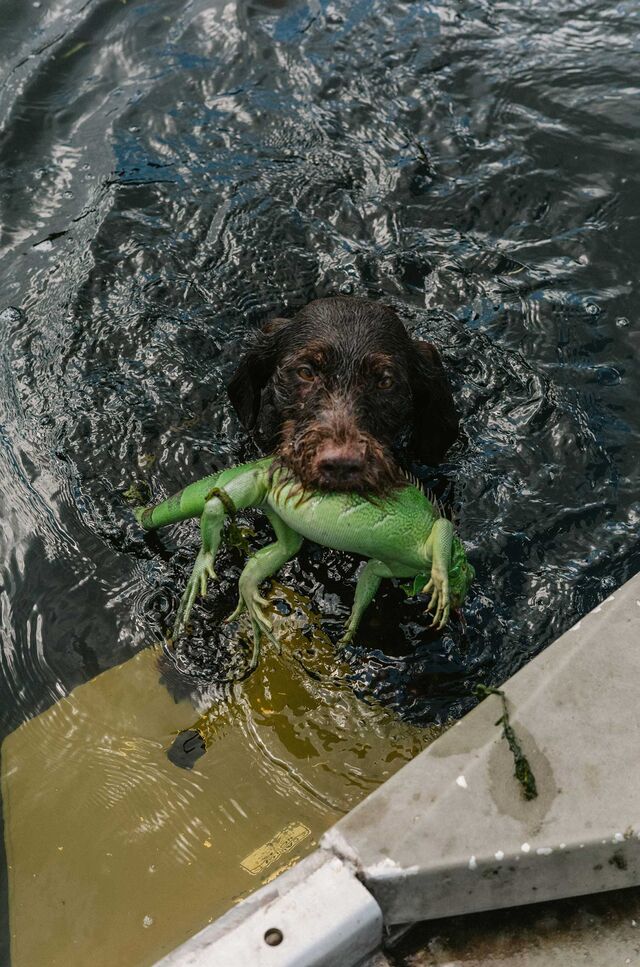
“Ooh, that’ll do. Get him, Trouble!” Kimmel said, commanding his German wirehaired pointer to fetch. Trouble rushed up and seized the lizard in her mouth. Its body writhed, to no use. Kimmel grabbed the iguana from a returning Trouble, suspended it over the water and used an air pistol to finish it off.
“Can’t let y’all have all the fun,” he said with a grin. For the next two hours, we continued like that. By midafternoon, at least three dozen iguana carcasses were on board.
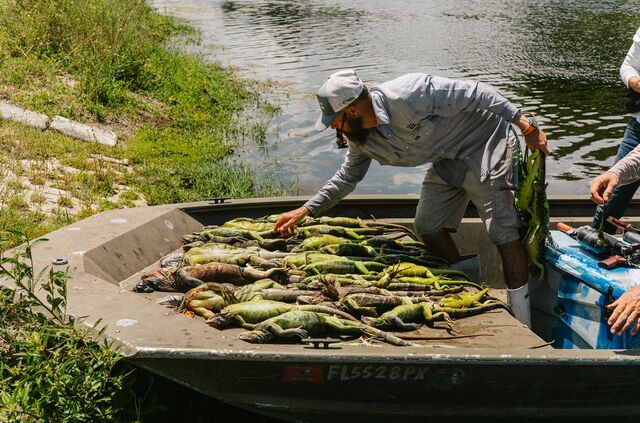
Kimmel’s hunts are marketed as having a serious purpose. South Florida is home to two particularly problematic invasive species: Burmese pythons and green iguanas. The pythons live mainly in the Everglades, where they feast on native birds, deer, the endangered Key Largo woodrat and even alligators. Since 2005 the US Fish and Wildlife Service has spent more than $6 million searching for ways to address the problem.
Iguanas, meanwhile, are a vector for salmonella, which they excrete into South Florida’s waterways. They feast on the state’s citrus trees and on the endangered tree snails that slink along palmetto trunks. They also burrow so ferociously—making cavities up to around a meter deep and 24 meters long—that they can erode and collapse sidewalks, seawalls and canal banks. In 2020, Palm Beach paid $1.8 million to repair damage they’d caused to a dam.
The state’s pythons number in the thousands; its iguanas, in the millions. “Florida’s climate is just ideal for any invasive plant or animal. There’s very little that comes in here that doesn’t find a way of making it,” says Andrew Walker, president and chief executive officer of the nonprofit Fish & Wildlife Foundation of Florida.
People have been seeing green iguanas in the state since the 1960s and Burmese pythons since at least 1979. Both were introduced from their native habitats in South and Central America through the captive wildlife trade. They either accidentally escaped or were intentionally released and then established themselves in the wild.
Over the past decade or so, as residents and ecosystems have come to seem overrun, the state has turned reptile control into something of a cause célèbre. Florida now contracts python hunters and sponsors an annual 10-day Python Challenge, with a $10,000 grand prize for whoever captures and kills the most. (This year, 934 people from 30 states and Canada participated, eliminating 294 pythons. The grand prize winner got 60 of them.) Iguanas haven’t been deemed bounty-worthy, but state officials have been concerned enough to legalize killing them in public canals and waterways. For both animals, hunters are cautioned to follow the guidelines of the American Veterinary Medical Association: Any contact should result in immediate unconsciousness; then the brain should be destroyed to prevent revival.
Kimmel is perhaps the most famous Floridian reptile hunter, thanks in part to his social-media-friendly nickname, the Python Cowboy. He has nearly half a million followers on Instagram, a YouTube channel featuring videos of his exploits, and a business selling branded reptile-leather gear. (A small-batch coffee company, Gundog Grind, also sells a medium-roast blend called Python Cowboy’s Swamp Water.) He talked about eating the pythons he kills on Tucker Carlson’s Fox News show before it was canceled and shared stories of his adventures on Joe Rogan’s podcast in 2023.
Kimmel’s company, Martin County Wildlife Services, has 12 full-time contractors and offers daily guided outings that last four or five hours. Python hunts start at $1,550 and iguana hunts at $1,250 for a party of four. You pay a premium to get the Python Cowboy himself as your escort. (It was an extra $250 to have him on Bloomberg Businessweek’s outing.) Kimmel runs alligator and wild hog hunts, too—which are also for purposes of population management, he says.
The business seems to be doing well. The day before I arrived, Kimmel ran three hunts for iguanas and two for pythons. The leather goods he sells, mostly online, are custom-crafted by the mother of his personal assistant. She turns gator, iguana and python skins into wallets, belts, dog collars, gun slings and sunglass straps. Kimmel also offers Hey Dude shoe customization for $285 a pair.
It’s a neat trick: labor-intensive biological control as social-media-driven cash cow. But the enterprise isn’t without its critics. Some say these hunts are pointless, that iguanas and pythons are in Florida to stay. J. Sean Doody, a conservation biologist at the University of South Florida, compares these sorts of capture-and-kill programs to a natural disaster. “Everyone wants to try to stop an invasive species,” he says, “but you can’t stop a hurricane.” Others have gone out of their way to corner Kimmel online, calling him cruel, abusive and, more inventively, a “redneck murderer.” For now, though, the state wants varmints dead, and he’s having fun leading the charge.
Kimmel is 37 and slim, at 5-foot-10 and 140 pounds. He has a weathered face and a twang that renders his wirehaired pointer’s name as “treble.” For our tour, he was dressed in a Suzuki snapback cap, a Python Cowboy-branded button-down, shorts and white wader boots. Add in that he wrestles with reptiles, and you have a bona fide Florida Man.
Nowhere is this more apparent than in a 2020 video posted on his YouTube channel. He was alone, deep in the Everglades, GoPro rolling, when he came upon a female python nearly 18 feet long. He was behind it, so he couldn’t grab its head and bag it. (You can kill pythons on the spot, but it’s much more difficult to carry out a 200-pound snake if it’s all dead weight.) Instead, Kimmel took the animal by the tail, hoping it would turn and attack him so he could get a better hold.
Pythons aren’t venomous—they kill by constricting their prey—but their teeth are needle-sharp. The snake struck at Kimmel as intended, but she caught him before he could get her, puncturing a vein near his left elbow. “I’ve never seen blood come out of my body like this,” he later told Rogan. He began to worry that he’d black out. If he did, he said, “It’s gonna wrap around me and kill me, 100%.” Kimmel managed to grab the snake’s head, wrangling it while wrapping a tourniquet above the wound on his arm, and pulled it back to his johnboat. (After I showed the clip to my wife and my mother, we agreed that I would hunt for iguanas.)
Kimmel’s fascination with reptiles started early. When he was 15, he was busted for some “stupid kid stuff,” as he puts it, and a family friend who worked at the Florida Fish and Wildlife Conservation Commission offered to let him fulfill his community service hours by volunteering there. Soon Kimmel was heading out on jobs that entailed removing live alligators from different locations, and trapping became an obsession.
He founded his own trapping and removal business about a decade later, getting hired to remove iguanas from yards and roadways, then swiftly expanded to pythons when the state’s pilot removal program started up. By the 2010s pythons had become more than a mysterious interloper lurking in Florida’s swamps. Their numbers were growing, aided by resilient and abundant offspring. (A single nest—picture a 15-foot-long snake curled up on eggs bigger than your fist—can yield 100 snakelets.) With native wildlife threatened and residential areas encroached upon, the state gave Kimmel and two dozen other operators special access to protected areas to find, capture and kill pythons.
In 2013, the Python Challenge came into being. Florida staged another one in 2016 and another in 2020, after which it became an annual event—life imitating the “Whacking Day” episode of The Simpsons. (Participants pay $25 to enter and must first take a 45-minute online training course so they can differentiate wild Burmese pythons from “scout” ones that have been tagged for study.) The South Florida Water Management District also launched a dedicated python removal initiative, which now sees 50 hunters paid an hourly rate plus an additional bounty. A python that’s at least 4 feet long brings in $50 or more, depending on total length. State officials estimate that more than 16,000 pythons have been eliminated in the past eight years.
To many Floridians, though, it seems like there’s no stopping the snakes. And they continue to feast. In a grisly test conducted about a decade ago, the state fish and wildlife commission and some partners released 95 marsh rabbits in areas of the Everglades where pythons were found. Within a year, at least 70 had been eaten by snakes. “If you go to Everglades National Park today, you’d be challenged to find a single mammal,” says Mike Kirkland, manager of the Python Elimination Program at the South Florida Water Management District.
For a handful of years, Kimmel continued working for the state as a removal agent. The snakes he found at first tended to be on the roadside, after they’d slithered away from their usual stomping grounds. Eventually, he concluded that he should look instead in the swamps, at the source. “I went to where people weren’t hunting,” he says. “That’s where the pythons are reproducing, where they’re laying nests and where they’re eating our wildlife.”
He ultimately quit working for the state so he could start using dogs to hunt pythons, as he’d been doing with iguanas. (The Florida program has never used dogs. According to state officials, they are “not an effective method for detecting” the snakes in the Everglades.) “These pythons could hide right next to you, and you’ll never see it. You’ll spend all day hunting,” Kimmel says. “Now I find more of them than ever with the dogs.”
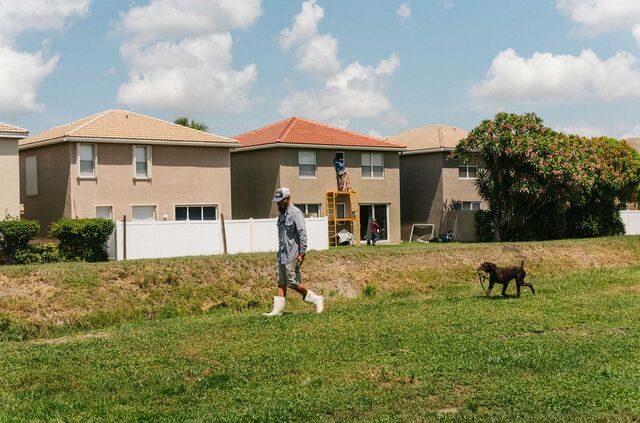
With Kimmel’s snake hunting picking up, one of his buddies took to calling him the Python Cowboy. The name caught on after an incident during a guided hunt. A python had wrapped itself around an alligator, slowly suffocating it. Kimmel separated the two, saving the gator and capturing the python as his client filmed it. The video went viral, and soon FloGrown, a popular Florida clothing brand, sent Kimmel some shirts and talked him into starting an Instagram page, which the company set up using his unofficial name. The legend of the Python Cowboy was born.
“Catching the pythons and everything I was doing was super cool and interesting,” Kimmel says. “But I never had any goal of being Python Cowboy. It just all sort of happened. And just grew from there.”
My own iguana hunt, which included Kimmel, Faitella, myself and our photographer, began with a crash course on the air rifles provided for us. (Kimmel says he uses these guns because they’re “insanely accurate,” though it’s also illegal to use firearms where we were hunting.) While a lot of basic gun safety is common sense—never point a weapon at anything you don’t intend to destroy, for instance—Kimmel has come to assume the worst. One time, he told us, a novice fired his weapon with a finger over the muzzle, immediately severing digit from hand. “I think he went to Guatemala to have it fixed,” he added.
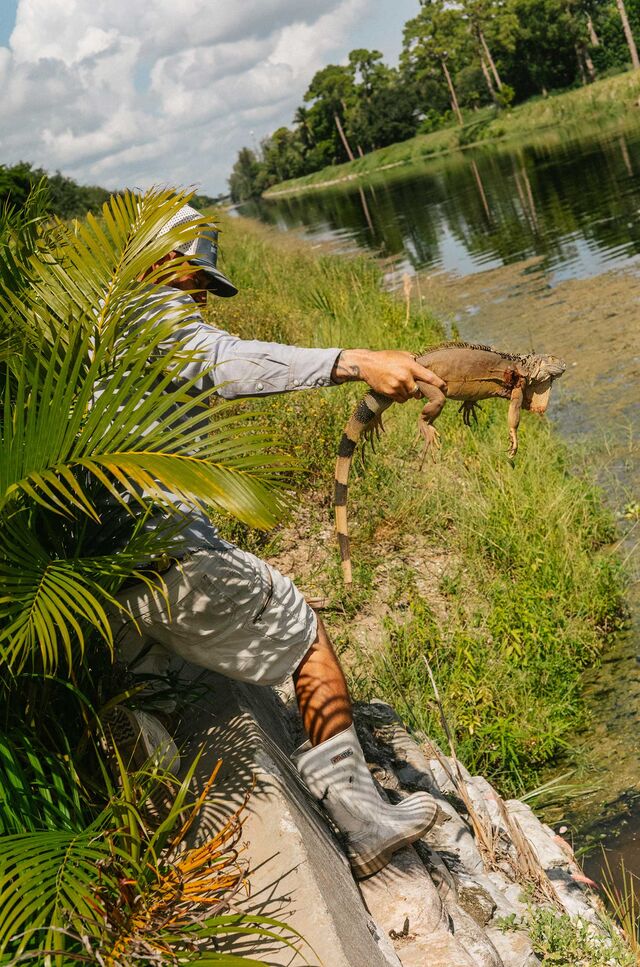
Then he got to today’s task. “These iguanas are extremely tough and resilient,” he said. “They can take 10 shots and keep going.” Killing even a stationary one would therefore be more difficult than I’d anticipated, and the last thing anyone wanted to do was fire 10 shots only to hurt the animal and see it escape. So Kimmel advised us to aim for the head.
Varmint-hunting is a brutal business, as I quickly learned. (For the dogs too: Barely a week and a half before, Kimmel’s best dog, Otto, was killed by a vehicle while chasing an iguana that had fled to the road.) The only defense nonnative reptiles like iguanas and pythons have in Florida is an anti-cruelty law that forbids unnecessary torment and mutilation. The objective of the hunt, Kimmel conveyed, was to clear invasive species as quickly and painlessly as possible. You didn’t relish the kill. You just accepted it for what it was.
Sometimes his clients understood that and conducted their hunts with a certain respect for nature. Other times, Kimmel said, they went full Rambo and emptied their clips as quickly as possible. His client roster is what you might expect, with one quirk: outfitters, outdoorsmen, people who have hunted all over the US, people who have hunted in Africa, people who have never hunted before—and the occasional vegan. “I think because it’s something so different, and it’s something where there’s more of a purpose behind it rather than just getting meat,” he says.
When the hunt began, our photographer and I acquitted ourselves well enough. We used barely half our allotted tin of 300 pellet rounds. Most of our shots hit true, though in some cases, despite our best efforts, we hit a torso or a tail, sending an iguana scampering for underwater cover. (They can swim fully submerged for about 40 minutes.) One missed shot from my rifle left an iguana barreling down an embankment toward the water, only for Kimmel to dive in after it and emerge holding it above his head.
For all the effort Florida is putting into combating iguanas and pythons, it’s difficult to quantify the economic impact these creatures have. One 2022 study in the journal Science of the Total Environment put the overall cost of invasive species in the US at $1.22 trillion since 1960, factoring in damage to agriculture, loss of native species and wildlife-management costs. But the study didn’t break the expenses down by state or discuss iguanas or pythons specifically, beyond a brief note saying that pythons and other invasive snakes can kill native birds and other wildlife. The state agencies I spoke with didn’t have especially helpful numbers either, though they did have abundant anecdotes about damage to infrastructure and vegetation from iguanas, and to wildlife and habitats from pythons.

The dearth of data has led plenty of people to question the effectiveness of capture and kill programs. Some criticism has come from expected corners: People for the Ethical Treatment of Animals has expressed concern, albeit primarily over how pythons are disposed of. (Rookie hunters who take part in the annual challenge, for example, might not know the proper way to administer a quick and merciful death.)
Doody, the conservation biologist, questions some of the rationales for the kills, such as the actual amount of infrastructure damage that burrowing can cause. “Iguanas aren’t good enough to ruin a dam,” he says, referring to the one that was damaged in Palm Beach. In a later conversation, he emphasizes the point: “If a cement structure would collapse from a few holes in the ground, it is already not a robust, safe structure.”
Still, Doody is careful to note that he isn’t against hunting, “provided the game is eaten or the hunting is regulated.” Nor is he against targeted invasive-species control along the lines of Kimmel’s operation if “there is evidence that it’s reducing numbers in a meaningful way.” He’d like to see more studies funded to determine these species’ underlying impact. “The analogy I tend to use is, it’s like swatting a mosquito on your arm and thinking you’re making a difference,” he says. “I think we should let these things do their thing, because you can’t stop them.”
Kimmel has long conceded that these species are unstoppable. “We’re never getting rid of the pythons. We’re never getting rid of the iguanas. They’re here to stay,” he told Rogan in 2023. “But management is absolutely essential.” He employs an analogy of his own: You’re never going to completely eliminate all of Florida’s rats, but that doesn’t mean you’re rolling out the welcome mat and letting them take up space in your house.
It was true that, during our hunt, iguanas escaped our sights as often as not. And even when we found them, the challenge was clear. At one point late in the day, after trawling miles of canal and sometimes going 20 minutes without spotting a single iguana, we came to a bridge underpass with half a dozen of them idling on the rocks beneath. We opened fire, then paused as Trouble launched herself from the boat in search of a target. Kimmel went after her. Soon, he noticed where one of the iguanas had gone, its long tail sticking out from a gap in the rocks. The animal was in there, digging, maybe toward the bridge’s foundations, or maybe just into the ground. Kimmel couldn’t dislodge it, so he left it there—a Florida problem, hiding in plain sight.