Upgrade the Democratic Party
The party’s frustrated upstarts aim to shake up its leadership with a big year coming up for US politics.
Democratic voters aren’t just furious at Donald Trump for tearing down much of the federal government (and a big chunk of the White House). They’ve had it with the leaders of their own party, too, for not doing a better job of standing up to the president. More than two-thirds of Democrats described themselves as “frustrated” with the party in a September survey by the Pew Research Center.
Managing this discontent will be one of the biggest challenges for Democrats heading into the midterm elections in November, when they’ll look to regain some amount of power in Washington. Decisive wins in New Jersey, Virginia and other states in 2025 have given them hope that voters who swung for Trump in 2024 may already be having second thoughts. The party is seeing a surge of newcomers eyeing public office. Many are notably young and left-wing, and some flaunt political inexperience as a credential. They all share a desire not only to win back control of the House of Representatives and possibly the Senate, but also to shake up their own party’s aging, entrenched establishment.
Here are some of the names you’ll be hearing for the first, or possibly the last, time in the tumultuous year in politics ahead.
The Targets
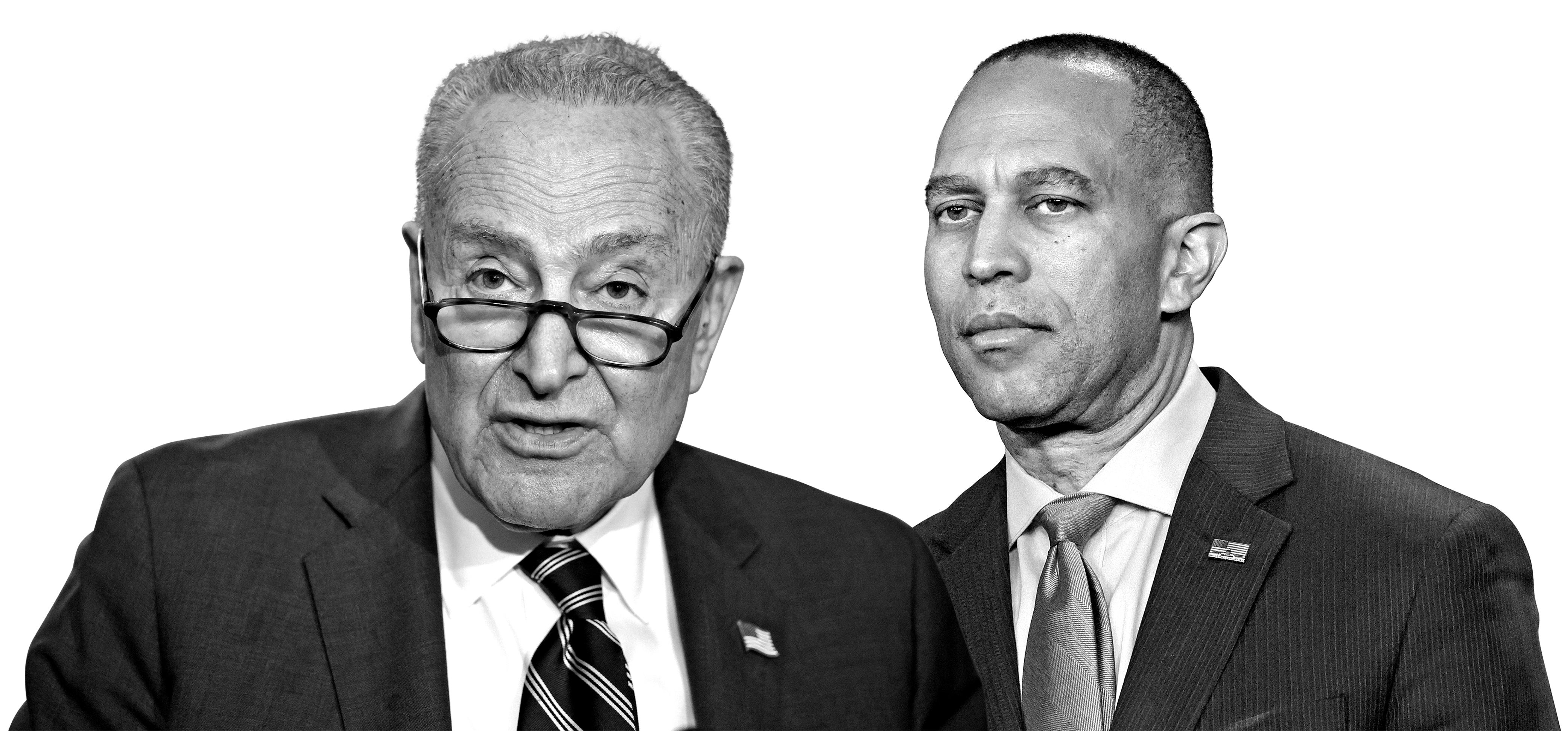
At 75, the Senate minority leader has been a fixture in DC for more than four decades. First elected to the House at 29, the New Yorker is now slower on his feet and no longer commands the obedience of his colleagues, many of whom were dismayed when he didn’t stop a handful of Democratic senators from ending the 2025 government shutdown without major concessions from Republicans. “Senator Schumer is no longer effective and should be replaced,” California Representative Ro Khanna wrote on X, echoing other progressive House Democrats. Schumer’s Senate colleagues have so far not joined in. He hasn’t hinted he’ll step down, and his current term isn’t up until 2028. But it looks increasingly unlikely that he’ll hang on as leader until then.
The cautious House minority leader has largely escaped the scorn heaped on fellow Brooklynite Schumer. In part that’s because his name barely registers outside Washington despite three years in the job. At times, Jeffries has appeared to struggle to find his footing against Trump and the Republicans. “I’m trying to figure out what leverage we actually have,” he told reporters early this year. “It’s their government.” Not quite the battle cry demoralized Democrats were hoping for. A growing number of the party’s members lament that they don’t have a scrappier leader, and if Democrats do win back the House this year, Jeffries will almost certainly face a fight for the speaker’s job he’s long coveted.
The Insurgents

It’s hard to overstate the political impact of Mamdani’s long-shot victory to become New York City’s mayor. His campaign pledges to help working families afford housing, groceries and child care—and to stick the city’s uber-rich with the bill—aren’t so different from the progressive wish list of left-wing Democrats Elizabeth Warren and Alexandria Ocasio-Cortez, or of his fellow Democratic Socialist Bernie Sanders. But Mamdani says it with a smile instead of a scowl. Overnight, “affordability” was on the lips of every Democrat across the country. Of course, promising free stuff is fun and easy, and Mamdani has enjoyed a postelection honeymoon period. Things will get more challenging when he’s sworn in on Jan. 1 and voters’ hopes become expectations.
● JoAnna Mendoza
Mendoza’s life story reads like a chatbot’s response to the prompt: Create an ideal Democratic candidate for an Arizona congressional district with two major military bases that sits on the border with Mexico. Raised poor in rural Arizona, Mendoza worked picking cotton as a kid. She joined the Navy at 17 and then re-upped in the Marines. After tours in Iraq and Afghanistan, she came home to earn a college degree. She’s an LGBTQ single mother who’s running a campaign based on health care, veterans’ rights and, yes, affordability. That formula has helped Mendoza outraise the other Democrats vying to unseat Juan Ciscomani, a Trump-endorsed Republican, in the suburban Tucson district.
● Graham Platner
Another ex-Marine, Platner is a gravel-voiced oyster farmer who often sounds as if he’s two seconds away from blowing his top. Backed by Sanders, he’s running as an everyman against Susan Collins, Maine’s Republican senator, who’s held tight to her seat for almost 30 years. Platner argues that Washington and Wall Street keep working people down. “The enemy is the oligarchy,” he said in a campaign video produced by the same consultant who burnished Mamdani’s outsider image. “It’s the billionaires who pay for it and the politicians who sell us out.” Platner’s online past caught up with him when social media posts surfaced in which he called rural Americans stupid, declared himself a communist and made homophobic comments. And he had an old tattoo from his military days covered up because it resembled a Nazi symbol. Platner apologized for the comments, attributing them to a period of disillusionment after returning from Afghanistan, and said he had no idea about the tattoo’s potential meaning. Schumer and other establishment Democrats are backing a safer candidate: the state’s governor, Janet Mills.
● Mallory McMorrow
If the name of this state senator from Michigan somehow sounds familiar, it might be from the viral video. In 2022 a MAGA Republican who opposed McMorrow’s support for LGBTQ materials in public schools sent around a fundraising letter accusing her of being a “groomer” who wanted to “sexualize” children. McMorrow, who calls herself a “straight, White, Christian, married, suburban mom,” delivered a fiery speech denouncing the false attack. “I am the biggest threat to your hollow, hateful scheme,” she said. The clip zipped across social media, and McMorrow, already a politician on the rise, was suddenly everywhere. She’s now running for US Senate to succeed Democrat Gary Peters, who’s retiring. Like every other Democrat this year, McMorrow is all about jobs, housing and health care. But don’t call her a progressive. In Michigan, which sits on the knife-edge between blue and red, she prefers “pragmatist.”
The Contenders

The next presidential election is still years away, but you can already hear prominent Democrats performing sound checks for 2028. Expect to see any number of boldface names turning up at campaign rallies for midterm candidates around the country—and grabbing a little camera time for themselves while they’re at it. At this point in the 2020 election cycle, the field of hopefuls was thick with senators. Now it’s all about governors. ● Wes Moore of Maryland, ● Gavin Newsom of California, ● JB Pritzker of Illinois, ● Josh Shapiro of Pennsylvania and ● Gretchen Whitmer of Michigan are all circling. So is ● Pete Buttigieg, the former transportation secretary whose frequent jaunts to help other candidates have banked him a lot of goodwill within the party. And don’t count out ● AOC. The New York representative, now in her fourth term and ready to move up, is weighing which desk to go after—Trump’s or Schumer’s.